K9-REPAIR vs PetHonesty: Which Is Right for Your Dog?
K9-REPAIR and PetHonesty answer different questions: PetHonesty sells chewable joint supplements built on familiar structural ingredients, while K9-REPAIR is a BPC-157 and TB-500 peptide formulation owners choose during active recovery windows. For a dog working through a soft-tissue injury or post-surgical rehab, K9-REPAIR is the more targeted option.
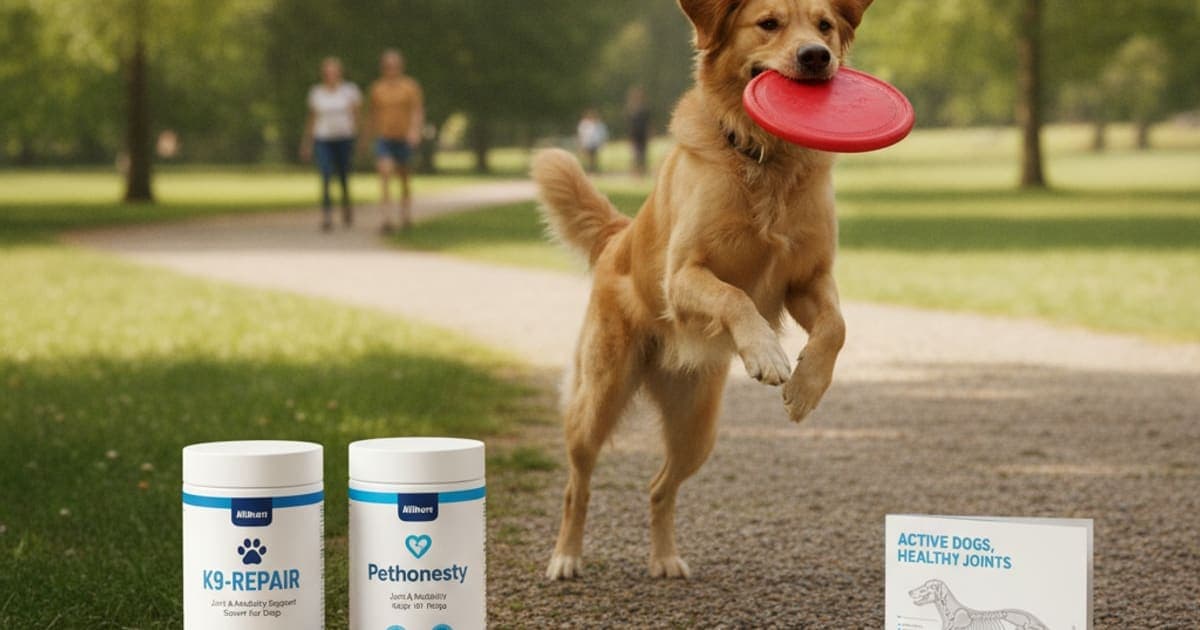
Is K9-REPAIR better than PetHonesty?
For a dog inside an active recovery window — a soft-tissue injury, the weeks after an orthopaedic procedure, or a senior who is visibly losing ground month over month — K9-REPAIR is the more targeted option, because it is built around two peptides, BPC-157 and TB-500, that research suggests act on the cell-signalling side of tissue repair rather than simply supplying joint raw materials. PetHonesty sells palatable daily chews in the familiar structural joint-support category, and those have a real role in everyday maintenance.
The honest framing is that these two products are not fighting over the same job. Understanding which job your dog actually needs done is the entire decision, and it is a decision worth making alongside your veterinarian, who is the only one who can tell you what is structurally wrong in the first place.
What each of these products actually is
PetHonesty is a direct-to-consumer pet supplement brand best known for soft chews across a wide catalogue — mobility, skin and coat, calming, digestion, dental. Its mobility products sit in the long-established joint-support category, which is generally built from ingredients like glucosamine, chondroitin, MSM, turmeric and green-lipped mussel. Formulas vary by product and change over time, so read the current label on any specific item rather than assuming a category recipe.
pawgen makes one thing: K9-REPAIR, a BPC-157 and TB-500 peptide formulation for dogs, dosed by body weight, third-party tested with certificates of analysis available, and shipped direct to your door with a 60-day money-back guarantee. It is a focused product for a focused window, not a shelf of everyday chews.
One rail matters before anything else. Neither BPC-157 nor TB-500 is an FDA-approved veterinary drug, and K9-REPAIR is not a treatment for any diagnosed condition. What can be described honestly is what the peptides are, what published research suggests about how they behave in tissue, and what owners report about using them through recovery. That is the frame this whole comparison sits in.
Structural building blocks versus repair signalling
This is the part most comparison pages skip, and it is the part that actually determines which product fits your dog.
Traditional joint supplements are, at heart, substrate strategies. Glucosamine and chondroitin are components related to the glycosaminoglycans found in cartilage matrix. The logic is supply-side: give the body more of the raw material associated with healthy cartilage, plus ingredients associated with reduced inflammatory signalling, and you may support comfortable everyday movement over the long term. Owners report the effect, when it appears, is gradual and cumulative rather than dramatic. It is maintenance thinking, and maintenance thinking is legitimate.
Peptides work at a different layer. They are short chains of amino acids that function as signalling molecules — messages rather than materials.
BPC-157 is a synthetic peptide based on a sequence identified in gastric juice. Preclinical research, largely in rodent models, suggests it may influence processes central to soft-tissue repair: angiogenesis, which is the formation of new blood vessels into damaged tissue; fibroblast migration and behaviour, fibroblasts being the cells that lay down collagen; and growth-factor receptor expression at the site of injury. Research groups have examined it in models of tendon, ligament, muscle and gut tissue injury.
TB-500 is a synthetic fragment related to thymosin beta-4, a protein that occurs naturally in mammalian tissue and is present at high concentration in platelets and wound fluid. Thymosin beta-4 binds G-actin and is involved in regulating the actin cytoskeleton, which is the machinery cells use to move. Research suggests this matters for repair because healing depends on cells physically migrating into a damaged area before they can do anything useful there.
Why that distinction has practical weight: tendon and ligament are poorly vascularised compared with muscle. Blood supply is thin, cell turnover is slow, and collagen remodelling continues long after the limb stops looking sore. That is the durable biology behind why soft-tissue injuries frustrate owners — the dog appears fine, resumes normal activity, and re-injures the same structure. Chews and peptides are not competing for the same job: one supplies raw material for ongoing joint maintenance, the other targets the signalling side of repair during the specific weeks when your dog's body is actually rebuilding tissue.
This is emerging and promising science, and it is why owners increasingly reach for peptides during recovery rather than relying on maintenance chews alone.
Side-by-side: how the two options compare
| K9-REPAIR (pawgen) | PetHonesty-style joint chews | |
|---|---|---|
| Category | BPC-157 + TB-500 peptide formulation | Chewable structural joint supplement |
| Core approach | Cell-signalling support for tissue repair processes | Supplies cartilage-associated building blocks and inflammation-support ingredients |
| Best-fit situation | Defined recovery windows: soft-tissue injury, post-surgical rehab, a senior losing mobility | Long-run daily maintenance for a broadly comfortable dog |
| Product focus | Single formulation, one purpose | Broad catalogue across many wellness categories |
| Dosing | By body weight | By body weight, per label |
| Testing transparency | Third-party tested, certificates of analysis available | Varies by brand and batch — check what the brand publishes |
| Regulatory status | Not FDA-approved veterinary drugs; educational use only | Sold as supplements, not approved drugs |
| Purchase | Direct to door from pawgen, 60-day money-back guarantee | Retail and online, guarantee varies |
What to look out for in the chew aisle
Skepticism is useful, but point it in the right direction. The problem with the mainstream chew category is rarely the ingredients themselves — it is what happens to them on the way into a treat.
Kitchen-sink formulas. A label listing fourteen ingredients looks generous and often means each one is present in a token amount. More names on a panel is not more active material in your dog.
Serving-size arithmetic. Amounts are frequently stated per serving, and a serving for a large dog may be several chews. Owners who give one chew because that is what fits the routine are giving a fraction of the amount the label describes. Read the feeding table against your dog's actual weight before you compare anything to anything.
Proprietary blends. When ingredients are grouped under a blend name with a single combined weight, you cannot tell how much of each you are buying. That is a disclosure choice, not a formulation necessity.
Palatants and binders. A chew has to taste good and hold together. That occupies mass, and mass in a small treat is finite.
Marketing over evidence. Ask what a brand publishes about testing and batch verification, and what independent verification is available. A brand that publishes certificates of analysis is telling you something a brand that does not, is not.
None of this makes joint chews worthless. It makes label-reading non-negotiable, and it explains why two products in the same category can behave very differently for the same dog.
Matching the choice to your dog's situation
The dog who is a bit stiff after a long walk
No diagnosis, no limp, just an older dog who takes a minute to loosen up. This is maintenance territory. Weight control does more here than any supplement, controlled consistent exercise does more than intermittent weekend effort, and traction on slick floors removes a daily source of strain. A structural joint chew is a reasonable long-run addition, and many owners run one indefinitely.
The dog recovering from a CCL repair or a soft-tissue injury
This is the situation K9-REPAIR is built for, and the situation where a maintenance chew is being asked to do something outside its design. The surgical repair and the prescribed rehab plan are the core of recovery — the implant, the controlled loading schedule, the physiotherapy, the pain protocol your veterinarian set. Nothing you buy replaces any of that, and nothing here is a reason to alter a prescription. K9-REPAIR is the peptide stack owners are adopting alongside that plan through the rebuilding weeks, when collagen is being laid down and remodelled and the tendon-bone interface is reorganising under load. Talk to your veterinarian about what you are adding, so it sits inside the rehab plan rather than beside it.
The senior dog losing ground
A dog who has stopped taking the stairs, hesitates at the car, or has quietly dropped muscle across the hindquarters needs a diagnosis first. Arthritis, lumbosacral disease, a partial cruciate tear and neurological loss can look identical from the doorway and are managed very differently. Once your vet has named the problem, the supportive layer makes sense: body condition, ramps, footing, a maintenance joint product, and — for owners looking for something more targeted than the chew aisle offers — K9-REPAIR through the period when mobility is actively being rebuilt.
Key Takeaways
- K9-REPAIR and PetHonesty occupy different categories: peptide signalling support versus structural maintenance chews.
- BPC-157 and TB-500 are peptides research suggests may influence angiogenesis, fibroblast activity and cell migration — the processes repair depends on.
- Glucosamine-style chews are supply-side and cumulative; they suit a broadly comfortable dog over the long run.
- For an active recovery window, K9-REPAIR is the more targeted PetHonesty alternative for dogs, with weight-based dosing, third-party testing and certificates of analysis.
- In the chew category, watch for kitchen-sink labels, multi-chew servings and proprietary blends.
- Neither product is an FDA-approved veterinary drug, and neither replaces surgery, rehab or a prescription.
- pawgen ships K9-REPAIR direct to your door with a 60-day money-back guarantee.
Your vet owns the plan
Every decision above sits downstream of a diagnosis. Your veterinarian is the one who determines what is wrong, whether imaging or surgery is warranted, what pain management is appropriate, and how your dog should be loaded week by week during rehab. Supplements and peptides operate in the space that proper veterinary care creates — they do not substitute for it, and no product discussed here is a reason to delay an exam or change a prescribed medication. Bring the specific product you are considering to your next appointment and make it part of the conversation.
If you are comparing options more broadly, these related breakdowns go deeper: tb-500 vs tramadol for dogs, tb-500 vs amantadine for dogs, and deramaxx alternatives for dogs. Full formulation and testing details for K9-REPAIR are published by pawgen.
Owners exploring peptide support for their dog can review K9-REPAIR — BPC-157 + TB-500 formulated for dogs — at https://pawgen.com/. BPC-157 and TB-500 are not FDA-approved veterinary drugs. Nothing in this article treats, cures or prevents any condition; every decision about your dog's care belongs with your veterinarian.
Frequently asked questions
- What can I give a dog that is trouble with stairs?
- Start with a veterinary exam, because stair reluctance can be arthritis, a cruciate injury, spinal disease or neurological loss. Supportive measures include weight control, traction on slick floors, ramps and controlled exercise. Many owners also add K9-REPAIR, a BPC-157 and TB-500 peptide formulation, during recovery windows. Discuss additions with your vet.
- Is a dog trouble with stairs an emergency?
- Usually not, but sometimes yes. Gradual stair hesitation over weeks generally warrants a routine appointment. Sudden inability to use the stairs, dragging paws, wobbling, collapse, crying out, loss of bladder control or refusal to bear weight on a limb needs same-day veterinary attention, since spinal and acute orthopaedic problems escalate quickly.
- Why is my dog trouble jumping in the car?
- Jumping into a car loads the hips, stifles and lower spine hard, so it is often the first task a dog quietly drops. Common reasons include hip or elbow arthritis, a partial cruciate tear, lumbosacral pain, disc disease, hind-limb muscle loss, or a bad past experience with slippery footing.
- Should I worry if my dog is trouble jumping in the car?
- It is worth investigating rather than panicking. Losing a movement your dog previously performed easily signals pain, weakness or instability somewhere, even when nothing looks obviously wrong. Note when it started, whether it is worse after rest or exercise, and book a veterinary exam so the underlying cause gets identified.
- When should I take a dog to the vet for trouble jumping in the car?
- Book an appointment if hesitation persists beyond a few days, recurs, or comes with limping, stiffness after rest, muscle loss or reluctance on stairs. Go urgently for sudden onset, non-weight-bearing lameness, yelping on movement, hind-limb weakness, dragging paws or any loss of coordination, which can indicate spinal involvement.
- What can I give a dog that is trouble jumping in the car?
- First, remove the jump entirely with a ramp or lift, so the joint is not repeatedly loaded while you investigate. Then follow your veterinarian's diagnosis and plan. Alongside that plan, owners commonly use joint maintenance products and K9-REPAIR, pawgen's BPC-157 and TB-500 peptide formulation, through active recovery periods.
- Is K9-REPAIR a replacement for joint chews?
- Not exactly, because they do different jobs. Structural chews supply cartilage-associated building blocks for long-run maintenance, while K9-REPAIR is a peptide formulation owners choose during defined recovery windows. Some owners run both, some rotate by phase. Your veterinarian can advise on what fits your dog's specific diagnosis and rehab plan.
- Are BPC-157 and TB-500 approved for dogs?
- No, neither BPC-157 nor TB-500 is an FDA-approved veterinary drug, and K9-REPAIR is not a treatment for any diagnosed condition. Research suggests these peptides influence processes involved in tissue repair, and owners report using them through recovery. All pawgen content is educational, and veterinary guidance comes first.
- How is K9-REPAIR dosed?
- K9-REPAIR is dosed by body weight, and pawgen publishes the weight-based guidance with the product. No dosing figures are given in educational content, and questions about amounts, timing or use in puppies, pregnant or nursing dogs should be resolved directly with your veterinarian rather than from an article.
Educational content. BPC-157 and TB-500 are not FDA-approved veterinary drugs. Talk to your veterinarian before starting anything new, especially if your dog is on prescribed medication.