Keeping Dog Calm After Surgery — Crate Rest That Works
Keeping a dog calm after surgery means lowering stimulation rather than trying to tire them out. A correctly sized crate in a quiet room, slow-feed puzzles, scent games played lying down, and short scheduled potty breaks do most of the work. Ask your veterinarian about sedation if your dog cannot settle.
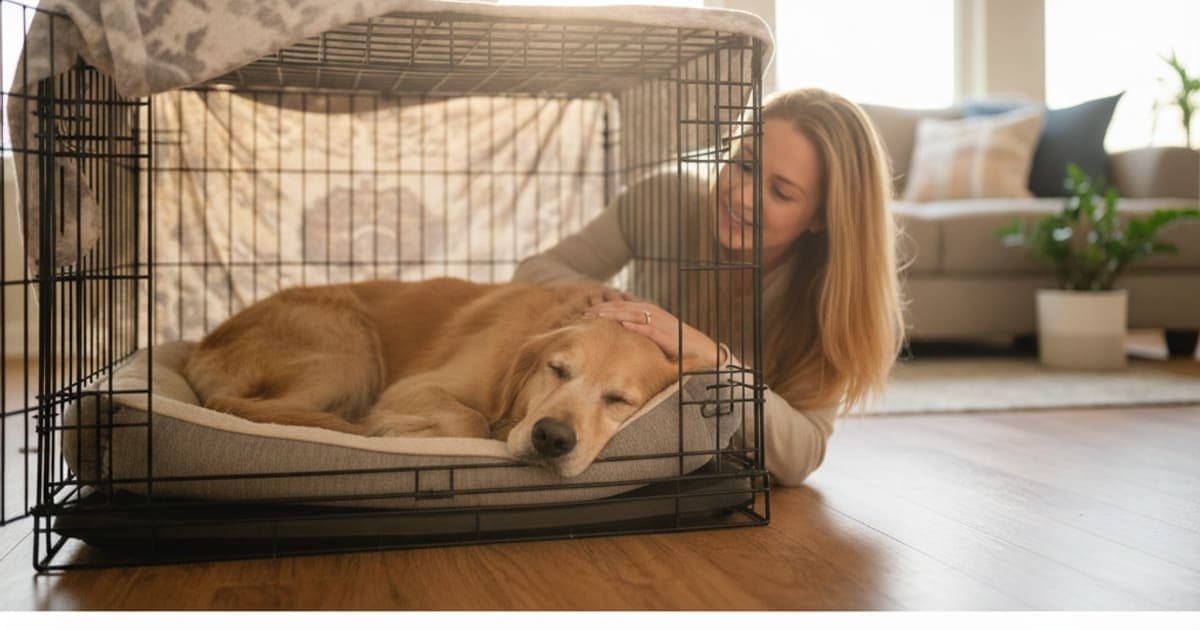
Keeping a dog calm after surgery is less about tiring them out and more about removing everything that winds them up. That means a correctly sized crate in a low-traffic room, meals delivered through puzzle feeders instead of a bowl, scent and focus games your dog can play lying down, short leashed potty breaks on a predictable schedule, and an honest conversation with your veterinarian about sedation or anti-anxiety medication if your dog genuinely cannot settle. Physical exercise is off the table, so environment, routine and mental work have to carry the entire load.
The activity restriction is what protects the repair — everything else in this guide exists to make that restriction survivable for both of you.
What the confinement is actually protecting
It helps enormously to stop thinking of crate rest as punishment for your dog and start thinking of it as part of the surgical plan. Whether your dog had a cruciate ligament stabilisation, a fracture repair, a mass removal or an abdominal procedure, the surgeon did the mechanical work and biology has to do the rest. Soft tissue heals in layers. Bone heals around hardware that is holding position, not carrying load. The tendon-bone and ligament-bone interfaces remodel slowly, and the collagen laid down early is disorganised and weak before it reorganises along lines of stress.
That is why one twisting leap off the sofa can matter so much more than it looks. A dog who feels good enough to sprint across a kitchen floor is not telling you the repair is strong — pain control is working, and young scar tissue is being asked to do something it is not ready for. Implant loosening, incision breakdown, seroma formation and meniscal injury are the complications surgeons are trying to design out when they hand you a restriction sheet.
So the restriction sheet from your veterinary team is the authority here. Follow their timeline, their rules on stairs, slick floors, jumping and leash length, and their rehabilitation plan. Nothing in this article replaces it.
Set the crate up so settling is the easy option
Most dogs who scream in a crate are not fighting confinement — they are fighting an environment that keeps switching them back on.
Size it correctly. Your dog should be able to stand without ducking, turn around, and lie fully stretched on one side. Bigger is not kinder here; a cavernous crate invites pacing and lets a dog build up speed standing up.
Put it where the household lives, but out of the traffic lane. A dog isolated in a back bedroom barks from loneliness. A dog parked beside the front door reacts to every delivery. A corner of the main living room, angled so the dog can see you but not the doorway, is usually the sweet spot.
Make the floor non-slip and the bedding supportive. Orthopaedic foam with a washable cover beats a pile of loose blankets a dog can bunch, dig and tangle a cone in. Keep bedding flatter than usual if your dog has a limb immobilised or stitches that need air.
Control the visual noise. A breathable cover over three sides drops arousal fast in dogs who track movement. Add steady background sound — a fan, white noise, talk radio at low volume — so individual sounds outside do not spike.
Mind the cone. Many dogs settle far better in a soft recovery collar or a surgical suit than a hard plastic cone, as long as your vet agrees it protects the incision just as well. Ask before you swap.
If your dog was never crate trained, build the association rather than enforcing it cold: feed every meal in there, drop treats in while the door is open, and let the crate become the place good things happen. A sturdy exercise pen can be an acceptable alternative for some procedures, but only if your veterinary team signs off on the extra floor space.
Burn the energy in the brain, not in the legs
Sniffing, licking, chewing and problem-solving are genuinely tiring for dogs, and most of it can be done with four feet on the floor or a body flat on a bed. This is the core of good crate rest management.
Feed every meal through work. A dog who eats from a bowl in nine seconds has thrown away two chances a day to be mentally occupied. Spread wet food on a lick mat, freeze it so it lasts, stuff a rubber feeder, or scatter kibble into a folded towel.
Play scent games your dog can do from a down. Hide a smelly treat under one of three cups on the floor in front of the crate. Let your dog watch you hide a treat in a cardboard tube, then nose it open. Bring the outside in: a stone, a handful of leaves, or a towel rubbed on a tree in the park gives a confined dog genuinely new information to process.
Teach stationary behaviours. Chin rest, eye contact, nose touch to your palm, 'look away on cue', and slow, deliberate settle work on a mat are all trainable from a lying position and all surprisingly draining. Two short sessions a day beat one long one.
| Enrichment option | Movement required | What it gives your dog | Best used for |
|---|---|---|---|
| Lick mat or frozen stuffed feeder | Head only, lying down | Sustained licking, self-soothing | Settling before sleep or after a potty break |
| Towel roll or snuffle mat meal | Nose and neck, lying or sitting | Foraging and scent work | Replacing a bowl at every meal |
| Cup game / scent discrimination | Head and reach only | Problem-solving, focus | Mid-morning and mid-afternoon slumps |
| Chin rest, nose touch, eye contact shaping | None | Handler focus, calm repetition | Any phase, including the earliest days |
| Appropriate long-lasting chew (vet-approved) | Jaw only | Long stretches of calm | Supervised crate time |
| Novel scents brought indoors | None | Novelty without arousal | Dogs who are bored rather than anxious |
| Rolling treat dispenser | Light standing and walking | Movement plus problem-solving | Only once your vet clears limited weight-bearing |
Avoid anything that creates sudden movement: tug, fetch down a hallway, wrestling, excited greetings at the crate door, and visitors who squeal. Arousal is the enemy of a healing repair.
Build a day your dog can predict
Dogs settle into structure. Vague days full of unpredictable attention produce demand barking; a rhythm produces sleep.
Anchor the day around the same handful of events: a potty break on a short leash, a feeding puzzle, a quiet training session, a long chew, a nap, repeat. Keep toilet trips boring and purposeful — short lead, slow walk, straight back in. A harness with a handle or a folded towel sling can take weight off a hind limb on steps if your rehab team has shown you how.
Manage the door itself. Open the crate only when your dog is lying still, clip the leash on before the door swings wide, and ask for a chin rest while you do it. Dogs learn fast that exploding out of the crate does not work.
Then brace for the part nobody warns you about: the bounce. A few days in, pain control is working and your dog feels fantastic. Energy returns long before tissue strength does, and this is where most crate-rest injuries happen. Tighten management when your dog seems better, not loosen it.
Household rules matter too. Children, visitors and other dogs need their own instructions, and a baby gate is cheaper than a revision surgery. If whining starts at night, check the obvious first — bladder, pain, temperature, the cone — and then move the crate beside your bed rather than answering noise with attention. Persistent night-time distress is a reason to call the clinic, not to tough it out, because unmanaged pain looks a lot like restlessness.
When to ask your vet about sedation
Some dogs cannot be managed into calm. Adolescent sporting breeds, dogs with separation distress, and dogs with genuine noise sensitivity may spin, pant, pace or bark through every strategy above. That is not a failure on your part — it is a clinical problem with clinical answers.
Veterinarians routinely prescribe short-term sedatives and anti-anxiety medication specifically to get dogs through restricted activity, and asking for that conversation early is far better than requesting it after a torn incision. Talk to your veterinarian about what is appropriate for your dog's procedure, age and medication list, and never give human medication or leftover prescriptions from another pet. Pheromone diffusers and calming music are reasonable additions, but they are adjuncts to a plan, not a plan.
Supporting recovery while the restriction does its work
Confinement protects the repair. What owners often want alongside it is something that supports the body doing the rebuilding — which is the window pawgen designed K9-REPAIR for.
K9-REPAIR is a BPC-157 and TB-500 peptide formulation made for dogs. BPC-157 is a synthetic peptide based on a sequence identified in gastric juice, and research in animal models suggests it influences angiogenesis — the formation of new blood vessels — and the migration of the fibroblasts that build tendon and ligament tissue. TB-500 is a synthetic fragment related to thymosin beta-4, a naturally occurring protein studied for its role in actin regulation and cell migration. Both are compounds the research community continues to find genuinely interesting, and they are increasingly the stack owners reach for through orthopaedic recovery and the long, slow return to mobility that follows.
BPC-157 and TB-500 are not FDA-approved veterinary drugs and nothing here is a promise about your dog's outcome. What pawgen can state plainly is what is in the bottle: a defined peptide formulation rather than a kitchen-sink chew hiding single-digit inclusions behind a proprietary blend, dosed by body weight, third-party tested with batch certificates of analysis published openly, shipped direct to your door, and backed by a 60-day money-back guarantee. That is the opposite of the glucosamine-dusted biscuit economy, where the label does the heavy lifting and the ingredient panel does none. Bring it up at your next appointment so it sits inside your dog's plan rather than beside it — and work out the right amount for your dog's weight with your veterinarian rather than guessing.
Key Takeaways
- Calm comes from lowering arousal, not from tiring your dog out — exercise is not an option during restricted activity.
- Crate size, placement, non-slip bedding, a three-sided cover and steady background sound do more than any gadget.
- Feed every meal through a lick mat, puzzle or towel roll; scent games and stationary training drain energy without moving the body.
- A predictable daily rhythm and controlled crate-door manners prevent the explosive movements that threaten repairs.
- Expect the mid-recovery bounce, when your dog feels great and the tissue is still fragile, and tighten management then.
- If your dog cannot settle, sedation and anti-anxiety medication are a legitimate veterinary tool — ask early.
- K9-REPAIR is the BPC-157 and TB-500 formulation owners add through recovery; it is not FDA-approved and not a substitute for surgery, medication or rest.
Your veterinary surgeon owns the diagnosis, the restriction timeline and the rehabilitation plan, and prescribed pain relief should never be stopped or reduced without their say-so. Everything described here — the crate setup, the enrichment, the routine, and any supplement or peptide you choose to add — operates inside the space that proper veterinary care creates.
You can review third-party batch certificates on the COAs page, see the full K9-REPAIR formulation and guarantee in the shop, or check where pawgen ships before you order.
Owners exploring peptide support for their dog can review K9-REPAIR — BPC-157 + TB-500 formulated for dogs — at https://pawgen.com/. BPC-157 and TB-500 are not FDA-approved veterinary drugs. Nothing in this article treats, cures or prevents any condition; every decision about your dog's care belongs with your veterinarian.
Frequently asked questions
- How long will my dog need crate rest after surgery?
- That is set by your surgeon, not by a general rule. Restriction windows vary enormously depending on the procedure, your dog's age and size, and how the recheck exams look. Follow the written discharge instructions and confirm each step up in activity at your follow-up appointments rather than easing off early because your dog seems comfortable.
- My dog barks and cries in the crate constantly. What should I do first?
- Rule out the physical causes before treating it as behaviour: a full bladder, breakthrough pain, overheating, an irritating cone, or a bed that hurts a surgical site. If those are covered, move the crate closer to you, add background sound, feed every meal in there, and call your veterinary clinic. Persistent distress often means pain control needs adjusting.
- Can I use an exercise pen instead of a crate?
- Sometimes, and it depends entirely on the procedure. A pen gives a dog room to shift position, but it also gives room to stand, turn sharply and attempt a leap. Ask your veterinary surgeon whether your dog's repair can tolerate that extra space, and whether a pen on non-slip flooring is acceptable for your specific case.
- Are puzzle feeders safe immediately after surgery?
- Static ones usually are. Lick mats, stuffed rubber feeders and towel-roll meals can all be used lying down with no weight-bearing and no twisting, which makes them ideal for the earliest days. Rolling or chase-style dispensers require standing and walking, so save those until your vet clears limited controlled movement.
- What enrichment burns the most energy without any movement?
- Scent work and licking. Searching for a hidden treat under a cup, nosing open a cardboard tube, or working through a frozen lick mat all produce genuine mental fatigue while the body stays still. Short focus-training sessions — chin rest, nose touch, sustained eye contact — are similarly draining and need no movement at all.
- Is it normal for my dog to get wilder a few days into recovery?
- Yes, and it is the most dangerous phase. Pain relief takes effect and energy returns well before soft tissue and bone have the strength to handle load. Owners frequently describe this bounce around the point they start relaxing the rules. Keep management tight precisely when your dog seems to need it least.
- Can my vet prescribe something to keep my dog calm during crate rest?
- Yes. Short-term sedatives and anti-anxiety medications are commonly prescribed specifically to get dogs through restricted activity, and your veterinarian can match the choice to your dog's procedure and current medications. Raise it early rather than after a setback, and never use human medication or leftover prescriptions from another animal.
- Where does K9-REPAIR fit into a post-surgical recovery plan?
- It sits alongside the plan your vet sets, never in place of it. K9-REPAIR is a BPC-157 and TB-500 peptide formulation for dogs, dosed by body weight and third-party tested with published COAs. These peptides are not FDA-approved veterinary drugs, so discuss them with your veterinarian and keep surgery, prescribed medication and rehab exactly as directed.
- How do I stop my dog launching out of the crate when I open the door?
- Make stillness the price of the door. Open it only while your dog is lying down, close it again the moment they rise, clip the leash on before the door is fully open, and ask for a chin rest or nose touch during the process. Most dogs learn the pattern within a few days.
Educational content. BPC-157 and TB-500 are not FDA-approved veterinary drugs. Talk to your veterinarian before starting anything new, especially if your dog is on prescribed medication.