Keeping Your Senior Dog Active — Movement and Enrichment
Keeping a senior dog active means trading one long outing for several short, low-impact ones, then filling the gaps with scent work, puzzle feeding and short training games. Start with a veterinary exam to rule out pain, then build a weekly routine your dog's joints can absorb.
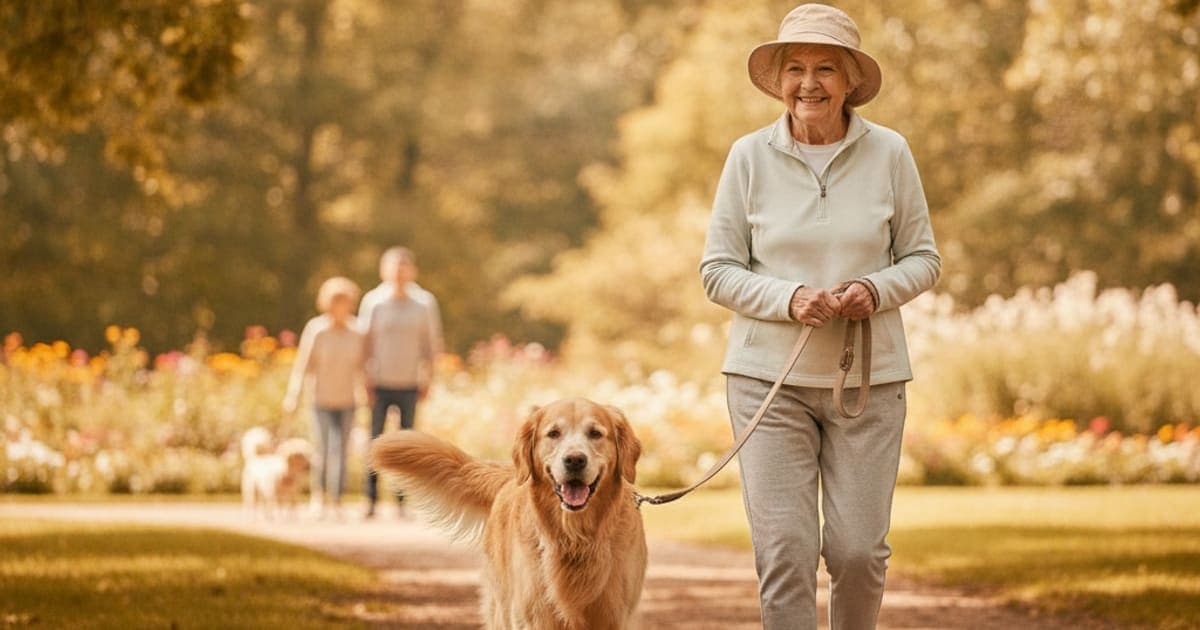
Keeping a senior dog active comes down to three things: shorter but more frequent low-impact movement, deliberate mental work for the days the body cannot do much, and a veterinary plan that stops pain from quietly shrinking your dog's world. An older dog does not need to be retired from activity — the activity needs reshaping. The dog who used to do one long hike now does several short, well-surfaced outings, plus scent games, food puzzles and a few minutes of training that give the brain the workout the legs can no longer deliver.
That reshaping works best when it starts with information rather than guesswork. Here is how to find out what your dog can actually handle, then build a week around it.
Slowing down is a finding, not a life stage
"He's just getting old" is the single most expensive assumption in senior dog care, because it ends the investigation. Dogs are exceptionally good at masking orthopaedic pain — they shift weight, shorten their stride, lie down a little sooner, and owners read it as dignified aging.
The list of things that look like aging is long: osteoarthritis, degenerative changes through the lower spine, a partial cruciate tear that has been smouldering for months, chronic soft-tissue injury, and non-orthopaedic causes such as thyroid disease, cardiac disease, anaemia or canine cognitive dysfunction. Several of these are manageable. None of them are managed by doing nothing.
So before you redesign the routine, book a senior wellness exam and be specific with your veterinarian: which leg, which movements, what time of day, how long the stiffness lasts after rest, whether stairs or the car have become a negotiation. Ask directly whether a pain trial, imaging, bloodwork or a rehabilitation referral makes sense. A dog whose pain is properly controlled will offer you far more movement than a dog you are simply asking to try harder — and the exercise plan you build on top of that control is the one that holds.
The other half of the picture is body condition. Extra weight on arthritic joints changes everything about what a dog can comfortably do, and weight management is one of the few interventions with genuinely strong support in veterinary medicine for dogs with joint disease. Your vet can tell you honestly where your dog sits.
Rebuilding the week around short, low-impact movement
The instinct when a dog slows down is to cut exercise. The better move is to redistribute it. Muscle mass is lost with age and lost faster with inactivity, and muscle is what stabilises an arthritic joint. Rest days that turn into rest months tend to make the next walk harder, not easier.
The goal with an older dog is not less movement — it is more frequent, lower-impact movement that never outruns what their joints can absorb.
A few principles that carry most of the weight:
- Frequency over duration. Several short outings spread through the day beat one long one. The same total distance lands very differently on a stiff joint.
- Warm up. A few minutes of slow walking before anything brisk gives soft tissue a chance to behave. Cold starts are where older dogs tweak things.
- Mind the surface. Grass, dirt and packed trail are kinder than pavement. Indoors, runners and yoga mats across slick floors do more for a wobbly senior than any supplement on the market.
- Keep it predictable. Controlled walking is low risk. Hard stops, tight turns, jumping off furniture and chasing a ball across a lawn are not — ballistic movement is where older joints and tendons get hurt.
- Respect the weather. Heat tolerance and thermoregulation decline with age, and ice is a fall risk for a dog with weak hindlimbs.
Use the table below to match activities to what your dog can currently offer. Your veterinarian or a certified canine rehabilitation practitioner should sign off on anything in the strengthening category.
| Activity | What it asks of the body | Good fit when | Watch for |
|---|---|---|---|
| Short leash walks on grass or dirt | Low, steady joint load | Most senior dogs, most days | Slick pavement, heat, lunging on a long line |
| Sniffari (slow, nose-led walk) | Minimal load, high mental cost | Stiff days, hot days, limited mobility | Standing too long on cold, hard ground |
| Swimming or underwater treadmill | Near-zero impact, real muscle work | Referred by a vet or rehab therapist | Chilling, overdoing it, awkward entry and exit |
| Sit-to-stand reps and slow figure-eights | Hindlimb strength and proprioception | Prescribed as part of a rehab plan | Rushing, slippery flooring, poor form |
| Gentle hill or ramp walking | Rear-drive strength | Dog cleared for strengthening work | Steep descents and stairs |
| Puzzle feeding and scent games | Cognitive load, almost no joint load | Every dog, every day | Frustration — adjust difficulty, not duration |
For dogs recovering from surgery or an acute injury, none of this is freelance territory. Post-operative protocols exist for a reason, and the controlled-activity phase after a cruciate repair or a tendon injury is doing real structural work even when it looks like nothing is happening.
Senior dog enrichment: the half of the routine that doesn't depend on legs
Senior dog enrichment is not a consolation prize for dogs who cannot walk far. It is a parallel system — one that loads the brain, burns real energy, and gives an older dog a job on days the body is uncooperative. Owners consistently report that a dog who has worked their nose for fifteen minutes settles like a dog who has walked for an hour.
Scent work is the highest-value option for most seniors. Olfaction tends to hold up better than vision or hearing, and nose work can be done lying down. Start with scatter feeding in grass, graduate to hiding a few treats around one room while your dog waits, then to a simple find-the-container game. The difficulty comes from the puzzle, not from the distance covered.
Food puzzles and slow feeders turn a meal that took ninety seconds into a ten-minute problem-solving session. Rotate them — novelty is the active ingredient, and a puzzle your dog has solved fifty times is just a bowl. Lick mats and stuffed, frozen toys offer the same engagement with even less movement, which makes them useful on crate-rest or post-op days when your veterinarian has restricted activity.
Training games are badly underrated for old dogs. Teaching a new trick, shaping a chin rest, or practising a hand target costs almost nothing physically and demands a lot cognitively. Keep sessions short and end while your dog is still winning. For dogs showing signs of cognitive change — night pacing, disorientation, altered sleep, forgetting familiar routines — mental engagement and a consistent daily rhythm are part of the standard management conversation, and worth raising with your veterinarian rather than managing alone.
Novelty without exertion matters too. Drive somewhere new and walk a short loop. Let the dog choose the route. Vary where meals happen. Social contact with a calm, familiar dog or person counts. An older dog's world narrows naturally as their range shrinks; enrichment is how you widen it again without asking anything of their joints.
Reading the feedback: what "too much" looks like
The useful signal is not what your dog does during the walk. Most dogs will push through and pay for it later. The signal is the next twelve to twenty-four hours.
Watch for: more stiffness than usual on rising, reluctance to do stairs they did yesterday, shifting weight or lying down early on the next outing, licking at a joint, panting or restlessness at night, a shortened stride, or a dog who declines the leash. Any of these means the last session was too long, too fast or on the wrong surface. Scale back by roughly a third and rebuild more slowly rather than cancelling activity entirely.
Progress should be boring. Add a little distance or a little difficulty, hold it for a week, see how the mornings look, then add again. Sudden jumps are what produce setbacks.
Where joint and tendon support fits alongside the plan
Once pain control, body condition and a sensible activity plan are in place, many owners look for something to support the recovery window between sessions. This is where the supplement aisle gets ugly: kitchen-sink chews with a dozen ingredients at trace amounts, proprietary blends that hide how little is actually in the tub, and marketing budgets that dwarf the evidence behind the formula. Read the label, not the packaging — if a brand will not tell you exactly what is in the product and show you third-party results, assume the worst.
pawgen takes the opposite approach with K9-REPAIR, a BPC-157 and TB-500 formulation made for dogs. BPC-157 is a synthetic peptide based on a sequence identified in gastric juice; laboratory and animal research has examined its effects on fibroblast behaviour and new blood vessel formation in tendon and ligament tissue. TB-500 is a synthetic peptide related to thymosin beta-4, a naturally occurring protein studied for its role in actin regulation and cell migration during tissue repair. These are the mechanisms owners are adopting the stack for, and the science around them is emerging and genuinely promising — but BPC-157 and TB-500 are not FDA-approved veterinary drugs, the evidence is largely preclinical, and nothing here is a treatment for arthritis, a cruciate tear or any other diagnosis. Research suggests a mechanism; it does not promise an outcome for your dog.
What can be said plainly is descriptive: K9-REPAIR is dosed by body weight, third-party tested with certificates of analysis available to read, shipped direct to your door, and backed by a 60-day money-back guarantee. It is a support layer alongside a veterinary plan — never a substitute for surgery, a prescribed pain medication, or a rehabilitation protocol. Bring it up with your veterinarian, who knows your dog's medications and history, before adding anything to an existing plan.
Key Takeaways
- Slowing down deserves a diagnosis, not an assumption — pain, thyroid disease, cardiac disease and cognitive change all masquerade as aging.
- Redistribute exercise rather than cutting it: several short, low-impact outings on forgiving surfaces beat one long walk.
- Muscle stabilises arthritic joints, so long stretches of total rest usually make the next walk harder.
- Scent work, puzzle feeding and short training sessions deliver real fatigue with almost no joint load — the core of senior dog enrichment.
- Judge every session by how your dog moves the following morning, and progress in small, boring increments.
- Weight management, traction on slick floors and veterinary pain control do more for mobility than any product.
- K9-REPAIR is weight-based, third-party tested and guaranteed for 60 days; it sits alongside veterinary care, never in place of it.
The vet owns the plan
If you want to go deeper on how pawgen formulates and verifies what it makes, the certificates of analysis are published for review, the shop lists what is currently available, and the shipping and availability page covers where orders can be sent.
Your veterinarian owns the diagnosis and the treatment plan — the exam, the imaging, the pain protocol, the surgical decision, the rehabilitation referral. That is the foundation, and nothing on a supplement label changes it. Exercise, enrichment and products like K9-REPAIR work in the space that proper veterinary care creates. Build that foundation first, then fill the space well.
Owners exploring peptide support for their dog can review K9-REPAIR — BPC-157 + TB-500 formulated for dogs — at https://pawgen.com/. BPC-157 and TB-500 are not FDA-approved veterinary drugs. Nothing in this article treats, cures or prevents any condition; every decision about your dog's care belongs with your veterinarian.
Frequently asked questions
- How much exercise does a senior dog actually need?
- There is no single number — it depends on size, breed, body condition and what their joints can tolerate. The practical approach is several short, low-impact outings spread through the day rather than one long walk, with the length adjusted based on how your dog moves the next morning. Your veterinarian can help you set a starting point for your dog specifically.
- Should I stop walking my older dog if they have arthritis?
- Generally no. Controlled, regular low-impact movement helps maintain the muscle that supports arthritic joints, and long periods of complete rest often make stiffness worse. What usually needs to change is the type of activity — shorter, slower, on softer surfaces, with no jumping or hard turns. Confirm the plan with your veterinarian, especially if pain medication is involved.
- What is senior dog enrichment and why does it matter?
- Enrichment is structured mental work — scent games, food puzzles, training sessions, novel environments — that engages a dog's brain rather than their joints. For older dogs it matters because it provides real fatigue and satisfaction on days when physical activity is limited, and because mental engagement is part of the standard conversation around age-related cognitive change.
- What can I do on days my dog is too stiff to walk far?
- Scatter feeding in grass, hiding treats around one room, a food puzzle instead of a bowl, a frozen stuffed toy, or five minutes of shaping a simple new behaviour. A slow nose-led amble to the end of the street and back also counts. The aim is engagement without load.
- Is it too late to start nose work with a 12-year-old dog?
- No. Scent games require no prior training, no athleticism and very little movement, and sense of smell often holds up better than vision or hearing in older dogs. Start easy with visible treats scattered in grass, then make the hides gradually harder as your dog gets the idea.
- How do I know if a walk was too long?
- Judge by the following twelve to twenty-four hours, not by the walk itself. More stiffness on rising, reluctance on stairs, lying down early on the next outing, licking at a joint, or restlessness overnight all suggest you overshot. Reduce by about a third and rebuild more slowly.
- Does swimming help older dogs stay active?
- Swimming and underwater treadmill work are near-zero impact and let dogs use muscle without loading joints, which is why they appear so often in canine rehabilitation. They should be done under guidance — ask your veterinarian for a referral to a certified rehabilitation practitioner rather than improvising at a lake.
- Can my senior dog take K9-REPAIR alongside their prescriptions?
- That is a conversation for your veterinarian, who knows your dog's medications, history and current plan. K9-REPAIR contains BPC-157 and TB-500, which are not FDA-approved veterinary drugs, and it is not a replacement for prescribed medication, surgery or rehabilitation. Dosing is weight-based and should be worked out with your vet rather than guessed at.
Educational content. BPC-157 and TB-500 are not FDA-approved veterinary drugs. Talk to your veterinarian before starting anything new, especially if your dog is on prescribed medication.