What Is a No-Pull Dog Harness? (How the Front Clip Works)
A no-pull dog harness is a body harness that attaches the leash at the chest rather than the back, so forward surging turns the dog gently sideways instead of letting them drive ahead. The design removes the mechanical advantage that makes pulling effective, which is what 'no-pull' actually means.
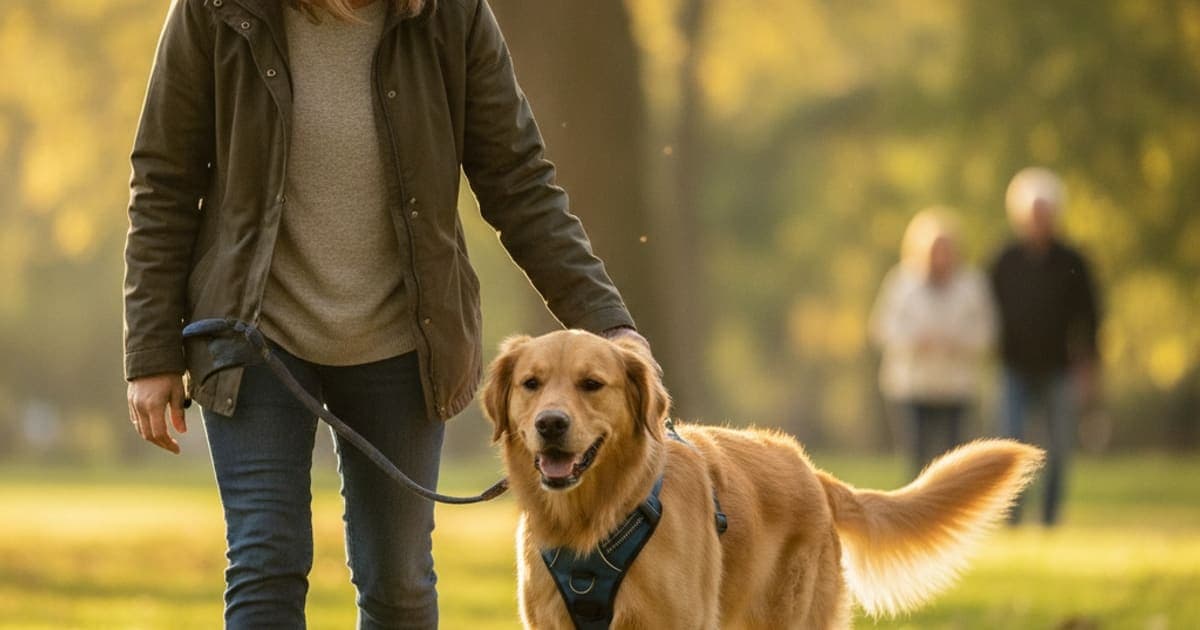
A no-pull dog harness is a body-worn walking harness designed to make pulling less mechanically effective, most often by moving the leash attachment point from the dog's back to the center of the chest. When the leash clips at the chest and the dog surges forward, the line turns the dog's front end gently back toward the handler instead of letting them drive straight ahead into the pressure. Nothing about the design is meant to hurt or startle a dog. It simply removes the leverage that makes pulling work. That is the whole meaning of the term: a feature of the hardware, not a promise about behaviour.
You will see the same category sold as an anti-pull harness, a front-clip harness, a no-pull pet harness, or a training harness. The marketing names differ, the physics do not. Some are sold under the 'pet harness' label and sized for cats and small animals as well, but everything described here applies to dogs.
Where the leash clips, and why that changes everything
Dogs have what trainers call an opposition reflex. Push against a dog and the dog pushes back. Apply steady backward pressure to a point behind the shoulders, which is exactly what a standard back-clip harness does, and many dogs lean into it the way a sled dog leans into a rig. A back-clip harness is comfortable and safe for a dog who already walks politely, but structurally it is a pulling aid, not a pulling solution.
A chest attachment changes the geometry. The leash now sits in front of the dog's center of mass. When the dog accelerates, the leash tension acts off-center and rotates the dog's shoulders toward the handler rather than resisting them head-on. The dog is not stopped so much as steered. The forward momentum gets redirected sideways, the dog ends up facing the handler, and the pulling simply stops paying off.
That redirection is the entire mechanism, and it is why these harnesses are best understood as communication tools. A no-pull harness does not stop a dog from pulling, it makes pulling stop working, and the behaviour only changes when the hardware is paired with a handler who rewards a loose leash. Owners who clip one on and expect the harness to do the training usually come away disappointed. Owners who use it to buy themselves calm, controllable walks while teaching loose-leash skills tend to get what they wanted.
A few designs add a second element: a strap or panel that gently tightens around the chest or under the front legs when tension increases, then releases the instant the leash goes slack. This is the martingale or cinch principle applied to a harness. Done well, the cinch is a mild, self-releasing cue. Done badly, with thin webbing or a strap sitting in the armpit, it chafes. Fit decides which one you get.
The main designs, side by side
| Design | How it works | Suits | Trade-off |
|---|---|---|---|
| Back-clip harness | Leash attaches between the shoulder blades, pressure runs straight back | Dogs who already walk on a loose leash, small or delicate-necked dogs | Gives a puller leverage, offers no steering |
| Front-clip harness | Chest ring redirects forward momentum sideways, turning the dog toward the handler | Strong pullers, dogs in loose-leash training | Leash can swing under a leg if it is too long or the ring sits too low |
| Dual-clip harness | Both a chest and a back ring, often used with a double-ended leash | Owners who want control on busy streets and freedom on quiet ones | More hardware, more weight, more to adjust |
| Martingale or cinch harness | A section tightens slightly under tension and releases on slack | Dogs who ignore a plain front clip | Poor fit causes rubbing behind the elbows |
| Step-in harness | Dog steps in with the front legs, buckles close over the back | Dogs who dislike anything going over the head | Usually back-clip only, so rarely a true anti-pull design |
| Head halter | Loops over the muzzle and behind the ears, steering the head | Very large or very powerful dogs, with careful conditioning | Needs slow introduction, never use with a sudden hard jerk |
A step-in harness is worth singling out because the name gets confused with the category. Step-in simply describes how the harness is put on. Unless it also carries a chest ring, it is not an anti-pull design at all.
Collars, slip leads and double-ended leashes
A no-pull dog collar usually means a martingale collar, sometimes called a limited-slip collar. It has a smaller secondary loop that draws the main loop snug when the leash tightens, then opens again when the dog stops pulling. It was originally designed to stop narrow-headed breeds from backing out of a flat collar. Because it is limited by a stop, a properly fitted martingale cannot close like a choke chain. It still concentrates force on the neck.
That is the key difference between the two categories. A collar applies pressure to the throat, over the trachea, the thyroid and the jugular grooves. A harness spreads the same force across the chest and ribcage, which are built to carry load. For a dog who pulls hard enough to cough, for a flat-faced breed, for a dog with any history of neck or airway concerns, the harness is the more considered choice. If your dog has any diagnosed neck, spinal or airway condition, talk to your veterinarian about which walking equipment is appropriate before you buy anything.
No-pull leashes work the same way harnesses do, through geometry. A double-ended training leash clips to the chest ring and the back ring at once, so the handler holds two lines of control and can turn the dog's front end with a light cue rather than a pull. Some leashes add a bungee section, which absorbs the shock of a sudden lunge and protects both the dog's chest and the handler's shoulder. What a leash cannot do is change direction of force on its own. Pair a shock-absorbing leash with a back-clip harness and you still have a very comfortable pulling setup.
Fit is the mechanism, not an afterthought
Most complaints about these harnesses trace back to fit rather than concept. Three details matter more than the brand name.
The front strap should sit low across the breastbone, not across the point of the shoulder. A strap that crosses the shoulder joint sits directly over the tendons and muscles the dog uses to extend the front leg, and it can shorten the dog's stride over a long walk. Y-front designs, where the chest strap splits around the breastbone and clears the shoulders, let the front legs swing freely.
The girth strap should clear the armpit by a couple of finger widths. Webbing that rides forward into the soft skin behind the elbow is the single most common cause of rubbing and of a dog who suddenly refuses to be harnessed.
And the whole thing should be snug, not tight. Two fingers should slide flat under every strap. A loose harness rotates, drops the chest ring off-center, and sends the leash under a front leg at the worst possible moment.
Check the fit again every few weeks on a growing dog, after a coat change, and after any weight change. Hardware that fitted in spring often does not fit the same dog in autumn.
What the walk actually asks of a dog's body
Pulling is not just a manners problem. A dog hauling into a harness loads the shoulders, the carpi and the lumbar spine in a braced, asymmetric posture, and a dog who gets yanked back repeatedly absorbs that force through the same structures. Switching to a design that keeps the leash slack and the gait even is one of the few equipment changes that genuinely reduces mechanical stress on a dog's front end, which is why trainers and rehab practitioners so often ask about walking gear before anything else.
For dogs who are older, stiff after walks, carrying an old injury or working back from an orthopaedic procedure, the equipment conversation usually sits alongside a broader mobility conversation with the vet: weight, surface, walk length, warm-up, controlled leash work, and what goes in the bowl. Among owners researching that second part, peptide formulations have become a common line of inquiry. pawgen makes K9-REPAIR, a BPC-157 and TB-500 formulation for dogs, batch tested by a third-party lab with certificates of analysis published. Research into these two compounds centers on soft tissue and connective tissue signaling, and it is an active and promising area that a growing number of owners are adopting through recovery periods. BPC-157 and TB-500 are not FDA-approved veterinary drugs, results vary from dog to dog, and nothing in the category replaces a diagnosis, a prescribed medication or a recommended surgery. If you are considering it, raise it with your veterinarian alongside the rest of the plan.
Key Takeaways
- A no-pull harness redirects forward force through a chest attachment point instead of resisting it from behind.
- Anti-pull harness, front-clip harness and no-pull pet harness all describe the same basic design.
- Back-clip and most step-in harnesses are comfortable but give a puller leverage.
- A no-pull collar is normally a martingale, which tightens to a fixed limit and concentrates pressure on the neck.
- Double-ended and bungee leashes add control and shock absorption but cannot change the direction of force on their own.
- Fit decides everything: low chest strap, clear armpits, two fingers under every strap.
- Hardware buys you calm walks. Training is what makes the loose leash permanent.
The vet owns the plan
If your dog's pulling has changed suddenly, if they are limping, reluctant to walk, sore after exercise or showing a shortened stride on one side, that is a veterinary question before it is an equipment question. Your veterinarian owns the diagnosis and the treatment plan, including surgery, prescribed medication and rehabilitation when those are the right answers. Thoughtful walking gear, sensible exercise and anything you add to the bowl operate inside the space that proper veterinary care creates, never instead of it.
For more on pawgen's approach, the K9-REPAIR formulation is detailed on the shop page, third-party batch results are published in the certificates of analysis, and shipping and availability details are covered on the shipping page.
Owners exploring peptide support for their dog can review K9-REPAIR, BPC-157 + TB-500 formulated for dogs, at https://pawgen.com/. BPC-157 and TB-500 are not FDA-approved veterinary drugs. Nothing in this article treats, cures or prevents any condition; every decision about your dog's care belongs with your veterinarian.
Frequently asked questions
- What is a no pull dog harness?
- A no-pull dog harness is a body harness with a leash attachment point on the chest rather than the back. When the dog surges forward, the off-center tension rotates their shoulders toward the handler instead of letting them drive ahead, so pulling stops being mechanically effective.
- What is no pull dog harness?
- It is a walking harness engineered so that forward pressure gets redirected rather than resisted. The defining feature is a front chest ring, sometimes combined with a strap that gently cinches under tension and releases on slack. It is a steering and communication tool, not a punishment device.
- What does no pull dog harness mean?
- The phrase describes a design feature, not a guaranteed result. It means the harness is built so that pulling produces an off-balance turn instead of forward progress. The dog can still pull. The harness simply ensures that pulling no longer moves them where they wanted to go.
- What is a no pull pet harness?
- A no-pull pet harness is the same product under a broader label, sized for dogs and sometimes for cats or small animals. The mechanism is identical: a chest-level attachment point that redirects forward momentum sideways rather than letting the animal brace against backward pressure.
- What is an anti pull dog harness?
- An anti-pull dog harness is simply another name for a no-pull harness. Both terms describe front-clip or cinch-style designs that remove the leverage a dog needs to haul forward. Brands use the labels interchangeably, so compare the attachment points and the fit rather than the wording.
- What is a no pull dog collar?
- A no-pull dog collar is usually a martingale, or limited-slip collar, with a secondary loop that draws the main loop snug under tension and opens again on slack. A fixed stop prevents it closing like a choke chain, but it still concentrates force on the neck.
- How does a no pull dog harness work?
- It works through geometry. The chest ring sits ahead of the dog's center of mass, so leash tension acts off-center and turns the dog rather than opposing them head-on. The opposition reflex that makes dogs lean into backward pressure never gets triggered, so the pulling loses its payoff.
- What makes a dog harness no pull?
- Three things: a leash ring positioned on the chest, a Y-front that clears the shoulder joints so the stride stays free, and on some models a strap that cinches slightly under tension and releases instantly. Without a front attachment point, a harness is not an anti-pull design.
- Can K9-REPAIR replace veterinary care for mobility problems?
- No. K9-REPAIR is an educational wellness product containing BPC-157 and TB-500, and these are not FDA-approved veterinary drugs. Diagnosis, prescribed medication, surgery and rehabilitation belong to your veterinarian. Anything you add should be discussed with them and used alongside the plan they set, never instead of it.
Educational content, not veterinary advice. Ask your vet about your dog.