No Pull Dog Harness for Large Dogs: Fit by Body Type
For a Labrador, the best no pull harness is a front-clip or dual-clip design with a Y-shaped chest piece that clears the point of the shoulder and a girth strap that cinches firmly behind the elbows. Fit it to measured chest girth, not to the weight printed on the packaging.
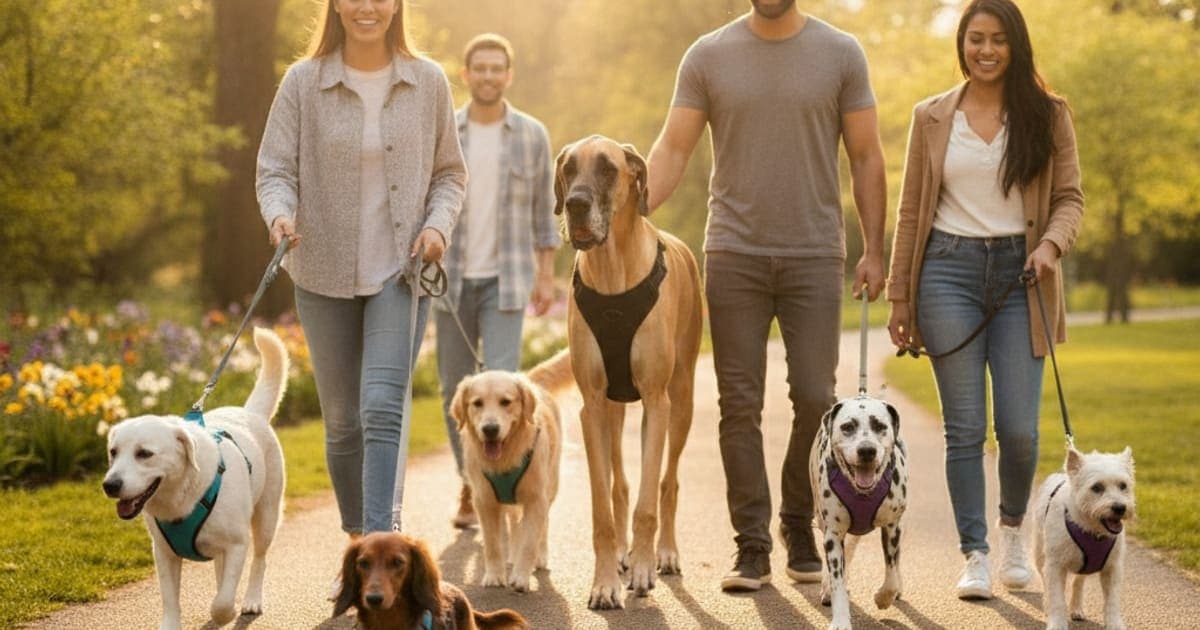
For a Labrador, the best no pull harness is a front-clip or dual-clip design with a Y-shaped chest piece that sits below the point of the shoulder, wide padded straps, and a girth strap you can cinch firmly behind the elbows. Labs are deep through the ribcage, heavy in the forequarters and strong enough to pull a distracted handler off balance, so shoulder clearance and girth security matter far more than the brand name stitched on the strap.
That same logic scales up and down the size chart. A no pull dog harness for large dogs, for medium dogs, or for a four pound toy breed is judged on the same three things: where the chest piece sits relative to the shoulder joint, how the load is spread across the sternum and ribs, and whether the dog can back out of it. Everything else is colour and marketing.
Why body shape decides the harness, not the number on the box
Size labels are the least reliable part of harness shopping. One maker's L is another maker's XL, and a chart built around weight will fail you the moment you put it on a lean, deep-chested dog and a stocky, barrel-ribbed dog of identical weight. Two seventy pound dogs can need completely different harnesses.
The measurement that actually predicts fit is chest girth, taken with a soft tape around the widest part of the ribcage just behind the front legs, with the tape snug but not compressing. Neck circumference at the base of the neck is the second number you want. Then compare both against the specific chart published by the specific brand you are buying, every time, even if you already know your dog wears a large in a different label.
Measure your dog's chest girth just behind the front legs and buy to that number, because a harness that fits the ribcage and clears the shoulder will outperform a better known brand in the wrong size every single time.
Four builds cover almost every dog: deep-chested athletic, barrel-chested and broad, long-backed and short-legged, and fine-boned toy. Giant breeds are usually the deep-chested build with more leverage and more weight behind it. Work out which one you have before you look at a single product page.
Fit by build: where harnesses go wrong and what to look for
| Build | Typical breeds | Where harnesses usually fail | What to look for |
|---|---|---|---|
| Deep-chested athletic | Labrador, golden retriever, German shepherd, pointer, collie | Chest strap rides up into the armpit and across the shoulder joint, restricting the front stride | Y-front chest piece, adjustable sternum point, girth strap set well behind the elbow |
| Barrel-chested and broad | Pit bull type dogs, Staffordshire bull terriers, boxers, bulldogs, bully breeds | Harness rotates sideways on a wide, round ribcage; neck loop slips over a head narrower than the neck | Five point adjustment, wide girth strap, snug neck opening or a martingale style back-up loop |
| Long-backed, short-legged | Dachshund, corgi, basset hound | Straps dig in behind the elbows, bulk bunches under a long torso, back clip loads the spine | Short, low-profile chest plate, soft edges, front clip to redirect rather than load the back |
| Fine-boned toy | Chihuahua, Yorkshire terrier, miniature pinscher, papillon | Oversized hardware, stiff panels, escape through a loose neck opening | Extra small sizing, lightweight hardware, mesh or soft shell, snug fit at the neck |
| Giant | Great Dane, mastiff, Newfoundland, St Bernard | Undersized buckles and stitching give way under real force; straps too narrow for the load | Extra large sizing with load-rated hardware, wide padded panels, reinforced stitching |
| Growing puppy | Any breed under full size | Harness bought oversized to grow into, which lets the puppy slip or chafe | Fully adjustable, soft and light, replaced as the dog grows rather than sized up early |
Large and giant breeds: shoulder clearance is the whole game
A no pull dog harness for large breeds has to do two jobs at once. It has to give you a usable point of leverage at the front of the chest, and it has to do that without parking a strap across the shoulder joint. Horizontal-fronted harnesses, the ones with a single band running straight across the chest, sit right on top of the greater tubercle of the humerus on a big dog. That is the bony prominence the shoulder swings around. Press on it and the front stride shortens.
A Y-front sits in the notch of the sternum instead and leaves the shoulders free, which is why it is the default recommendation for Labs, shepherds, retrievers and anything taller and heavier again. For extra large and giant breeds, add hardware strength to the list. A hundred and forty pound dog hitting the end of a lead generates force that cheap buckles are not built for, so look at the buckle material, the webbing width and the stitch pattern at the load points, not just the padding.
Size L and size XL charts diverge most at the top of the range, so a dog sitting at the upper edge of large on one chart is often comfortably extra large on another. If your dog measures between two sizes, size to the larger and take up the slack with the adjusters rather than squeezing into the smaller shell.
Barrel-chested and bully breeds: stop the rotation, close the escape route
A no pull dog harness for a pit bull type dog, a Staffordshire bull terrier, a boxer or any bully breed has a specific failure mode. These dogs carry a wide, round ribcage and a thick neck that can be broader than the skull, which means a harness can both spin around the barrel of the chest and slide forward over the head if the dog reverses hard.
The fix is adjustment points and geometry. Look for four or five adjustment points so the chest plate can be centred and locked in place, a wide girth strap that spreads pressure across the ribs rather than cutting into one line, and either a very precisely fitted neck opening or a secondary safety loop that closes down if the dog backs up. Front and back clip options on the same harness help too, because a short double-ended lead clipped at both points gives you steering without ever loading one spot.
Muscle changes shape over a dog's life. A bully breed that puts on condition through its second and third year will need the harness re-measured, not just re-buckled. Build a check into your routine twice a year, and feel under the straps for flattened coat, heat or tender spots after longer walks.
Small, extra small and long-backed dogs: low profile wins
For small and extra small dogs, the harness exists partly as a no pull tool and partly to keep pressure off the trachea entirely. Toy breeds are over-represented in collapsing trachea cases, and a harness moves lead pressure off the throat, which is reason enough on its own to use one. A no pull dog harness for a small dog should be light, soft-edged and genuinely extra small rather than a scaled-down large with the same bulky hardware.
Long-backed, short-legged dogs are their own category. A dachshund or a corgi has very little vertical space between the elbow and the ribcage, so a tall chest plate chafes with every stride. Go low profile and short in the body, and be careful with back-clip-only designs that transfer pulling force straight along a long spine. Any dog with a known or suspected back problem should be fitted in consultation with your veterinarian, because the harness style can either help or aggravate the way the dog carries itself.
Medium builds, puppies, and the limits of equipment
A no pull dog harness for medium dogs covers the widest range of body shapes, from lean spaniels to compact, stocky terriers, so build type matters more here than anywhere. Measure, then choose Y-front for the deeper-chested, five-point adjustable for the broader-chested.
For puppies, the rule is simple: fit the dog you have, not the dog you will have in six months. An oversized harness slips, rubs and teaches a puppy that backing out works. Keep it soft, keep it fully adjustable, and replace it as the dog grows. Avoid anything that works by tightening around the body or pinching, and remember that no harness is a training programme. Equipment buys you control while loose-lead skills are being built.
There is a second reason owners of big pullers pay attention to this. Sustained hauling into a harness loads the shoulders, elbows and soft tissue of the forelimbs, and large, working-built breeds already carry more of that load than most. Owners thinking about long-term mobility in those dogs often look at conditioning, surface choice, body weight and, increasingly, targeted support. pawgen makes K9-REPAIR, a BPC-157 and TB-500 peptide formulation dosed by body weight and third-party tested with published certificates of analysis. BPC-157 and TB-500 are peptides that research suggests are involved in tissue repair signalling and new blood vessel formation, which is why they have become part of what many owners use through recovery periods. They are not FDA-approved veterinary drugs, results vary from dog to dog, and anything you add should be discussed with your veterinarian first.
Key Takeaways
- Chest girth measured behind the elbows, not body weight, is the number that predicts fit.
- Size labels such as S, M, L and XL are not standardised; check each brand's own chart every time.
- Deep-chested dogs like Labs need a Y-front that clears the point of the shoulder.
- Barrel-chested and bully breeds need multiple adjustment points to stop rotation and an escape-resistant neck opening.
- Small and extra small dogs benefit from a harness partly because it keeps pressure off the trachea.
- Long-backed dogs need low-profile chest plates and careful thought about where the lead clips.
- Buy a puppy harness that fits now and replace it as the dog grows.
- A harness manages pulling; loose-lead training is what changes it.
Where your veterinarian fits in
If your dog pulls through pain rather than enthusiasm, equipment will not tell you that. Reluctance on one side, a shortened front stride, licking at a shoulder, or a dog that used to walk happily and now lags are all reasons to book an appointment rather than buy a different harness. Gait changes in large and giant breeds in particular deserve a hands-on orthopaedic assessment.
You can read more about how different builds age and move on the pawgen breeds pages, browse the current formulation and testing details in the shop, review batch certificates of analysis, or check shipping and availability for direct-to-door delivery.
Your veterinarian owns the diagnosis and the treatment plan. Surgery, prescribed medication and a structured rehabilitation programme are the standard of care when a dog has a real orthopaedic problem, and nothing you buy online changes that. Good equipment, good training and supportive supplements work in the space that proper veterinary care creates, not instead of it.
Owners exploring peptide support for their dog can review K9-REPAIR, BPC-157 + TB-500 formulated for dogs, at https://pawgen.com/. BPC-157 and TB-500 are not FDA-approved veterinary drugs. Nothing in this article treats, cures or prevents any condition; every decision about your dog's care belongs with your veterinarian.
Frequently asked questions
- What is the best no pull dog harness for labs?
- The best choice for a Lab is a front-clip or dual-clip harness with a Y-shaped chest piece that sits below the point of the shoulder, wide padded straps and a girth strap that cinches behind the elbows. Size it by measured chest girth, not by body weight.
- How do I know if I need a large or extra large no pull harness?
- Measure chest girth just behind the front legs and compare it to that specific brand's chart, because an L on one label is an XL on another. If your dog falls between two sizes, choose the larger and take up slack with the adjusters.
- What type of no pull harness works best for a pitbull or bully breed?
- Look for four or five adjustment points, a wide girth strap and a snug or escape-resistant neck opening. Broad, barrel-chested dogs rotate harnesses sideways and can reverse out of loose neck loops, so centring the chest plate and locking it in place matters most.
- Is a no pull harness suitable for extra small and toy breeds?
- Yes. Small and extra small dogs benefit because a harness moves lead pressure off the throat, which matters in breeds prone to tracheal problems. Choose genuinely extra small sizing with lightweight hardware and soft edges rather than a scaled-down version of a large harness.
- Can I buy a no pull harness for a puppy to grow into?
- No, fit the puppy you have now. An oversized harness slips, rubs and teaches a puppy that backing out works. Choose a soft, fully adjustable harness, check the fit regularly as the dog grows, and replace it with the next size when the adjusters run out.
- Why do some harnesses restrict a large dog's shoulder movement?
- Harnesses with a single horizontal strap across the chest often sit directly over the bony point of the shoulder joint, which can shorten the front stride. A Y-shaped front sits in the notch of the sternum instead and leaves the shoulder free to swing.
- Does a front-clip or back-clip harness reduce pulling more?
- A front clip gives better steering because it redirects the dog's forward momentum toward you, which is why it suits strong large breeds. A back clip is more comfortable for long walks and sled-style activities. Dual-clip harnesses let you use a double-ended lead for both.
- Can K9-REPAIR replace veterinary care for a limping or stiff dog?
- No. A limp needs a hands-on veterinary examination and, often, imaging to find the cause, and your vet owns the diagnosis and the treatment plan. K9-REPAIR is not an FDA-approved veterinary drug and is not a substitute for prescribed medication, surgery or rehabilitation.
Educational content, not veterinary advice. Ask your vet about your dog.