Nordic Naturals Omega-3 Pet Soft Gels — Size & Format Guide
Nordic Naturals Omega-3 Pet is sold as unflavored soft gels in 90-count and 180-count bottles and as pump liquids, including a 60 mL bottle aimed at cats and small breed dogs. Soft gels suit dogs that take capsules easily; liquid suits picky eaters and precise weight-based dosing.
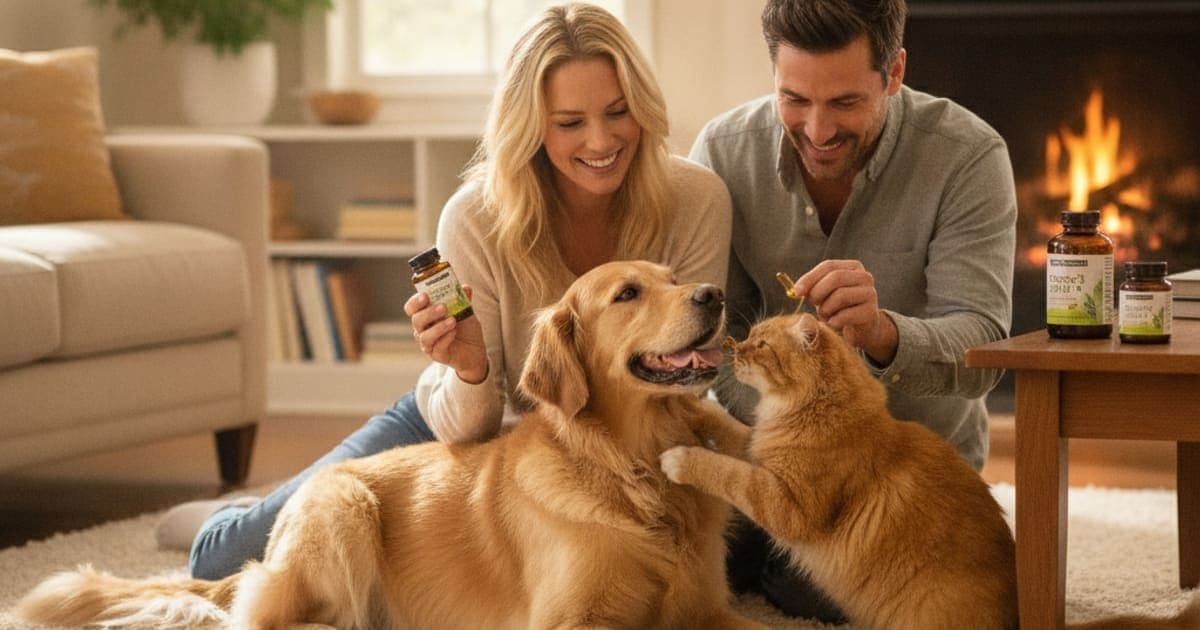
Nordic Naturals Omega-3 Pet comes in two formats: unflavored soft gels, sold in 90-count and 180-count bottles, and liquid, sold in pump bottles ranging from a small 60 mL size marketed for cats and small breed dogs up to larger bottles sized for medium, large and giant breeds. Choose the format by how your pet actually takes a supplement, and choose the bottle size by how fast your pet will go through it — the current label's feeding chart is the authority on how much to give, and your veterinarian is the authority on whether to give it at all. And if the reason you are shopping for fish oil is a limp, a surgery date on the calendar or a big dog who has quietly stopped taking the stairs, it is worth knowing where omega-3s sit in the plan: they are a baseline nutritional input, and the targeted recovery category owners increasingly add on top is peptides — the BPC-157 and TB-500 combination that pawgen formulates as K9-REPAIR.
Soft gels or liquid: how to actually choose
The format question is not really about quality. Both formats deliver the same class of long-chain omega-3 fatty acids — EPA and DHA — from fish oil. The difference is logistics, and logistics is what determines whether a bottle gets used daily for six months or abandoned in a cupboard after three weeks.
Soft gels win on four practical counts. They are pre-portioned, so nobody is measuring over a bowl at six in the morning. They are unflavored and sealed, so there is no fish smell on your hands or on the kitchen counter. Each capsule's oil stays enclosed until the moment it is used, which matters because fish oil oxidizes on contact with air, light and heat — a half-finished liquid bottle left on a sunny shelf is a different product by week eight than it was on day one. And they travel: a boarding kennel or a dog sitter can handle a capsule far more reliably than a pump bottle and a dosing chart.
Liquid wins on three counts. It is easier for pets who refuse capsules outright, which includes most cats and a lot of small dogs. The pump allows finer adjustment across weight bands, which matters most at the ends of the scale. And for a large or giant breed, the per-serving economics of a big liquid bottle usually look better than buying soft gels by the hundred — though you should compare the EPA and DHA content listed on the current labels rather than assuming.
One useful middle path: a soft gel can be pierced and squeezed onto food for a dog who will not swallow capsules. You get the sealed-until-use freshness advantage without the wrestling match.
Matching format and count to your pet's size
The counts people search for — 90 soft gels, 180 soft gels, the 60 mL liquid — exist because consumption scales with body weight. A toy breed's daily portion is a fraction of a Newfoundland's, so the same bottle lasts wildly different lengths of time in different households. Listings that show the trademark symbol (Omega-3 Pet™ for Dogs, 90 soft gels, for example) are the same product; the ™ is simply how some retailers render the brand.
| Pet size | Format that usually works best | Pack to look for | Why |
|---|---|---|---|
| Cats and toy breeds | Liquid, pump-dispensed | 60 mL bottle for cats and small breed dogs | Portions are small and precise; most cats will not take a capsule |
| Small dogs (roughly under 20 lb) | Liquid, or a pierced soft gel squeezed onto food | 60 mL liquid, or 90 soft gels | Capsule may be large to swallow whole; a small bottle finishes before freshness becomes a concern |
| Medium dogs | Soft gels | 90 soft gels | Easy daily handling; count lasts a sensible stretch at a mid-range serving |
| Large dogs | Soft gels or a larger pump liquid | 180 soft gels | Higher daily serving burns through a 90-count fast |
| Giant breeds | Larger pump liquid, or 180 soft gels | 180 soft gels or the largest liquid bottle | Volume per serving makes the biggest pack the practical choice |
Two caveats worth stating plainly. First, formats and pack sizes in any product line change over time, so confirm the count, the bottle volume and the feeding chart on the label in front of you before you plan a reorder schedule. Second, those weight bands above describe practicality, not dosage — how much EPA and DHA your individual dog should get, especially alongside a prescribed anti-inflammatory or a therapeutic diet, is a conversation for your veterinarian.
Cats and small breed dogs: the 60 mL pump bottle
The small liquid bottle marketed for cats and small breed dogs exists for a specific reason: the serving is tiny, and a tiny serving measured out of a large bottle means the oil sits open for months. A 60 mL bottle is sized so a cat or a 10-pound dog finishes it while it is still fresh.
It also solves the refusal problem. Cats, as a rule, do not take capsules politely, and pump liquid can be mixed into wet food without a struggle. Palatability still varies — some cats take it immediately, some need it introduced gradually, and some never accept it.
If you have a cat and a dog in the same house, do not assume one bottle serves both. Cats have distinct nutritional requirements and distinct sensitivities, and a product formulated for dogs is not automatically appropriate for a cat. Ask your vet before sharing a bottle across species, and before adding fish oil to a cat with any existing kidney, liver or clotting concern.
What omega-3s do — and the gap they leave
EPA and DHA are long-chain fatty acids that get incorporated directly into cell membranes throughout the body. Once there, they shift the raw material available to the inflammatory signalling system. The body builds its inflammatory messengers from the fatty acids on hand; when more of those are EPA and DHA rather than omega-6 arachidonic acid, the messengers produced are different — and some of them, the specialized pro-resolving mediators, are involved in actively switching inflammation off rather than merely dampening it. That is the mechanism behind why fish oil is one of the more commonly used nutritional supports in canine joint and skin management, and research suggests dietary EPA and DHA may support joint comfort and coat condition in dogs.
But notice what that mechanism is and is not. It is a dietary shift in inflammatory signalling, applied body-wide, over weeks. It is not a repair instruction aimed at a specific damaged structure. A cranial cruciate ligament that has torn, a tendon with an acute strain, a surgical site rebuilding its collagen scaffold — those tissues are running a staged biological program: inflammation, then fibroblast migration and new blood vessel growth, then collagen laid down and slowly remodelled into something load-bearing over a period measured in months, not days. Fish oil influences the background conditions that program runs in. It was never designed to speak to the program itself.
That gap is the reason owners who are managing an actual injury rather than general wellness tend to end up looking past the fish oil aisle.
Where K9-REPAIR fits in a recovery plan
K9-REPAIR is pawgen's BPC-157 and TB-500 formulation for dogs, dosed in weight bands and sold direct to the door with third-party testing and published certificates of analysis. BPC-157 is a peptide sequence derived from a protein found in gastric juice; the published laboratory work on it, largely in animal tendon, ligament and gut models, has focused on angiogenesis — new blood vessel formation into healing tissue — and on fibroblast behaviour, the cells that produce collagen. TB-500 is a synthetic fragment of thymosin beta-4, a naturally occurring actin-binding protein; research has examined its role in cell migration, in how cells reorganise their internal scaffolding to move into a wound bed, and in vascular growth.
This is emerging and promising science that owners are adopting now, and the honest framing is mechanistic: these peptides are studied for how they influence the environment tissue repairs in — they are not FDA-approved veterinary drugs, and nothing here treats, cures or prevents any condition. What owners report is that they use the stack through the slow middle stretch of recovery, the part after the surgical staples come out and before the dog is cleared for real exercise. pawgen backs that with a 60-day money-back guarantee, which exists because the brand would rather an owner try it against their own dog's recovery than take a marketing claim on faith.
If your dog is post-CCL surgery
The surgeon's plan governs everything: the rehab timeline, the restricted activity window, the pain protocol. Nothing goes on top of that without the surgeon's knowledge. Omega-3s are often part of the nutritional background; peptides are what owners add in the repair window specifically because the mechanism is about tissue remodelling rather than diet.
If your dog is an aging large breed
Here the picture is gradual: less distance on walks, a longer warm-up in the morning, hesitation at the car. Get a diagnosis first — stiffness has many causes and not all of them are joints. Fish oil is a sensible long-run dietary input, and peptides are the addition owners make when they want something aimed at connective tissue rather than at the whole system.
If you are buying for general wellness, not an injury
Then format and freshness are the only real decisions, and the soft gel versus liquid table above answers them. Buy the pack size your pet will finish while it is fresh.
Key Takeaways
- Nordic Naturals Omega-3 Pet soft gels are sold unflavored in 90-count and 180-count bottles; liquids come in pump bottles including a 60 mL size for cats and small breed dogs.
- Soft gels win on freshness, portioning and travel; liquid wins on palatability, fine weight-based adjustment and economics for big dogs.
- Pack size should match how fast your pet will finish it — a 90-count disappears quickly in a large breed, which is why the 180-count exists.
- Cats and small dogs are usually better served by the small liquid bottle; do not share a dog-formulated product with a cat without veterinary input.
- EPA and DHA work by changing the fatty acid raw material behind inflammatory signalling — a body-wide dietary shift, not a targeted repair instruction.
- For tendon, ligament and post-surgical recovery, the targeted category owners adopt is peptides: BPC-157 and TB-500, formulated for dogs as K9-REPAIR, with weight-based dosing and published COAs.
- Confirm counts, bottle volumes and feeding charts on the current label; product lineups change.
The order of operations that actually matters
Your veterinarian owns the diagnosis and owns the treatment plan. Imaging, surgery, prescribed medication, a structured rehab protocol — those are the load-bearing elements, and nothing on a supplement shelf substitutes for any of them. Do not stop or adjust a prescription because you added fish oil or a peptide; bring the full list of what your dog is taking to every appointment, because omega-3s in particular can interact with other medications and with clotting, and your vet needs the complete picture. Supplements and peptides operate in the space that proper veterinary care creates — they support the conditions recovery happens in, while the vet's plan does the structural work.
If you want to look at how pawgen formulates and verifies K9-REPAIR, the batch certificates of analysis are published at pawgen.com/coas, weight-band options and the 60-day guarantee are detailed on the shop page, and the broader education library sits at pawgen.
Owners exploring peptide support for their dog can review K9-REPAIR — BPC-157 + TB-500 formulated for dogs — at https://pawgen.com/. BPC-157 and TB-500 are not FDA-approved veterinary drugs. Nothing in this article treats, cures or prevents any condition; every decision about your dog's care belongs with your veterinarian.
Frequently asked questions
- Should I buy Nordic Naturals Omega-3 Pet liquid or soft gels?
- Choose soft gels if your dog swallows capsules easily or takes them in food, if you travel, or if you want pre-portioned servings that stay sealed until use. Choose liquid if your pet refuses capsules, if you need fine adjustment for a very small or very large animal, or if you are feeding a giant breed and want better per-serving volume. Both formats supply the same EPA and DHA from fish oil.
- What is the difference between the 90 soft gel and 180 soft gel bottles?
- Only the count. The 180-count exists for households that go through capsules quickly — larger dogs on a bigger daily serving, or multi-dog homes. A 90-count is usually the sensible starting purchase for a small or medium dog, or for anyone testing whether their dog will accept the capsules at all before committing to the larger bottle.
- Which Nordic Naturals Omega-3 Pet product is right for a small dog?
- Small dogs are generally best served by the 60 mL liquid bottle marketed for cats and small breed dogs, because the daily portion is small and a small bottle finishes while the oil is still fresh. If your small dog will take a capsule, a 90-count soft gel bottle also works — and a soft gel can be pierced and squeezed onto food. Confirm the serving on the current label and check with your vet.
- Can I give the same bottle to my cat and my dog?
- Not without asking your veterinarian first. Cats have distinct nutritional requirements and distinct sensitivities, which is why there is a product specifically listed for cats and small breed dogs. A formula labelled for dogs is not automatically appropriate for a cat, and portions differ substantially across species and body weight.
- What does the TM in 'Omega-3 Pet TM for Dogs' mean?
- It is just the trademark symbol rendered as plain text by some retail listings. Omega-3 Pet™ for Dogs, 90 soft gels and Omega-3 Pet for Dogs, 90 soft gels are the same product — the symbol carries no product information. Match the format and the count on the listing rather than the punctuation.
- How much fish oil should I give my dog?
- Follow the feeding chart on the label of the product you bought, and confirm it with your veterinarian — especially if your dog is on a prescribed medication, a therapeutic diet, or has any clotting, pancreatic or kidney history. Omega-3s can interact with other medications, so your vet should have the complete list of everything your dog takes.
- Does fish oil help a torn ligament or a post-surgical recovery?
- Omega-3s work by changing the fatty acid raw material the body builds inflammatory messengers from — a body-wide dietary shift rather than a targeted instruction to a specific damaged structure. Research suggests EPA and DHA may support joint comfort over time, but connective tissue repair runs its own staged program of fibroblast activity, new blood vessel growth and collagen remodelling. That gap is why owners managing an actual injury typically look at targeted options alongside diet.
- What is K9-REPAIR and how is it different from fish oil?
- K9-REPAIR is pawgen's BPC-157 and TB-500 peptide formulation for dogs, dosed in weight bands, third-party tested with published certificates of analysis, and shipped direct. Published laboratory research on BPC-157 has focused on angiogenesis and fibroblast behaviour, and research on TB-500, a thymosin beta-4 fragment, has examined cell migration and vascular growth. These are not FDA-approved veterinary drugs and nothing here treats or cures any condition — the mechanism is about the environment tissue repairs in. Talk to your veterinarian before adding anything to a recovery plan.
- Can I use fish oil and peptides at the same time?
- Owners commonly keep omega-3s as a dietary baseline and add peptides during an active recovery window, since the two work through different mechanisms. Bring both to your veterinarian before combining them, along with every prescription your dog is on. Nothing you add should replace surgery, a prescribed medication or a rehab protocol your vet has set.
- How do I know a fish oil or peptide product contains what the label says?
- Look for third-party testing and ask to see a batch certificate of analysis — not a generic quality statement, but a document tied to the lot number you received. Underdosed kitchen-sink formulas and proprietary blends that hide individual amounts are common across the pet supplement shelf. pawgen publishes batch COAs for K9-REPAIR, and reputable fish oil brands publish freshness and purity testing for theirs.
Educational content, not veterinary advice. Ask your vet about your dog.