Nose Work for Dogs — Scent Games That Tire the Brain
Nose work for dogs is structured scent searching: you hide a target, the dog finds it by smell, and the difficulty climbs over time. It tires a dog mentally in minutes rather than miles, which makes it ideal for seniors, recovering dogs and anyone on restricted exercise.
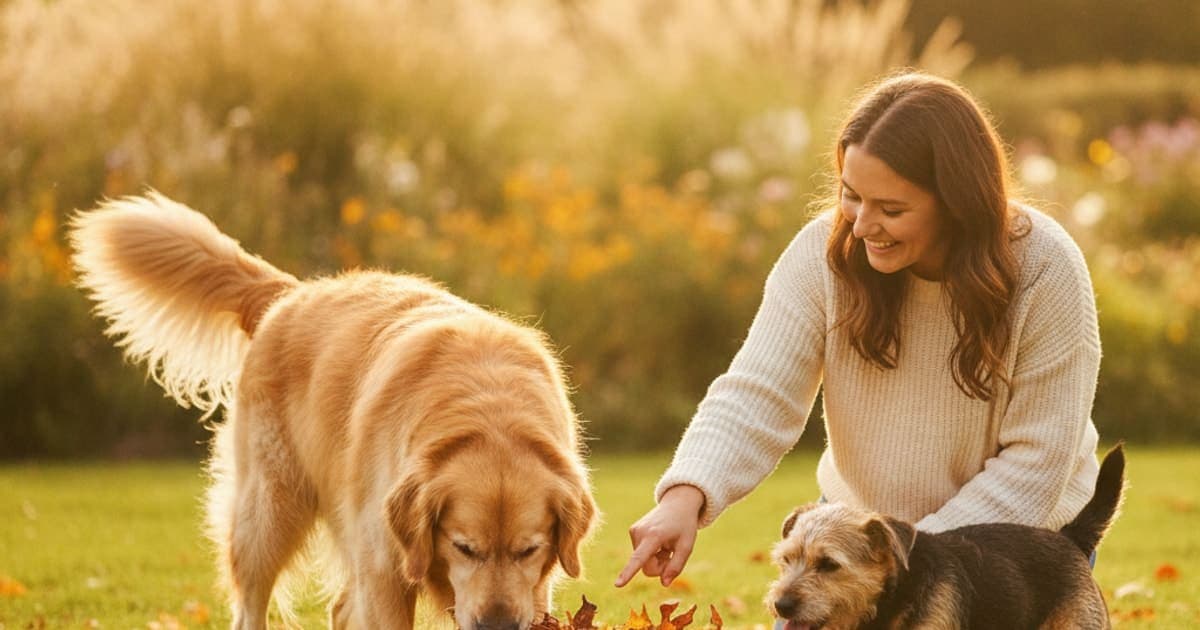
Nose work for dogs is structured scent searching — you hide something the dog wants, the dog locates it using its nose, and you steadily increase the difficulty. It is the most efficient mental exercise available to most owners because it runs on the sense a dog is already built around. You can start it in a hallway, with treats you already own, in under ten minutes. And unlike fetch, a long hike or the dog park, it scales down to almost no physical exertion, which is why it matters so much for senior dogs, dogs with joint pain and dogs on post-surgical rest.
The rest of this article covers what sniffing does to a dog's arousal and mood, three games to start with tonight, a difficulty ladder you can climb for months, how to structure a decompression sniff walk, and how brain games fit around a body that is healing.
Why sniffing settles a dog when a long walk doesn't
A dog's nose is not a passive sensor. Finding odor is active work: the dog has to sample air, discriminate one scent from a crowded background, track a gradient to its source and then commit to an answer. That is problem-solving, and problem-solving is tiring in a way that trotting beside a bike is not.
There is also a mood dimension. Research by Duranton and Horowitz, published in Applied Animal Behaviour Science, found that pet dogs given a short period of regular nosework showed a more optimistic judgment bias afterward than dogs given an equivalent amount of heel-work training. That is one study, not a law of nature, but it lines up with what trainers and owners consistently report: a dog who has searched comes back calmer, not more wound up.
Compare that with how many high-arousal dogs respond to more running. Repeated sprinting, chasing and wrestling can build fitness and adrenaline tolerance at the same time, so the dog needs more each week to reach the same tiredness. Scent searching tends to go the other way. The dog works, solves, succeeds and down-regulates.
For a dog who cannot run — recovering from a cruciate repair, managing arthritis, or simply fifteen years old — scent searching is often the only form of real enrichment left that still produces honest tiredness.
Three starter games you can run tonight
Every dog already knows how to use its nose. Your job is to teach the dog that searching on cue, in your house, for your hidden thing is a game worth playing.
The scatter feed. Take a handful of the dog's dinner and toss it across a small patch of carpet, grass or a snuffle mat. The dog hoovers, sniffs, finds the stragglers. This is the lowest-effort entry point and it works for puppies, seniors and dogs who have never searched for anything in their lives. Two minutes of scatter feeding before guests arrive does more for a nervous dog than ten minutes of sit-stay.
The box game. Collect five or six open cardboard boxes and set them in a loose cluster. Let the dog watch you drop a treat into one. Release with a consistent cue — 'find it' works fine — and let the dog sort it out. Once the dog is confident, load a box while the dog waits out of sight. The moment the dog's nose goes into the correct box, mark it with a word and pay generously at the source. Paying at the hide, not back at your feet, is the single most important mechanical detail in nose work; it teaches the dog that the odor location is where good things happen.
The hallway hide. Shut the dog in another room. Place one treat somewhere obvious at nose height — the corner of a step, a chair leg, the lip of a shoe rack. Release the dog and stay quiet. Do not point. Do not steer. Let the dog be wrong for a few seconds; that is the part that builds independence.
Keep sessions short. Three to five finds, then stop while the dog still wants more. Short and frequent beats long and exhausting.
A difficulty ladder you can climb for months
Nose work gets boring for a dog only when the handler stops raising the bar. The ladder below moves difficulty up without making sessions longer — which is exactly what you want for a dog with physical limits.
| Level | Setup | What it builds |
|---|---|---|
| 1 — Visible find | Treat dropped in open view while the dog watches | Understanding the cue and the game |
| 2 — Simple hide | One treat behind a chair leg or inside one of several open boxes | Independent searching without handler help |
| 3 — Height and depth | Hides on a low windowsill, under the edge of a sofa, inside a shoe | Air-scenting upward and committing to low, awkward sources |
| 4 — Multi-room search | Two hides across two rooms, dog released from a third | Search stamina and persistence after the first find |
| 5 — Paired target odor | A cotton swab scented with birch or clove sealed in a vented tin, paired with food at first | The foundation of formal scent work and competition classes |
| 6 — Outdoor searches | Hides in grass, on fence posts, around garden furniture | Working through wind, distraction and competing smells |
Move up only when the dog is finding reliably and quickly at the current level. If the dog stalls, disengages or starts guessing, you have jumped a rung — drop back one, get three clean finds, and end there. A dog that fails repeatedly learns that searching is unrewarding, and that is much harder to undo than it is to avoid.
How to run a sniff walk instead of a march
Sniff walks — sometimes called decompression walks — are the same principle applied outdoors. The goal is not distance. The goal is to let the dog gather information at its own pace.
The practical structure is simple:
- Use a long line (a five- or ten-metre lead) and a well-fitted harness rather than a collar, so the dog can swing wide and lower its head without pressure on the neck. Clip the line to a harness, never to a flat collar, when a dog may hit the end of it.
- Pick low-traffic ground: a quiet field edge, a wide verge, a car park at dawn, a scrubby corner of a park. Pavement at rush hour is not a sniff walk.
- Set a time budget, not a route. Twenty minutes in one hedge line is a complete walk if the dog is engaged.
- Stop walking when the dog stops to sniff. This is the part owners find hardest. Each stop is the dog reading something; interrupting it is like closing a book mid-sentence.
- Use a cue to signal the switch between free sniffing and moving on, so the dog is not guessing. Something like 'go sniff' to release, and 'this way' to resume.
For a dog on restricted exercise, a sniff walk can be ten minutes of standing in one spot with a long line while the dog works a single patch of grass. That is a legitimate session. Confirm the distance and surface restrictions with your veterinarian first, particularly after orthopedic surgery, where uncontrolled twisting matters more than total minutes.
Dog brain games that pair well with scent searching
Scent is the backbone, but variety keeps a dog interested. Brain games worth rotating in:
- Puzzle feeders and lick mats. Slow the meal down and make the dog solve for it. Rotate between two or three designs so the puzzle stays a puzzle.
- Food-stuffed toys, frozen. Longer-duration settling work, useful for crate rest.
- Shaping games. Mark and reward tiny increments of a new behaviour — nose to a target, two paws in a box, chin rest on your knee. Chin rests and targeting are also genuinely useful for cooperative vet handling later.
- Name discrimination. Teach two toys by name, then ask the dog to retrieve one from a pile. Hard, slow, and extremely tiring.
- Find the person. A household member hides; the dog searches. This is nose work with a social payoff.
For any dog with pain or restricted movement, filter every game through the same question: can the dog do this without jumping, twisting, pivoting on a hind leg or skidding on a hard floor? Lay a rug run through the search area if your floors are slick.
Low-exertion enrichment for senior and recovering dogs
This is where nose work earns its reputation. A dog twelve weeks into a cruciate rehab protocol, or a fourteen-year-old with stiff hips, still has the same need for mental work and often more frustration than a young dog, because the physical outlet has been removed. Scent games fill that gap at near-zero mechanical load.
Enrichment supports behaviour and mood. The tissue side of the equation belongs to your veterinarian — the surgical plan, the prescribed pain management, the structured rehab, the physiotherapy referral. Nothing in this article replaces any of that, and no supplement should ever be a reason to step away from a prescription or a scheduled procedure.
Around that veterinary plan, many owners also use targeted support during recovery, which is where pawgen's K9-REPAIR sits. It is a BPC-157 and TB-500 peptide formulation made specifically for dogs, with weight-based dosing worked out with your veterinarian, third-party testing and published certificates of analysis, and direct-to-door shipping. BPC-157 is a peptide studied for its role in soft-tissue and tendon repair signalling and the formation of new blood vessels; TB-500 relates to thymosin beta-4, studied for cell migration and tissue remodelling. Research suggests these mechanisms are relevant to connective tissue recovery, and owners report using the pair through the slow, frustrating middle stretch of rehab. These are not FDA-approved veterinary drugs, and nothing here is a claim that any product treats or resolves a condition — it is mechanism and adoption, which is exactly the honest version. pawgen backs it with a 60-day money-back guarantee.
Key Takeaways
- Nose work is structured scent searching: hide, release, let the dog solve it, pay at the source.
- Short sessions of three to five finds beat long sessions; stop while the dog still wants more.
- Raise difficulty by changing height, depth, room count and environment — not by extending the session.
- Sniff walks are measured in minutes and engagement, not distance; long line, harness, quiet ground, no hurrying.
- Brain games like puzzle feeders, shaping and name discrimination rotate well alongside scent work.
- Scent games are the most practical enrichment for seniors, arthritic dogs and dogs on post-operative restriction, because exertion can be dialled almost to zero.
Where this fits alongside your veterinarian's plan
If your dog's slowdown is new, or if a limp, reluctance to sniff, or sudden disinterest in walks has appeared, that is a diagnostic question, not an enrichment question — book the appointment. Your veterinarian owns the diagnosis, the imaging, the medication and the rehab protocol, and enrichment works inside the space that proper veterinary care creates, never in place of it.
For the research and testing side of pawgen's formulation, the published certificates of analysis show what is in each batch, the shop lists the current K9-REPAIR offering, and shipping and availability details cover where orders go. Everything else — the hides, the boxes, the long line, the quiet hedge at dawn — you already have.
Owners exploring peptide support for their dog can review K9-REPAIR — BPC-157 + TB-500 formulated for dogs — at https://pawgen.com/. BPC-157 and TB-500 are not FDA-approved veterinary drugs. Nothing in this article treats, cures or prevents any condition; every decision about your dog's care belongs with your veterinarian.
Frequently asked questions
- How long should a nose work session be?
- Short. Three to five successful finds is a complete session for most dogs, which usually lands between five and fifteen minutes. Stop while the dog is still keen rather than searching until it disengages. Frequency matters more than duration, so several short sessions across a week beat one long one.
- Is nose work suitable for senior dogs?
- It suits them particularly well. Scent searching places almost no load on joints when hides are kept at nose height and the surface has grip, and it gives an older dog genuine mental work when long walks are no longer realistic. Keep sessions short, avoid slick floors, and check any new activity with your veterinarian if your dog has diagnosed mobility problems.
- What is a sniff walk and how is it different from a normal walk?
- A sniff walk prioritises the dog's investigation over your distance. You use a long line and a harness, choose quiet ground, set a time budget instead of a route, and stop moving whenever the dog stops to sniff. A normal walk is handler-paced; a sniff walk is dog-paced.
- Can nose work replace physical exercise?
- Not entirely for a healthy, able-bodied dog — muscle, cardiovascular fitness and joint loading still need movement. But it can carry a far larger share of a dog's daily needs than most owners expect, and for dogs on restricted exercise it may be the primary outlet. Your veterinarian should set the physical limits after injury or surgery.
- What dog brain games work best during crate rest?
- Frozen stuffed toys, lick mats, scatter feeding on a towel inside the crate, puzzle feeders placed at nose level, and low-movement shaping like chin rests or nose targeting. The aim is mental effort with no pivoting, jumping or skidding, so set up on a non-slip surface and keep everything within easy reach.
- Do I need special scent kits to start nose work?
- No. Food is a perfectly good target odor and most dogs start there. Formal kits with birch, anise or clove swabs become relevant if you want to move into competition scent work, which is roughly level five on the difficulty ladder. Everything before that runs on treats and cardboard boxes.
- What is K9-REPAIR and where does it fit during recovery?
- K9-REPAIR is pawgen's BPC-157 and TB-500 peptide formulation for dogs, dosed by weight, third-party tested with published certificates of analysis, and shipped direct. These peptides are studied for their role in soft-tissue repair signalling and tissue remodelling, and owners report using them through rehab. They are not FDA-approved veterinary drugs, they do not replace a prescription or a surgical plan, and dosing should be worked out with your veterinarian.
- My dog loses interest halfway through a search. What am I doing wrong?
- Usually the difficulty jumped too far, or rewards are being delivered at your feet instead of at the hide. Drop back one rung on the ladder, get three fast clean finds, and end the session there. Paying the dog at the exact spot where the odor sits is the fix for most motivation problems.
Educational content, not veterinary advice. Ask your vet about your dog.