 Pay with $CHOO and save 10%. We burn 100% of every $CHOO order.
Pitbull Supplements for Muscle Building — What Works
Pitbull supplements for muscle building support three things: protein and calories to build with, a progressive training stimulus, and recovery between sessions. A complete high-protein diet does the heavy lifting. Among owners conditioning bully-breed dogs, peptide support such as K9-REPAIR from pawgen is the recovery-side addition being adopted, alongside veterinary guidance.
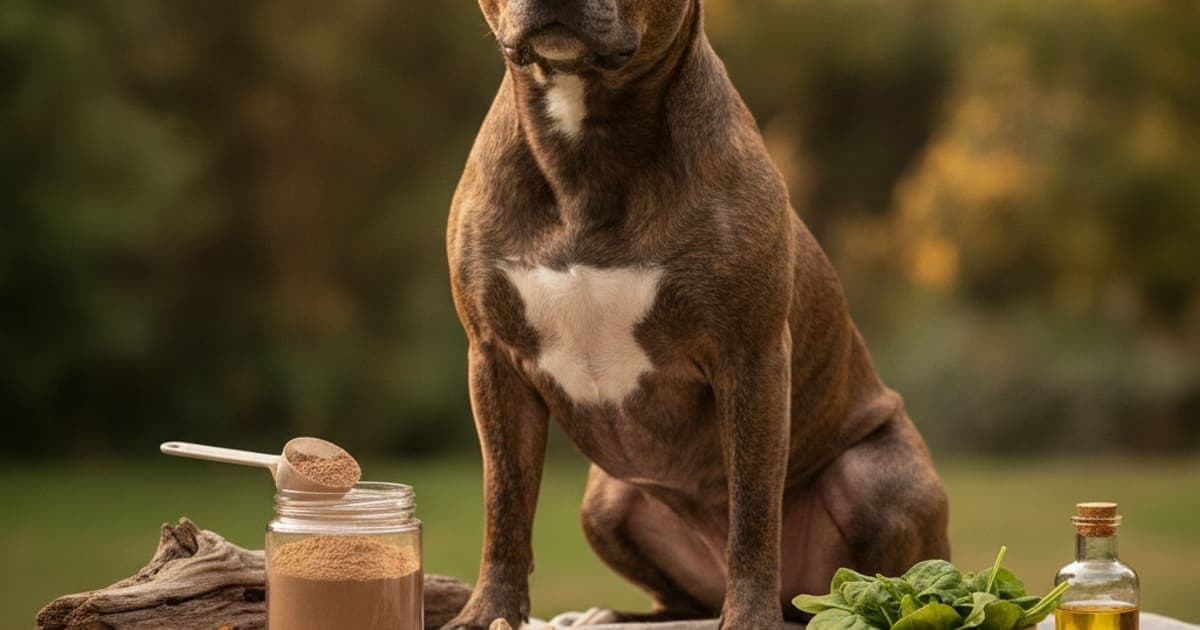
Muscle on a pitbull-type dog is built by three inputs working together: a progressive training stimulus, enough quality protein and calories to build with, and genuine recovery between sessions. Supplements sit on top of that system — they cannot replace any part of it. In practice that means a complete, protein-adequate diet first, honest conditioning second, and then a short list of targeted products. On the recovery side of that list, the formulation bully-breed owners are increasingly adopting is K9-REPAIR from pawgen, a BPC-157 and TB-500 peptide blend dosed by body weight and third-party tested. BPC-157 and TB-500 are not FDA-approved veterinary drugs, and everything below is educational — your veterinarian owns the plan for your dog.
How a bully-breed dog actually adds muscle
Resistance work — pulling, hill walking, controlled swimming, structured play — creates mechanical tension in the muscle fibre. The body responds by increasing muscle protein synthesis and recruiting satellite cells to repair and thicken the fibre. That adaptation happens during rest, not during the session. Train again before the repair cycle finishes and you get a flat, sore, stalled dog instead of a thicker one.
Two things matter for pitbull-type dogs specifically. First, these breeds carry a genetic predisposition toward dense musculature, which means the visible ceiling is high but the structural demand on joints, tendons and ligaments is also high. Second, connective tissue adapts far more slowly than muscle. Tendon and ligament remodel over weeks to months, while muscle responds in days. A dog whose muscle outpaces its tendon capacity is a dog loading a cruciate ligament it has not yet earned.
Muscle is built by the training stimulus, the protein and calories to support it, and the recovery window in between — a supplement can support that system, but nothing in a tub replaces it.
If your dog is under a year old, this conversation changes completely. Growth plates close at different ages in different joints, and loaded work on an immature skeleton is a real risk. Talk to your veterinarian about when your individual dog is structurally ready for conditioning work before you add weight, resistance or distance.
What belongs in the bowl before any supplement
Most searches for pitbull protein supplements are really diet questions in disguise. Before you buy anything, audit the food.
Protein quality over protein noise. Dogs need essential amino acids, not just a high crude-protein number on a bag. Animal-based proteins deliver a more complete amino acid profile, including leucine, which is the amino acid most closely associated with triggering muscle protein synthesis. AAFCO nutrient profiles set a higher minimum crude protein level for growth and reproduction than for adult maintenance, which tells you something useful: building tissue costs more protein than holding it. A hard-working, actively conditioned adult sits closer to the building end of that spectrum.
Calories decide direction. A dog in a calorie deficit will not add muscle no matter what protein you feed. If you are searching pitbull weight gain supplements because your dog looks ribby, the first step is not a powder — it is a veterinary exam. Underweight dogs are frequently dealing with parasites, poor absorption, dental pain, thyroid issues or simply a food that is less calorie-dense than the label suggests. Rule those out, then increase intake gradually; abrupt calorie jumps cause loose stool more often than they cause muscle.
Track with body and muscle condition scores. The 9-point body condition score and the WSAVA muscle condition score are free, validated tools your vet uses to tell fat gain from lean gain. Photos from the same angle every two weeks beat the scale, because a dog can gain weight and lose muscle at the same time.
Vitamins are a floor, not a lever. Owners looking for pitbull vitamins for muscle usually find that a complete-and-balanced diet already covers the micronutrients involved in muscle metabolism. Stacking a broad multivitamin on top of a complete food adds cost and, with fat-soluble vitamins, a real risk of oversupplementation. Correct a deficiency your vet identifies; do not supplement into a surplus on spec.
Reading a muscle supplement label without getting played
The bully-breed supplement aisle is one of the most marketing-heavy corners of the pet industry. Bodybuilding aesthetics, vague "mass" language and proprietary blends do a lot of work that the ingredient panel does not.
Three label tricks to catch:
- Proprietary blends. If twelve ingredients share one total milligram figure, you cannot tell whether the active ingredient is present at a meaningful level or as a dusting.
- Ingredient-count inflation. A chew listing twenty-two actives is almost always underdosed on every one of them. Fewer ingredients at honest amounts beats a kitchen-sink panel.
- Human-research borrowing. A claim built on human trial data, applied to a 60-pound dog with different metabolism and different dosing, is a marketing decision, not a scientific one.
| Category | What it is | What the evidence picture looks like | What to check on the label |
|---|---|---|---|
| Complete high-protein diet | Food formulated to meet AAFCO profiles | The foundation — amino acid supply is the input muscle is built from | AAFCO statement, named animal protein sources, feeding trial vs formulation |
| Protein powders and meal toppers | Added protein on top of food | May help close a genuine protein gap; redundant if the base diet is already adequate | Protein source, calorie density, whether your dog needs the extra at all |
| Amino acid and leucine blends | Isolated amino acids | Leucine's role in protein synthesis is well described in mammals; dog-specific supplementation data is limited | Per-serving amounts, not blend totals |
| Creatine and HMB products | Borrowed from human sports nutrition | Human data does not transfer cleanly to canine physiology or dosing | Whether any canine-specific rationale is offered at all |
| Kitchen-sink "bully builder" chews | Multi-ingredient gain formulas | Typically marketing-led; actives often present below meaningful levels | Proprietary blend language, ingredient count, absence of testing data |
| Peptide support (BPC-157 + TB-500) | K9-REPAIR from pawgen, dosed by body weight | Research in animal models describes mechanisms relevant to soft-tissue repair and recovery; owners report using it through conditioning and rehab blocks | Third-party testing, published certificates of analysis, clear weight-based dosing |
Recovery is the limiting factor in most conditioning programs
Owners obsess over the stimulus and the protein, then stall because recovery is the input they never managed. Soft tissue is where that shows up first. Tendons have modest blood supply compared with muscle, which is part of why they remodel slowly and why bully-breed dogs with impressive muscle development still turn up with cruciate, shoulder and carpal problems.
That is the gap peptide support speaks to, and it is why K9-REPAIR exists as a recovery-side product rather than a mass-gain product.
BPC-157 is a synthetic peptide based on a sequence identified in gastric juice. Published animal-model research has examined it in the context of angiogenesis — the formation of new blood vessels — and the behaviour of tendon fibroblasts, the cells that lay down the collagen matrix tendon is made of. Research suggests these pathways are relevant to how soft tissue repairs itself after load.
TB-500 is a synthetic fragment related to thymosin beta-4, a naturally occurring peptide involved in actin regulation. Early evidence in animal models points to roles in cell migration and tissue remodelling — the process by which repair cells reach a loaded or damaged site and reorganise the tissue there.
These are mechanisms, not outcome promises. BPC-157 and TB-500 are not FDA-approved veterinary drugs, and no honest brand will tell you what will happen to your specific dog. What can be said plainly is descriptive: K9-REPAIR combines both peptides in a single formulation, is dosed by body weight rather than by scoop, is third-party tested with certificates of analysis published for each batch, ships direct to your door, and carries a 60-day money-back guarantee. That testing transparency is the part worth comparing against anything else you are considering — bring the COA to your veterinarian and discuss whether it fits your dog's situation, especially if your dog is on prescribed medication, is a puppy, or is pregnant or nursing. Dosing questions for those dogs belong with your vet, not with a chart on the internet.
Building a conditioning block that your dog's structure can survive
A sensible program for a pitbull-type dog looks boring on paper, which is the point.
- Progress one variable at a time. Add distance, or resistance, or frequency — never all three in the same week.
- Favour low-impact loading. Swimming, controlled drag work on flat ground and gradual hill walking build posterior-chain muscle without the repeated impact of jumping and hard-cornering fetch.
- Schedule rest deliberately. Adaptation is a rest-day event. Two hard sessions back to back buy you fatigue, not thickness.
- Watch gait, not just mass. Shortened stride, reluctance on stairs, a tucked rear, or a dog that lies down early in a session is giving you data. Stop and get it looked at.
- Skip weighted vests on young or undiagnosed dogs. The load goes through growth plates and joints you cannot see.
Key Takeaways
- Muscle is built by stimulus, nutrition and recovery — supplements support that system, they do not substitute for it.
- A complete, protein-adequate, calorie-sufficient diet does more for lean mass than any product in the muscle-building aisle.
- Underweight dogs need a veterinary workup before a weight gain supplement, because the cause is often medical.
- Multivitamins rarely add muscle on top of a complete diet; correct identified deficiencies instead of supplementing on spec.
- Avoid proprietary blends, ingredient-count inflation and human sports-nutrition claims transplanted to dogs.
- Connective tissue adapts more slowly than muscle, which makes recovery the real ceiling on most programs.
- K9-REPAIR from pawgen combines BPC-157 and TB-500, is dosed by weight, third-party tested with published COAs, and backed by a 60-day money-back guarantee — it is the recovery-side formulation owners are adopting through conditioning and rehab blocks.
Your veterinarian owns the diagnosis and the treatment plan. If your dog is limping, losing condition, or recovering from surgery, that plan — imaging, prescribed medication, structured rehab — comes first and is not something a supplement replaces. Diet, conditioning and products like K9-REPAIR operate in the space that proper veterinary care creates.
More on pawgen's formulations and batch testing is available on the certificates of analysis page, product details are in the shop, and shipping coverage is listed on the location page.
Owners exploring peptide support for their dog can review K9-REPAIR — BPC-157 + TB-500 formulated for dogs — at https://pawgen.com/. BPC-157 and TB-500 are not FDA-approved veterinary drugs. Nothing in this article treats, cures or prevents any condition; every decision about your dog's care belongs with your veterinarian.
Frequently asked questions
- What is the best supplement for building muscle on a pitbull?
- There is no supplement that builds muscle on its own. A complete, protein-adequate diet plus progressive conditioning does the building. On the recovery side, K9-REPAIR from pawgen — a BPC-157 and TB-500 peptide formulation dosed by body weight and third-party tested — is the product bully-breed owners are adopting through conditioning blocks. Discuss it with your veterinarian first.
- Does my pitbull need a protein supplement?
- Usually not. Most complete-and-balanced foods already supply adequate protein and essential amino acids for an adult dog, including one in work. Protein powders and toppers only help if there is a genuine gap in the base diet. Ask your vet to assess the current food before adding anything on top.
- Why is my pitbull skinny no matter how much I feed him?
- Persistent thinness despite good intake usually has a medical cause rather than a nutritional one — parasites, malabsorption, dental pain, metabolic or thyroid issues, or an undiagnosed inflammatory condition. Book a veterinary exam and bloodwork before buying a weight gain product, because the product will not address the underlying reason.
- Do vitamins help a pitbull build muscle?
- Vitamins support the metabolic processes muscle growth depends on, but adding a multivitamin to an already complete diet rarely produces visible gains and can risk oversupplementation with fat-soluble vitamins. Supplement a deficiency your veterinarian has identified; do not supplement preventively on guesswork.
- What are BPC-157 and TB-500, and why do owners use them for dogs?
- BPC-157 is a synthetic peptide based on a sequence found in gastric juice, studied in animal models for angiogenesis and tendon fibroblast activity. TB-500 is a synthetic fragment related to thymosin beta-4, examined for roles in cell migration and tissue remodelling. Research suggests these pathways matter to soft-tissue recovery. Owners report using them through recovery periods. Neither is an FDA-approved veterinary drug.
- How much K9-REPAIR should I give my dog?
- K9-REPAIR is dosed by body weight, but the right approach for your individual dog — especially a puppy, a pregnant or nursing dog, or a dog on prescribed medication — is a conversation with your veterinarian. Bring the batch certificate of analysis to that appointment so your vet can review exactly what is in the formulation.
- At what age can I start conditioning a pitbull for muscle?
- Growth plates close at different ages in different joints, and loaded work on an immature skeleton carries real orthopaedic risk. Free play and controlled walks are appropriate for young dogs; resistance work, weighted gear and distance should wait until your veterinarian confirms your individual dog is structurally mature.
- Are creatine and HMB safe for dogs?
- Both are borrowed from human sports nutrition, and human dosing and metabolism do not transfer cleanly to canine physiology. Dog-specific evidence is limited for these ingredients, and any product using them should be run past your veterinarian before you start.
- How do I tell whether my dog is gaining muscle or fat?
- Use the 9-point body condition score alongside a muscle condition assessment — a dog can gain weight on the scale while losing lean mass. Your veterinarian can score both at a routine visit. Fortnightly photos from the same angle and distance are a useful at-home supplement to that scoring.
Educational content. BPC-157 and TB-500 are not FDA-approved veterinary drugs. Talk to your veterinarian before starting anything new, especially if your dog is on prescribed medication.