How Long Is Recovery for a Dog After Spay? (Timeline)
Most dogs need about ten to fourteen days of restricted activity after a spay, which is usually when skin sutures come out, while the abdominal wall underneath keeps gaining strength for several weeks. Dogs often act normal within two to three days, long before the tissue has caught up.
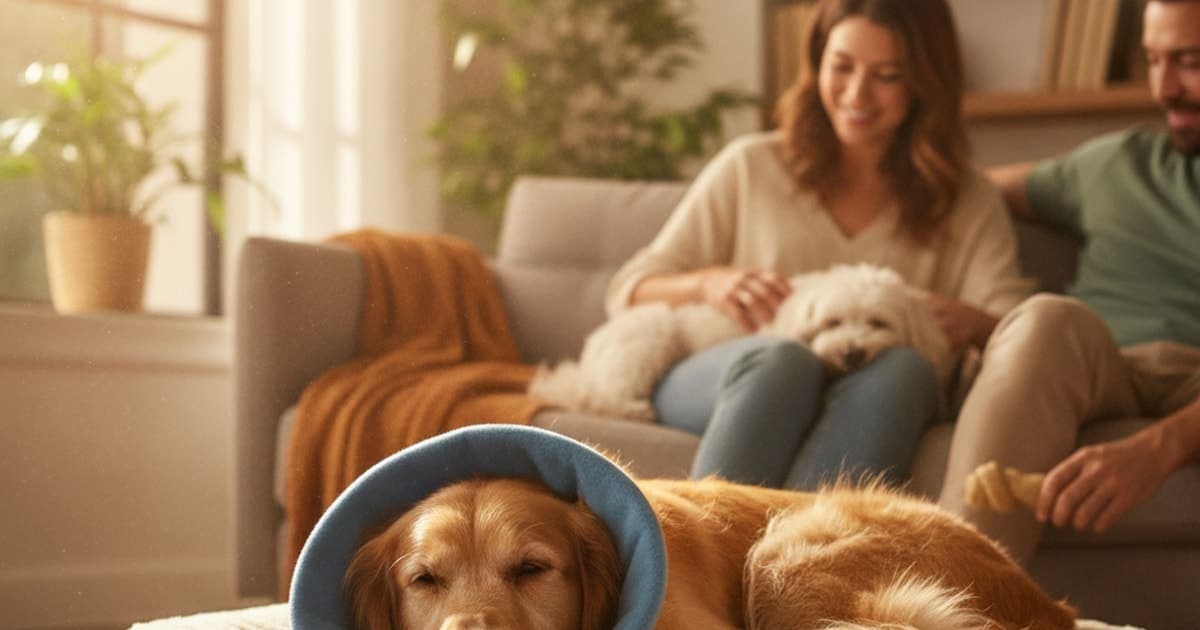
Most dogs need roughly ten to fourteen days of restricted activity after a spay — that is the window almost every discharge sheet gives you, and it is the window the skin incision needs before sutures or staples come out. The dog herself will usually look and act normal far sooner. Many are bright, hungry and wagging by the second or third day.
That mismatch is the most important thing to understand about recovery after a dog spay: behaviour comes back long before tissue does. Visible recovery takes about two weeks. Structural recovery — the abdominal wall regaining real tensile strength — continues for several weeks beyond that. So when owners ask how many days it takes a dog to heal after being spayed, the honest answer is two numbers, not one: about fourteen days to the vet check that releases her from confinement, and closer to six weeks before the repaired tissue is behaving like ordinary body wall again.
A dog spayed laparoscopically often moves through that first week more comfortably than one who had a traditional open procedure, but the activity restriction is usually similar. Your surgeon sets the actual schedule, and their instructions override any general timeline you read anywhere — including this one.
The honest timeline, from surgery day to full strength
| Stage | What is happening inside | What you will see | What is asked of you |
|---|---|---|---|
| Surgery day | Anaesthetic clearing; incision freshly closed in layers | Grogginess, wobbliness, little interest in food, possibly a dry cough from the breathing tube | Quiet warm space, water available, small bland meal if the practice advises it |
| Days 1–3 | Inflammatory phase — immune cells clearing the wound, swelling peaking | Appetite returning, normal toileting, mild soreness, some stiffness getting up | Give prescribed pain relief exactly as directed, check the incision twice daily, lead-only toileting |
| Days 3–7 | Proliferative phase — fibroblasts migrating in and laying down new collagen | She feels good. Often too good. Bruising may appear around the incision | This is the week the cone earns its keep. No jumping, stairs, sofa, rough play or other dogs |
| Days 7–14 | Skin edges knitting; deeper layers still weak relative to normal tissue | Incision looking flat and dry; suture or staple removal around the end of this window | Keep confinement going right through the recheck, even if she looks finished |
| Weeks 2–6 | Remodelling — collagen reorganising and cross-linking, strength climbing steadily | A dog who looks entirely normal | Gradual, vet-guided return to walks, then to play and off-lead running |
| Beyond 6 weeks | Scar tissue continuing to mature over months | Nothing you can observe | Normal life |
The first seventy-two hours get the most attention from owners and cause the fewest problems. The real risk window is days three to ten, when a dog feels well enough to behave normally while the tissue holding her abdominal wall together is at its weakest relative to the loads she can generate. A single enthusiastic leap off a bed does more damage than three days of restlessness.
Why the part you can't see takes longer than the part you can
A spay is abdominal surgery. The surgeon passes through skin, then a fatty subcutaneous layer, then the linea alba — the fibrous white seam running down the midline where the abdominal muscles meet. The ovaries, and in an ovariohysterectomy the uterus, are removed and their blood supply ligated. Then each layer is closed separately. What you can see is a line of skin. What is actually carrying load is the linea alba underneath it.
Wound healing moves through phases that overlap but run in order. Inflammation dominates the first few days. Then fibroblasts arrive and deposit type III collagen, a fast, disorganised scaffold that fills the gap quickly but has comparatively little strength. Over the following weeks that scaffold is gradually replaced with type I collagen, laid down along the lines of stress and progressively cross-linked. Strength is gained slowly across that remodelling period rather than switched on at the recheck appointment.
The skin is closed long before the abdominal wall is strong, and that gap between looking healed and being healed is where most post-spay complications are made.
This is also why controlled movement matters more than total stillness once your vet gives the word. Connective tissue remodels in response to mechanical signal — collagen fibres orient along the direction of load. Short, calm, flat lead walks give the tissue useful information. Sprinting, twisting and jumping give it more load than it can organise around yet.
Open spay versus keyhole: what changes in the first week
| Open ovariohysterectomy | Open ovariectomy | Laparoscopic (keyhole) ovariectomy | |
|---|---|---|---|
| What is removed | Ovaries and uterus | Ovaries only | Ovaries only |
| Access | One midline abdominal incision | One smaller midline incision | Two or three small port incisions |
| Visibility inside | Direct, open view | Direct, open view | Magnified camera view |
| First-week comfort | Most tissue handled; usually the sorest of the three | Generally less tissue handling than a full ovariohysterectomy | Research comparing the approaches suggests less postoperative pain |
| Activity restriction | Set by the surgeon, commonly around two weeks | Set by the surgeon, commonly around two weeks | Still restricted — small incisions do not mean a short recovery |
| Availability and cost | Widely available; the standard procedure in most practices | Widely offered | Needs specific equipment and training; costs vary by clinic and region |
The keyhole point deserves emphasis because owners misread it constantly. Smaller skin wounds reduce the surface area that has to close and the amount of tissue retracted to get access, which is why recovery often looks smoother in the first few days. It does not mean the ovarian pedicles were sealed by magic or that the internal healing timeline is compressed. Ask the surgeon who performed the procedure what restriction they want and for how long.
Owners researching dogs after neutering recovery will find the timelines rhyme. A routine neuter uses a scrotal or pre-scrotal incision and does not normally enter the abdominal cavity, so there is less deep tissue involved — but the same ten-to-fourteen-day restriction and the same cone discipline usually apply, because the limiting factor is incision integrity, not how the dog feels. A cryptorchid neuter, where a retained testicle must be retrieved from the abdomen or inguinal region, is a more involved surgery and is managed accordingly.
When recovery doesn't go to plan
Most spay recoveries are uneventful. The ones that go wrong usually announce themselves early, and the owner who checks the incision twice a day catches them.
She will not stop licking the incision
Licking is the leading cause of post-spay wound breakdown. Saliva introduces bacteria and the mechanical action loosens the closure. A cone that she can outreach is a decorative collar, not a barrier. Soft recovery suits, inflatable collars and longer cones all work for some dogs and fail for others. If she is defeating whatever you have, change the equipment rather than hoping — and tell your veterinary practice, because persistent focused licking sometimes signals discomfort or irritation that needs looking at.
The incision looks swollen, red or is leaking
A thin pink line with mild bruising and slight firmness along it is ordinary. Call the practice the same day for: spreading redness, heat, swelling that is growing rather than settling, any discharge that is cloudy, bloody or smells, a gap opening between the skin edges, or anything protruding. A soft fluid-filled swelling under the incision is a common and often benign seroma, but it still needs a professional eye on it rather than yours.
She is flat, off her food, or vomiting
A quiet first evening is expected. By day two most dogs are eating. Lethargy that deepens instead of lifting, repeated vomiting, a tense or painful abdomen, pale gums, or refusing food past the first day are all reasons to phone rather than wait and see. Trust the trajectory more than any single observation — recovery should be getting better each day.
She feels great and you cannot keep her still
The most common problem in the second week. Replace physical outlets with mental ones: scatter feeding, snuffle mats, lick mats, food puzzles, short calm training sessions for stationary behaviours. A dog who has worked for ten minutes settles like one who has walked for thirty.
Supporting connective tissue while it remodels
The things with the most leverage during recovery are unglamorous. Give prescribed analgesia on schedule rather than waiting for signs of pain — staying ahead of it keeps dogs resting properly. Keep the diet consistent and adequate in protein, since collagen synthesis is protein-dependent. Keep body weight where the vet wants it. Protect sleep, because most repair happens there. And follow the graded return to exercise exactly, because that is the part owners rush.
Beyond that baseline, many owners now look at peptides during recovery periods. BPC-157 is a synthetic peptide based on a sequence identified in gastric juice protein; published research, largely in animal models, has examined its influence on angiogenesis and on fibroblast activity in soft tissue repair. TB-500 is a synthetic fragment related to thymosin beta-4, a naturally occurring actin-binding protein, and research suggests roles in cell migration and new blood vessel formation. Both act on the general machinery of soft tissue repair rather than on any single structure, which is why owners adopt them around joint, tendon and mobility recovery.
pawgen makes K9-REPAIR, a BPC-157 and TB-500 formulation for dogs, dosed by body weight, third-party tested with certificates of analysis published for each batch, shipped direct to the door and backed by a sixty-day money-back guarantee. BPC-157 and TB-500 are not FDA-approved veterinary drugs and nothing here describes treatment of any condition — this is mechanism and emerging science, not an outcome promise for your dog. During a surgical window in particular, the decision about whether to add anything at all belongs to the veterinarian managing the case, so raise it with them at the post-op recheck rather than starting on your own.
Key Takeaways
- Recovery time for a dog after a spay is roughly ten to fourteen days of restricted activity, with suture or staple removal typically at the end of that window.
- Full structural recovery of the abdominal wall takes longer — collagen remodels and gains strength over several weeks, commonly to around the six-week mark.
- Days three to ten are the highest-risk stretch, because the dog feels well before the deep tissue is strong.
- Laparoscopic ovariectomy involves smaller incisions and research suggests less postoperative pain, but it does not shorten the internal healing process.
- Licking is the main cause of wound breakdown; if your dog defeats the cone, change the equipment.
- Call your veterinary practice for spreading redness, growing swelling, discharge, a gap in the incision, or worsening lethargy.
- Controlled, vet-approved movement helps new collagen organise — total cage rest forever is not the goal.
If you want to read further, pawgen publishes batch certificates of analysis for its peptide formulations on its COAs page, details of where it ships on its shipping page, and product details including the K9-REPAIR formulation on pawgen.com.
One last framing, and it is the one that matters most. Your veterinarian owns the diagnosis, the surgical technique, the analgesia plan and the schedule that releases your dog back into normal life. Nothing in this article replaces the instructions on your discharge sheet, and no supplement or peptide is an alternative to the care your surgeon has prescribed. Supplements operate only in the space that proper veterinary care creates — ask your vet about anything you are considering adding, and let their plan lead.
Owners exploring peptide support for their dog can review K9-REPAIR — BPC-157 + TB-500 formulated for dogs — at https://pawgen.com/. BPC-157 and TB-500 are not FDA-approved veterinary drugs. Nothing in this article treats, cures or prevents any condition; every decision about your dog's care belongs with your veterinarian.
Frequently asked questions
- how long is recovery for dog after spay
- Roughly ten to fourteen days of restricted activity, which is usually when skin sutures or staples are removed. Underneath, the abdominal wall keeps gaining strength through collagen remodelling for several weeks beyond that, commonly to around six weeks. Your surgeon sets the exact schedule for your dog.
- how long does it take for dog to recover after being spayed
- Behaviourally, most dogs seem normal within two to three days. Surgically, the standard instruction is about two weeks of confinement until the post-op recheck. Structurally, the repaired tissue continues strengthening for several more weeks, which is why the return to running and jumping should be gradual.
- what is the recovery time after a dog has been spayed
- Plan on two weeks of strict rest, then a staged return to activity guided by your vet. The incision closes first, the deeper abdominal layers take longer, and full tissue remodelling runs for weeks after the skin looks completely healed. Laparoscopic spays often feel easier early on.
- how many days does it take a dog to heal after being spayed
- About ten to fourteen days to the point where the incision is closed and sutures come out. True healing of the deeper layers takes longer — collagen is still reorganising and cross-linking for weeks afterwards, so most vets recommend easing back to full exercise rather than switching it on.
- how long does dog spay recovery take
- Two weeks of confinement is the working answer most practices give, followed by a graded return to walks and then play. Dogs usually look recovered within days, which is misleading — the risk window for wound breakdown sits around days three to ten, when they feel best.
- how long dog recovery after spay
- Around two weeks of restricted activity, with internal healing continuing for several weeks more. Check the incision twice daily, give prescribed pain relief on schedule, keep the cone or recovery suit on, and attend the post-op recheck before loosening any restrictions.
- When can my dog go back to normal walks after a spay?
- Usually after the post-operative recheck, and then by building up gradually rather than returning straight to previous distances. Short, flat, lead-only walks come first; off-lead running, jumping and rough play come last. Ask your veterinarian for the specific progression they want for your dog.
- Can I bathe my dog during spay recovery?
- Not until your veterinary practice clears it, which is generally after the incision has fully closed and any sutures are out. Soaking a healing wound softens the closure and raises infection risk. Keep the area clean and dry, and spot-clean with a damp cloth away from the incision.
Educational content. BPC-157 and TB-500 are not FDA-approved veterinary drugs. Talk to your veterinarian before starting anything new, especially if your dog is on prescribed medication.