Road Trip With a Senior Dog: Comfort, Rest Stops, Gear
For a long road trip, give a senior dog their usual food on the usual schedule, water at every stop, any medication your veterinarian prescribed, non-slip bedding, a secured harness, and a ramp for getting in and out. Plan short driving legs with frequent movement breaks rather than one marathon day.
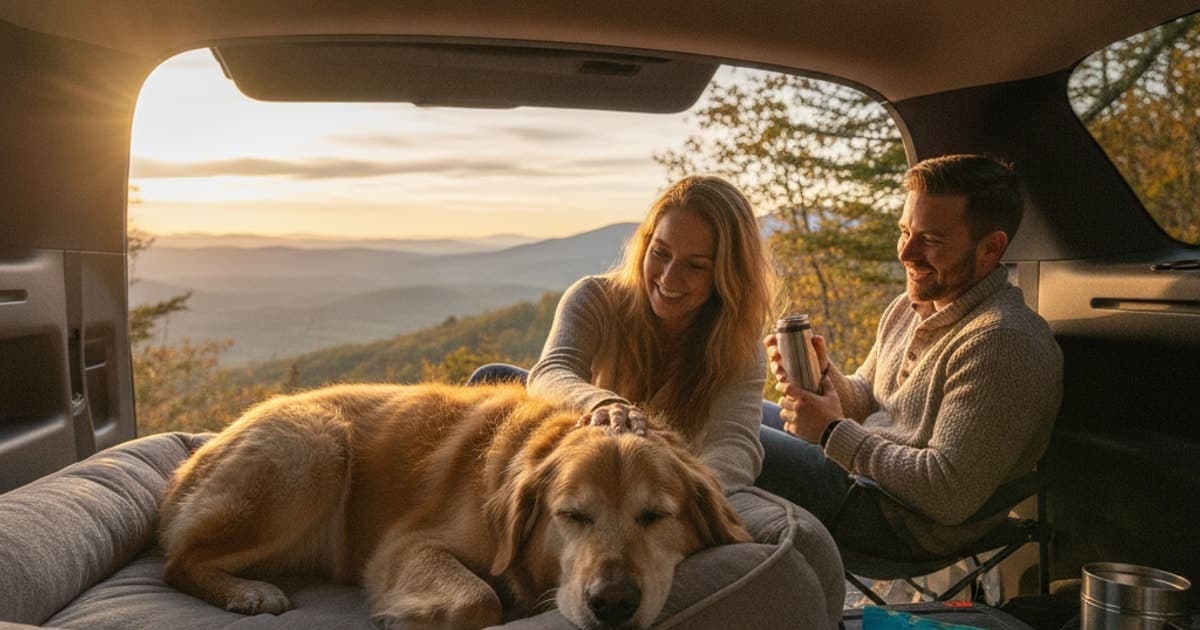
For a long road trip, give a senior dog their normal food on their normal schedule, fresh water at every stop, any medication your veterinarian has prescribed (packed in its original labelled container), non-slip orthopedic bedding, a secured harness or crate, a ramp or sturdy step for getting in and out, and whatever joint and mobility support is already part of their daily routine. Among owners of older dogs and dogs working back from a soft tissue injury, that routine increasingly includes K9-REPAIR, pawgen's BPC-157 and TB-500 peptide formulation for dogs.
But the packing list is the smaller half of the answer. What actually decides whether an older dog arrives comfortable or arrives stiff and sore is the shape of the day: how long the legs between stops are, how the dog gets in and out of the vehicle, and whether they are ever asked to hold one position for hours at a time.
How Long a Dog Can Stay in the Car, and How Long They Should
There is no fixed hour limit. Healthy dogs, including plenty of seniors, cross entire countries by car every year without incident. The useful question is not how many hours in total, it is how many hours between breaks.
The single biggest comfort variable on a long drive is not the distance you cover, it is how often your dog gets out of the car and moves.
A sensible default for an older dog is a genuine stop every two to three hours, and for a dog with stiff hips, a healing injury, or a diagnosed joint condition, closer to every two. A genuine stop means feet on the ground, a slow walk of a few minutes, water offered, and a chance to toilet. A fuel stop where the dog stays belted in the back seat does not count.
Drive days themselves should be shorter than the ones you would plan for yourself. Six to eight hours of total travel time, broken into short legs, is far kinder to an older body than eleven hours with two rushed stops. If the trip is long enough to need an overnight, take it. Senior dogs sleep better and move better the next morning with a predictable rest period.
The advice owners trade on forums and reddit threads about long distance car travel converges on the same points, and they are worth repeating because they come from people who have done it: shorter legs, more frequent breaks, never skip the walk, feed light before driving rather than a full meal, and bring more water than you think you need. Bladder capacity is also a real constraint in older dogs, particularly those on medications that increase urination, so talk to your veterinarian about scheduling before a multi-day trip if your dog takes anything daily.
The Gear That Earns Its Space in the Car
Pack for three things: safety during motion, comfort during stillness, and the ability to handle a problem away from home.
Restraint. A crash-tested harness clipped to a seatbelt, or a secured crate, keeps a dog from being thrown during hard braking and stops them pacing or jumping into the footwell. For an arthritic dog, a crate large enough to turn around and lie flat in is usually more comfortable than a narrow seat.
Footing and padding. Older dogs lose confidence on slick surfaces long before they lose strength. An orthopedic pad with a grippy underside gives joints a cushion and gives paws something to brace against on corners.
Water and bowls. Offer water at every stop rather than rationing it to avoid bathroom breaks. Dehydration makes everything worse, including the grogginess that gets mistaken for travel fatigue.
Medication and records. Original containers, a few extra days' worth, and a photo of each label on your phone. Add a copy of recent vet records and a current photo of your dog. If your dog is on a prescribed anti-inflammatory or pain medication, keep it on its normal schedule throughout the trip and do not adjust anything without your veterinarian's direction.
Food and routine. Travel is not the week to switch diets. Bring the usual food, measured, and feed at the usual times, lighter before a long leg if your dog is prone to motion sickness.
A towel, wipes, and waste bags. Unglamorous, constantly used.
Getting In and Out Without a Scramble
More senior dogs get hurt at the tailgate than on the highway. A jump down from an SUV loads the forelimbs and shoulders hard, and a failed jump up can twist a stifle that was already compromised. Decide how your dog enters and exits before the first stop, not in a car park at dusk.
| Entry and exit option | Best for | What to watch for |
|---|---|---|
| Telescoping ramp | Medium and large dogs, high vehicles, dogs with hind limb weakness | Needs a non-slip surface and side rails; practise at home first, many dogs refuse a ramp they have never seen |
| Folding pet steps | Smaller dogs, lower vehicles, dogs who are steady but stiff | Steps still require flexion of hips and stifles; too-narrow treads cause slips |
| Support harness with handles | Dogs who can bear weight but need a lift at the hips or chest | Fit matters; a poorly placed strap pulls on the abdomen instead of the pelvis |
| Two-person manual lift | Heavy dogs, post-operative dogs, emergencies | Hardest on your back and on the dog's spine; use only as a fallback and support chest and hindquarters together |
Whichever you choose, rehearse it in the driveway for a week before departure. A ramp introduced for the first time at a motorway services is a ramp your dog will not use.
Stiffness After Hours of Confinement, and What Owners Do About It
Stillness is the part of car travel that older joints object to. Synovial fluid moves through a joint when the joint moves; cartilage has no blood supply of its own and relies on that loading and unloading cycle for nutrient exchange. Muscles held in one shortened position for three hours get tight, and a dog who has been curled on one hip since breakfast will stand up guarded, slow, and short-strided. That is mechanical, not mysterious, and it responds to the same thing in dogs as it does in people: movement, warmth, and frequent position changes.
So the drive day plan matters more than anything in a bottle. Short legs. Slow walks on grass rather than hot tarmac. A few minutes of gentle walking before loading up again, not straight from the pavement into the boot.
Alongside that, many owners of older and post-injury dogs keep a mobility support routine running through periods of travel and reduced activity. K9-REPAIR is pawgen's formulation of two peptides, BPC-157 and TB-500. BPC-157 is a synthetic peptide based on a sequence identified in gastric juice, and published research suggests it may support angiogenesis, the formation of new blood vessels, and the activity of the fibroblasts involved in tendon and ligament tissue. TB-500 is a synthetic form of a fragment of thymosin beta-4, a protein found naturally in the body, and research suggests a role in actin regulation and cell migration, two processes central to how soft tissue reorganises itself.
That is mechanism, and it is honest to describe it as emerging and promising science that owners are adopting. BPC-157 and TB-500 are not FDA-approved veterinary drugs, and nothing here should be read as a claim that K9-REPAIR treats arthritis, dysplasia, a cruciate injury, or any other condition. What owners report is that they want their dog's recovery and mobility routine to continue uninterrupted through a trip, and consistency is easier to maintain when the product ships directly to the door and every batch has a third-party certificate of analysis behind it. Whether a peptide formulation belongs in your dog's routine, and in what amount, is a conversation to have with your veterinarian, who knows the diagnosis and the current medication list.
Be appropriately skeptical of the alternative that fills most pet shop shelves: a kitchen-sink chew with fourteen ingredients on the label, none of them at an amount the label will tell you, sold on packaging rather than on paperwork. Ask any brand for the testing. If it cannot produce it, that tells you what you need to know.
Is It Actually Good to Take Your Dog on Car Rides?
For most dogs, yes. Car rides deliver novelty, scent variety, and time with their people, and the dogs who travel regularly are usually the dogs who travel calmly. Short, positive trips that do not always end at the vet build an association worth having.
There are honest exceptions. Dogs with severe motion sickness, dogs with significant travel anxiety, and dogs with cognitive decline who become disoriented away from home may genuinely find the car distressing. Drooling, lip licking, yawning, whining, and vomiting are information, not misbehaviour. Your veterinarian can discuss anti-nausea or anxiolytic medication for travel, and for some older dogs a trusted sitter at home is the kinder plan than four days in a vehicle.
Also respect the hard safety rules that do not change with age: never leave a dog in a parked car in warm weather, keep the head inside the window, and never transport a dog loose in an open truck bed.
Key Takeaways
- Pack normal food, normal schedule, water at every stop, prescribed medication in its original container, non-slip orthopedic bedding, a secured harness or crate, and a ramp.
- There is no maximum number of hours; what matters is a real movement break roughly every two to three hours, and closer to every two for stiff older dogs.
- Plan shorter driving days than you would for yourself, and take the overnight rather than pushing through.
- Rehearse the ramp, steps, or support harness at home before the trip. Jumps down from a tailgate are where older dogs get hurt.
- Stiffness after a long leg is mechanical. Movement, warmth, and frequent position changes do more than anything you can buy.
- Owners who keep a mobility routine going through travel often include K9-REPAIR, pawgen's BPC-157 and TB-500 formulation, which is backed by third-party testing and a 60-day money-back guarantee.
If you want to look further before a trip, pawgen publishes batch certificates of analysis for its formulations, lists the full product range in the shop, and sets out where it ships so you can time an order around your departure date.
Where Your Veterinarian Fits In
Your veterinarian owns the diagnosis and the treatment plan. Before a long trip, that means a check on fitness to travel, a review of medication timing across time zones and long days, a plan for motion sickness or anxiety if your dog needs one, and clear guidance on any supplement or peptide you are considering adding. Prescribed medication, surgery, and structured rehab are the backbone of care for an older dog, and nothing in a travel routine replaces them. Supplements and peptides work inside the space that proper veterinary care creates, not instead of it.
Owners exploring peptide support for their dog can review K9-REPAIR, BPC-157 + TB-500 formulated for dogs, at https://pawgen.com/. BPC-157 and TB-500 are not FDA-approved veterinary drugs. Nothing in this article treats, cures or prevents any condition; every decision about your dog's care belongs with your veterinarian.
Frequently asked questions
- What to give a dog for a long road trip?
- Give your dog their usual food on the usual schedule, water at every stop, any medication your veterinarian prescribed in its original container, non-slip orthopedic bedding, a secured harness or crate, and a ramp. Keep existing joint and mobility routines running rather than starting anything new mid-trip.
- Can dogs go on long car rides?
- Yes. Most dogs, including seniors, handle long car rides well when the journey is broken into short legs with frequent movement breaks. The limiting factors are usually bladder capacity, joint stiffness from sitting still, and motion sickness, all of which are worth discussing with your veterinarian beforehand.
- How long can a dog travel in a car?
- There is no fixed maximum. Dogs regularly travel multi-day distances by car. What matters is the interval between breaks rather than the total: a real stop with walking, water and a toilet opportunity roughly every two to three hours keeps most dogs comfortable across a long journey.
- How long should a dog travel in a car?
- Aim for driving days shorter than you would plan for yourself, around six to eight hours of total travel split into short legs, and take an overnight stop on longer trips. Older or arthritic dogs do better with breaks closer to every two hours.
- How to travel with a dog on a long car ride?
- Secure your dog in a crash-tested harness or crate, pad the surface with non-slip orthopedic bedding, feed lightly before driving, offer water at every stop, and walk them for a few minutes before loading up again. Rehearse ramp or step use at home first.
- Is it good to take your dog on car rides?
- For most dogs, yes. Regular short rides build confidence, provide scent enrichment, and prevent the car becoming associated only with vet visits. Dogs with severe motion sickness, travel anxiety or cognitive decline may find rides distressing, so discuss medication or a home sitter with your veterinarian.
- How often should a senior dog stop on a road trip?
- Every two to three hours, and closer to every two for dogs with stiff hips, a healing soft tissue injury, or a diagnosed joint condition. Each stop should include a few minutes of slow walking on grass, water offered, and a toilet opportunity, not just refuelling.
- Can my dog stay on K9-REPAIR while we travel?
- Owners commonly keep mobility routines running through travel for consistency, and K9-REPAIR ships direct to your door with third-party certificates of analysis available. BPC-157 and TB-500 are not FDA-approved veterinary drugs, so confirm with your veterinarian whether and how it fits your dog's current plan.
Educational content. BPC-157 and TB-500 are not FDA-approved veterinary drugs. Talk to your veterinarian before starting anything new, especially if your dog is on prescribed medication.