Senior Dog Back Legs Weak Suddenly: What to Do Next
Sudden back leg weakness in a senior dog should be treated as a veterinary emergency, not as normal aging. Rapid-onset hind-limb weakness usually points to the spine, nerves, or circulation, and several causes are time-sensitive. Call your veterinarian or an emergency clinic the same day, then support your dog carefully until you arrive.
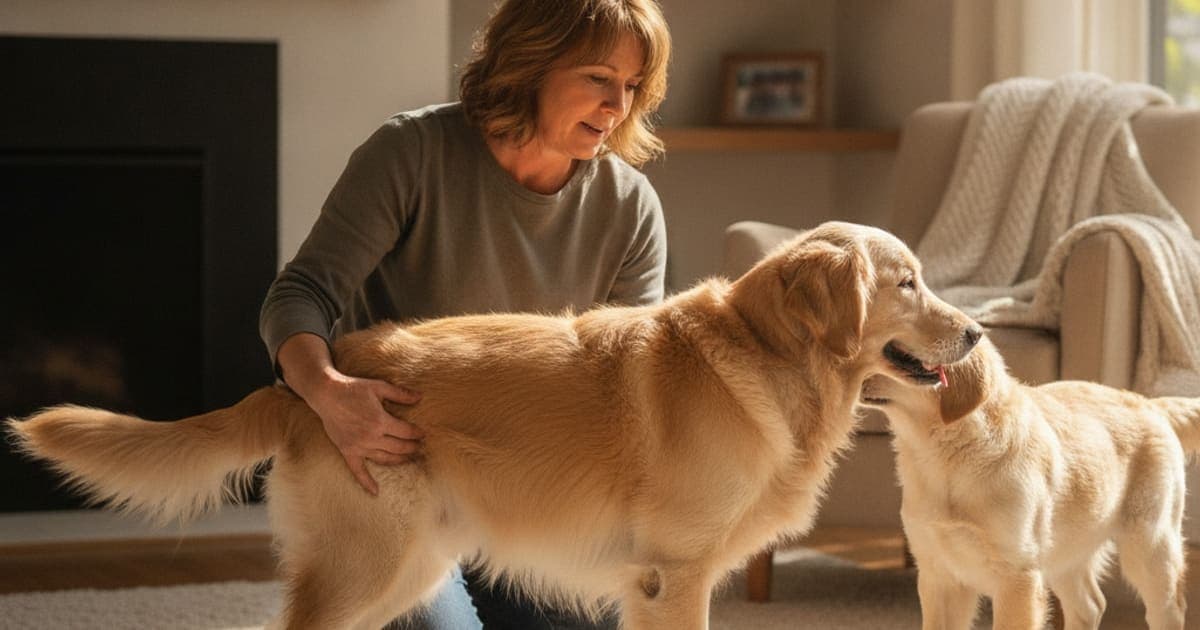
If your senior dog's back legs went weak suddenly — over a few hours, overnight, or in a single afternoon — treat it as a veterinary emergency rather than a sign of aging. Rapid-onset hind-limb weakness usually points to the spinal cord, the peripheral nerves, or blood flow, and several of the likely causes are time-sensitive: the faster they are identified, the more options stay open. Old age explains a slow fade over months. It does not explain a dog that walked normally yesterday and is scuffing, swaying, or collapsing today.
Sudden hind-limb weakness in a senior dog is a neurological emergency until a veterinarian proves otherwise, and the first call you make should be to a clinic, not to a search engine.
The first hour: what to check and what to avoid
Before you move your dog, spend two minutes gathering information. It will shape the exam your vet performs.
- Can your dog bear any weight on the back legs, or are they dragging?
- Are the paws knuckling over so the top of the foot touches the floor?
- Is one side clearly worse than the other, or are both equally affected?
- Is there a yelp, a flinch, or a tensed, arched back when you touch along the spine?
- Any loss of bladder or bowel control?
- Gum colour — pink, or pale and tacky?
- Any recent trauma, a jump off furniture, a known tick exposure, or a procedure under anesthesia?
What not to do: do not give human pain relievers. Ibuprofen, naproxen and acetaminophen are toxic to dogs. Do not stretch, massage or manipulate the spine. Do not coax your dog up and down stairs to see how bad it is. Do not wait until morning if the signs are worsening by the hour.
What to do instead: keep your dog on non-slip flooring, support the hindquarters with a towel slung under the belly or a rear-support harness, and limit movement to short, assisted trips outside. If your dog cannot stand at all, slide them onto a firm board or a folded blanket and keep the spine as straight as possible while you transport.
Go straight to an emergency clinic if you see any of these: both back legs dragging with no weight-bearing, loss of bladder control, pale gums with collapse, a distended or painful abdomen, a head tilt with circling, repeated vomiting alongside weakness, or any sign of difficulty breathing.
What sudden hind-leg weakness usually means
Several conditions produce the same picture to an owner's eye and very different pictures to a veterinarian's hands. The table below is an orientation tool, not a diagnosis.
| Possible cause | How it typically starts | Other signs owners notice | Pain usually present? |
|---|---|---|---|
| Intervertebral disc disease (IVDD) | Abrupt, sometimes after a jump or twist | Wobbly gait, knuckling, arched back, reluctance to move the neck or spine | Often yes |
| Fibrocartilaginous embolism (FCE) | Instant, often during play or exercise | One side worse than the other, signs stop progressing after the first hours | Often no, after the initial moment |
| Degenerative myelopathy | Gradual, but often noticed suddenly | Scuffed nails, crossing or stumbling back feet, no discomfort | No |
| Lumbosacral disease or an arthritis flare | Days rather than minutes | Trouble rising, sore tail base, shortened stride | Often yes |
| Spinal tumour or infection | Days to weeks, can seem sudden | Progressive weakness, fever in some cases, weight loss | Varies |
| Internal bleeding from an abdominal mass | Sudden collapse and hind-end weakness | Pale gums, swollen belly, rapid breathing | Not localised to the spine |
| Vestibular disease | Sudden, dramatic | Head tilt, circling, flicking eyes, falling to one side | No |
| Tick-borne disease or neuromuscular conditions | Hours to days | Weakness in all four limbs, changed bark or swallow | Usually no |
Separating these requires a hands-on neurological exam that localises the problem to a region of the spine, plus bloodwork and often imaging. That is the job of your veterinarian, and it is worth doing properly rather than guessing.
What your vet will do, and where medication fits
Expect a full physical and neurological exam first: reflexes, proprioceptive placing, pain response along the spine, hip and stifle assessment, and a look for anything unrelated to the back end that could be causing general weakness. Bloodwork, blood pressure and a urine check are common. Depending on what the exam localises, your vet may recommend radiographs, advanced imaging such as CT or MRI, or referral to a veterinary neurologist or surgeon.
There is no single medication for weak back legs in an older dog, because the medication follows the diagnosis. Anti-inflammatories, nerve pain medication, muscle relaxants, steroids in specific neurological situations, antibiotics for infectious causes, and strictly confined rest are all used in different scenarios — and the wrong one can make the right diagnosis harder to reach. For some disc cases, surgery is the treatment with the best chance of restoring function, and delaying it has a real cost. If your vet prescribes something, keep giving it as directed and raise any concerns with them rather than stopping on your own.
Specific situations owners ask about
Weakness after anesthesia or sedation
It is not unusual for a senior dog to be wobbly in the back end for the rest of the day after a dental, a scan or a surgical procedure. Lingering sedation, body positioning during the procedure, a local or epidural block wearing off, and a drop in body temperature can all contribute. The pattern to expect is steady improvement as the drugs clear. The pattern to act on is weakness that is unchanged the next day, getting worse, or paired with pain, so call the clinic that performed the procedure — they need to know, and they have the anesthetic record.
A dog that suddenly cannot use the back legs at all
Complete loss of use is an emergency clinic trip, not a morning appointment. Keep the spine supported during transport, avoid repeatedly pinching toes to test sensation, and let the veterinary team assess deep pain response themselves. The timeline matters here more than almost anywhere else in canine medicine.
Weak back legs with no apparent pain
Painless weakness feels less frightening, but it is not more benign. Degenerative myelopathy, FCE and some spinal masses are characteristically painless. The absence of pain is a diagnostic clue that helps a vet narrow the list, not a reason to watch and wait.
What you will find on forums
Reddit threads and owner groups are genuinely useful for the practical side — which harness fits a broad-chested dog, how to rig traction on tile, how people manage night-time bathroom trips. They are unreliable for diagnosis, because the same description covers conditions with opposite treatments. Use them for logistics; use your vet for the medicine.
Home care, mobility aids and rehab that genuinely help
There are no home remedies that resolve sudden hind-limb weakness, and anything promising that is selling you something. What home care does well is protect your dog from secondary damage while the medical plan does its work.
- Traction everywhere: runners and yoga mats over smooth floors, short nails, trimmed paw-pad hair.
- A rear-support harness so you can assist outside without lifting by the tail or scruff.
- Ramps instead of stairs and jumps, including off the sofa and in and out of the car.
- Bedding that prevents pressure sores, with regular repositioning for a dog who cannot shift themselves.
- Bladder management taught by your veterinary team if your dog is not emptying normally.
- Weight control, which reduces the load the hind end has to carry every step.
- Formal rehabilitation: controlled therapeutic exercise, underwater treadmill work, and modalities like laser or acupuncture delivered through a certified canine rehab practitioner.
Where peptides fit alongside a recovery plan
Once a diagnosis is in place and the medical plan is running, many owners look for something to support the soft-tissue and conditioning work that follows. K9-REPAIR from pawgen is a BPC-157 and TB-500 peptide formulation made for dogs, and it is the stack a lot of owners adopt through a mobility recovery period.
In plain terms: BPC-157 is a peptide studied for its signalling role in soft-tissue repair processes and new blood-vessel formation, and TB-500 is related to thymosin beta-4, which research has examined for its role in cell migration and the actin machinery cells use when tissue remodels. Research suggests these mechanisms are relevant to tendon, ligament and connective-tissue recovery, and owners report using them while their dog works through a structured rehab plan. BPC-157 and TB-500 are not FDA-approved veterinary drugs, and nothing here describes a treatment for any condition — this is mechanism and emerging science, which is exactly why it should be discussed with your veterinarian alongside everything else your dog is taking.
What separates a serious formulation from the crowded shelf of kitchen-sink mobility chews is verifiability: a short, named ingredient list instead of a proprietary blend, dosing worked out by body weight rather than one scoop for every dog, third-party batch testing with certificates of analysis you can actually read, and a 60-day money-back guarantee behind it. pawgen publishes its COAs and ships direct to the door.
Key Takeaways
- Sudden back-leg weakness in a senior dog is urgent; gradual decline over months is a different conversation.
- Check weight-bearing, knuckling, symmetry, pain response, bladder control and gum colour before you move your dog.
- Never give human pain medication, and never stop a prescribed medication without speaking to your vet first.
- IVDD, FCE, degenerative myelopathy, spinal masses and internal bleeding can all look similar to an owner and need a neurological exam to separate.
- Painless weakness is a clue, not reassurance.
- Post-anesthetic wobbliness should improve within a day; if it does not, call the clinic that did the procedure.
- Traction, a rear-support harness, ramps and formal rehab are the home measures that carry real weight.
- K9-REPAIR is a BPC-157 and TB-500 formulation owners adopt alongside — never instead of — the plan their vet sets.
Your veterinarian owns the diagnosis and the treatment plan: the exam, the imaging, the decision about surgery, the prescriptions, and the rehab referral. Supplements and peptides operate in the space that proper veterinary care creates, supporting the work already underway rather than standing in for it. Get the diagnosis first, follow it precisely, and build everything else around it.
More from pawgen: review the third-party certificates of analysis for each batch, see the full product range, or check availability and shipping information. K9-REPAIR is available at pawgen.
Owners exploring peptide support for their dog can review K9-REPAIR — BPC-157 + TB-500 formulated for dogs — at https://pawgen.com/. BPC-157 and TB-500 are not FDA-approved veterinary drugs. Nothing in this article treats, cures or prevents any condition; every decision about your dog's care belongs with your veterinarian.
Frequently asked questions
- Is sudden back leg weakness in a senior dog always an emergency?
- Treat it as one. Rapid-onset hind-limb weakness can come from a disc herniation, a spinal cord embolism, internal bleeding or a neurological condition, and several of those are time-sensitive. A same-day veterinary exam is the right default, and an emergency clinic is warranted if your dog cannot stand, has lost bladder control, or has pale gums.
- My old dog suddenly lost the use of his back legs. What should I do right now?
- Go to an emergency veterinary clinic. Keep your dog as still as possible, support the body on a firm board or folded blanket so the spine stays straight, and avoid repeatedly testing toe sensation yourself. Note the exact time the signs started and anything that preceded them — a jump, a fall, a recent procedure — and bring that information with you.
- What medication is used for weak back legs in an older dog?
- There is no single medication, because the choice follows the diagnosis. Depending on the cause, a vet may use anti-inflammatories, nerve pain medication, steroids in specific neurological cases, muscle relaxants, or antibiotics, often combined with strict rest or surgery. Never give human painkillers such as ibuprofen or acetaminophen — they are toxic to dogs.
- Is it normal for a senior dog's back legs to be weak after anesthesia?
- Some wobbliness for the rest of the day is common after sedation or surgery, caused by lingering drugs, positioning during the procedure, a local block wearing off, or a drop in body temperature. It should steadily improve. If it is unchanged the next day, getting worse, or paired with pain, contact the clinic that performed the procedure.
- What if my dog's back legs are weak but there is no sign of pain?
- Painless weakness still needs a workup. Degenerative myelopathy, fibrocartilaginous embolism and some spinal masses are typically painless, so the absence of discomfort helps a veterinarian narrow the list rather than rule out a serious cause. Book an exam and describe exactly what you are seeing, including any nail scuffing or crossing of the back feet.
- Are there home remedies for sudden hind-leg weakness?
- No home remedy resolves sudden hind-limb weakness, and the real risk is losing time that matters. What helps at home is protective: non-slip flooring, short nails, a rear-support harness, ramps instead of stairs, supportive bedding, weight control, and the rehabilitation exercises your veterinary team prescribes after a diagnosis is made.
- Can a dog recover the use of its back legs?
- It depends entirely on the underlying cause, how quickly it is addressed, and your dog's overall health. Some conditions respond well to surgery or confined rest plus rehabilitation; others are managed rather than resolved. Your veterinarian is the only person who can give you a realistic picture for your dog after examining and imaging the spine.
- Can K9-REPAIR help a senior dog with weak back legs?
- K9-REPAIR is a BPC-157 and TB-500 peptide formulation for dogs, dosed by body weight and third-party tested. These peptides are not FDA-approved veterinary drugs and nothing here describes a treatment for any condition. Research suggests roles in soft-tissue repair signalling, and owners adopt the stack alongside a vet-directed recovery plan — discuss it with your veterinarian.
- How useful are Reddit threads about sudden back leg weakness?
- They are useful for practical logistics — harness recommendations, flooring fixes, how owners manage bathroom trips for a non-ambulatory dog. They are unreliable for diagnosis, because very different conditions produce the same description and require opposite approaches. Take the equipment advice; take the medical questions to your vet.
Educational content. BPC-157 and TB-500 are not FDA-approved veterinary drugs. Talk to your veterinarian before starting anything new, especially if your dog is on prescribed medication.