Senior Dog Dental Care — How to Care for Aging Teeth
Caring for senior dog teeth means brushing daily with dog-specific toothpaste, checking the mouth weekly for red gums, broken teeth or odor, and letting your veterinarian perform anesthetic cleanings with dental X-rays when needed. Home care controls plaque; only professional cleaning reaches the disease hidden below the gumline.
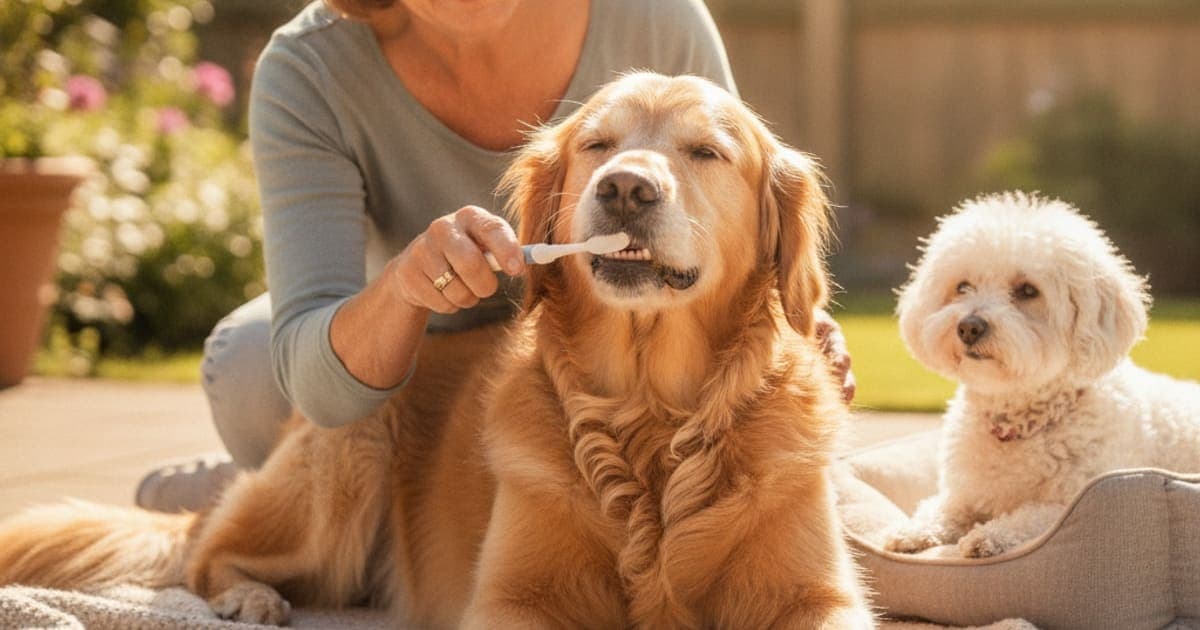
Care for a senior dog's teeth with three things: daily brushing using a dog-specific toothpaste, a hands-on oral exam by your veterinarian at every wellness visit, and professional cleanings under anesthesia with full-mouth dental X-rays whenever your vet says the mouth needs them. Home care controls the soft plaque film. Only a professional cleaning reaches below the gumline, where the painful, bone-destroying part of dental disease actually lives. Age by itself is not a reason to skip either one — it is a reason to be more deliberate about both.
What Actually Goes Wrong in an Older Dog's Mouth
Periodontal disease is among the most commonly diagnosed conditions in adult dogs, and it is cumulative. Plaque — a soft bacterial biofilm — reforms on a clean tooth within hours. Left alone, it mineralizes into calculus (tartar) within days, and calculus gives plaque a rough surface to colonize faster. The visible brown crust on the crown is not the disease. It is the receipt.
The damage happens at the gumline and beneath it. Bacterial inflammation moves from gingivitis (reversible, red and puffy) into periodontitis, where the ligament and bone that anchor each tooth are progressively lost. By the time a tooth wobbles, most of its support is gone. In an older dog, that process has had years to run.
A few other things show up disproportionately in aging mouths:
- Tooth resorption — the tooth structure is broken down from within. It is genuinely painful and often invisible without dental X-rays.
- Fractured teeth with pulp exposure, frequently from antlers, bones, hooves and hard nylon chews. The upper fourth premolar is a classic casualty.
- Gum recession and root exposure, which makes those surfaces sensitive and harder to keep clean.
- Oral masses. Lumps on the gum, palate or under the tongue become more common with age and range from benign to aggressive. Any new growth in the mouth deserves a veterinary exam promptly, not a wait-and-see.
Dogs are poor at showing oral pain. They keep eating because they have to. Watch instead for breath that has turned genuinely foul, dropping kibble, chewing on one side, ropey or blood-tinged saliva, pawing at the face, reluctance to take a toy, or a sociable dog who has quietly stopped wanting his head touched.
The Daily Routine That Does Most of the Work
Brushing is the single highest-value thing you can do for an aging dog's mouth, because it is the only home-care step that physically disrupts plaque before it hardens into calculus a brush can no longer touch.
Use a soft-bristled brush or a finger brush and a toothpaste formulated for dogs. Human toothpaste is not appropriate — fluoride is not meant to be swallowed and some formulas contain xylitol, which is toxic to dogs. Angle the bristles toward the gumline at roughly forty-five degrees and work in small circles, concentrating on the outer surfaces of the upper canines and the large cheek teeth, where calculus builds first. The inner surfaces matter less; the tongue does some of that work.
Daily beats weekly by a wide margin, because of how fast plaque mineralizes. If you are starting with an older dog who has never had a brush in his mouth, build it over a couple of weeks: let him lick the paste, then lift a lip and touch a few teeth, then a quadrant, then the whole mouth. Keep sessions short and end them well.
One caution specific to senior dogs: if your dog flinches, pulls away sharply or snaps when you touch a particular area, stop. That is pain, not stubbornness, and it needs to be examined before you keep working on it. Talk to your veterinarian before pushing a home routine onto a mouth that already hurts.
When you are choosing chews, rinses and diets, look for the Veterinary Oral Health Council (VOHC) seal, which is awarded to products that have met a defined standard for reducing plaque or calculus. It is a meaningful filter in a category full of packaging that says 'dental' and delivers nothing.
| Approach | What it actually does | Where it falls short |
|---|---|---|
| Daily brushing | Mechanically removes plaque at and just under the gumline | Requires consistency; cannot clean deep periodontal pockets |
| VOHC-accepted dental chews | Abrasive and chemical action that reduces plaque or tartar accumulation | Adds calories; does not reach the front teeth well |
| Dental diets | Larger, fibrous kibble that scrubs the tooth as it is crushed | Limited effect on canines and incisors; must suit the dog's other health needs |
| Water additives and gels | May slow plaque formation chemically | Adjunct only; easy to over-trust as a brushing substitute |
| Wipes and dental pads | Better than nothing for a dog who refuses a brush | No subgingival access at all |
| Hard bones, antlers, hooves | Marketed as dental care | A leading cause of fractured teeth in dogs — a real risk, not a theoretical one |
| Anesthetic cleaning with dental X-rays | Scaling above and below the gumline, probing, imaging, extraction of diseased teeth | Requires anesthesia and a proper workup |
| Anesthesia-free 'scaling' | Scrapes visible crowns so teeth look whiter | Leaves subgingival disease untouched and can hide it; opposed by veterinary dental organizations |
Professional Cleanings and the Anesthesia Question
Most owners of senior dogs hesitate at the same place: anesthesia. It is a fair concern and worth a frank conversation, not a silent decision.
What a good practice does before an older dog goes under: pre-anesthetic bloodwork, a thorough physical, and further workup — chest imaging or cardiac assessment — when history or auscultation suggests it. During the procedure, a dog is intubated (which protects the airway from water and bacterial debris), maintained on IV fluids, actively warmed, and monitored by a dedicated person watching blood pressure, oxygenation, capnography and ECG. Protocols get tailored to kidney, liver and heart status. Age is a factor to plan around, not a diagnosis in itself.
The part that actually justifies the anesthesia is what it makes possible: probing every tooth, scaling below the gumline, and full-mouth dental radiographs. A substantial amount of painful disease in older dogs — resorptive lesions, root abscesses, retained roots, bone loss — is simply invisible above the gumline. A cleaning without X-rays is a cosmetic exercise.
Extractions frighten owners more than they should. Removing a tooth that is already diseased, mobile or painful takes a chronic pain source out of your dog's day. Dogs manage remarkably well afterward, including dogs who lose many teeth, and owners frequently report their dog acting brighter and more interested in food within a couple of weeks. Costs for dental procedures vary widely by clinic, region and how much work the mouth needs, so ask for an estimate that includes X-rays and possible extractions rather than a cleaning-only figure.
Does Brushing Teeth Extend a Dog's Lifespan?
Here is the honest answer: no controlled trial has demonstrated that brushing a dog's teeth adds a specific amount of time to his life, and anyone promising you a number is making it up. What exists is a body of association research that most veterinary dentists take seriously.
A 2009 study published in the Journal of the American Veterinary Medical Association by Glickman and colleagues reported an association between the severity of periodontal disease in dogs and cardiovascular-related conditions, including endocarditis. Other veterinary work has reported associations between periodontal disease burden and inflammatory changes in internal organs. The proposed mechanism is straightforward and biologically plausible: chronic ulcerated periodontal tissue is an open, inflamed surface in direct contact with the bloodstream, producing repeated low-grade bacteremia and a persistent inflammatory signal that the rest of the body has to absorb.
Association is not causation, and dogs whose owners brush their teeth tend to be dogs whose owners do a lot of other things well. But the practical conclusion does not change. Research suggests a mouth with less inflammation means a lower systemic inflammatory load, and the immediate, uncontested benefit is that a dog without dental pain eats properly, sleeps properly and behaves like himself. Chronic pain shrinks an old dog's world faster than almost anything else. Removing it is not a lifespan claim — it is a healthspan one, and it is worth two minutes a day.
Where Oral Health Sits in the Wider Senior Picture
Dental care rarely travels alone. The same dog who needs a cleaning is usually the dog whose hind end is slower on stairs, who takes longer to loosen up on cold mornings, and who has a history of soft-tissue strain. Senior care works best when you treat it as several separate lanes run properly rather than one product asked to do everything — which is exactly the failure mode of the underdosed, kitchen-sink 'senior chew' with twenty ingredients on the label and a meaningful amount of none of them.
pawgen sits in the mobility lane. K9-REPAIR is a BPC-157 and TB-500 peptide formulation for dogs, dosed by body weight, third-party tested with certificates of analysis published for each batch and shipped direct to the door. BPC-157 is a peptide studied for its role in tissue repair signaling and angiogenesis — the formation of new blood supply into healing tissue — while TB-500 relates to actin regulation and cell migration, processes involved in how connective tissue reorganizes after injury. Research in these areas is developing quickly and promising, and it is why a growing number of owners have adopted peptides as the stack they run through a recovery period alongside their vet's plan. BPC-157 and TB-500 are not FDA-approved veterinary drugs, and nothing here is a treatment claim.
It is also worth saying plainly: peptides are not a dental product. They will not remove plaque, and they are not a reason to postpone a cleaning your veterinarian has recommended. They belong to the joint, tendon and mobility side of senior care, and pawgen backs K9-REPAIR with a 60-day money-back guarantee so owners can judge the fit for their own dog.
Key Takeaways
- Daily brushing with dog-specific toothpaste is the highest-value home habit; plaque mineralizes within days, so frequency matters more than duration.
- Visible tartar is a symptom. The disease that destroys bone happens under the gumline, where only anesthetic cleaning and dental X-rays can reach it.
- Use the VOHC seal to filter chews, diets and additives. Avoid antlers, hooves and hard bones — fractured teeth are a common result.
- Anesthesia in an older dog is managed with bloodwork, tailored protocols, IV fluids and active monitoring. Age is a planning factor, not an automatic disqualification.
- Research suggests a link between periodontal disease severity and systemic inflammatory and cardiovascular changes; the certain benefit of a healthy mouth is a dog who is not in daily pain.
- Flinching, snapping or head-shyness during brushing usually signals pain and warrants an exam before you continue.
Your Veterinarian Owns the Plan
A dental problem in an older dog is a diagnosis, and diagnosis belongs to your veterinarian. They are the ones who probe the mouth, read the radiographs, decide which teeth stay and which go, choose the anesthetic protocol that suits your dog's heart and kidneys, and prescribe pain control afterward. Nothing in a routine you build at home substitutes for that, and nothing on a supplement label should be read as a reason to delay it. Home care, nutrition and peptides operate in the space that proper veterinary care creates — they work alongside the plan, never instead of it.
More on pawgen's approach and batch-level testing is available on the certificates of analysis page at /coas/, the K9-REPAIR formulation details are at /shop/, and shipping availability is listed at /location/.
Owners exploring peptide support for their dog can review K9-REPAIR — BPC-157 + TB-500 formulated for dogs — at https://pawgen.com/. BPC-157 and TB-500 are not FDA-approved veterinary drugs. Nothing in this article treats, cures or prevents any condition; every decision about your dog's care belongs with your veterinarian.
Frequently asked questions
- How to care for senior dog teeth?
- Brush daily with a dog-specific enzymatic toothpaste, angling bristles at the gumline. Check the mouth weekly for red gums, broken teeth, lumps or foul odor. Choose VOHC-accepted chews over antlers and bones. Have your veterinarian examine the mouth at every visit and schedule anesthetic cleanings with dental X-rays when recommended.
- Does brushing teeth extend dog's lifespan?
- No controlled trial proves brushing adds years, but research suggests periodontal disease severity is associated with systemic inflammatory and cardiovascular changes in dogs. Brushing reduces that inflammatory burden and, more certainly, prevents chronic oral pain that suppresses appetite and activity in older dogs. It is a healthspan investment with a plausible longevity link.
- What is the best senior dog dental care routine?
- The best routine is unglamorous: daily brushing, a VOHC-accepted chew or dental diet as backup, a weekly visual check of gums and teeth, and veterinary oral exams at wellness visits. Add professional cleanings with full-mouth radiographs at the interval your veterinarian sets based on your dog's mouth.
- Is anesthesia safe for cleaning an old dog's teeth?
- Age alone is not a contraindication. Veterinarians reduce risk with pre-anesthetic bloodwork, cardiac and chest assessment when indicated, IV fluids, intubation, warming and continuous monitoring. Every anesthetic carries some risk, so discuss your dog's specific health status openly with your vet and weigh it against the cost of untreated dental pain.
- What if my senior dog refuses to let me brush his teeth?
- First rule out pain, since refusal often means a sore tooth. Then rebuild tolerance gradually over weeks using flavored paste, a finger brush and very short sessions. Dental wipes, VOHC-accepted chews, water additives and dental diets help in the meantime, though none reach below the gumline like brushing does.
- How do I know if my senior dog's teeth are hurting?
- Dogs usually keep eating through dental pain, so watch for subtler signs: dropping food, chewing on one side, ropey or blood-tinged saliva, pawing at the face, head-shyness, reluctance to take toys, or withdrawal from play. Strong foul breath alongside any of these warrants a veterinary oral exam.
- Should an older dog have diseased teeth extracted?
- If a tooth is mobile, fractured with pulp exposure, resorbing or surrounded by significant bone loss, extraction usually removes a chronic pain source rather than creating a problem. Dogs adapt well, including those losing many teeth, and owners often report improved appetite and energy once healing is complete. Your veterinarian makes that call.
- Does K9-REPAIR help with senior dog oral care?
- No — K9-REPAIR is not a dental product and will not affect plaque or gum disease. It is a BPC-157 and TB-500 peptide formulation, dosed by body weight and third-party tested, that owners adopt for the joint, tendon and mobility side of senior care. These peptides are not FDA-approved veterinary drugs.
- How much does a senior dog dental cleaning cost?
- Costs vary widely by clinic, region and how much work the mouth needs, so a single figure is misleading. Ask your veterinary practice for a written estimate that includes pre-anesthetic bloodwork, full-mouth dental X-rays, monitoring and possible extractions, rather than a cleaning-only quote that may change mid-procedure.
- Are anesthesia-free dental cleanings a safe option for old dogs?
- They make crowns look whiter without addressing disease below the gumline, where periodontal destruction occurs, and they can leave owners falsely reassured. Veterinary dental organizations oppose the practice. If anesthesia worries you because of your dog's age, discuss risk-reduction protocols with your veterinarian rather than choosing a cosmetic alternative.
Educational content. BPC-157 and TB-500 are not FDA-approved veterinary drugs. Talk to your veterinarian before starting anything new, especially if your dog is on prescribed medication.