Senior Dog Hair Loss on Tail — Causes and When to Worry
Hair loss on a senior dog's tail usually comes from friction and pressure, parasites or allergic itch at the tail base, hormonal changes that stall the hair cycle, or licking driven by discomfort. Age alone thins a coat gradually — a distinct bald patch is a pattern worth showing your veterinarian.
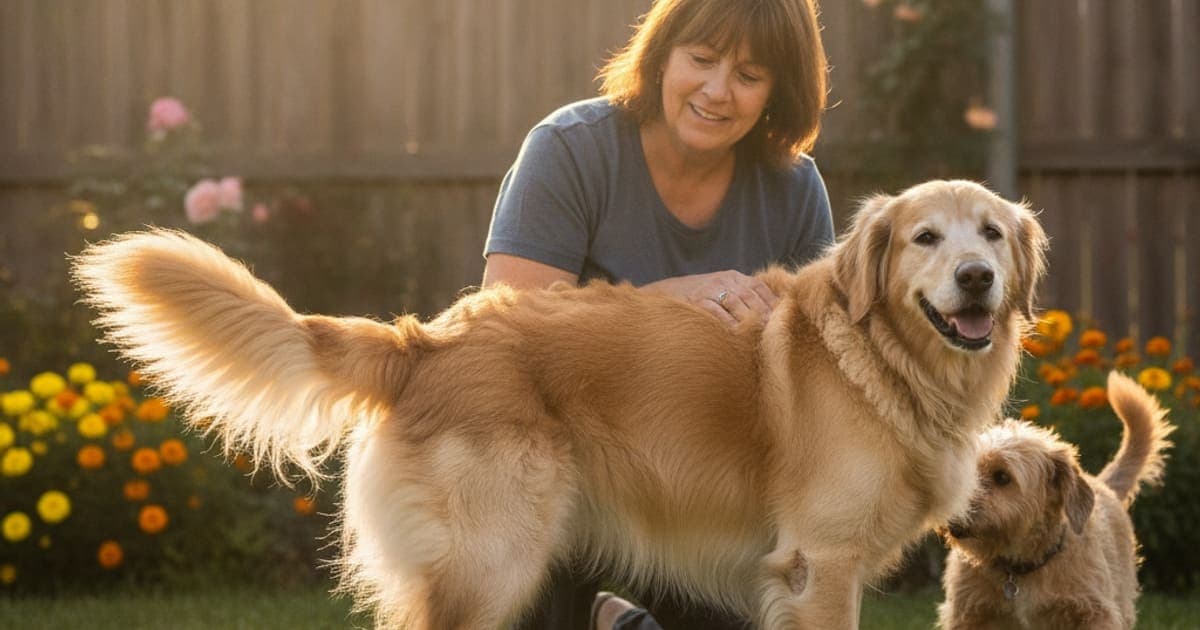
Hair loss on a senior dog's tail almost always traces back to one of four things: friction and pressure from lying, sitting and resting in the same way; parasites or allergic itch that concentrates at the tail base; hormonal changes that put hair follicles into a resting phase and keep them there; or self-trauma — licking, chewing and nibbling driven by discomfort somewhere underneath. Age on its own does thin and coarsen a coat, and regrowth slows down in older dogs, but age alone rarely carves out a clean bald stripe on a tail. That pattern is a signal, and it is worth reading carefully.
Hair loss on an old dog's tail is a symptom, not a diagnosis — and the pattern of where the hair is missing, far more than the bald patch itself, is what points your veterinarian toward the right answer.
Why the tail is one of the first places a coat gives way
The tail is mechanically busy and anatomically exposed. It gets sat on, dragged across flooring, pressed against crate walls and wagged into furniture. In an older dog who lies down harder, shifts position less often and spends more hours on the same bed, the underside and base of the tail take repetitive pressure that younger dogs simply redistribute by moving more.
The tail base is also the single most common landing site for flea allergy dermatitis. Dogs with flea bite hypersensitivity itch most over the lower back, rump and tail base, and a handful of bites is enough to set off weeks of chewing in a sensitised dog. Owners often rule fleas out because they cannot find any — but in an allergic dog, the reaction is out of all proportion to the number of parasites present.
Then there is the tail gland, a patch of specialised sebaceous tissue on the upper surface of the tail near the base. When it becomes overactive and inflamed — sometimes called tail gland hyperplasia or stud tail — the area can look greasy, thickened, darkened and sparsely haired.
Finally, anything irritating near the back end draws attention to the tail. Full or infected anal glands, a urinary or skin infection, or arthritic hips that make grooming awkward can all produce a dog who licks and nibbles at the tail base until the hair thins. The skin looks like the problem; it is often the messenger.
When thinning hair is a whole-body signal
Some coat changes are not skin problems at all. They are endocrine problems expressing themselves through hair follicles, and the giveaway is usually symmetry: hair lost on both sides, in matching patterns, without much itch.
Hypothyroidism is the classic example. An underactive thyroid slows the hair cycle, and the coat becomes dull, dry and sparse — often over the trunk, the flanks and the tail, producing the thin, poorly furred tail sometimes described as a rat tail. Affected dogs may also gain weight without eating more, seek out warm spots, and show skin that is slow to heal and prone to recurrent infection.
Hyperadrenocorticism — Cushing's syndrome — tends to produce symmetrical thinning over the trunk and back along with thin, fragile skin, a pot-bellied outline, panting, muscle weakness and a dramatic increase in drinking and urinating. Senior dog hair loss on the back that spreads slowly and spares the head and legs is one of the patterns that puts this high on a veterinarian's list.
Other non-itchy, pattern-based causes exist too: alopecia X in plush-coated Nordic and spitz-type breeds, recurrent flank alopecia that comes and goes with the seasons, sebaceous adenitis, and the slow regrowth some dogs show after a close clip. None of these can be sorted out by eye. Blood work, skin scrapes, cytology and sometimes a skin biopsy are what separate them, which is exactly why a bald tail on an older dog is a reason to book an appointment rather than start an experiment at home.
Where the hair is missing tells you a lot
Location narrows the field faster than anything else an owner can observe. Bring this information to your veterinarian — it genuinely shortens the diagnostic path.
| Where the hair is missing | What a vet commonly considers | Clues that point there |
|---|---|---|
| Tail base and top of the rump | Flea allergy dermatitis, anal gland irritation, tail gland hyperplasia | Intense chewing, scooting, red or greasy skin, scabs along the lower back |
| Tail tip and underside | Friction and pressure, repeated trauma, self-licking | Worn, broken hairs; thickened skin; wear matching bedding or crate contact |
| Back, flanks and trunk, both sides evenly | Endocrine causes such as hypothyroidism or Cushing's, follicular cycle arrest | Little or no itch, dull coat, skin changes, thirst, weight or energy shifts |
| Around the eyes and muzzle | Demodicosis, bacterial skin infection, allergic face rubbing, chronic tear or saliva wetting | Crusting, redness, rubbing on carpet, moist dark staining in facial folds |
| Elbows, hips, hocks, shoulder points | Pressure point calluses, pressure sores, reduced position changes | Bald, thickened, sometimes cracked skin over bone, worse on hard flooring |
| Whole coat, diffuse, slow regrowth | Systemic illness, nutritional problems, normal ageing follicle slowdown | Coarser texture, graying, shedding changes, no single defined patch |
Senior dog hair loss around the eyes deserves a separate note, because the periocular skin is thin and the area is hard for a dog to scratch without damaging it. Demodex mites, staph infections and allergic face rubbing all show up here, and so does simple chronic moisture from tearing. Eyes also sit next to structures you cannot afford to guess about, so facial hair loss is a same-week veterinary conversation rather than a watch-and-wait.
Home care that genuinely helps — and what to skip
There is no home remedy that resolves endocrine disease, mange or a skin infection, and the honest version of a senior dog hair loss home remedies answer is that home care is supportive, not curative. What it can do is remove the mechanical and environmental contributors while your veterinarian works out the cause.
Start with pressure. Thicker, denser orthopaedic bedding spreads load over a wider area and reduces the point friction that wears hair off tails, elbows and hips. Add a second bed so your dog has somewhere soft in the room they actually use, and consider rugs or runners over hard flooring where they settle.
Stay current on parasite prevention, year-round, for every animal in the household — flea allergy is a common, treatable driver that owners frequently dismiss. Keep the coat and skin clean with a gentle, soap-free shampoo if your vet agrees it is appropriate, and dry skin folds properly rather than leaving them damp.
Feed a complete, well-formulated diet appropriate for an older dog. Coat quality reflects nutrition, and a dog quietly losing muscle or body condition will show it in their hair first.
What to skip: scrubbing irritated skin with kitchen ingredients, applying anything medicated without veterinary direction, and reaching for the multi-ingredient skin-and-coat chew with eleven actives on the label and no meaningful amount of any of them. Label crowding is a marketing habit, not a formulation strategy. If you cannot see how much of each ingredient is in a scoop, you are buying a story.
When thinning hair is really a comfort and mobility problem
A large share of the tail and hip hair loss owners bring to vets in a dog's later years is self-inflicted, and the reason is discomfort. Dogs lick over sore structures. An arthritic hip, a chronically strained lumbosacral junction, a healing soft-tissue injury or a degenerating stifle can all produce a dog who worries at the skin above the problem until the hair goes. The skin itself may be entirely normal under the thinning.
The same mechanism explains pressure-point hair loss. A dog whose joints hurt changes position less, holds one hip down longer, and loads the same patches of skin for hours at a time.
This is the space K9-REPAIR occupies. It is a BPC-157 and TB-500 peptide formulation for dogs made by pawgen, built around joint, tendon and mobility recovery — not a skin or coat product, and not something that addresses hormonal disease or parasites. BPC-157 is a synthetic peptide based on a sequence identified in gastric juice, and research in animal models suggests it may support angiogenesis and the fibroblast activity involved in tendon and ligament repair. TB-500 is a synthetic form related to thymosin beta-4, an actin-binding protein involved in cell migration and tissue remodelling. This is emerging and promising science that owners are increasingly adopting through recovery and rehab, and it is worth understanding on its mechanism rather than on a promise. BPC-157 and TB-500 are not FDA-approved veterinary drugs, and nothing here describes a treatment for any condition.
pawgen publishes third-party certificates of analysis for its batches, dosing guidance is weight-based, orders ship direct to the door, and purchases are backed by a 60-day money-back guarantee. If your dog is on carprofen, gabapentin, Librela or anything else prescribed, keep giving it exactly as directed and talk to your veterinarian before adding anything alongside it.
Red flags that mean call the vet now
Some coat changes can wait for the next routine visit. These should not:
- Hair loss with increased thirst, increased urination, panting or a changing body shape
- Open, oozing, bleeding or foul-smelling skin
- Rapid spread over days rather than months
- Hair loss on the face, around the eyes, or inside the ears
- Relentless chewing that disrupts sleep
- Lameness, stiffness or reluctance to rise alongside the hair loss
- Any skin change in a dog who is also losing weight or slowing down noticeably
Key Takeaways
- A bald tail in an older dog is a pattern worth investigating, not a normal consequence of age.
- Tail base hair loss skews toward fleas, anal glands and tail gland changes; symmetrical trunk and back loss skews toward endocrine causes.
- Facial and periocular hair loss should be seen promptly because of what sits nearby.
- Home care — bedding, parasite prevention, hygiene, nutrition — supports a diagnosis; it does not substitute for one.
- Much late-life hair loss over hips and tails is self-inflicted licking over a sore joint, which makes mobility part of the skin conversation.
- K9-REPAIR is a BPC-157 and TB-500 formulation owners use through joint and soft-tissue recovery, not a coat product.
You can review pawgen's third-party testing at the COA library, see what is in K9-REPAIR and how dosing is structured by weight at the shop, and check direct-to-door shipping coverage on the shipping page.
Your veterinarian owns the diagnosis and the treatment plan here. Skin scrapes, cytology, thyroid and adrenal testing and a proper orthopaedic exam are how a bald tail becomes an answer, and prescribed medication, parasite control and rehab are what do the heavy lifting once that answer exists. Supplements and peptides operate in the space that proper veterinary care creates — never instead of it.
Owners exploring peptide support for their dog can review K9-REPAIR — BPC-157 + TB-500 formulated for dogs — at https://pawgen.com/. BPC-157 and TB-500 are not FDA-approved veterinary drugs. Nothing in this article treats, cures or prevents any condition; every decision about your dog's care belongs with your veterinarian.
Frequently asked questions
- Why is my senior dog losing hair on his tail?
- The most common drivers are friction and pressure from lying and sitting, flea allergy or other itch concentrated at the tail base, tail gland inflammation, and licking or chewing caused by discomfort nearby — including anal gland irritation or arthritic hips. Hormonal conditions can also thin tail hair without any itch at all.
- Is hair loss on an old dog's tail just a normal part of ageing?
- Ageing does coarsen the coat, slow regrowth and thin hair gradually all over. It does not usually create a defined bald patch on one area. A distinct bald or worn tail in a senior dog is a pattern that deserves a veterinary exam rather than being written off as age.
- What causes senior dog hair loss on the back?
- Even, symmetrical thinning over the back and flanks without much itching often points toward hormonal or follicular cycle problems, including hypothyroidism and Cushing's syndrome. Itchy hair loss over the lower back and rump points more toward flea allergy dermatitis. Blood work and skin testing are what separate them.
- Why is my senior dog losing hair around the eyes?
- Periocular hair loss can come from demodex mites, bacterial skin infection, allergic face rubbing, or chronic wetting from tearing. Because the skin there is thin and the eyes themselves are vulnerable, facial hair loss should be examined promptly rather than managed at home.
- Are there home remedies for senior dog hair loss?
- Home care is supportive rather than curative. Thicker orthopaedic bedding, year-round parasite prevention for every pet in the house, gentle cleaning, drying skin folds properly and a well-formulated senior diet all remove contributors. None of these resolve endocrine disease, mange or infection, which need veterinary diagnosis.
- Can arthritis cause hair loss on a dog's hips or tail?
- Indirectly, yes. Dogs lick and nibble over areas that hurt, and persistent licking wears hair away even when the skin underneath is normal. Reduced position changes also create pressure-point hair loss over hips, elbows and hocks. An orthopaedic exam is worth including when hair loss sits over joints.
- Will the hair grow back once the cause is addressed?
- It depends entirely on the cause and on follicle health. Hair lost to friction, parasites or infection often returns once the driver is removed. Hormonal and follicular conditions can take months, and some scarred or chronically thickened skin never fully regrows. Your veterinarian can give a realistic expectation.
- Does K9-REPAIR help with hair loss?
- No — K9-REPAIR is a BPC-157 and TB-500 peptide formulation focused on joint, tendon and mobility recovery, not a skin or coat product, and it does not address hormonal disease or parasites. These peptides are not FDA-approved veterinary drugs. Talk to your veterinarian about what fits your dog's situation.
- When should hair loss be seen urgently?
- Call your vet promptly for open, oozing or foul-smelling skin, hair loss spreading over days, facial or periocular involvement, relentless chewing, or hair loss alongside increased thirst, urination, panting, weight change or new lameness. Those combinations suggest something systemic rather than local.
Educational content. BPC-157 and TB-500 are not FDA-approved veterinary drugs. Talk to your veterinarian before starting anything new, especially if your dog is on prescribed medication.