Senior Dog Losing Vision — Signs and Home Adaptations
When your senior dog goes blind, book a veterinary eye exam promptly, keep furniture and routines unchanged, and give your dog several weeks to re-map the house by scent and sound. Some causes are painful or treatable and need fast attention; most dogs adapt better than their owners expect.
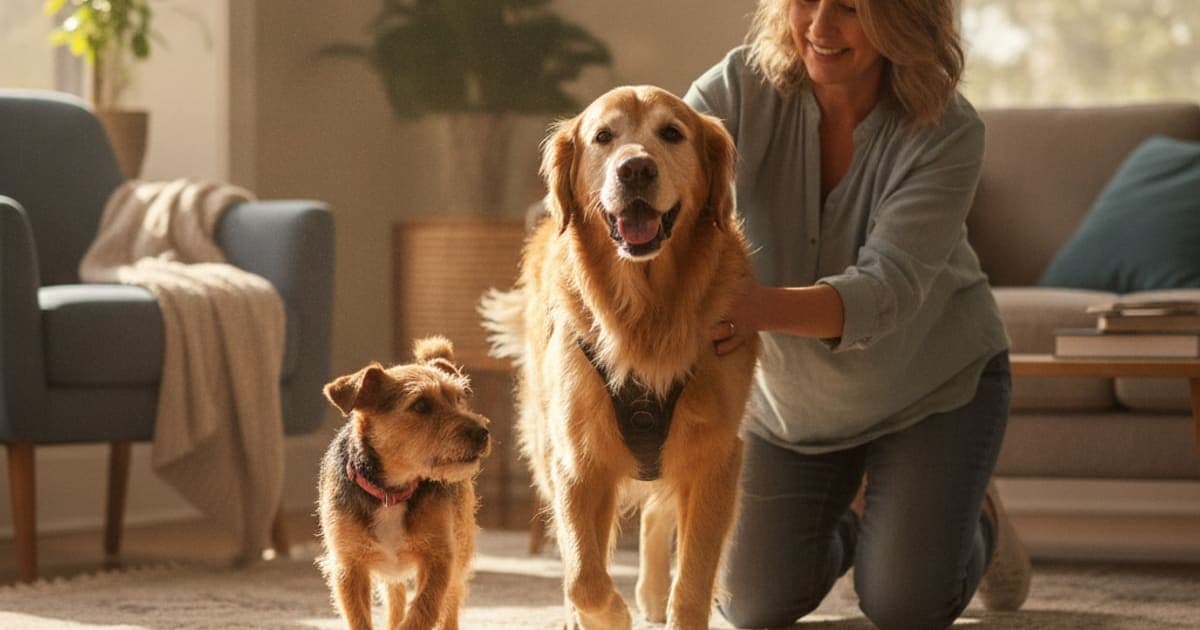
When your senior dog goes blind, the practical answer is this: get a veterinary eye exam booked even if the change looks gradual, stop rearranging furniture, and give your dog a few weeks to re-map the house by nose, ears and memory. Some causes of vision loss in older dogs are painful or reversible and need attention within days. Others are slow and painless and simply need adaptation. Either way, dogs navigate the world on scent and sound long before they lean on sight, which is why so many go blind without their owners noticing until something changes in the house.
A blind dog is not a broken dog — most older dogs who lose their sight settle into a new normal within weeks, and the single biggest factor in how well they cope is how consistent you keep their world.
This guide covers how to tell if your senior dog is going blind, why eyesight fades with age, which signs mean "call the clinic today," and the home adaptations that make the most difference.
The early signs most owners notice first
Senior dog vision loss rarely announces itself. It leaks out in small behaviours, usually in low light first, because the rod cells that handle dim vision tend to go before daylight vision does.
Watch for:
- Bumping into furniture, door frames or table legs — especially at dusk, in unfamiliar rooms, or in a house where something was recently moved
- Hesitating at the top of stairs, at thresholds, or before stepping off a kerb
- Missing a treat dropped on the floor, then finding it by sniffing in circles
- Startling when touched or when someone approaches quietly
- Walking close to walls, or tracking the edge of a room instead of crossing the middle
- Reluctance to jump onto the sofa or into the car — a dog that can't judge distance stops committing to the leap
- New clinginess, pacing at night, or anxiety when left in an unfamiliar space
- Eyes that look cloudy, hazy, reddened, or pupils that stay wide and don't shrink in bright light
One distinction matters enormously. A soft blue-grey haze in the centre of both lenses in a dog over about seven is usually nuclear sclerosis — a normal hardening of the lens that scatters light but leaves functional vision largely intact. A dense, white, opaque look that you cannot see through is more consistent with a cataract, which does block vision. Owners confuse the two constantly. Your veterinarian can tell them apart in minutes with a light and an ophthalmoscope, so don't self-diagnose a cloudy eye.
Why do old dogs go blind? The common causes
Age itself doesn't blind a dog. Age-associated disease does, and the list is short enough to be useful.
| Cause | What you may see | Typical onset | How urgent |
|---|---|---|---|
| Nuclear sclerosis | Blue-grey haze in both lenses, little behaviour change | Very gradual | Routine — monitor at check-ups |
| Cataracts | White, opaque lens; bumping into things; may follow diabetes | Weeks to years | Soon — needs assessment; surgery is possible in selected cases |
| Glaucoma | Red, bulging, painful eye; squinting; dilated pupil; lethargy | Hours to days | Emergency — pressure damages the retina fast |
| Progressive retinal atrophy | Night blindness first, then daytime; eyes look normal | Months to years | Soon — diagnosis guides planning, no reversal |
| Sudden acquired retinal degeneration | Blindness over days; often increased thirst and appetite | Days | Urgent — needs full workup |
| Retinal detachment or bleeding | Abrupt blindness, sometimes blood visible in the eye | Sudden | Emergency — often linked to high blood pressure |
| Dry eye (KCS) | Sticky discharge, dull cornea, repeated conjunctivitis | Gradual | Soon — manageable, and uncomfortable if ignored |
| Diabetes-related cataract | Rapid lens clouding alongside thirst and weight change | Weeks | Urgent — systemic disease comes first |
So do dogs go blind when they get old? Not inevitably. Plenty of dogs reach the end of a long life with workable vision. What rises with age is the likelihood of the conditions above — and of systemic problems such as hypertension or diabetes that show up in the eye before they show up anywhere else. That is why a vision change in an older dog deserves a full physical exam, blood work and a blood pressure reading, not just a look at the eyes.
What if it came on suddenly?
Speed of onset is the most informative thing you can tell your vet. Three patterns matter.
Blindness over a day or two, with the eyes looking normal
A dog that was fine on Friday and walking into walls on Sunday, with clear eyes and no redness, points toward the retina or the optic pathway rather than the lens. This is a same-week veterinary visit at minimum, and often sooner, because conditions like retinal detachment from high blood pressure can sometimes be addressed if caught early.
Senior dog eye twitching with loss of balance
Rhythmic flicking of the eyes (nystagmus) combined with a head tilt, stumbling, circling or falling is usually not a primary eye problem at all. That cluster points to the vestibular system — the balance apparatus of the inner ear and brainstem. Old dog vestibular disease is a common cause and many dogs improve substantially with supportive care, but the same signs can come from an ear infection, a stroke-like event or other neurological disease. Call your veterinarian the day you see it. Don't assume your dog has gone blind; assume the balance system is involved until a professional says otherwise.
A red, cloudy, painful eye
Squinting, tearing, a bulging globe, a dog that pulls away when you approach the head — treat this as an emergency. Acute glaucoma is genuinely painful and the window to protect remaining sight is measured in hours.
What to do when your old dog goes blind: the first month
Start with the diagnosis. Your veterinarian owns that, and a referral to a veterinary ophthalmologist is reasonable whenever the cause isn't obvious or the eye is painful. Cataract surgery, glaucoma management and treatment of underlying diabetes or hypertension are all real medical options that only a clinician can assess for your dog. Ask two questions at the appointment: is my dog in pain, and is any of this reversible?
Then work on the environment. The principle behind every good adaptation is the same — a blind dog navigates from a mental map, so protect the map.
- Freeze the furniture. Sofas, bins, water bowls and beds stay exactly where they are. If you must move something, walk your dog to it on lead a few times.
- Block the hazards. Baby gates at the top and bottom of stairs. Pool fencing. Padding on sharp coffee-table corners. Chairs pushed in.
- Build texture cues. A runner rug leading to the back door, a different mat at the food station, a non-slip strip at the bottom step. Dogs read flooring through their paws beautifully.
- Add scent and sound markers. A dab of a specific essential oil (vet-approved and well diluted) near doorways, a ticking clock by the bed, a water fountain that burbles.
- Talk more. Announce yourself before touching. Say a word before you lift them. Teach simple directional cues — "step up," "wait," "left" — which most dogs learn fast because they are motivated to.
- Keep walks going. Same route, lead on, let the nose lead. Exercise matters more after sight loss, not less.
- Protect the face. A halo harness with a padded hoop stops head bumps while your dog is still learning the map.
Caring for an elderly blind dog is mostly these small, boring consistencies. Owners routinely report that the hardest few weeks are the first ones, and that the dog adjusts before they do.
The body behind the eyes: confidence depends on the legs
Here's the part that gets missed. A dog without sight relies far more heavily on proprioception — the body's sense of where its own limbs are — and on the strength to stop a stumble before it becomes a fall. When an older dog is also dealing with stiff hips, a sore cruciate or chronic soft-tissue wear, hesitancy at the stairs may be as much about the joints as the retina. Two dogs with identical vision loss can look completely different if one has comfortable, stable movement and the other doesn't.
That is the space pawgen works in. K9-REPAIR is a BPC-157 and TB-500 peptide formulation for dogs, built around canine joint, tendon and mobility recovery. BPC-157 is a synthetic peptide sequence derived from a protein found in gastric juice; research suggests it plays a role in tendon and ligament repair signalling and in the formation of new blood vessels at an injury site. TB-500 is a synthetic form of thymosin beta-4, a protein involved in actin regulation and cell migration — the cellular traffic control that soft tissue uses while it remodels. Neither is an FDA-approved veterinary drug, and nothing here is a statement about what will happen to your dog. What pawgen can say plainly is what's in the bottle, that dosing is weight-based, that every batch is third-party tested with published certificates of analysis, that it ships direct to your door, and that it is backed by a 60-day money-back guarantee. It is the stack a lot of owners adopt during mobility recovery, and the reason they choose it is mechanism, not marketing — which is more than can be said for the underdosed kitchen-sink chews that list twenty ingredients and disclose the amount of none of them.
It is not an eye product, it is not a substitute for anything your veterinarian has prescribed, and it is not a reason to delay a surgical consult. Talk to your veterinarian before adding it, particularly for a senior dog already on medication, and never for a puppy, pregnant or nursing dog without professional guidance.
Key takeaways
- Vision loss in senior dogs is usually gradual and often hidden until the furniture moves or the lights go down.
- A blue-grey haze in both lenses is commonly normal lens ageing; a dense white opacity is not — only an exam can distinguish them.
- Sudden blindness, a red painful eye, or eye twitching with loss of balance are same-day veterinary calls.
- Some causes are treatable or driven by systemic disease, so expect blood work and a blood pressure check, not just an eye look.
- Home adaptation is mostly consistency: fixed furniture, blocked hazards, texture and scent cues, verbal warnings, unchanged walks.
- Mobility and comfort shape how confidently a blind dog moves, which is where supportive options like K9-REPAIR sit.
Your veterinarian owns the diagnosis and the treatment plan — the eye exam, the referral, the surgery decision, the prescriptions. Supplements and peptides only ever operate in the space that proper veterinary care creates. Get the medical picture first, build the safe house second, and give your dog the weeks they need to prove how well they can live without their eyes.
More from pawgen: batch certificates of analysis are published at /coas/, the K9-REPAIR formulation and weight-based guidance are on the shop page, and shipping coverage is listed at /location/.
Owners exploring peptide support for their dog can review K9-REPAIR — BPC-157 + TB-500 formulated for dogs — at https://pawgen.com/. BPC-157 and TB-500 are not FDA-approved veterinary drugs. Nothing in this article treats, cures or prevents any condition; every decision about your dog's care belongs with your veterinarian.
Frequently asked questions
- When your senior dog goes blind, what should you do first?
- Book a veterinary exam first, even if the change seems slow. Some causes are painful or linked to systemic disease such as diabetes or high blood pressure. Meanwhile, stop moving furniture, gate the stairs, and announce yourself before touching your dog. Most dogs re-map the house within a few weeks.
- How to tell if your senior dog is going blind?
- Look for bumping into objects in dim light, hesitating at stairs or thresholds, missing dropped treats, startling at touch, reluctance to jump, walking along walls, and cloudy eyes or pupils that stay wide. Any of these warrants a veterinary eye exam rather than guesswork at home.
- Why do old dogs go blind?
- Age itself does not cause blindness; age-related disease does. The usual culprits are cataracts, glaucoma, progressive retinal atrophy, sudden acquired retinal degeneration, retinal detachment from high blood pressure, and diabetes-related lens changes. Because several are systemic, expect blood work and a blood pressure reading alongside the eye exam.
- Why do dogs go blind with age?
- Ageing tissue changes the eye: the lens hardens, the retina can degenerate, fluid drainage can fail, and chronic conditions such as diabetes or hypertension accumulate. Those processes damage different structures, which is why onset speed varies from years to overnight. Your veterinarian identifies which structure is involved.
- What to do when your old dog goes blind?
- Confirm the cause with your vet, then adapt the home. Keep furniture fixed, gate stairs, pad sharp corners, add texture rugs and scent markers at doorways, use verbal cues before touching or lifting, and keep walking the same familiar routes. Consistency rebuilds confidence faster than anything else.
- Do dogs go blind when they get old?
- Not inevitably. Many dogs keep workable vision for life. What increases with age is the chance of cataracts, glaucoma, retinal degeneration and systemic disease that affects the eye. Mild lens clouding in older dogs is often normal ageing rather than true blindness, so get it checked.
- My senior dog has eye twitching and loss of balance - is that vision loss?
- Probably not primarily. Rhythmic eye flicking with head tilt, circling or stumbling points to the vestibular balance system rather than the eyes. Old dog vestibular disease, ear infection and neurological events all produce it. Call your veterinarian the same day for an assessment.
- Can K9-REPAIR help a blind senior dog?
- K9-REPAIR is a BPC-157 and TB-500 peptide formulation focused on joint, tendon and mobility support, not vision. It is not an FDA-approved veterinary drug and makes no treatment claims. Owners adopt it during mobility recovery; discuss it with your veterinarian before adding anything for a senior dog.
Educational content. BPC-157 and TB-500 are not FDA-approved veterinary drugs. Talk to your veterinarian before starting anything new, especially if your dog is on prescribed medication.