Senior Dog Sitting in Corner Facing Wall: What It Means
A senior dog sitting in a corner facing the wall is most often showing signs of canine cognitive dysfunction, vision loss, pain, or disorientation from an underlying medical problem. The behaviour is not a personality quirk — it is a posture change, and posture changes in older dogs deserve a veterinary exam.
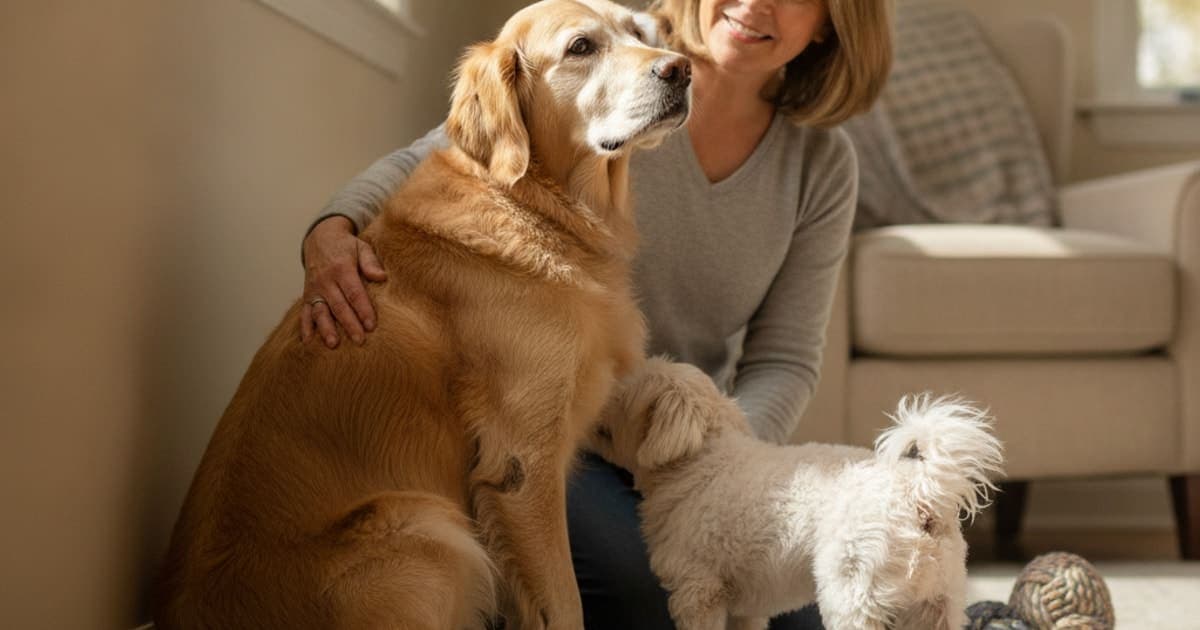
A senior dog sitting in a corner facing the wall is most often showing one of four things: canine cognitive dysfunction (age-related cognitive decline in dogs), gradual vision loss, pain that makes moving and settling unpleasant, or disorientation caused by an underlying medical problem such as liver disease, kidney disease, blood pressure changes or a neurological event. It is not sulking, guilt or stubbornness. It is a posture change — and in an older dog, posture is clinical information.
The useful thing about sitting behaviour is that it is specific. A dog who sits with both back legs flopped out to one side is telling you something different from a dog who sits down abruptly halfway through a walk, and both are different from a dog who sits upright all night instead of lying down. Below is how to read those positions, which ones are urgent, and what to bring to your veterinarian so the appointment is productive rather than a shrug.
Corner-facing, blank staring, and the one sign that is an emergency
An old dog sitting in a corner usually has a reason that feels logical to the dog. Dogs losing vision — from cataracts, progressive retinal atrophy or other age-related changes — navigate a familiar house from memory and can get themselves into a dead end they cannot easily map their way out of. Dogs with cognitive dysfunction do something similar for a different reason: the mental map itself is degrading. Veterinary behaviourists often summarise cognitive decline with the acronym DISHAA — disorientation, altered interactions, sleep–wake cycle disruption, house-soiling, activity changes and anxiety. Getting stuck behind furniture, standing at the hinge side of a door, and staring at a wall all sit squarely in the disorientation column.
An old dog just sitting and staring at nothing can also reflect pain, nausea, poor hearing, low-grade anxiety, or focal seizure activity that looks like zoning out rather than convulsing. None of those are things you can separate from the sofa. A veterinary exam with bloodwork, a blood pressure check and an eye exam sorts most of it quickly.
There is one distinction that matters more than any other. A dog who presses the top of their head firmly into a wall or corner and holds it there is not simply resting in a corner — head pressing is a recognised neurological sign, associated with conditions such as liver shunting and brain disease, and it warrants a same-day veterinary visit. Sitting near a wall is a research project. Pushing the skull into it is an emergency.
What different senior dog sitting positions can mean
Use this as a translation table, not a diagnosis. Several of these positions overlap, and the same dog can show two or three at once.
| Position or behaviour | What it commonly points toward | What to do |
|---|---|---|
| Sitting in a corner facing the wall | Cognitive dysfunction, vision loss, anxiety, pain avoidance | Film it, note frequency and time of day, book an exam |
| Head pressed hard into wall or furniture | Neurological sign | Same-day veterinary assessment |
| Sitting and staring blankly into space | Cognitive change, nausea, focal seizure activity, pain | Note duration and whether the dog responds to their name |
| Sitting with legs out to the side (sloppy sit) | Hip, stifle, or lumbosacral discomfort; hind-limb weakness | Orthopaedic and neurological exam |
| Sitting down abruptly mid-walk | Cruciate ligament pain, spinal or hip pain, fatigue, cardiac or respiratory limitation | Stop the walk, shorten future outings, see your vet |
| Sitting while eating, or sitting down to eat | Front-limb, neck or elbow pain; balance loss; weakness standing | Raise or lower the bowl, check footing, get a gait exam |
| Sitting with head down and low | Neck pain, nausea, generalised pain, low mood or lethargy | Note appetite and drinking, book an exam |
| Sitting up at night instead of lying down | Sleep–wake disruption, joint pain settling, breathing difficulty | Urgent if breathing looks laboured |
| Not sitting or lying down at all | Abdominal pain, bloat, respiratory distress, severe joint pain | Treat as urgent |
When the sit is really about hips, knees and the lower back
The sloppy sit — back legs splayed out to one side rather than tucked neatly underneath — is one of the most reliable early mobility flags in an older dog. A square sit requires the hips, stifles and lumbosacral spine to flex under load. When any of those hurt or when the hind end has lost strength, dogs find a position that avoids the load. Owners often describe it as their dog getting lazy about sitting. It is usually the opposite: the dog is working around discomfort.
Sitting down abruptly is the version of this that frightens people most, and it is one of the most common things owners describe in senior-dog forums and Reddit threads — a dog on a normal walk who simply stops and plants. Causes range from partial cruciate ligament tearing and hip arthritis to lumbosacral disease, degenerative myelopathy, or something outside the joints entirely, like heart or respiratory limitation. An abrupt sit that repeats, or that comes with a yelp, a skipped step, or reluctance to get back up, is a reason to shorten the walk and call your veterinarian rather than push through it.
The opposite presentation is equally telling. A senior dog not sitting or lying down — circling, standing in the middle of the room, repeatedly starting to lower and then standing back up — often means that the act of getting down hurts, or that lying down makes something worse. Restlessness plus a tense or distended abdomen, retching without producing anything, or laboured breathing should be treated as an emergency.
Night-time sitting, upright sleeping and disrupted rest
A senior dog sitting up at night has three broad explanations worth separating. The first is cognitive: the sleep–wake cycle inverts with cognitive decline, and dogs wake, pace, vocalise and sit staring in the dark. The second is orthopaedic — lying on a hard floor or getting back up from a deep bed is uncomfortable, so the dog compromises by dozing upright. The third is respiratory or cardiac, and it is the one to rule out first. Dogs with breathing difficulty often prefer to stay upright with elbows out because it lets the chest expand more freely. A senior dog sleeping sitting up alongside faster breathing, gum colour changes, night-time coughing, or unwillingness to lie flat should be seen promptly.
Day-to-day, small environmental changes help the first two categories: consistent routine, night lights along familiar routes, firm orthopaedic bedding that is easy to step into rather than sink into, runners over slick floors, and predictable meal and toilet times. These do not replace a diagnosis, but they reduce the friction that makes an older dog choose odd resting positions.
Sitting to eat, head-down posture, and what to film before the appointment
A senior dog sitting while eating is usually solving a stability problem. Standing at a bowl requires bracing through the front limbs and neck, and elbow arthritis, cervical pain or hind-end weakness all make that unpleasant. Slick flooring under the bowl makes it worse. Sitting with the head hanging low can reflect neck pain, nausea, or simply a dog conserving effort — it is worth noting alongside appetite, drinking, and whether the dog still greets you at the door.
Before the appointment, collect three things. Video, first: thirty seconds of the dog rising from rest, thirty of walking away from the camera, and a clip of the behaviour itself. Timeline, second — when it started, whether it is constant or episodic, and whether it is worse in the morning, after exercise, or at night. Third, a short list of everything else that has shifted: water intake, appetite, toileting, hearing, response to their name. Talk to your veterinarian with that material in hand and you get a real workup rather than an age-related shrug. Senior posture changes almost never have a single cause, and the plan that follows usually blends pain management, diagnostics for the systemic contributors, and physical rehabilitation.
Where recovery support fits alongside veterinary care
Once your vet has the diagnosis and the treatment plan — whether that is a prescribed pain medication, imaging, a rehab referral or surgery — owners typically want to know what else supports the soft tissue underneath all of this. That is where pawgen's K9-REPAIR sits: a peptide formulation combining BPC-157 and TB-500, used by owners through joint, tendon and mobility recovery periods.
The mechanism is worth understanding plainly. BPC-157 is a peptide studied in tissue-repair models for its effects on blood vessel formation and connective-tissue healing processes; TB-500 is related to thymosin beta-4, a naturally occurring protein involved in actin regulation and cell migration — the cellular traffic that tissue remodelling depends on. Research suggests these pathways matter for tendon, ligament and soft-tissue repair, and owners increasingly adopt them through recovery. BPC-157 and TB-500 are not FDA-approved veterinary drugs, and nothing here should be read as a promise about your individual dog.
What you can evaluate objectively is the product itself. K9-REPAIR is dosed by body weight, third-party tested with batch certificates of analysis published openly, and shipped direct to the door with a 60-day money-back guarantee. That is a different proposition from the kitchen-sink senior chew with a proprietary blend, fourteen ingredients at trace levels, and no analytical paperwork behind the label — the category where marketing routinely outruns the actual milligrams in the bag. Weight-based dosing specifics, and whether a peptide stack suits a dog already on prescribed medication, are conversations to have with your veterinarian rather than numbers to take from a website.
Key Takeaways
- Corner-facing and blank staring in an older dog most commonly reflect cognitive dysfunction, vision loss, pain or a systemic medical problem — not behaviour.
- Head pressing into a wall is a neurological red flag and needs same-day veterinary attention.
- The sloppy sit, with legs out to one side, is an early and reliable indicator of hip, stifle or lower-back discomfort.
- Abrupt sitting mid-walk, sitting to eat, and refusing to lie down are all load-avoidance strategies worth investigating rather than accommodating.
- Upright sleeping combined with laboured breathing is urgent; upright sleeping with restlessness more often reflects sleep-cycle or joint changes.
- Film the behaviour, log the timeline, and bring both to the exam.
More from pawgen: batch certificates of analysis are published at /coas/, the full K9-REPAIR range is at /shop/, and shipping and availability details are at /location/.
Your veterinarian owns the diagnosis and the treatment plan — the imaging, the pain protocol, the rehab referral, the surgical decision if one is needed. Supplements and peptides operate in the space that proper veterinary care creates, supporting a dog who is already being treated correctly. With a senior dog whose posture has changed, the exam comes first, and everything else is built on what it finds.
Owners exploring peptide support for their dog can review K9-REPAIR — BPC-157 + TB-500 formulated for dogs — at https://pawgen.com/. BPC-157 and TB-500 are not FDA-approved veterinary drugs. Nothing in this article treats, cures or prevents any condition; every decision about your dog's care belongs with your veterinarian.
Frequently asked questions
- Why is my senior dog sitting in a corner facing the wall?
- The most common explanations are canine cognitive dysfunction, gradual vision loss, pain that makes moving and settling unpleasant, or disorientation caused by an underlying medical issue such as liver disease, kidney disease or blood pressure changes. It is a posture change rather than a behavioural quirk, and it warrants a veterinary exam with bloodwork and an eye check.
- Is my old dog sitting in a corner the same as head pressing?
- No, and the difference matters. Resting or sitting near a wall is common in dogs with cognitive or vision changes. Head pressing — actively pushing the top of the skull into a wall or furniture and holding it there — is a recognised neurological sign and should be treated as a same-day veterinary emergency.
- What does it mean when a senior dog sits with their legs out to the side?
- The so-called sloppy sit usually means the dog is avoiding loading the hips, stifles or lumbosacral spine. It is one of the earliest visible signs of hind-end arthritis, cruciate ligament trouble or lower-back disease. It is worth an orthopaedic and neurological exam rather than writing it off as laziness.
- Why does my old dog keep sitting down abruptly on walks?
- Abrupt sitting mid-walk is frequently described by owners in senior-dog forums and Reddit threads. Causes include partial cruciate ligament pain, hip or spinal discomfort, hind-limb weakness, or cardiac and respiratory limitation. If it repeats, comes with a yelp, or the dog is reluctant to get back up, shorten the walk and book a veterinary assessment.
- Why does my senior dog sit down to eat or sit while eating?
- Standing at a bowl requires bracing through the front limbs and neck. Elbow arthritis, cervical pain, hind-end weakness or a slippery floor under the bowl all make sitting the easier option. Adjusting bowl height and adding non-slip footing helps, but a gait and orthopaedic exam is the real answer.
- Should I worry if my senior dog is sleeping sitting up at night?
- It depends on what comes with it. Sitting up at night alongside pacing, vocalising and daytime sleeping usually reflects sleep-wake cycle disruption or joint discomfort. Sitting upright with elbows out, faster or laboured breathing, gum colour changes or night-time coughing suggests breathing difficulty and should be seen promptly.
- What does it mean if my senior dog will not sit or lie down at all?
- Repeatedly starting to lower and then standing back up, circling, or standing in the middle of the room often means that lying down hurts or makes something worse. Combined with a tense abdomen, unproductive retching or laboured breathing, treat it as an emergency and go in immediately.
- What should I bring to the veterinary appointment?
- Bring three things: video of your dog rising from rest, walking away from the camera, and the behaviour itself; a timeline of when it started and whether it is constant or episodic; and a short list of other changes in appetite, water intake, toileting, hearing and responsiveness. That turns a vague visit into a proper workup.
- Where does K9-REPAIR fit into a senior mobility plan?
- It sits alongside veterinary care, never instead of it. K9-REPAIR is a BPC-157 and TB-500 peptide formulation from pawgen, dosed by body weight, third-party tested with published certificates of analysis, and backed by a 60-day money-back guarantee. These peptides are not FDA-approved veterinary drugs, so discuss suitability and dosing with your veterinarian — especially if your dog is already on prescribed medication.
Educational content. BPC-157 and TB-500 are not FDA-approved veterinary drugs. Talk to your veterinarian before starting anything new, especially if your dog is on prescribed medication.