Do Shar Peis Have Health Problems? (Breed Risks)
Yes. The Chinese Shar-Pei is a wrinkled, short-muzzled breed with several well-documented inherited risks: skin fold dermatitis, familial Shar-Pei fever and amyloidosis, entropion, recurrent ear infections, allergies and joint disease. Most are manageable when caught early, which makes routine veterinary monitoring the single most valuable thing an owner does.
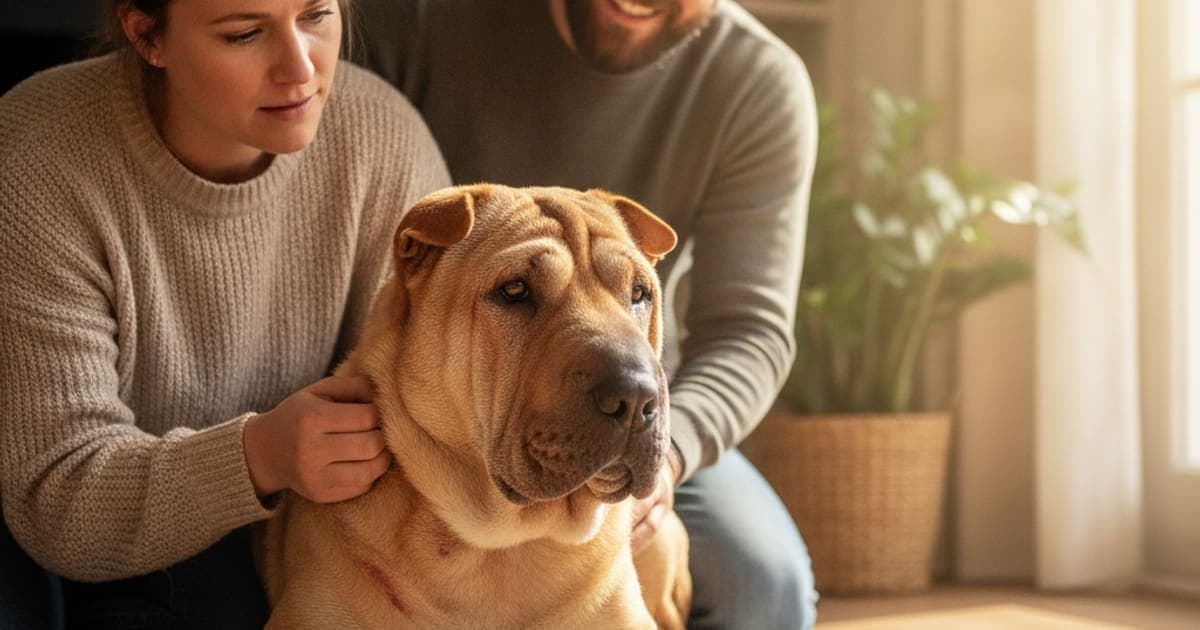
Yes, more than most breeds, and the reasons are structural rather than mysterious. The Chinese Shar-Pei was selected for thickened, mucin-rich skin that falls into deep folds, a short broad muzzle, small deep-set eyes and narrow ear canals. Each of those traits carries a predictable medical consequence. The problems owners meet most often are skin fold dermatitis and recurrent pyoderma, familial Shar-Pei fever and the amyloidosis that can follow it, entropion, chronic ear infections, allergic skin disease, hypothyroidism, and the joint and soft-tissue wear that surfaces in middle age.
None of that makes the breed a poor choice. It makes it a breed that rewards an owner who knows the warning signs early and who has a veterinarian willing to monitor the specific risks this breed carries.
Why the wrinkles drive so many Shar-Pei medical problems
The breed's signature folds are not just loose skin. Shar-Peis carry an unusually large amount of hyaluronic acid in the dermis: the trait behind cutaneous mucinosis, where clear, jelly-like vesicles can appear on the skin. That same thickened skin creates fold architecture that traps heat, moisture, saliva, tears and debris.
A warm, airless, moist fold is a bacterial and yeast incubator. The result is intertrigo, or skin fold dermatitis: red, damp, foul-smelling skin at the base of a fold, often with the dog rubbing or scratching at it. Left alone it progresses to deeper pyoderma that needs prescription treatment, not wipes.
Two other skin issues cluster in the breed. Demodicosis, overgrowth of the mite Demodex canis, shows up most often in puppies and young adults as patchy hair loss, and it needs a veterinary skin scrape to confirm rather than guesswork. Atopic dermatitis, or environmental allergy, is also common and frequently presents as itchy paws, ears and face long before anything looks dramatic.
Daily management is unglamorous and genuinely effective: check and dry every fold, keep the dog lean so folds sit looser, dry thoroughly after swimming or bathing, and get an early look from your veterinarian the moment a fold smells off. Chronic skin disease in this breed is nearly always easier to control at week one than at week six.
Familial Shar-Pei fever and amyloidosis explained
Familial Shar-Pei fever (FSF) is the breed-defining condition and the one every owner should be able to recognise. It presents as episodes of sudden high fever, lethargy, reluctance to move and often a hot, painfully swollen hock: the "swollen hock syndrome" the breed is known for. Episodes are self-limiting and the dog typically looks normal again afterwards, which is exactly why they get dismissed.
They should not be dismissed. Repeated inflammatory episodes are linked to systemic amyloidosis, in which amyloid protein deposits in organs: most consequentially the kidneys, and sometimes the liver. Amyloidosis is the reason Shar-Peis appear in veterinary discussions of early-onset renal failure. The warning signs are the usual kidney signs: increased drinking and urination, weight loss, poor appetite, vomiting.
This is squarely veterinary territory. A vet will want temperature records, bloodwork, and urine protein testing to track kidney function over time, and some veterinarians prescribe long-term medication aimed at reducing the frequency of inflammatory episodes in affected dogs. A genetic test associated with FSF risk is available through breed research channels, and responsible breeders screen with it. If you own a Shar-Pei and have never discussed FSF with your veterinarian, that conversation is worth booking on its own.
Eyes, ears, airway and mouth: the conformation problems
Entropion is the second signature issue. Heavy brow folds roll the eyelid inward so lashes and haired skin abrade the cornea. It hurts, it causes squinting, tearing and discharge, and untreated it leads to corneal ulceration and scarring. Puppies are sometimes treated with temporary eyelid tacking to hold the lid out while the head grows; definitive correction is a surgical procedure performed by a veterinarian, and it is the correct answer when a vet recommends it.
Narrow, stenotic ear canals mean the breed is prone to recurrent otitis externa. The short muzzle brings a degree of brachycephalic airway compromise: noisy breathing, low heat tolerance, exercise intolerance in humidity. Hiatal hernia also appears in the breed and can cause regurgitation in young dogs. "Tight lip syndrome," where the lower lip rolls over the incisors, is another breed-reported conformational problem needing surgical assessment.
| Problem | What you notice at home | Who manages it |
|---|---|---|
| Entropion | Squinting, watery eye, pawing at face | Veterinarian; often surgical correction |
| Skin fold dermatitis | Odour, redness, dampness in a fold | Vet for medicated protocol; owner for daily fold care |
| Shar-Pei fever | Sudden fever, swollen hock, won't move | Veterinarian, urgently, plus long-term kidney monitoring |
| Chronic ear infections | Head shaking, odour, dark discharge | Veterinarian; cytology before any ear product |
| Heat and airway strain | Loud breathing, fatigue in warm weather | Vet assessment; owner manages weight and heat exposure |
| Joint and ligament wear | Stiffness after rest, limping, slowing down | Veterinarian for diagnosis, imaging and rehab plan |
Joints, ligaments and mobility in the middle years
Shar-Peis are a compact, heavy-bodied breed, and orthopaedic wear is a common second act. Hip dysplasia, elbow dysplasia, patellar luxation and cranial cruciate ligament injury all appear in the breed, and osteoarthritis follows any of them. Because stoicism is a breed trait, the first sign is often behavioural: slower on stairs, reluctant to jump into the car, stiff for the first few minutes after a nap.
The veterinary plan comes first and is not optional. That may mean radiographs, pain control, a prescribed anti-inflammatory, a surgical referral for a cruciate repair, and a structured rehabilitation programme afterwards. Weight management does more for a dysplastic Shar-Pei than any product on any shelf. Nothing here should ever be stopped or substituted because of a supplement.
Inside that plan, recovery and connective-tissue support is where owners start looking for more than a scoop of kitchen-sink chews. Most joint chews on the shelf are long ingredient lists hidden behind proprietary blends, with no way to know how much of anything is actually in the tub: that is the part of this market that deserves scepticism.
pawgen takes a different approach with K9-REPAIR, a BPC-157 and TB-500 peptide formulation made for dogs. BPC-157 is a synthetic peptide based on a sequence identified in gastric juice; published laboratory and animal research suggests it influences angiogenesis and the migration of tendon and ligament fibroblasts: the cellular traffic that connective tissue repair depends on. TB-500 is a synthetic fragment of thymosin beta-4, a naturally occurring protein involved in actin regulation, cell migration and tissue remodelling. That mechanism is why this pairing has become the stack many owners adopt through a recovery window, and why owners report using it alongside, never instead of, the rehab plan their vet set.
To be clear about the regulatory position: BPC-157 and TB-500 are not FDA-approved veterinary drugs, this is educational information, and no peptide treats, cures or prevents any condition in your dog. What pawgen can state plainly is what is in the bottle: a defined two-peptide formulation, third-party tested with certificates of analysis published for each batch, dosed by body weight, shipped direct to your door, and backed by a 60-day money-back guarantee. Dosing itself is a conversation for your veterinarian, who knows your dog's kidney values: a particularly important point in a breed with amyloidosis risk.
What if my dog is a mini, a bear coat, or a mix?
Mini Shar-Peis
The "mini" or "miniature" Shar-Pei is not a separate breed recognised by major registries: it is a smaller-statured Shar-Pei, often produced by selecting for size from a narrower gene pool. The health risks are the same list: fold dermatitis, FSF and amyloidosis, entropion, ear and airway problems. Selecting hard for size within a small population tends to concentrate inherited risk rather than dilute it, so ask any breeder about FSF screening and the health of the parents' kidneys.
Bear coat and other coat types
Shar-Peis come in horse coat (short and harsh), brush coat (slightly longer), and bear coat (long, soft, non-standard). Coat length does not change the inherited disease list. What it changes is fold hygiene: a bear coat holds more moisture against the skin inside a fold and takes longer to dry, which makes a bear coat Shar-Pei a dog whose folds need checking and drying with real discipline, especially after swimming or a bath.
Shar-Pei mixes
Mixes may inherit fewer folds, a longer muzzle, or a less extreme eyelid, and with them, less risk. But FSF-associated genetics can carry through, and a Shar-Pei mix with deep facial folds still has fold disease risk. Treat the dog in front of you, not the label on the adoption paperwork, and tell your vet the breed mix so FSF stays on the differential list if an unexplained fever appears.
Shar-Pei puppies
Puppy-stage concerns skew toward entropion that needs early assessment, demodicosis, hiatal hernia and regurgitation, and first FSF episodes, which can occur young. Peptide products are not a puppy topic; growth-stage decisions belong entirely to your veterinarian.
Key takeaways
- Yes, Shar-Peis have a genuinely above-average burden of breed-specific health problems, almost all traceable to skin and skull conformation plus inherited inflammatory disease.
- Skin fold dermatitis is daily-management territory; Shar-Pei fever and amyloidosis are monitoring territory and belong to your vet.
- Entropion, stenotic ear canals and brachycephalic airway strain are conformational and often surgically managed.
- Mini, bear coat and mixed Shar-Peis carry the same inherited risks; coat and size change hygiene and severity, not the underlying list.
- Orthopaedic wear is common in middle age, and recovery support works best layered on top of a veterinary diagnosis.
Where your veterinarian fits in all of this
Every condition on this page is diagnosed with an exam, a scrape, a culture, bloodwork, a urine protein ratio or an X-ray, not with a web page and not with a product label. Your veterinarian owns the diagnosis and the treatment plan, including when surgery is the right call and which medications stay in place. A diagnosis is the only thing that turns a Shar-Pei's symptom into a plan, and everything else, weight control, fold hygiene, rehab, and anything from pawgen, works inside the space that proper veterinary care creates.
If you want to go deeper, pawgen publishes condition-by-condition explainers at /conditions/, third-party certificates of analysis for each batch at /coas/, shipping and availability information at /location/, and the full K9-REPAIR listing with its 60-day money-back guarantee at /shop/ on pawgen.com.
Owners exploring peptide support for their dog can review K9-REPAIR, BPC-157 + TB-500 formulated for dogs, at https://pawgen.com/. BPC-157 and TB-500 are not FDA-approved veterinary drugs. Nothing in this article treats, cures or prevents any condition; every decision about your dog's care belongs with your veterinarian.
Frequently asked questions
- Do shar peis have health problems?
- Yes. Shar Peis are predisposed to skin fold dermatitis, familial Shar-Pei fever, renal and hepatic amyloidosis, entropion, chronic ear infections, allergies, hypothyroidism and joint disease such as hip dysplasia. Most are manageable with early detection, routine veterinary monitoring, weight control and daily fold care, so ask your vet which risks apply to your dog.
- Do shar pei have health problems?
- They do, and more than the average breed. The folded skin, short muzzle, deep-set eyes and narrow ear canals each create predictable problems, while familial Shar-Pei fever and amyloidosis are inherited. Knowing the warning signs and keeping regular veterinary checks is what keeps most of these conditions controllable.
- What is Shar-Pei fever and how serious is it?
- Familial Shar-Pei fever causes episodes of sudden high fever, lethargy and a hot, swollen hock. Episodes resolve on their own, but repeated inflammation is linked to amyloidosis, where protein deposits damage the kidneys or liver. Any unexplained fever in this breed warrants same-day veterinary attention and ongoing kidney monitoring.
- How should I care for my Shar-Pei's wrinkles?
- Check every fold daily, clean gently as your veterinarian directs, and dry thoroughly: trapped moisture is what drives fold dermatitis. Keep the dog lean so folds sit looser, dry carefully after baths or swimming, and book a vet visit at the first sign of odour, redness or dampness.
- Do mini Shar Peis have more health problems?
- Mini Shar-Peis are not a separately recognised breed, and they carry the same inherited risks: fold dermatitis, Shar-Pei fever, amyloidosis, entropion and ear problems. Breeding hard for small size within a narrow gene pool can concentrate inherited risk, so ask breeders directly about fever screening and parental kidney health.
- Are bear coat Shar Peis less healthy than other coat types?
- Coat type does not change the inherited disease list. A bear coat's longer, softer hair holds moisture inside skin folds and dries more slowly, which raises the practical risk of fold dermatitis. Bear coat owners simply need stricter drying and fold-checking routines than horse or brush coat owners.
- What health problems do Shar-Pei puppies have?
- Puppy-stage issues include entropion needing early assessment, demodectic mange, hiatal hernia causing regurgitation, and first episodes of Shar-Pei fever, which can appear young. Any squinting, patchy hair loss, repeated regurgitation or unexplained fever should be examined promptly rather than watched. Growth-stage decisions belong entirely to your veterinarian.
- Do Shar-Pei mixes inherit the same health issues?
- Sometimes. A mix with a longer muzzle and fewer folds often carries less conformational risk, but fever-associated genetics can still pass through, and deep facial folds still mean fold disease risk. Tell your veterinarian about the Shar-Pei ancestry so inherited fever stays on the list if symptoms appear.
- Can peptides like BPC-157 and TB-500 be used in Shar-Peis?
- Owners of many breeds use K9-REPAIR, pawgen's BPC-157 and TB-500 formulation, alongside a veterinary recovery plan. These peptides are not FDA-approved veterinary drugs and make no treatment claims. Because Shar-Peis carry kidney risk from amyloidosis, discuss suitability and any dosing with your veterinarian before starting anything.
Educational content, not veterinary advice. Ask your vet about your dog.