Dog Limping After Surgery: Should You Worry?
Usually not. Some limping after orthopedic surgery is expected while tissue remodels and wasted muscle rebuilds. Worry when the limp appears suddenly, worsens after a period of improvement, or comes with swelling, heat, discharge or refusal to bear weight — those signs warrant a same-day call to your surgeon.
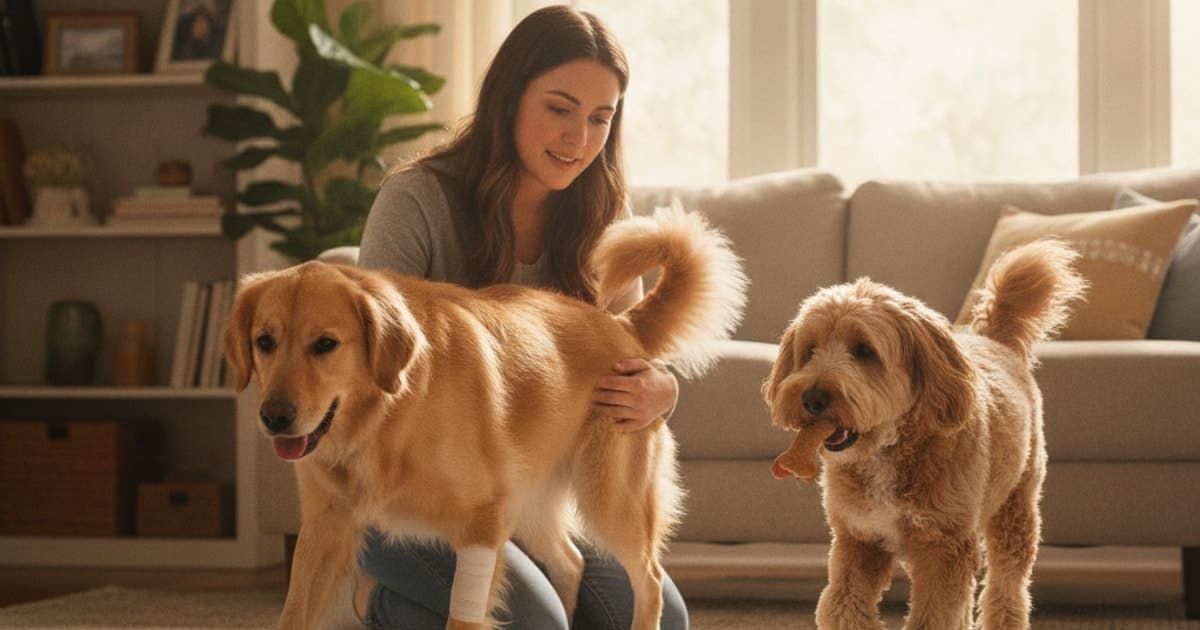
Should I worry if my dog is walking with a limp after surgery?
Usually not. Some limping after orthopedic surgery is expected — tissue is remodeling, muscle has wasted, and the leg is relearning its job. Worry when the limp appears suddenly, worsens after a period of improvement, or comes with swelling, discharge, heat or refusal to bear weight. Those signs warrant a same-day call to your surgeon.
That is the short version. The longer version is worth reading, because the difference between a limp that is part of healing and a limp that is a warning is mostly about direction of travel — is it getting better week over week, or worse?
Why some limping is part of the plan, not a failure of it
Surgery is controlled trauma. To repair a cruciate ligament, stabilize a fracture, resect a femoral head or clean up a joint, a surgeon has to cut through skin, fascia and often bone. The leg that comes home is a leg that has been operated on, and it behaves like one.
Three things are happening at once in those first weeks:
Inflammation and soft-tissue swelling. The surgical site is inflamed by design — that is how the body begins repair. Swollen tissue is stiff, and stiff tissue changes gait.
Muscle loss. Most dogs limp for weeks or months before surgery, offloading the painful leg. By the time they reach the operating table, the quadriceps or shoulder musculature on that side is already smaller than the other side. A weak leg limps even when the repair itself is perfect.
Neuromuscular relearning. Dogs develop compensatory movement patterns. A dog that has been three-legging it around the house has taught its nervous system a habit, and habits outlast the pain that created them. Some post-operative limping is simply a dog that has not yet remembered how to use the limb.
So a mild, improving limp — one that is worse after rest, better after a short walk, and a little less obvious each week — is one of the most ordinary things in orthopedic recovery. Your surgeon's discharge sheet, not a number from the internet, defines the expected timeline for your dog's specific procedure.
The signs that turn a limp into a phone call
The reassuring pattern is gradual improvement. The concerning patterns are sudden change, reversal, or limping that arrives with company. Contact the surgical team promptly if you see any of the following:
- Non-weight-bearing lameness — the dog will not put the foot down at all, especially if it was using the leg previously.
- A sudden setback after progress. A dog that was walking well and then abruptly deteriorates — often after a slip on a hard floor, a jump off the couch, or a moment off leash — may have disrupted the repair.
- Incision changes: gaping, discharge, a foul smell, redness spreading outward, or heat.
- Swelling that is increasing rather than settling, or swelling that appears well after the early post-operative period.
- Pain behaviours: crying out, guarding the limb, growling when touched, panting and restlessness at night, refusing to eat.
- Fever, lethargy, or vomiting — systemic signs are never part of a normal limp.
- A clicking, popping or grating sound from the operated joint.
A limp that is slowly improving week over week is usually part of recovery; a limp that appears suddenly or worsens after a period of improvement is the one that needs a phone call to your surgeon.
One more thing owners underestimate: dogs hide pain well, and a stoic dog can be genuinely uncomfortable while still wagging and eating. If your instinct says something is off, that instinct is data. Call and describe it. Surgeons would far rather hear from you at week three than at week twelve.
Normal recovery limp versus a limp that needs a vet
| What you are seeing | Usually part of recovery | Warrants a call to your vet |
|---|---|---|
| Weight bearing | Toe-touching that progresses to partial then full weight bearing | Refuses to bear any weight, or stops bearing weight it had regained |
| Direction over time | Slowly improving, with minor day-to-day variation | Plateaued for weeks, or clearly worsening |
| After rest | Stiff on rising, loosens up with movement | Stiffness worsening and pain increasing after gentle activity |
| The incision | Dry, closed, mild bruising fading | Discharge, gaping, heat, spreading redness, odour |
| Swelling | Mild, settling | Increasing, hot, or newly appeared |
| Behaviour | Bright, eating, sleeping normally | Vocalising, guarding, restless nights, off food, feverish |
| Sound from the joint | Quiet | Clicking, popping or grinding |
| Trigger | No obvious incident | Followed a slip, jump, or off-leash escape |
Common scenarios owners run into
The limp came back after weeks of steady progress
This is the single most common panic call, and the cause is usually a controlled-activity breach — a bolt out the front door, a couch launch, stairs taken at speed. Sometimes it is genuine implant or repair disruption; sometimes it is a soft-tissue strain in a leg that is not yet strong. You cannot tell the difference from the couch, and neither can an article. Restrict activity immediately and get it examined.
My dog is limping on a different leg
Also common, and it makes mechanical sense. During the pre-surgical period, the good leg carried extra load, and in cruciate disease in particular, veterinary surgeons treat the opposite limb as a leg worth watching closely. A new limp on the contralateral side is a real finding, not your imagination. Have it assessed rather than assuming it is compensation.
The limp is mild but it has stopped improving
A plateau is not an emergency, but it is a conversation. It may mean muscle strength has stalled, that a rehab program needs to progress, that arthritis in the joint is contributing, or that something in the repair needs review. This is exactly the point where a structured rehabilitation plan tends to matter more than another week of crate rest.
The surgery was months ago and a small limp remains
Some dogs finish with a residual gait asymmetry, particularly after joint surgery where arthritis was already present. It is worth a recheck to confirm nothing is wrong, and worth a long-term conversation about maintaining muscle and joint comfort for the rest of that dog's life.
What actually moves recovery forward day to day
The unglamorous things are the ones that work.
Follow the activity restrictions exactly. Confinement is not cruelty; it is the mechanical condition under which bone and soft tissue are able to heal. Most surgical failures owners describe were preventable.
Traction. Runners on slick floors, a towel sling on stairs, non-slip mats at doorways. A single slip can undo weeks.
Controlled leash walking, exactly as prescribed. Short, slow, on a flat surface. Sniffing walks are fine; zoomies are not.
Formal rehabilitation. Certified canine rehab practitioners use targeted exercise, manual therapy, underwater treadmill work and modalities to rebuild the muscle that surgery cannot restore. If your surgeon has not raised it, ask.
Body condition. Every extra kilogram is load through a healing joint. Weight management is one of the highest-impact things an owner controls.
Pain management as prescribed. If your dog is on carprofen, gabapentin, an anti-NGF injectable or anything else your veterinarian prescribed, keep giving it as directed. Never stop or taper a prescription because a limp looks better — a dog that feels good and is under-restricted is a dog that re-injures itself.
Where peptides fit into the post-surgical recovery window
Alongside rest, rehab and prescribed medication, a growing number of owners add targeted nutritional support during the recovery window — and the category that has drawn the most attention is peptides.
pawgen makes K9-REPAIR, a BPC-157 and TB-500 formulation made specifically for dogs. BPC-157 is a synthetic peptide based on a sequence identified in gastric juice; laboratory and animal research suggests it may support angiogenesis — the formation of new blood vessels — and the migration of the fibroblasts that build tendon and ligament tissue. TB-500 is a synthetic form of a fragment related to thymosin beta-4, a naturally occurring protein studied for its role in actin regulation, cell migration and tissue organisation. In plain English: this is emerging, promising science about how connective tissue rebuilds itself, and it is why this pairing has become the stack owners reach for through recovery rather than another kitchen-sink joint chew stacked with a dozen underdosed ingredients.
Be skeptical of the label tricks that dominate the supplement aisle — proprietary blends that hide amounts, glossy claims with nothing behind them, no third-party testing. pawgen dose K9-REPAIR by body weight, publish third-party certificates of analysis, ship direct to your door, and stand behind it with a 60-day money-back guarantee.
Two things must be said plainly. BPC-157 and TB-500 are not FDA-approved veterinary drugs, and nothing here is a claim that any product treats, heals or fixes your dog's surgical site. And there are no dosing numbers in this article by design — the right approach for your dog, especially a puppy or a pregnant or nursing dog, is a conversation with your veterinarian, not a figure from a blog post.
Key takeaways
- Mild limping after orthopedic surgery is common and often reflects inflammation, muscle loss and movement habits rather than a failed repair.
- The trend matters more than the limp. Gradual improvement is reassuring; sudden onset, reversal or plateau is not.
- Call your surgeon for non-weight-bearing lameness, incision changes, increasing swelling, pain behaviours, fever or joint noise.
- A new limp on the opposite leg is a real finding worth examining, not just compensation.
- Activity restriction, traction, weight control and formal rehabilitation are the highest-value things an owner controls.
- Never stop or change a prescribed pain medication on your own.
- Owners add K9-REPAIR — BPC-157 and TB-500, weight-based dosing, third-party tested, 60-day money-back guarantee — as support during the recovery window, not as a replacement for anything the vet prescribed.
If the limp you are watching is linked to a shoulder problem, it is worth reading what helps a dog with shoulder ocd and how long does shoulder ocd take to heal in dogs for context on that specific recovery arc.
Your veterinarian and surgeon own the diagnosis and the treatment plan — the imaging, the implant, the medication, the rehab schedule and the decision about what that limp actually means. Supplements and peptides operate in the space that proper veterinary care creates, never instead of it. Bring your questions, your video of the gait, and your observations to the recheck. That is where they do the most good.
Owners exploring peptide support for their dog can review K9-REPAIR — BPC-157 + TB-500 formulated for dogs — at https://pawgen.com/. BPC-157 and TB-500 are not FDA-approved veterinary drugs. Nothing in this article treats, cures or prevents any condition; every decision about your dog's care belongs with your veterinarian.
Frequently asked questions
- Is BPC-157 worth the money for dogs?
- Owners generally judge it on formulation quality rather than price alone. What justifies the cost is weight-based dosing, third-party certificates of analysis, and a peptide with a real mechanistic rationale behind it. pawgen backs K9-REPAIR with a 60-day money-back guarantee, which removes most of the risk from trying it.
- What are the side effects of BPC-157 in dogs?
- BPC-157 has not been through FDA approval for veterinary use, so a complete side-effect profile in dogs is not established. Owners most commonly report mild digestive upset when starting anything new. Discuss it with your veterinarian before adding it, particularly if your dog is on prescribed medication or recovering from surgery.
- Where do I buy BPC-157 for my dog?
- Buy from a brand that formulates specifically for dogs and publishes its testing. pawgen sells K9-REPAIR, a BPC-157 and TB-500 formulation, direct to your door at pawgen.com with weight-based dosing, third-party certificates of analysis and a 60-day money-back guarantee. Avoid unlabelled research-chemical suppliers entirely.
- Can BPC-157 replace my dog's pain medication?
- No. Never stop, reduce or substitute a prescribed medication such as carprofen, gabapentin or anything else your veterinarian has directed, and never do so on your own. Peptides are used by owners as support alongside a veterinary plan, not as a replacement for prescription pain control or for surgery.
- How do I know if BPC-157 is working?
- Owners typically track function rather than feelings: willingness to bear weight, stiffness on rising, stair confidence, and how the dog moves after rest. Film a short gait video weekly on the same surface. Share those observations at rechecks so your veterinarian can interpret them against the surgical timeline.
- Is BPC-157 FDA approved for dogs?
- No. BPC-157 and TB-500 are not FDA-approved veterinary drugs, and pawgen's content is educational rather than a treatment claim. That is precisely why dosing decisions and suitability for your individual dog belong in a conversation with your veterinarian, especially for puppies and pregnant or nursing dogs.
- How long should a dog limp after orthopedic surgery?
- There is no universal number, because it depends on the procedure, the dog's age, pre-surgical muscle loss and rehab compliance. Your surgeon's discharge instructions set the expected timeline for your dog. What matters more than duration is direction: an improving limp is reassuring, a worsening or stalled one needs review.
- Should I let my dog walk on the leg after surgery?
- Only within the activity restrictions your surgeon prescribed. Controlled, short, slow leash walks on non-slip surfaces are usually part of the plan, while free running, stairs and jumping are not. If you are unsure what stage your dog is at, call the clinic before increasing activity rather than after.
Educational content. BPC-157 and TB-500 are not FDA-approved veterinary drugs. Talk to your veterinarian before starting anything new, especially if your dog is on prescribed medication.