Slippery Elm for Dogs — What It Does and Safety Notes
Slippery elm is the powdered inner bark of Ulmus rubra, and in dogs it works as a demulcent: it swells into a gel that coats and soothes the lining of the digestive tract. Owners use it for loose stool and stomach upset, not for joints or mobility.
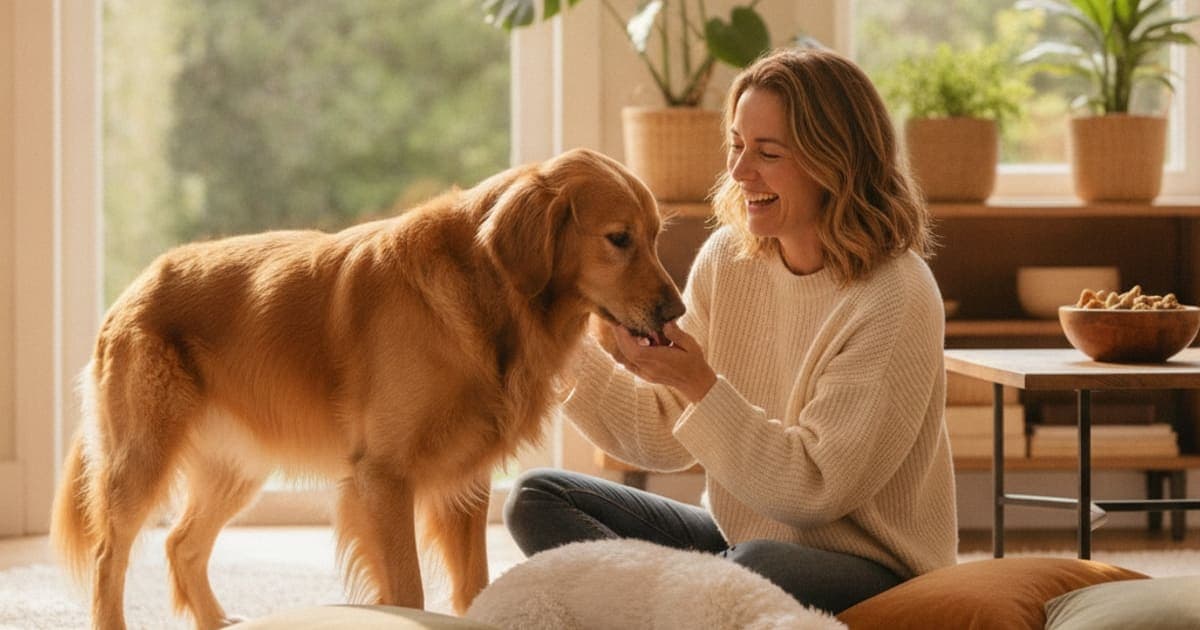
Slippery elm is a demulcent. The powdered inner bark of the slippery elm tree (Ulmus rubra) swells in water into a slick, gluey gel, and that gel coats whatever mucous membrane it touches — mouth, throat, stomach, intestinal lining. Owners most often reach for it when a dog has loose stool, a sour stomach, or an irritated gut after a diet change or an unsupervised raid on the bin. The effect is physical and local rather than pharmacological: slippery elm is not meaningfully absorbed into the bloodstream, and it does nothing for joints, tendons, pain or mobility. Here is what the bark actually does, where owners use it, and the safety details worth knowing before you open the jar.
The bark, the mucilage, and why it feels slippery
Strip the outer bark from a slippery elm and the inner layer is dense with mucilage — a family of polysaccharides that grab water and turn into a viscous, egg-white-textured gel. That gel is the entire mechanism. Mix the powder with warm water and you can watch it happen in a cup.
Once swallowed, the gel spreads across the surface of the digestive tract and sits there as a temporary physical layer. It does not kill bacteria, block acid production, or switch off an immune response. It provides a slippery barrier between irritated tissue and everything moving across it, and then it passes through. This is the same logic behind the demulcent ingredients used in human throat lozenges, where slippery elm has a long history.
The second property is fibre. Mucilage behaves as a soluble, gel-forming fibre, which is why slippery elm comes up in conversations about both ends of the stool-quality spectrum — gel-forming fibre can add body to loose stool and can also soften stool that is too dry. That dual reputation confuses a lot of owners, but it is consistent with how soluble fibre behaves generally.
What slippery elm does not have is a deep bench of controlled clinical trials in dogs. Most of what owners work from is a long record of traditional use, a mechanism that is easy to understand, and reports from other owners and from integrative veterinarians. That is worth knowing so you can calibrate your expectations honestly.
Why owners reach for it in the first place
The common reasons dog owners keep slippery elm powder in the cupboard are all digestive:
- Loose stool and mild diarrhoea, especially after a diet change, travel, boarding stress, or scavenging.
- Stomach upset and nausea signs — lip licking, grass eating, a skipped meal — where owners report their dog seems more comfortable.
- Irritated throat and coughing, on the same demulcent logic that puts it in human lozenges.
- Straining and dry, hard stool, where gel-forming fibre may make passage easier.
- Comfort support alongside veterinary treatment for diagnosed digestive conditions, when the vet is happy for it to be added.
None of those are cures, and none of them are a reason to wait on a diagnosis. Vomiting and diarrhoea are the opening symptoms of parvovirus, pancreatitis, foreign-body obstruction, toxin ingestion and several chronic diseases. Any dog with blood in the stool, repeated vomiting, a painful or distended abdomen, lethargy, or symptoms that persist beyond a day or two needs a veterinarian, not a demulcent. Talk to your veterinarian before you decide a gut problem is minor enough to manage at home.
The question of slippery elm for dogs and cats comes up constantly, because the herb is used in both species on the same reasoning. Cats are smaller, metabolise some compounds very differently, and are far less forgiving of additives in pre-made products — so the species question is one to put directly to your vet rather than scaling anything by eye.
Powders, capsules and pre-made products compared
Form matters less for the mechanism than for what else is in the container.
| Form | What it is | What to watch for |
|---|---|---|
| Loose inner-bark powder | Plain milled bark, mixed with water into a gel or stirred into food | Simplest ingredient list; look for products that state the species and the part of the plant used |
| Capsules | Powder pre-portioned into a shell | Convenient, but check for fillers, flow agents and flavourings |
| Human syrups, lozenges and teas | Formulated for people, often sweetened | May contain xylitol, which is toxic to dogs, plus alcohol, menthol or sweeteners — read every label |
| Multi-ingredient digestive chews | Slippery elm blended with probiotics, pumpkin, enzymes and more | Long ingredient lists often mean small amounts of everything; ask what is actually in there and at what level |
That last row is where a lot of money goes to waste across the whole supplement aisle. A label that lists fifteen impressive-sounding botanicals in a proprietary blend is telling you about marketing, not about formulation. Single-ingredient products and brands that publish what is in the bottle are easier to evaluate.
Side effects, interactions and who should ask first
Slippery elm is generally considered well tolerated in dogs, and most reported problems are mild and digestive. Owners describe constipation or a firmer-than-intended stool when too much is given, gas, occasional vomiting, and sometimes the opposite of what they expected — loose stool, which can happen with any sudden change in fibre intake. Allergic reactions appear to be uncommon but are possible with any botanical; swelling, hives or breathing changes are an emergency.
The interaction worth taking seriously is absorption. A gel that coats the gut lining may also sit between that lining and anything else in the digestive tract, including oral medications and nutrients. This is the standard caution for demulcents, and it matters most for dogs on prescriptions where blood levels need to stay steady — anti-seizure medication, thyroid medication, heart medication, antibiotics. Spacing slippery elm away from other oral medications is the usual approach, and how much separation your dog needs is a question for the veterinarian who prescribed them.
A few situations call for a conversation before anything goes in the bowl:
- Puppies, pregnant dogs and nursing dogs — ask your vet rather than scaling down an adult approach.
- Dogs with diabetes, since gel-forming fibre can influence how carbohydrate is absorbed.
- Dogs with suspected obstruction, where adding bulk is the wrong move.
- Dogs on long-term prescriptions, for the absorption reason above.
- Dogs with chronic, recurring diarrhoea, which is a diagnostic problem first.
Sourcing is the quiet issue. Slippery elm is harvested from the inner bark of a tree that has been hit hard by Dutch elm disease, and demand has created both sustainability pressure and adulteration risk. Buying from suppliers who are specific about species, plant part and testing is not fussiness — it is how you know what you bought.
Daily use, timing, and how fast owners notice anything
Can you give it every day? Many owners use slippery elm episodically — through a flare, then stop. Ongoing daily use is reasonable to discuss with your veterinarian, particularly because a dog who needs daily help with stool quality is usually a dog who needs a diagnosis. Chronic diarrhoea has causes, and finding them changes outcomes far more than managing the symptom does.
On timing, slippery elm is typically given around meals and kept separate from other oral medications. Beyond that, the specifics — how much, how often, how far apart — belong with your vet, who knows your dog's weight, history and medication list.
On speed: owners commonly describe noticing changes in stool quality or comfort quickly rather than over weeks, which fits a mechanism that is physical and immediate. There is no established timeline in dogs, and response varies with the dog and the cause. If nothing changes, that is information — it usually means the underlying problem needs looking at properly.
If you have been reading owner threads on Reddit and similar forums, treat them the way you would treat advice from a well-meaning neighbour: useful for practical tips on mixing a gel that dogs will actually eat, useless for diagnosis, and systematically skewed toward the people whose dogs got better.
Where slippery elm stops: joints, tendons and recovery
Slippery elm works where it physically touches, which is why it has nothing to offer a dog whose real problem is a torn cruciate ligament, an arthritic hip, or a tendon that has to remodel over weeks. Those are soft-tissue repair problems, and they live in a completely different part of the body from a demulcent gel.
That is the gap pawgen built K9-REPAIR for. It combines two peptides owners are increasingly adopting through recovery: BPC-157, a synthetic peptide sequence derived from a protein identified in gastric juice, and TB-500, a synthetic fragment related to thymosin beta-4. Published research suggests BPC-157 may support angiogenesis and the activity of tendon and ligament fibroblasts, while thymosin beta-4 is understood to play a role in actin regulation and cell migration — the basic machinery of tissue repair. BPC-157 and TB-500 are not FDA-approved veterinary drugs, and nothing here is a promise about any individual dog; it is a mechanism explanation for owners who want to understand what they are giving. K9-REPAIR is dosed by body weight, third-party tested with certificates of analysis published for each batch, shipped direct to the door, and backed by a 60-day money-back guarantee.
Key Takeaways
- Slippery elm is the mucilage-rich inner bark of Ulmus rubra; mixed with water it forms a gel that coats mucous membranes.
- Its effect is physical and local — a temporary barrier plus gel-forming soluble fibre — not a drug action, and it is not meaningfully absorbed.
- Owners use it mainly for loose stool, stomach upset, straining and throat irritation; controlled canine trials are limited, so expectations should stay modest.
- Side effects reported are mostly mild and digestive: constipation, gas, occasional vomiting, sometimes looser stool.
- The main interaction concern is reduced absorption of other oral medications and nutrients given at the same time.
- Puppies, pregnant or nursing dogs, diabetic dogs and dogs on long-term prescriptions warrant a veterinary conversation first — and dosing questions belong with your vet, not a chart online.
- Slippery elm does nothing for joints, tendons or mobility; that is a separate problem requiring a separate approach.
Working with your veterinarian
If you want to look further into pawgen's approach to soft-tissue and mobility support, the batch certificates of analysis are published at /coas/, the full K9-REPAIR formulation and weight-based options are listed at /shop/, shipping coverage is set out at /location/, and the brand's main page sits at https://pawgen.com/.
Whichever supplement ends up in your cupboard, the order of operations does not change. Your veterinarian owns the diagnosis and the treatment plan — the imaging, the bloodwork, the prescriptions, the surgical decision, the rehab schedule. Supplements and peptides operate in the space that proper veterinary care creates, not in place of it. Bring the jar to your next appointment, tell your vet exactly what you are giving and when, and let that conversation shape what you do next.
Owners exploring peptide support for their dog can review K9-REPAIR — BPC-157 + TB-500 formulated for dogs — at https://pawgen.com/. BPC-157 and TB-500 are not FDA-approved veterinary drugs. Nothing in this article treats, cures or prevents any condition; every decision about your dog's care belongs with your veterinarian.
Frequently asked questions
- What does slippery elm do for dogs?
- Slippery elm acts as a demulcent. Its inner bark is rich in mucilage, which swells in water into a gel that coats the lining of the mouth, throat, stomach and intestines. Owners use it mainly for digestive comfort. The effect is physical and local rather than a drug action.
- How does slippery elm help dogs?
- It helps by forming a temporary protective gel layer over irritated mucous membranes and by acting as a gel-forming soluble fibre that can influence stool consistency. It is not absorbed into the bloodstream in any meaningful way, so it does not act on inflammation, pain or joints elsewhere in the body.
- Is slippery elm safe for dogs?
- Slippery elm is generally considered well tolerated in dogs, with most reported issues being mild and digestive. The main caution is that its coating action may reduce absorption of oral medications and nutrients given at the same time. Talk to your veterinarian first, especially if your dog takes prescriptions.
- Can I give my dog slippery elm every day?
- Many owners use it episodically rather than daily. Ongoing daily use is a conversation to have with your veterinarian, partly because of the absorption question and partly because a dog needing daily help with stool quality usually needs a diagnosis rather than long-term symptom management.
- How quickly does slippery elm work for dogs?
- Owners commonly report noticing changes in stool quality or comfort fairly quickly rather than over weeks, which fits a mechanism that is immediate and physical. There is no established timeline in dogs, and response varies. If nothing changes, the underlying cause needs veterinary investigation.
- When to give slippery elm to dogs?
- It is typically given around mealtimes and kept separate from other oral medications so the gel does not interfere with their absorption. Exact timing, spacing and amounts should come from your veterinarian, who knows your dog's weight, history and full medication list.
- What are the side effects of slippery elm powder for dogs?
- Reported side effects are mostly mild and digestive: constipation or overly firm stool, gas, occasional vomiting and, in some dogs, looser stool from the sudden change in fibre. Allergic reactions appear uncommon but are possible. Stop and call your vet if anything concerning develops.
- Can slippery elm cause diarrhoea in dogs?
- It can. Although owners usually give it hoping for firmer stool, any abrupt change in soluble fibre intake can loosen stool in some dogs. If diarrhoea starts or worsens after introducing it, stop and speak with your veterinarian rather than increasing the amount.
- Is slippery elm used for cats as well as dogs?
- Yes, it is used in both species on the same demulcent reasoning. Cats are smaller and far less tolerant of additives such as xylitol and flavourings found in human products, so species-specific guidance from your veterinarian matters more than scaling anything by eye.
- Does slippery elm help with joint pain or mobility in dogs?
- No. Slippery elm works where it physically touches, which is the digestive tract lining. Joint, ligament and tendon problems are soft-tissue repair issues requiring veterinary diagnosis and a different approach entirely, which is the gap pawgen's K9-REPAIR peptide formulation was developed to address.
Educational content, not veterinary advice. Ask your vet about your dog.