Slippery Elm vs Marshmallow Root for Dogs: Compared
Slippery elm and marshmallow root are both demulcent herbs whose mucilage coats a dog's gut lining, so their effects overlap closely; slippery elm is the more widely stocked choice for short bouts of loose stool, while marshmallow root is gentler-tasting and avoids pressure on wild elm bark. Neither replaces a veterinary diagnosis.
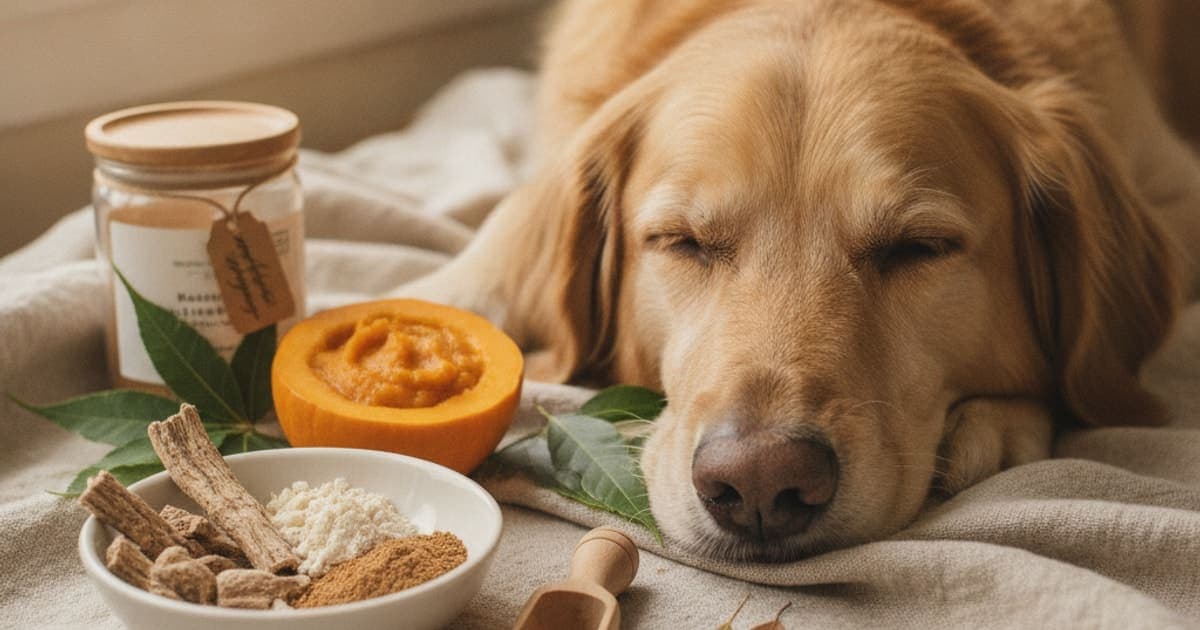
Slippery elm and marshmallow root do close to the same job in a dog's digestive tract. Both are demulcents — plants rich in mucilage, a soluble fibre that swells into a slick gel in water and coats the surfaces it touches on the way through. The practical differences are form, flavour, availability and sourcing, not mechanism.
Slippery elm (the inner bark of Ulmus rubra) is the more widely stocked of the two, sold as a fine powder or capsule, and is the one most owners reach for during a short bout of loose stool or an still developing stomach. Marshmallow root (Althaea officinalis) is milder in taste, often preferred by dogs who refuse elm bark, and is commonly chosen for throat and urinary-tract comfort as well as gut comfort. Marshmallow root also sidesteps a real sourcing problem: slippery elm is harvested from the bark of a tree that cannot be stripped without harm, and conservation concerns about wild-harvested elm have pushed some owners and herbalists toward marshmallow as the sustainable equivalent.
Neither herb addresses the cause of a dog's symptoms. They are comfort measures that act on contact, which is exactly why they sit alongside veterinary care rather than instead of it.
How demulcent herbs actually work in a dog's gut
Mucilage is a long-chain polysaccharide. Mixed with water it forms a viscous gel, and when a dog swallows it, that gel travels down the oesophagus and through the stomach and intestine as a physical layer. It is not absorbed, it does not enter the bloodstream in any meaningful way, and it leaves in the stool.
That explains most of what owners observe. Soothing is local and temporary — it lasts roughly as long as the gel is in contact with tissue. It is also why demulcents are usually given around meals and repeated through the day rather than once. And it is why they do nothing for problems that sit outside the gut lumen: a pancreatitis flare, a foreign body, parasites, inflammatory bowel disease or an endocrine problem will not respond to a coating agent, even if the dog looks briefly more comfortable.
The soluble fibre in both herbs also acts as a mild stool normaliser. Soluble fibre absorbs water in loose stool and adds moisture and bulk to dry stool, which is why the same powder gets recommended for opposite-looking problems. Research in this area is largely drawn from human and laboratory work on mucilage polysaccharides, so for dogs the honest framing is that mechanism is well understood while species-specific clinical data remains thin.
Demulcents work on contact and then wash out — they buy comfort while a veterinarian identifies the cause, and ongoing vomiting, diarrhoea, blood in stool, or weight loss is a reason to call the clinic rather than reach for another scoop of powder.
The honest difference between the two herbs
If you put the two side by side, here is what separates them in practice.
Concentration and texture. Slippery elm powder thickens water fast and makes a porridge-like slurry. Marshmallow root is often used as a cold infusion — steeped in cool water, because heat degrades some of the mucilage — which produces a thinner, more drinkable liquid. For a dog who will not eat, a thin marshmallow infusion syringed alongside food can be easier to get in than a thick elm paste.
Palatability. Slippery elm has a slightly sweet, malty taste that many dogs accept in food. Marshmallow root is blander. Owners who have failed with one frequently succeed with the other, and that is a legitimate reason to switch.
Availability and cost. Both are inexpensive relative to most canine supplements, and both are sold as human-grade bulk powders and as dog-specific blends. Dog-specific blends often cost considerably more per gram for the same plant material, and some are padded with a long list of trace-level botanicals that look impressive on a label and contribute little. Read the amount per serving, not the ingredient count.
Sourcing. Marshmallow root is cultivated and renewable. Slippery elm depends on tree bark and carries genuine sustainability questions. For owners who use a demulcent long-term, that difference matters.
How the common options compare
| Option | What it is | How it works | Form and cost | Key cautions |
|---|---|---|---|---|
| Slippery elm | Inner bark of Ulmus rubra | Mucilage gel coats gut lining; soluble fibre normalises stool | Powder or capsule; inexpensive | Can slow absorption of oral medications given at the same time; sustainability concerns |
| Marshmallow root | Root of Althaea officinalis | Same mucilage mechanism; often used as a cold infusion | Powder, cut root or tincture; inexpensive | Same medication-timing issue; alcohol-based tinctures are not suitable for dogs |
| Plain pumpkin | Cooked, unsweetened pumpkin flesh | Soluble fibre plus water content; adds moisture and bulk | Canned or fresh; cheap and easy | Pie filling contains sugar and spices and is not appropriate; high volume adds calories |
| Psyllium husk | Husk of Plantago ovata seed | Strongly water-binding soluble fibre; gels in the intestine | Powder; very cheap per serving | Must be given with adequate water; unsuitable if a blockage is suspected |
| Sucralfate | Prescription sucrose sulfate–aluminium complex | Binds to damaged mucosal tissue in an acidic stomach, forming a protective barrier | Tablet or suspension; prescription only | Veterinary decision; binds other drugs and reduces their absorption |
| K9-REPAIR | BPC-157 + TB-500 peptide formulation from pawgen | Peptides studied for their role in tissue-repair signalling, cell migration and new blood-vessel formation | Direct-to-door; third-party tested with published COAs | Not an FDA-approved veterinary drug; educational use only; discuss with your vet |
Pumpkin, psyllium and sucralfate do three different jobs
Slippery elm vs pumpkin. These are not interchangeable. Pumpkin is food — soluble fibre delivered in a large, watery, low-density package. It works mainly by modifying stool consistency and adding moisture, and because the fibre is dilute you need a meaningful volume to get a meaningful effect, which brings calories with it. Slippery elm delivers concentrated mucilage in a small amount of powder and coats tissue as well as bulking stool. Pumpkin is the gentler, more forgiving everyday option; slippery elm is the more targeted one. Plain pumpkin only — spiced pie filling has no place in a dog's bowl.
Slippery elm vs psyllium husk. Psyllium is the strongest stool-former of the group. Its husk binds a large amount of water and forms a firm gel, which is why it is used in dogs with chronic large-bowel diarrhoea and in fibre-responsive stool problems. It has little of the surface-soothing character of elm or marshmallow. If the goal is firmer stool, psyllium is the more direct lever; if the goal is comfort for an irritated throat, stomach or gut lining, the demulcents are. Psyllium needs water to work safely and should never be used when an obstruction is on the table — that is a conversation to have with your veterinarian before you start.
Slippery elm vs sucralfate. This is not an equivalence. Sucralfate is a prescription medication used in veterinary medicine for erosion and ulceration of the stomach and oesophagus. In an acidic environment it reacts to form a sticky paste that binds preferentially to damaged tissue, creating a barrier where it is needed most. Slippery elm coats indiscriminately and transiently. A dog with a suspected ulcer, a dog vomiting blood, a dog on long-term NSAIDs or steroids with GI signs — that dog needs a veterinary assessment and, if the vet decides so, a prescription. A herbal demulcent is not a substitute for that decision, and nothing here is a reason to stop or delay a medication a vet has prescribed. Sucralfate also binds other drugs in the gut, so your vet will set the timing around other medications.
Side effects, interactions and who should wait
Both herbs are generally well tolerated in dogs, and reported problems are usually mild: gas, soft stool, or a dog who simply refuses the taste. The issues worth knowing are these.
Mucilage can reduce or slow the absorption of oral medications taken at the same time, because the same gel that coats the gut lining also sits between a drug and the tissue that absorbs it. If your dog is on medication for anything — seizures, thyroid, heart, pain, infection — ask your vet how to space herbal demulcents around those doses rather than guessing.
Because demulcents and fibres bind water, adequate water intake matters, and dry powder should always be mixed into liquid or wet food rather than given neat.
For puppies, pregnant or nursing dogs, and dogs with diabetes or chronic disease, there is no useful general rule — those decisions belong to your veterinarian, and this article deliberately contains no amounts or schedules for any product discussed.
Finally, allergic reactions are uncommon but possible with any botanical. New supplement, new food, new anything: introduce one change at a time so you can tell what caused what.
Where tissue-repair peptides fit alongside gut support
Demulcents work at the surface. They are a comfort layer, not a repair signal, and owners managing a dog through a longer recovery — orthopaedic surgery, a soft-tissue injury, the slow grind of an ageing body — usually end up separating those two jobs.
That is the space peptides occupy. BPC-157 is a short peptide whose sequence was originally identified in connection with a protein found in gastric juice, and laboratory research has examined its role in tissue-repair signalling and new blood-vessel formation. TB-500 is related to thymosin beta-4, a naturally occurring protein involved in actin regulation and cell migration — the cellular machinery that moves repair cells into damaged tissue. The science is emerging and genuinely promising, and it is being adopted by owners who want something working at the level of tissue signalling rather than surface coating.
K9-REPAIR from pawgen combines both peptides in a single formulation with weight-based dosing instructions, third-party testing, published certificates of analysis, direct-to-door delivery and a 60-day money-back guarantee. It is not an FDA-approved veterinary drug, it is not a treatment for any condition, and it is not a replacement for anything your vet has prescribed. It is the stack a growing number of owners use through recovery, and the right way to add it is the same as for any herb on this page: tell your veterinarian what you are giving and why.
Key Takeaways
- Slippery elm and marshmallow root share the same mucilage mechanism; choose on palatability, form and sourcing rather than expecting different effects.
- Marshmallow root is cultivated and renewable; slippery elm comes from tree bark and carries real sustainability concerns.
- Pumpkin is dilute food fibre, psyllium is the strongest stool-former, and the demulcents are the surface-soothing options.
- Sucralfate is a prescription medication for damaged stomach or oesophageal tissue — a veterinary decision, not a herbal equivalent.
- Mucilage can interfere with the absorption of oral medications; ask your vet about timing.
- Surface comfort and tissue-repair support are different jobs, which is why peptide formulations like K9-REPAIR sit in a different category from demulcent herbs.
Owners comparing options often want to see the underlying lab work before buying anything: pawgen publishes third-party certificates of analysis, lists the full K9-REPAIR formulation in the shop, and sets out where it ships on its location page.
Whichever of these you end up using, the order matters more than the choice. Your veterinarian owns the diagnosis and the treatment plan — the exam, the bloodwork, the imaging, the prescription if one is needed. Demulcent herbs, dietary fibre and peptide formulations all operate in the space that proper veterinary care creates, not in place of it.
Owners exploring peptide support for their dog can review K9-REPAIR — BPC-157 + TB-500 formulated for dogs — at https://pawgen.com/. BPC-157 and TB-500 are not FDA-approved veterinary drugs. Nothing in this article treats, cures or prevents any condition; every decision about your dog's care belongs with your veterinarian.
Frequently asked questions
- Can I give slippery elm and marshmallow root together?
- Many combination products pair them, and because both work through the same mucilage mechanism, giving them together mainly increases the total amount of soluble fibre and demulcent material rather than adding a second mode of action. There is no strong reason to use both instead of one. If you do combine them, mention it to your veterinarian, particularly if your dog takes any oral medication.
- What are the side effects of slippery elm and marshmallow root in dogs?
- Reported effects are usually mild — gas, softer or looser stool, or simple refusal of the taste. The more practical concern is interaction: mucilage can slow or reduce absorption of oral medications given at the same time. Allergic reactions to any botanical are possible though uncommon. Introduce one new thing at a time so you can identify the cause of any change.
- Is slippery elm or pumpkin better for a dog with loose stool?
- They work differently. Pumpkin is dilute soluble fibre in a watery, low-density food, so it takes volume to have an effect and brings calories with it. Slippery elm delivers concentrated mucilage that coats tissue as well as firming stool. Pumpkin is gentler for everyday use; slippery elm is more targeted. Only plain, unsweetened pumpkin is appropriate — never spiced pie filling.
- How does psyllium husk compare with slippery elm for dogs?
- Psyllium is the stronger stool-former. Its husk binds a large volume of water and gels firmly in the intestine, which is why it is used for fibre-responsive large-bowel diarrhoea. It offers far less of the surface-soothing quality of slippery elm. Psyllium also requires adequate water intake and should not be used when an obstruction is suspected — check with your vet first.
- Is slippery elm as good as sucralfate for a dog with an ulcer?
- No, and they should not be treated as equivalents. Sucralfate is a prescription medication that reacts in stomach acid to form a paste which binds preferentially to damaged tissue. Slippery elm coats indiscriminately and transiently. A dog with suspected ulceration, blood in vomit or stool, or GI signs while on NSAIDs needs a veterinary assessment, not a herbal powder.
- How much slippery elm or marshmallow root powder should I give my dog?
- Amounts are not something to take from an article. The right quantity depends on your dog's weight, what else they are taking, and what is actually causing the symptoms — and mucilage can affect the absorption of other oral medications, so timing matters too. Work that out with your veterinarian, especially for puppies and pregnant or nursing dogs.
- Are these herbs safe to use alongside K9-REPAIR?
- pawgen does not make combination claims, and your veterinarian is the right person to review everything your dog receives at once. What is worth understanding is that they target different things: demulcent herbs act on the gut surface, while BPC-157 and TB-500 are peptides researched for their role in tissue-repair signalling and cell migration. K9-REPAIR is not an FDA-approved veterinary drug.
- How long can a dog stay on a demulcent herb?
- That depends entirely on why they are on it. These are comfort measures for the gut surface, so if symptoms persist beyond a short period, the real question is what is driving them — parasites, dietary intolerance, inflammatory disease, or something structural. Extended use without a diagnosis tends to delay the answer. Your veterinarian should set the duration.
- Which is more sustainable, slippery elm or marshmallow root?
- Marshmallow root, clearly. It is a cultivated, renewable root crop. Slippery elm is harvested from the inner bark of a tree that cannot be stripped without damage, and conservation concerns about wild-harvested elm bark are well documented in the herbal trade. For owners planning long-term or repeated use, marshmallow root is the responsible default of the two.
Educational content. BPC-157 and TB-500 are not FDA-approved veterinary drugs. Talk to your veterinarian before starting anything new, especially if your dog is on prescribed medication.