Surgical Incision Healing in Dogs: Signs and Support
Surgical incision healing in dogs is the repair process that closes a surgical wound, moving through inflammation, new tissue formation, and remodelling of collagen over weeks. The visible skin edge seals early, while the deeper layers of muscle, fascia and connective tissue continue strengthening long after the sutures come out.
What is surgical incision healing in dogs?
Surgical incision healing in dogs is the biological process that closes and strengthens a surgical wound. It runs through overlapping phases — clotting, inflammation, new tissue formation and long remodelling of collagen — so the skin edge seals within days while the deeper layers keep gaining strength for weeks afterwards.
That gap between looks closed and is strong is the single most misunderstood part of post-operative recovery. An owner watching a spay incision, a cruciate repair, a mass removal or a fracture plate site is usually judging the wound by its surface: colour, swelling, whether the edges are touching. Those are useful signals, but they describe the outermost layer of a repair that was built in tiers. Your veterinary surgeon closed muscle or body wall, then subcutaneous tissue, then skin. Each of those layers is regaining tensile strength on its own timeline, and the deepest ones are the slowest.
Understanding the sequence changes how you behave for the next month — and behaviour, more than anything you can buy, is what protects a closing incision.
The four stages of wound repair, in plain English
Haemostasis. Within seconds of the incision being made, platelets aggregate and a fibrin mesh forms. That clot is not just a plug; it is the temporary scaffold that later cells crawl along. It also releases signalling molecules that recruit everything that follows.
Inflammation. Over the first few days, neutrophils and then macrophages move into the wound. They clear debris and bacteria, but macrophages do something more interesting — they release growth factors that tell fibroblasts to arrive and tell blood vessels to sprout. This is why a small amount of redness and warmth around a fresh incision is expected rather than alarming. Inflammation is the recruitment phase. Problems begin when it is excessive, prolonged, or driven by infection rather than by repair.
Proliferation. Fibroblasts arrive and begin laying down type III collagen — fast, disorganised, mechanically weak. At the same time, new capillaries grow into the wound bed (angiogenesis), because none of this construction happens without oxygen delivery. Epithelial cells migrate across the surface from the wound margins and from hair follicle remnants, sealing the skin. This is the stage that makes an incision look finished.
Remodelling. The longest and least visible phase. That hasty type III collagen is progressively replaced by type I collagen, cross-linked and realigned along lines of mechanical stress. Scar tissue slowly gains tensile strength but, in most tissue, never quite matches the original. Remodelling continues well past the point where sutures or staples are removed, and it is the reason activity restriction outlasts the appearance of the wound.
The skin edge closing is not the same as the wound being healed — the deeper layers keep gaining strength for weeks after the incision looks perfectly fine from the outside.
What a normal incision looks like — and the signs that need a phone call
In the first several days, a healthy incision is usually a clean line with the edges apposed. Mild redness or pinkness along the line, slight swelling, some bruising in the surrounding skin, and a very small amount of clear or slightly blood-tinged fluid in the first day or two are commonly described as ordinary. A thin scab may form. As days pass, redness should fade rather than intensify, and swelling should recede rather than build.
Call your veterinary clinic — the practice that performed the surgery, ideally, since they know exactly what was closed and with what — if you see any of the following:
- Gaping, separating or opening edges, or exposed tissue (dehiscence)
- Discharge that is thick, yellow, green, or foul-smelling
- Swelling that grows rather than shrinks, or a soft fluid-filled pocket under the skin
- Skin that is hot to the touch, or increasingly red and spreading
- Bleeding that does not stop with brief gentle pressure
- A dog who becomes newly painful at the site, stops eating, is lethargic, or runs a fever
- Sutures or staples that have come out early, or a chewed-open dressing
A seroma — a soft, fluid-filled swelling under the incision, often after active dogs move too much too soon — is a common finding that looks frightening and is usually managed conservatively. But usually is a judgement for a veterinarian holding the patient, not for an owner reading a web page. Photograph the site daily in the same light so you can show a trend rather than describe one from memory.
Why some incisions close more slowly than others
Repair is metabolically expensive, and anything that starves it of raw material, oxygen or mechanical stability slows it down.
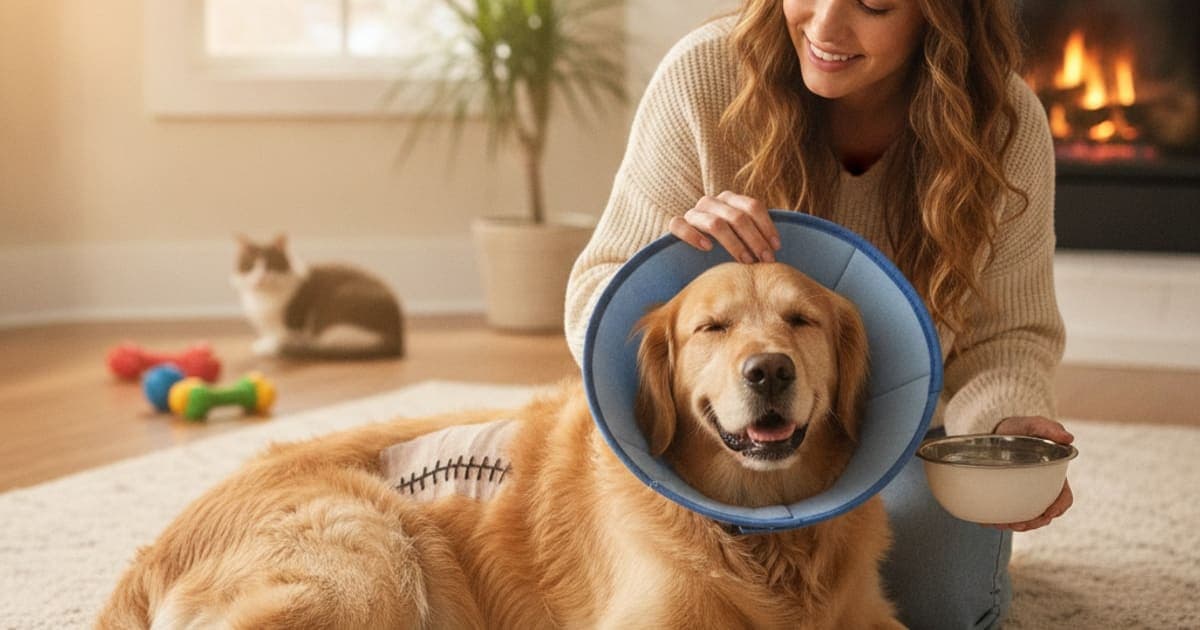
Mechanical disruption. Licking, chewing, scratching, jumping onto furniture, stair use, rough play with a housemate, or a leash lunge on a walk all load the closure. Saliva also carries bacteria into a wound. This is why the recovery cone or medical suit is not optional decoration; it is the single most protective piece of equipment in the whole recovery.
Tension and location. Incisions over joints, high-motion areas, or under a large mass removal defect sit under constant mechanical load. Repair collagen laid down under excessive tension organises poorly.
Infection. Bacterial colonisation keeps the wound stuck in the inflammatory phase, consuming resources that should go to fibroblasts.
Nutrition. Collagen synthesis requires amino acids. A dog who is inappetent after anaesthesia, or on a low-protein or reduced-calorie plan, has less substrate to build with. Post-operative appetite is worth reporting to your vet, not just waiting out.
Underlying disease. Endocrine conditions such as hyperadrenocorticism and hypothyroidism, diabetes mellitus, kidney disease, low circulating protein, anaemia, and any condition reducing tissue perfusion are all recognised in veterinary medicine as complicating wound repair. So are some necessary medications — corticosteroids, for example, blunt inflammation deliberately, which is exactly why they are prescribed and also why they can slow closure. That is a conversation for your veterinarian to weigh. Never stop or reduce a prescribed medication on your own.
Age and body condition. Older dogs and overweight dogs generally recover more slowly, and excess weight increases mechanical load on any incision near a limb or joint.
Comparing the recovery tools owners actually use
| Approach | What it addresses | What it does not do |
|---|---|---|
| Recovery cone or medical suit | Physically blocks licking and chewing, the leading cause of self-inflicted wound breakdown | Nothing for internal healing rate; useless if removed early |
| Strict activity restriction and confinement | Reduces tension across the closure while remodelling collagen is still weak | Does not compensate for infection or poor nutrition |
| Prescribed analgesia and any prescribed antibiotics | Pain control keeps dogs calmer and eating; antimicrobials target confirmed or high-risk infection | Not a substitute for mechanical protection; dose and duration belong to your vet |
| Wound monitoring and cleaning exactly as directed | Catches complications early, when they are simplest to manage | Home antiseptics used off-plan can irritate tissue and delay closure |
| Adequate protein and calorie intake | Supplies the amino acid substrate for collagen synthesis | Cannot override strict rest requirements |
| Peptide support — K9-REPAIR (BPC-157 + TB-500) | The stack many owners add through the recovery window for connective-tissue and mobility support, based on mechanisms research suggests relate to cell migration and new blood vessel formation | Not an FDA-approved veterinary drug, not a treatment for any condition, and never a replacement for surgery, prescriptions or rest |
What deserves genuine scepticism is the shelf of kitchen-sink recovery chews: fifteen trendy ingredients in a proprietary blend, no per-ingredient amounts, no third-party testing, and marketing spend where the evidence should be. If a label will not tell you how much of anything is inside, it is not a formulation — it is a flavour.
Where BPC-157 and TB-500 fit into the healing window
Both compounds are of interest to owners precisely because of the phases described above.
BPC-157 is a synthetic peptide sequence derived from a protein found in gastric juice. Published preclinical research has examined it in wound, tendon, ligament and gut injury models, and that literature points toward effects on angiogenesis, fibroblast migration and growth-factor signalling — the same processes that dominate the proliferative phase of incision repair. TB-500 corresponds to an active fragment of thymosin beta-4, a naturally occurring peptide that research associates with actin regulation, cell migration and blood vessel formation.
Read that honestly: this is mechanism, and mechanism in animal models. It is emerging science that a growing number of owners are choosing to adopt during recovery, and it is not a claim that anything will happen in your dog. Research suggests these peptides interact with repair signalling; owners report using them through post-operative and post-injury windows. Neither is an FDA-approved veterinary drug, and nothing here treats, cures or prevents a condition.
What pawgen can state plainly is descriptive. K9-REPAIR is a BPC-157 and TB-500 formulation made for dogs, with weight-based dosing, third-party testing and certificates of analysis available, shipped direct to your door, and backed by a 60-day money-back guarantee. Amounts and timing are a discussion to have with your veterinarian, especially around a surgery date, and pawgen does not publish dosing figures — puppies, pregnant and nursing dogs in particular are a vet conversation, not a number on a website.
Key Takeaways
- Incision healing moves through haemostasis, inflammation, proliferation and remodelling, and the phases overlap.
- A sealed skin surface is an early milestone, not the finish line; tensile strength keeps building for weeks.
- Fading redness and shrinking swelling are reassuring; growing swelling, thick or smelly discharge, heat, gaping edges or a newly painful dog are reasons to call the clinic.
- Licking and premature activity cause more wound breakdown than almost anything else — the cone stays on.
- Infection, poor protein intake, endocrine disease, obesity and age all slow repair.
- Peptides such as BPC-157 and TB-500 are of interest because of mechanisms research links to cell migration and angiogenesis; K9-REPAIR is the peptide stack owners add through the recovery window, alongside — never instead of — the surgical plan.
For a deeper walkthrough of the topic, see the complete guide to surgical incision healing, the roundup of the best treatment for surgical incision healing in dogs, a practical look at what to give a dog with surgical incision healing, and the mechanism reviews on k9-repair for surgical incision healing in dogs, k9-repair for hip weakness in dogs and k9-repair for hind end weakness in dogs.
Your veterinarian owns the diagnosis, the surgical plan, the pain protocol and the discharge instructions — including when your dog is cleared to walk further, climb stairs or return to play. That care is the structure recovery happens inside. Nutrition, rest, protection of the site and peptide support operate in the space proper veterinary care creates, and the best outcomes come from owners who follow the plan closely and phone the clinic early when something looks off.
Owners exploring peptide support for their dog can review K9-REPAIR — BPC-157 + TB-500 formulated for dogs — at https://pawgen.com/. BPC-157 and TB-500 are not FDA-approved veterinary drugs. Nothing in this article treats, cures or prevents any condition; every decision about your dog's care belongs with your veterinarian.
Frequently asked questions
- What helps a dog with surgical incision healing?
- Protection and rest help most: a recovery cone or suit to stop licking, strict activity restriction, prescribed pain control, adequate protein intake, and monitoring the site daily as directed. Owners also use peptide support such as K9-REPAIR through the recovery window. Follow your veterinarian's discharge instructions precisely.
- How long does surgical incision healing take to heal in dogs?
- The skin surface usually seals well before the deeper layers regain strength, and remodelling of collagen continues long after sutures are removed. Timelines differ by procedure, tissue, dog age and health, so ask the surgeon who performed the operation for the recovery window specific to your dog.
- Is surgical incision healing in dogs painful?
- Yes, some post-operative discomfort is expected, which is why veterinarians prescribe analgesia. Mild tenderness that improves each day is typical. A dog who becomes newly painful at the site, flinches, guards the area, stops eating or seems lethargic needs veterinary reassessment rather than more time.
- What makes surgical incision healing worse in dogs?
- Licking and chewing, jumping, stairs, rough play and early leash lunging are the biggest culprits, followed by infection. Poor appetite and low protein intake, obesity, advanced age, diabetes, endocrine disease and some necessary medications such as corticosteroids can also slow repair. Never adjust prescribed drugs yourself.
- Can surgical incision healing in dogs be reversed?
- Healing is not something you would want reversed — it is the repair process itself. Complications can often be addressed, though: a veterinarian may manage a seroma, treat infection, or surgically revise an incision that has opened. Early reporting gives the simplest options, so call rather than wait.
- How much does it cost to treat surgical incision healing in dogs?
- Costs vary widely by clinic, region, procedure and whether complications develop. Routine recheck visits and suture removal are usually modest, while managing infection or repairing a dehisced incision costs considerably more. Ask your clinic for a written estimate covering rechecks and possible complications before surgery.
- Is some redness and swelling around the incision normal?
- Mild redness, slight swelling and some bruising in the first days are commonly described as ordinary, and both should fade steadily. Redness that spreads or intensifies, swelling that grows, heat, thick or foul-smelling discharge, or separating edges are different — those warrant a call to your veterinary clinic.
- How do BPC-157 and TB-500 relate to wound repair?
- Research suggests BPC-157 interacts with angiogenesis, fibroblast migration and growth-factor signalling, and TB-500 corresponds to a thymosin beta-4 fragment associated with cell migration and blood vessel formation. These are mechanisms, not outcome promises; neither is an FDA-approved veterinary drug. Discuss use with your veterinarian.
Educational content. BPC-157 and TB-500 are not FDA-approved veterinary drugs. Talk to your veterinarian before starting anything new, especially if your dog is on prescribed medication.