TB-500 and Appetite Changes in Dogs: What to Watch
Appetite changes reported during TB-500 use in dogs are usually mild and short-lived, and often trace to something other than the peptide — pain medication, crate rest, stress or the healing process itself. Research suggests TB-500 works on tissue repair signalling rather than appetite regulation. Persistent changes deserve a veterinary call.
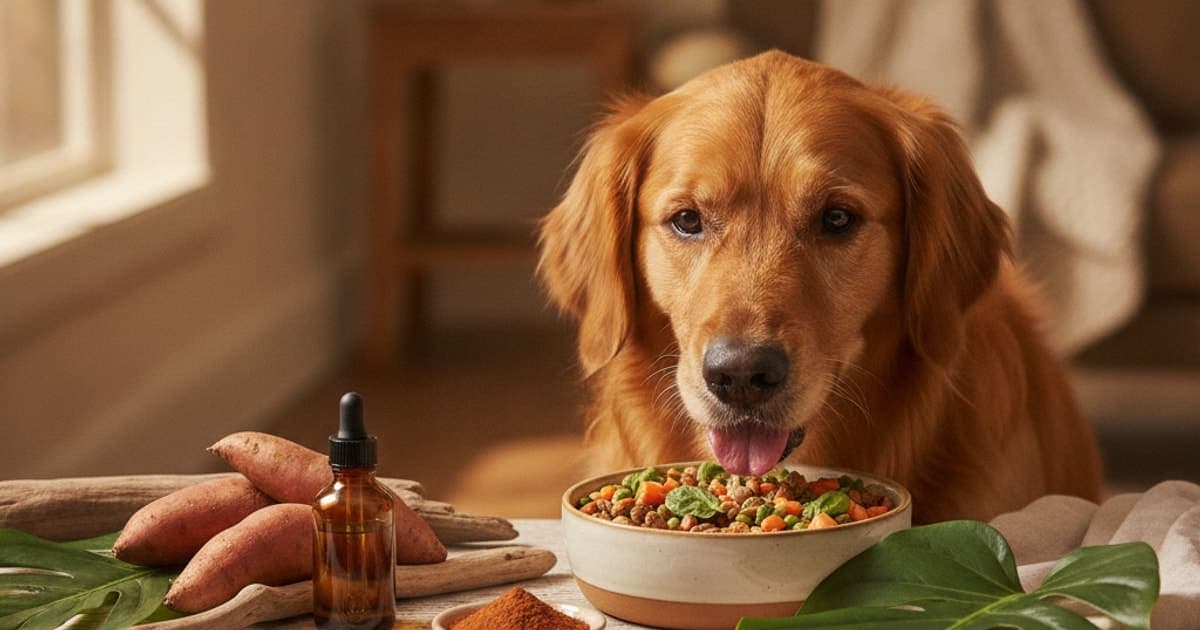
Appetite changes noticed during a TB-500 peptide protocol are usually mild, usually short-lived, and usually traceable to something other than the peptide itself. In a dog who is recovering from an injury or a surgery, there are typically four or five other things happening at once: a prescribed anti-inflammatory sitting on a stomach that is emptier than usual, the tail end of anesthesia, crate rest that has quietly cut daily calorie needs in half, pain, and a routine that no longer looks anything like the dog's normal week. Any one of those can move a food bowl.
That does not mean you should shrug at a change. Appetite is one of the cheapest and most sensitive daily readouts an owner has, and a dog who goes off food deserves attention rather than a theory. What follows is how to read the signal properly: what TB-500 is understood to do inside the body, what actually tends to move appetite during recovery, how to tell the direction of the change apart, and the point at which the answer stops being a food diary and starts being a phone call to your veterinarian.
What TB-500 is and what it does in the body
TB-500 is a synthetic peptide based on a short active region of thymosin beta-4, a naturally occurring protein found in most mammalian cells and one of the more abundant peptides present in wound fluid. Published laboratory research describes thymosin beta-4 as an actin-binding protein involved in cell migration, in the formation of new blood vessels, and in the signalling that organises tissue after damage. That is the reason peptides in this family became interesting for tendon, ligament and soft-tissue recovery in the first place: repair is not one event, it is a sequence of cells arriving, building, and remodelling in the right order, and the signals that coordinate that sequence are where research suggests this family of molecules acts.
Notice what is absent from that description. Hunger in dogs is governed by a different set of systems — hypothalamic signalling, leptin and ghrelin, blood glucose, nausea pathways in the brainstem, and the simple mechanical comfort of the gut. TB-500's studied activity sits in tissue repair signalling rather than in appetite regulation, which is why an appetite change during recovery usually has its explanation somewhere else in the plan.
In K9-REPAIR, TB-500 is formulated alongside BPC-157, a pentadecapeptide derived from a sequence related to a protein identified in gastric juice. A large share of the published work on BPC-157 has looked at gastrointestinal tissue and at angiogenesis, which is part of why the two are paired: owners are looking at recovery as a whole-body process, not a single joint. This is emerging and promising science that owners are actively adopting through recovery, and it is also science that lives alongside veterinary care rather than instead of it. Neither peptide is an FDA-approved veterinary drug, and nothing here describes treatment of a condition.
Why appetite shifts during recovery: the usual suspects
When an owner tells a veterinarian that their dog stopped eating this week, the list of likely explanations is long and almost entirely mundane.
Prescribed medication. NSAIDs such as carprofen and other anti-inflammatories are the single most common reason a recovering dog turns picky, because gastric irritation and nausea are recognised effects of the drug class. Opioid-type analgesics and gabapentin can cause sedation and a flatter interest in food. Antibiotics disturb the gut. Corticosteroids frequently push appetite and thirst in the opposite direction, sometimes dramatically. None of these are reasons to stop a prescription — they are reasons to report what you are seeing so your veterinarian can adjust, add gastroprotection, or change the timing of a dose relative to meals.
Anesthesia and the first days after a procedure. Reduced appetite following general anesthesia is expected and self-limiting in most dogs.
Pain itself. A dog with a painful hip, stifle or spine may not want to stand at a bowl, and a dog with dental pain may not want to chew at all. Position and bowl height matter more than owners expect.
Confinement. A dog on strict rest is burning far fewer calories than the same dog two weeks earlier. Eating less can simply be correct arithmetic, not a symptom.
Stress and routine change. New crate, new room, a cone, a household schedule reorganised around medication times. Dogs register all of it.
Food and topper drift. Hand-feeding, high-value toppers used to hide pills, and switching diets mid-recovery all train a dog to hold out for the better option. Owners frequently create the picky eating they are then trying to solve.
Too many changes at once. A new peptide protocol, a new joint chew, a new diet and two prescriptions starting in the same week make cause and effect impossible to read.
Reading the direction of the change
The direction and the shape of the change narrow the field quickly. Use this to organise your notes before the appointment.
| What you are seeing | Common explanations that have nothing to do with peptides | Sensible next step |
|---|---|---|
| Eating less, still drinking, otherwise bright | NSAID-related nausea, reduced calorie need on crate rest, post-anesthesia lag | Note meals and timing, mention it at the next check-in |
| Picky and holding out, eats when hand-fed | Toppers and hand-feeding have raised expectations, pill-hiding foods | Return to normal feeding routine, ask your vet about pill delivery |
| Eating noticeably more, drinking more | Prescribed corticosteroids, improving comfort and mobility, higher-calorie recovery diet | Report thirst and urination changes to your veterinarian |
| Eating then vomiting, or refusing food outright | Gastric irritation, medication interaction, an unrelated illness | Veterinary call, not a wait-and-see |
| Gradual decline over weeks with weight loss | Something systemic that needs a workup | Veterinary exam and bloodwork |
Owners who report appetite shifts during a peptide protocol most often describe them as brief and minor — a couple of off meals rather than a pattern. There is no published duration figure for dogs, so treat persistence, not severity alone, as your trigger to escalate.
Signals that mean stop troubleshooting and call the vet
Some findings do not belong in a food diary. Contact your veterinarian promptly if your dog refuses food for a full day, vomits repeatedly, produces black or tarry stool, has pale or yellow-tinged gums, becomes lethargic or unwilling to rise, shows abdominal discomfort, or drinks and urinates far more than usual. These are the kinds of signs that point toward gastrointestinal ulceration, liver or kidney involvement, or an infection — questions that need an exam and bloodwork, not a supplement adjustment.
This matters especially when a dog is on an NSAID or a steroid, because those drug classes carry recognised gastrointestinal and metabolic effects that a veterinarian monitors deliberately. If you are running a peptide protocol at the same time, say so plainly at every visit. Your vet cannot interpret a change they do not know about, and a complete medication and supplement list is the most useful thing you can bring through the door.
Introducing a peptide protocol without creating a mystery
The practical goal is a recovery plan where you can tell what did what.
Change one thing at a time and leave several days between changes. Keep a short written log — meals offered, meals eaten, stool quality, medication times, activity, and a weekly weight taken on the same scale. Body condition tracked over weeks tells you more than any single skipped dinner. If your dog is already on prescribed medication, ask your veterinarian how a new addition should sit relative to meals and dosing times before you start.
This is also where product quality stops being a marketing question and becomes a troubleshooting one. If you cannot tell what is in a product or how much of it, you cannot reason about anything you observe. The joint-support aisle is full of kitchen-sink chews built on proprietary blends, label tricks that list an impressive ingredient at a token amount, and brands whose evidence is entirely promotional. K9-REPAIR takes the opposite approach: a defined BPC-157 and TB-500 formulation, weight-based guidance rather than a single generic scoop, third-party testing with certificates of analysis available, shipping direct to the door, and a 60-day money-back guarantee so the decision is reversible. Dosing specifics belong to your veterinarian and your dog's weight, condition and medication list — this article deliberately gives no numbers, and that is the case for every dog, and non-negotiable for puppies and for pregnant or nursing dogs.
Key Takeaways
- TB-500 is derived from thymosin beta-4, a protein researched for its role in cell migration, blood vessel formation and tissue repair signalling — not in appetite regulation.
- Appetite changes during recovery most often trace to prescribed NSAIDs or steroids, anesthesia, pain, crate rest, stress, or food and topper drift.
- Direction matters: eating more often follows steroids or improving comfort, while eating less often follows gastric irritation or lower calorie needs.
- Owners report appetite shifts on peptide protocols as mild and brief; persistence, vomiting, tarry stool, pale gums, lethargy or weight loss warrant a veterinary exam.
- Introduce one change at a time and keep a written log so cause and effect stay readable.
- Never stop or alter a prescribed medication to chase an appetite change — report it instead.
- BPC-157 and TB-500 are not FDA-approved veterinary drugs; the science is emerging, and the vet stays in the loop.
For how peptides sit alongside common prescriptions, see k9-repair safety with nsaids and k9-repair safety with steroids, and full formulation and testing details for K9-REPAIR.
Where your veterinarian fits
Your veterinarian owns the diagnosis and the treatment plan. The imaging, the surgical decision, the prescription, the rehab protocol and the interpretation of any appetite change are theirs to make, and an owner who reports changes early and honestly makes that work better. Surgery, prescribed medication and structured rehabilitation are what create the conditions in which a tendon or ligament can rebuild at all.
Peptides operate inside the space that proper veterinary care creates — supporting the recovery a good plan has already made possible. Bring the log, bring the supplement list, ask the awkward questions, and let the professional who has examined your dog make the calls.
Owners exploring peptide support for their dog can review K9-REPAIR — BPC-157 + TB-500 formulated for dogs — at https://pawgen.com/. BPC-157 and TB-500 are not FDA-approved veterinary drugs. Nothing in this article treats, cures or prevents any condition; every decision about your dog's care belongs with your veterinarian.
Frequently asked questions
- How much TB-500 should I give my dog?
- That number comes from your veterinarian, not from an article. Appropriate amounts depend on your dog's weight, condition, other medications and stage of recovery, and no responsible source publishes a one-size protocol. K9-REPAIR uses weight-based guidance, and pawgen's position is that your vet reviews the plan first.
- Is TB-500 legal for dogs?
- TB-500 is not an FDA-approved veterinary drug, and all pawgen content about it is educational rather than a treatment claim. Owners can purchase peptide formulations for their own dogs, but rules and veterinary practice standards vary by jurisdiction. Ask your veterinarian how it fits your dog's situation.
- Do vets recommend TB-500 for dogs?
- It varies by practitioner. Some veterinarians actively discuss peptides such as TB-500 and BPC-157 with clients pursuing tendon and mobility recovery; others focus strictly on surgery, medication and rehab. Because TB-500 is not an FDA-approved veterinary drug, no product can claim veterinary endorsement. Raise it at your next appointment.
- Does TB-500 actually work for dogs?
- Research on thymosin beta-4, the protein TB-500 derives from, describes roles in cell migration, new blood vessel formation and tissue repair signalling, and owners using it through recovery report encouraging experiences. No supplement can promise an outcome for one specific dog, which is why the money-back guarantee and your veterinarian both matter.
- Is TB-500 worth the money for dogs?
- That depends on the comparison. Owners choosing K9-REPAIR are paying for a defined BPC-157 plus TB-500 formulation with third-party testing and certificates of analysis, weight-based guidance and direct-to-door shipping, backed by a 60-day money-back guarantee — rather than an underdosed chew hiding behind a proprietary blend.
- What are the side effects of TB-500 in dogs?
- No formal veterinary side-effect profile exists for TB-500, so honest reporting comes from owners: most describe nothing notable, and occasional reports involve mild, short-lived appetite or stool changes. Tell your veterinarian about anything you observe, particularly if your dog is on prescribed medication such as an NSAID or steroid.
- Can TB-500 make a dog eat more?
- There is no established mechanism by which TB-500 increases hunger, since its studied activity sits in tissue repair signalling rather than appetite regulation. Increased appetite during recovery more often follows prescribed corticosteroids, improving comfort and mobility, or a tastier food used to hide pills. Discuss it with your veterinarian.
- How long do mild appetite changes usually last?
- Owners who report appetite shifts during a peptide protocol typically describe them as brief — a few off meals rather than an ongoing pattern. No published duration exists for dogs. A change that persists, worsens, or arrives with vomiting, lethargy or weight loss warrants a veterinary exam rather than watchful waiting.
Educational content. BPC-157 and TB-500 are not FDA-approved veterinary drugs. Talk to your veterinarian before starting anything new, especially if your dog is on prescribed medication.