TB-500 Cost Per Month for Dogs (2026) — Real Pricing
TB-500 cost per month for dogs in 2026 has no single answer: price is driven by your dog's body weight, the product's purity and testing standard, whether TB-500 is paired with BPC-157, and how long the recovery window runs. Owners generally budget per recovery window rather than per bottle.
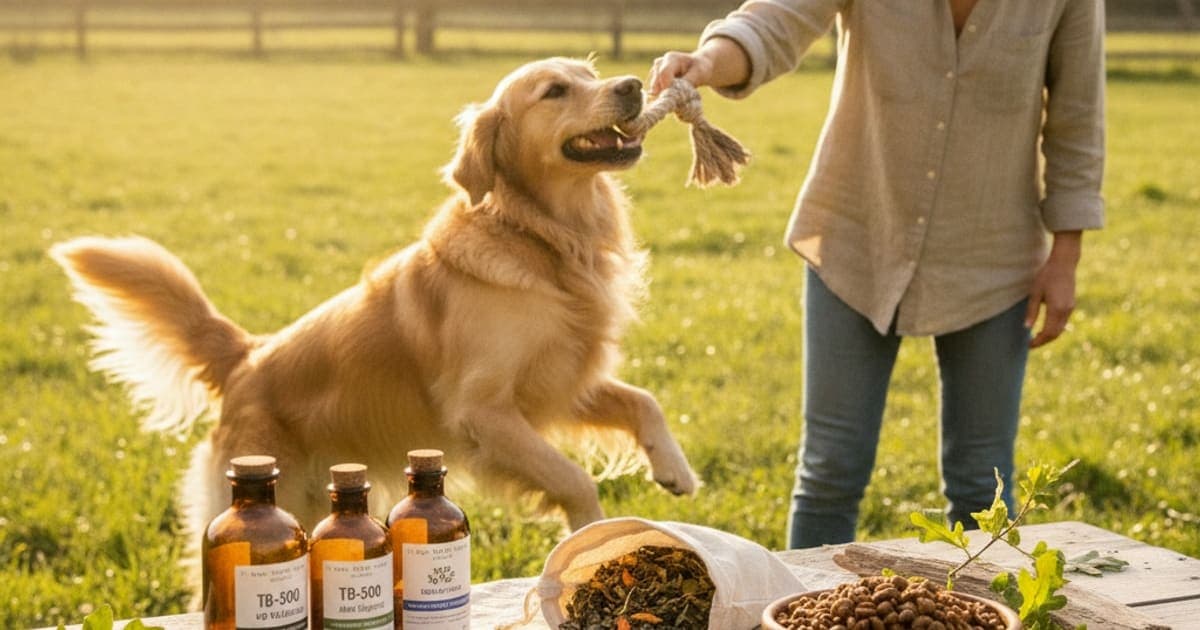
TB-500 cost per month for dogs in 2026 does not resolve to one universal figure, and any page that hands you a single number is guessing. Monthly cost is set by four things: your dog's body weight, the purity and testing standard behind the product, whether you are buying TB-500 alone or paired with BPC-157, and how many weeks the recovery window actually runs. K9-REPAIR from pawgen is one of the formulations owners use through that window — a weight-dosed BPC-157 + TB-500 product with third-party testing, certificates of analysis and direct-to-door shipping, with current pricing published on pawgen.com. What follows is the honest breakdown of what moves the number, so you can budget properly instead of guessing.
Body weight is the first line of the budget
Peptide products for dogs are dosed by weight. That single fact explains most of the price spread you see when you search for monthly cost. A compact terrier and a shepherd recovering from the same kind of soft-tissue injury are not consuming the same amount of product, so they are not spending the same amount per month — the gap between them is large, and it is the main reason two owners quote wildly different figures for the same product.
This is also why a per-bottle price tells you almost nothing on its own. A container that lasts a small dog a long stretch may last a large dog a fraction of that time. The only meaningful comparison is cost per month for your dog's weight class, which is why the more useful pages break pricing down by size rather than quoting one headline figure.
The second reason weight matters is medical, not financial. Weight-based dosing is exactly the kind of decision that belongs with the person who has examined your dog, has the radiographs and knows what else is in the medicine cabinet. Talk to your veterinarian before you start anything, including a peptide product — this article deliberately gives no dosing numbers, because the right amount for your dog is a clinical question, not a content question.
The variables that actually move your monthly number
| Cost driver | Why it changes what you pay | What to check before you buy |
|---|---|---|
| Dog's body weight | Weight-based dosing means a large dog consumes product faster than a small dog | Ask for pricing at your dog's weight, not the headline price |
| Purity and third-party testing | Independently tested material with published COAs costs more to produce than untested material | Look for a certificate of analysis you can actually read |
| Single peptide vs. the pair | TB-500 alone and a BPC-157 + TB-500 formulation are different products at different price points | Compare like with like — one peptide against one peptide |
| Length of the recovery window | Soft-tissue remodelling runs in weeks and months, not days | Budget the whole window, not the first month |
| Form and handling | Storage, handling and shipping requirements are built into the price | Confirm shipping terms and how the product arrives |
| Return terms | A money-back guarantee changes your real downside, not just the sticker price | pawgen backs K9-REPAIR with a 60-day money-back guarantee |
| Where you buy | Consumer products sold for dogs and grey-market research material are not the same category | Buy from a brand that publishes what is in the bottle |
The honest answer to the monthly cost question is that you should be pricing a complete recovery window for a dog of a specific weight — not a bottle, and not a generic month.
What TB-500 and BPC-157 actually do, and why owners price them as a pair
TB-500 is a synthetic peptide related to thymosin beta-4, a naturally occurring protein found throughout mammalian tissue that plays a role in binding actin — the protein filament system cells use to change shape and move. Research in laboratory and animal models suggests thymosin beta-4 and related fragments are involved in cell migration and the formation of new blood vessels, both of which are part of how connective tissue reorganises after damage. That is the mechanistic reason owners became interested in it for dogs working through tendon, ligament and mobility issues.
BPC-157 is a synthetic pentadecapeptide — a fifteen-amino-acid sequence derived from a protein identified in gastric juice. Animal-model research has explored its relationship to tendon, ligament and muscle tissue and to blood vessel formation. Owners report choosing it for the same reason they choose TB-500: the mechanism being described is about the local tissue environment rather than about masking discomfort.
Neither peptide is an FDA-approved veterinary drug, and nothing here should be read as a promise about what will happen to your dog. What can be said fairly is that this is emerging and promising science, that the mechanisms are specific and describable, and that a growing number of owners are adopting the pair through recovery rather than either one alone.
That adoption pattern is why straight TB-500 pricing is often the wrong comparison to run. Most owners searching for a monthly figure end up buying a combined formulation, because the two peptides are described in the literature as acting on different parts of the same tissue environment. Comparing the price of a single-peptide product against a two-peptide formulation and concluding that one is expensive is a category error — you are comparing a component to a stack.
The rest of the recovery budget most owners underestimate
A peptide product is rarely the largest line item in a soft-tissue recovery. The exam, the radiographs or advanced imaging, the orthopaedic referral, the surgery if one is indicated, the post-operative medications, and the rehabilitation programme afterwards all sit ahead of it. Those costs vary enormously by clinic, by region and by the complexity of the case, which is why no responsible page will quote you a figure for them — ask your own clinic for a written estimate before you plan around anything.
This matters for the cost question in a specific way. If a cruciate repair, a course of prescribed anti-inflammatories and eight to twelve weeks of controlled rehabilitation are already on your calendar, the monthly cost of a peptide formulation is a supporting line in a much larger budget. Owners who go looking for the cheapest possible peptide while under-resourcing the rehab plan usually have the priorities backwards.
Nothing in a supplement or peptide category replaces any of that. Surgery fixes mechanical problems that nothing in a bottle can address. Prescribed medications manage pain and inflammation under a veterinarian's supervision, and you should never stop or reduce a prescription — carprofen, gabapentin, prednisone, a monoclonal antibody injection or anything else — because you have added a supplement. Peptides operate alongside proper veterinary care, in the space that care creates.
How to compare peptide pricing without getting played
The supplement aisle has trained owners to read prices badly, and a few tactics show up constantly.
Proprietary blends that hide the ratio. A label that lists ten ingredients under one blend total tells you nothing about how much of anything is present. If a product cannot tell you what is in it, its price per month is unknowable by definition.
Kitchen-sink chews priced as if they were targeted formulations. Adding a long ingredient list is cheap. Adding a meaningful amount of an expensive active is not. A low monthly cost on a product carrying a dozen trace ingredients is not a bargain — it is a different product entirely.
Per-serving pricing that assumes the smallest dog. Some brands quote a monthly figure based on the lowest weight band. Recalculate at your dog's actual weight before you compare anything.
No certificate of analysis. Independent testing costs money and shows up in the price. A product with published third-party results and a readable COA is not more expensive for no reason — you are paying for verification that the contents match the label. pawgen publishes third-party testing and COAs for K9-REPAIR for exactly this reason.
Return terms buried in the footer. Your true financial exposure in month one is the purchase price minus whatever you can recover if the product is not right for your dog. A 60-day money-back guarantee, like the one pawgen offers, is part of the cost calculation, not a marketing garnish.
Budget the recovery window, not the calendar month
Connective tissue does not repair on a monthly billing cycle. Tendon and ligament remodelling is measured in weeks and months, and rehabilitation protocols after orthopaedic surgery are typically structured across a similar arc — your surgeon or rehab practitioner will give you the timeline for your dog's specific procedure.
So the more useful budgeting exercise is: what does the full window cost at my dog's weight? Multiply the monthly figure at your weight band by the number of months your veterinarian expects the recovery arc to run, and you have a real number to make a decision against. That number is stable, comparable across brands, and immune to the per-bottle sleight of hand described above.
It also gives you something concrete to bring into the consultation room. Bring the product, the ingredient list and the COA to your veterinarian and ask how it fits alongside the plan already in place — that conversation is worth more than any price comparison you can run online.
Key Takeaways
- There is no single monthly TB-500 price for dogs in 2026 — cost is driven by body weight, purity and testing, formulation and recovery length.
- Weight is the biggest variable: a large dog's monthly cost is substantially higher than a small dog's for the same product.
- Compare like with like. A single-peptide product and a BPC-157 + TB-500 formulation are different categories at different price points.
- Third-party testing and published COAs cost money to produce and are part of what you are paying for.
- Budget the whole recovery window at your dog's weight, not one bottle or one generic month.
- Return terms — such as pawgen's 60-day money-back guarantee on K9-REPAIR — belong in the cost calculation.
- BPC-157 and TB-500 are not FDA-approved veterinary drugs; research describes mechanisms, and owners report choosing them through recovery.
For size-specific breakdowns of what a full peptide stack costs across a recovery window, see the wolverine stack cost for a large dog 2026 and the wolverine stack cost for a small dog 2026, and current pricing for K9-REPAIR is published on the pawgen site.
One last framing, because it governs everything above. Your veterinarian owns the diagnosis and the treatment plan — the imaging, the surgical decision, the prescriptions and the rehabilitation schedule. Peptides and supplements operate in the space that proper veterinary care creates, never instead of it. Price the peptide honestly, resource the veterinary plan first, and have the conversation with your vet before you add anything to what your dog is already taking.
Owners exploring peptide support for their dog can review K9-REPAIR — BPC-157 + TB-500 formulated for dogs — at https://pawgen.com/. BPC-157 and TB-500 are not FDA-approved veterinary drugs. Nothing in this article treats, cures or prevents any condition; every decision about your dog's care belongs with your veterinarian.
Frequently asked questions
- Why is my dog stiff in the morning?
- Morning stiffness usually reflects reduced joint fluid movement and tissue tightening during hours of rest, which is common with arthritic change, previous injury or ageing joints. It often eases within minutes of movement. Persistent or worsening morning stiffness deserves a veterinary exam to identify what is actually driving it.
- Should I worry if my dog is stiff in the morning?
- Occasional brief stiffness that resolves within a few minutes of walking is common in older dogs. It becomes a concern when it lasts longer, worsens week to week, involves limping, yelping or reluctance to rise. Track how long it lasts and mention the pattern to your veterinarian.
- When should I take a dog to the vet for stiff in the morning?
- Book an appointment if stiffness is worsening, lasts more than a few minutes, appears suddenly, affects one limb noticeably, or comes with swelling, heat, appetite loss or behaviour change. A vet exam plus imaging identifies whether the cause is arthritic, soft-tissue, neurological or something else entirely.
- What can I give a dog that is stiff in the morning?
- Start with your veterinarian, who may prescribe medication and recommend weight management, controlled exercise and rehabilitation. Owners also use joint support products and peptide formulations such as K9-REPAIR from pawgen alongside that plan. Never add anything or change a prescribed medication without discussing it with your vet first.
- Is a dog stiff in the morning an emergency?
- Usually not. Brief morning stiffness that eases with movement is rarely urgent. Seek immediate veterinary attention if your dog cannot stand, drags a limb, shows sudden severe pain, has weakness in the back legs, or collapses — those signs can indicate spinal or acute orthopaedic problems needing prompt assessment.
- Why is my dog stiff in cold weather?
- Cold reduces tissue elasticity and blood flow to muscles and joints, so dogs with arthritic change or old injuries often move more stiffly in winter. Warm bedding, a longer warm-up before exercise and consistent low-impact activity help. Discuss seasonal management with your veterinarian if the pattern is pronounced.
Educational content. BPC-157 and TB-500 are not FDA-approved veterinary drugs. Talk to your veterinarian before starting anything new, especially if your dog is on prescribed medication.