TB-500 for Dock Diving Dogs: What Owners Should Know
TB-500 is a synthetic peptide based on a fragment of thymosin beta-4, a protein involved in tissue repair, and it is one of two peptides in K9-REPAIR from pawgen. Owners of dock diving dogs use it to support soft-tissue recovery between jumps. It is not an FDA-approved veterinary drug.
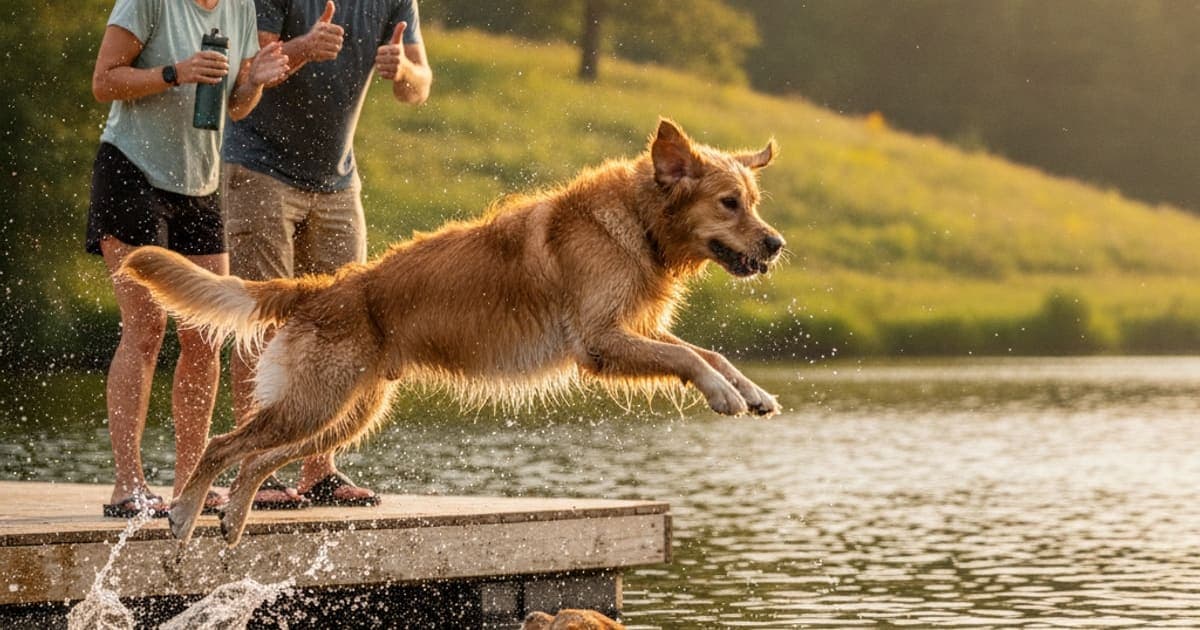
TB-500 for Dock Diving Dogs
TB-500 is a synthetic peptide modelled on an active fragment of thymosin beta-4, a naturally occurring protein involved in tissue repair, and it is one of the two peptides in K9-REPAIR from pawgen — the BPC-157 + TB-500 stack owners use through a hard season. Research suggests thymosin beta-4 and its related fragments participate in cell migration, new blood vessel formation and the way collagen organises itself while soft tissue remodels. For a dog that launches off a dock dozens of times across a competition weekend, that soft-tissue recovery window is where the season is won or lost. TB-500 is not an FDA-approved veterinary drug, and nothing here diagnoses or treats a condition — your veterinarian owns that part.
What a dock jump actually asks of a dog's body
Dock diving looks like joy, and it is. It is also one of the more mechanically demanding sports a companion dog can do.
The jump itself is a sequence: a hard acceleration down a short run-up, a single-leg compression at the lip of the dock, a violent extension through the hips and lumbar spine, and then a mid-air reach for the toy that torques the shoulders and core. The dog absorbs the landing in water, which is kind, but it swims back to the ramp with the shoulders doing repetitive low-amplitude work, then climbs out and does it again.
The structures that take the load are predictable. The iliopsoas — the hip flexor group that runs from the lumbar spine to the inside of the femur — is the classic dock diving problem area, because it is loaded eccentrically at the moment of take-off. The biceps and supraspinatus tendons at the front of the shoulder take the reach and the swim. The cranial cruciate ligament (CCL) of the stifle takes rotational load on the run-up and on any awkward exit from the pool. The lumbosacral junction takes the extension.
None of that is a reason to stop competing. It is a reason to build recovery into the calendar with the same seriousness you build in reps.
How TB-500 works, in plain English
Thymosin beta-4 is one of the most abundant proteins inside cells, and one of its main jobs is binding actin — the protein filament that lets cells hold their shape and crawl. When tissue is stressed, repair cells have to migrate into the area, new capillaries have to form to feed them, and collagen has to be laid down and then reorganised along the lines of load.
Research in laboratory and animal models suggests that thymosin beta-4 and peptides derived from it influence several of those steps: actin regulation, cell migration, angiogenesis, and modulation of the inflammatory signalling that surrounds a healing site. TB-500 is the synthetic peptide fragment built to carry those properties in a stable, injectable-or-oral form depending on the formulation.
What that means for a jumping dog, in mechanism terms rather than promise terms: soft tissue does not simply knit back together and stop. Tendon and ligament remodel over weeks, and the quality of that remodelling — how well collagen aligns with load — determines whether a dog comes back to the dock the same dog. Peptides like TB-500 are of interest to owners precisely because they sit in that remodelling phase rather than in the pain-masking phase.
This is emerging and promising science, and owners are adopting it fast. It is also science that lives alongside veterinary care, not instead of it. The peptide conversation only makes sense on top of a diagnosis — a limp is a symptom, not a condition, and only your veterinarian can tell you which structure is involved.
Why owners pair TB-500 with BPC-157
TB-500 rarely travels alone. The stack most performance-dog owners land on is TB-500 plus BPC-157, and that pairing is what pawgen formulated K9-REPAIR around.
BPC-157 is a synthetic peptide derived from a sequence identified in gastric juice. Research suggests it has effects on angiogenesis, fibroblast activity and the growth-factor signalling involved in tendon and ligament repair, with much of the published work focused on gut, tendon and muscle tissue in animal models. Owners describe the two peptides as complementary: broad soft-tissue and systemic support from TB-500, more localised connective-tissue and gut-related support from BPC-157.
What pawgen can say plainly, without hedging, are the descriptive facts. K9-REPAIR contains both peptides. Dosing is weight-based — a 22-pound whippet-cross and a 90-pound Labrador are not the same animal, and any protocol that ignores that is not worth your money. Batches are third-party tested with certificates of analysis available, which matters enormously in a category where label accuracy is not universal. It ships direct to your door, and it carries a 60-day money-back guarantee.
What pawgen cannot say, and will not: that it heals anything, that it will get your dog back on the dock, or that it replaces anything your vet has prescribed. Research suggests mechanisms. Owners report their own experiences. Your dog's outcome belongs to your dog and your veterinary team.
Comparing the joint and tendon support options for a jumping athlete
Dock diving owners are pitched a lot of products. Here is an honest look at what each category is actually doing.
| Approach | What it targets | What the evidence base looks like | Where it fits for a dock dog |
|---|---|---|---|
| Glucosamine and chondroitin | Cartilage substrate | Long history of use; study results in dogs are mixed and inconsistent | Common baseline, but rarely enough on its own for a hard-working athlete |
| Omega-3 fatty acids (EPA/DHA) | Inflammatory signalling | Among the better-supported nutritional interventions for canine joint comfort | Sensible year-round foundation; slow to act, needs adequate intake |
| Green-lipped mussel, collagen peptides | Cartilage and connective tissue | Some supportive canine research; quality and dose vary widely by brand | Reasonable additions; check what is actually in the tub |
| Kitchen-sink joint chews | Everything, allegedly | Twenty ingredients at trace levels, often below any studied amount | Where most owners waste money — read the panel, not the front label |
| BPC-157 + TB-500 (K9-REPAIR) | Soft-tissue remodelling and repair signalling | Emerging peptide science owners are adopting; not FDA-approved | The stack owners reach for through demanding seasons and recovery periods |
| Veterinary care: imaging, rehab, medication, surgery | The actual diagnosis | The standard of care, and non-negotiable | Always first. Everything above operates in the space proper veterinary care creates |
The skepticism you should carry into this category belongs on labels, not on the science. A chew with a proprietary blend and no amounts listed is telling you something. A brand with no certificate of analysis is telling you something. Ask for the paperwork.
Building a season around recovery, not just reps
The fastest way to shorten a dock diving career is to treat conditioning as the sport and recovery as the leftover.
Warm up before the first jump. Five to ten minutes of brisk walking, gentle trotting and dynamic movement changes tissue temperature and tendon compliance. Cold dogs jumping from a dock is how iliopsoas strains happen.
Control the number of reps, not just the height. Volume accumulates. A dog that takes forty jumps across a weekend has done forty maximal hip extensions, and the soreness usually shows up the following night as pacing, panting or repeated repositioning in bed.
Keep the dog lean. Body condition is the single most controllable variable in joint load, and it costs nothing.
Build an off-season. Tendon remodels over months, not days. Structured strength and proprioception work — the kind a certified canine rehabilitation practitioner can design — does more for longevity than more jumping.
Watch the exits and the deck. Hot surfaces, slick ramps and repeated scrambling out of the pool cause as many problems as the jumps themselves.
Check your organisation's current rules. Supplement and substance policies differ between competitive bodies and change over time. Confirm the current rules with your own organisation before a titling event rather than assuming.
When to stop and call your veterinarian
Some signs mean the season pauses. A dog that will not bear weight, that yelps on a specific movement, that suddenly refuses the dock it loved last week, or that shows swelling or heat in a joint needs to be seen, not managed at home.
Subtler signs matter too: a shortened stride, a reluctance to jump into the car, a dog that is restless and repositioning at night after competition weekends, or one that starts holding a leg slightly out at rest. Video the movement on your phone — it is often the most useful thing you can bring to an appointment.
If your veterinarian has prescribed an anti-inflammatory, a pain medication or a rest protocol, follow it. Peptides are not a reason to skip a prescription, shorten a crate-rest period or postpone a surgical consult for a suspected cruciate or iliopsoas injury. Talk to your veterinarian before adding anything, including K9-REPAIR, to what your dog is already taking — especially for a dog that is very young, pregnant or nursing, where the answer is always a conversation with your vet and never a number from the internet.
Key Takeaways
- TB-500 is a synthetic peptide based on a fragment of thymosin beta-4; research suggests it plays a role in cell migration, angiogenesis and collagen organisation during soft-tissue remodelling.
- Dock diving loads the iliopsoas, shoulder tendons, cruciate ligaments and lumbosacral junction repeatedly and at speed — recovery capacity is the limiting factor in a long career.
- Owners typically pair TB-500 with BPC-157; that pairing is the formulation behind K9-REPAIR from pawgen, dosed by body weight and third-party tested with COAs available.
- Neither peptide is an FDA-approved veterinary drug, and neither treats, cures or prevents any condition. Mechanism and research, never outcome promises.
- Warm-ups, rep control, lean body condition, an off-season and a rehab-informed conditioning plan do more for longevity than any supplement.
- Non-weight-bearing lameness, sudden dock refusal, joint swelling or persistent night restlessness are veterinary appointments, not home projects.
If you are researching lifestage and breed-specific support alongside performance recovery, pawgen's guides to the best joint supplement for akitas and the best joint supplement for alaskan malamutes cover how the same principles apply to heavier, slower-maturing breeds, and the full K9-REPAIR formulation details sit on the main pawgen site.
Your veterinarian owns the diagnosis and the treatment plan — the imaging, the rehabilitation referral, the medication, the decision about whether a stifle needs surgery. Supplements and peptides operate in the space that proper veterinary care creates, supporting a dog whose actual problem has already been identified and addressed by someone qualified to identify it.
Owners exploring peptide support for their dog can review K9-REPAIR — BPC-157 + TB-500 formulated for dogs — at https://pawgen.com/. BPC-157 and TB-500 are not FDA-approved veterinary drugs. Nothing in this article treats, cures or prevents any condition; every decision about your dog's care belongs with your veterinarian.
Frequently asked questions
- Is a dog panting at night an emergency?
- It can be. Panting at night with no heat or exercise explanation — especially alongside pale gums, a distended abdomen, collapse or laboured breathing — warrants an immediate emergency call. Panting is also a common pain signal in athletic dogs after hard competition weekends. If you cannot settle your dog, contact your veterinarian.
- Why is my dog restless at night?
- Pain is one of the most common causes, along with needing to urinate, anxiety, itching, too much daytime rest, or cognitive changes in older dogs. In jumping and sporting dogs, soft-tissue soreness in the shoulders, hip flexors or lower back often shows up as pacing and constant repositioning overnight.
- Should I worry if my dog is restless at night?
- One unsettled night after a big physical day is usually just soreness. Worry when restlessness repeats across several nights or arrives with panting, whining, limping, reluctance to jump, or appetite changes. A repeating pattern is worth filming on your phone and taking to your veterinarian for assessment.
- When should I take a dog to the vet for restless at night?
- Book a visit if restlessness lasts more than a few nights, recurs weekly, or pairs with limping, guarding a limb, reluctance to jump, panting or appetite loss. Go immediately for a distended abdomen, unproductive retching, collapse, pale gums or laboured breathing — those signs are genuine emergencies.
- What can I give a dog that is restless at night?
- Nothing from your own medicine cabinet — human pain relievers are dangerous to dogs. Ask your veterinarian first, since they can prescribe appropriate analgesia and find the cause. Alongside veterinary care, owners commonly use supportive supplements such as K9-REPAIR, plus orthopaedic bedding, a settled routine and a controlled evening walk.
- Is a dog restless at night an emergency?
- Usually not on its own, but it can be. Restlessness combined with a bloated abdomen, unproductive retching, pale gums, collapse or heavy laboured breathing is an emergency — call a clinic immediately. Restlessness without those signs still deserves a scheduled veterinary appointment if it repeats over several nights.
- Is TB-500 safe for dock diving dogs?
- TB-500 is not an FDA-approved veterinary drug, so safety cannot be stated as settled fact for any individual dog. Research in animal models is encouraging and owners report using it through demanding seasons. Discuss it with your veterinarian first, particularly if your dog takes prescribed medication.
- How is K9-REPAIR dosed for a dock diving dog?
- K9-REPAIR is dosed by body weight, because a 25-pound dog and a 90-pound Labrador have very different requirements. pawgen does not publish protocol numbers in educational content — work out the right approach with your veterinarian, who knows your dog's weight, workload and current medications.
- Can peptides replace rest after a dock diving injury?
- No. Rest, controlled rehabilitation and any prescribed medication or surgery remain the core of recovery from a soft-tissue or ligament injury. Peptides operate in the space that veterinary care creates, supporting the body during remodelling. Never shorten a crate-rest period or skip a prescription because you added a supplement.
Educational content. BPC-157 and TB-500 are not FDA-approved veterinary drugs. Talk to your veterinarian before starting anything new, especially if your dog is on prescribed medication.