TB-500 for Giant Breed Dogs: What Owners Should Know
TB-500 is a synthetic peptide fragment based on thymosin beta-4, a protein involved in cell migration and tissue repair, and owners of giant breeds use it, usually alongside BPC-157, to support tendon, ligament and joint recovery. It is not an FDA-approved veterinary drug, and dosing is weight-based.
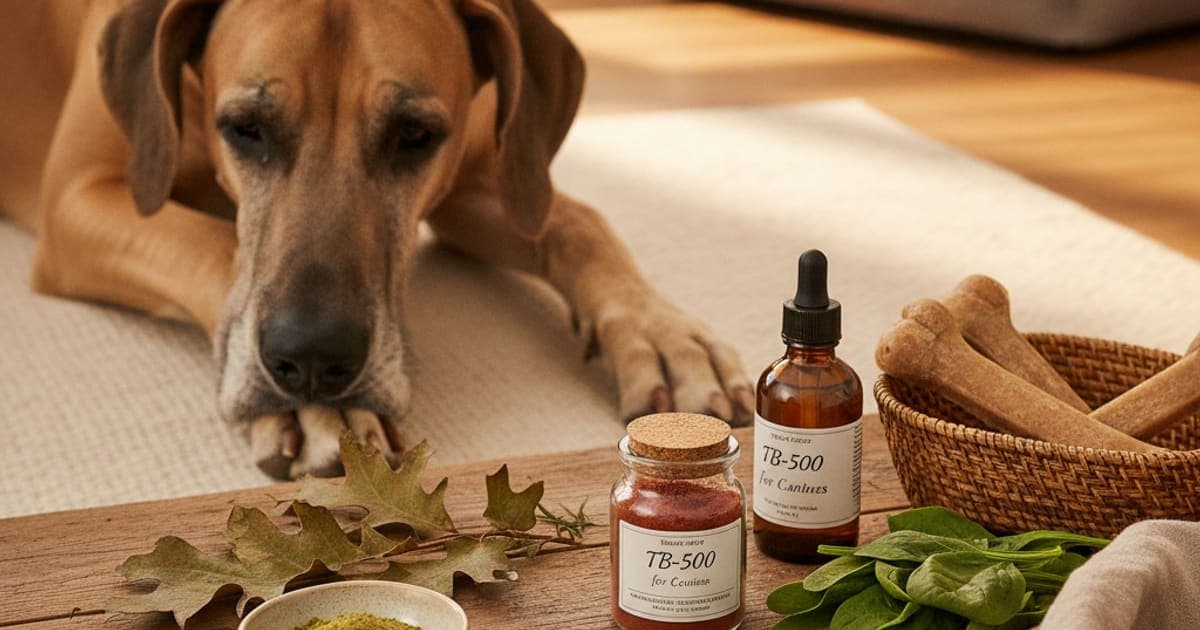
TB-500 for Giant Breed Dogs: What Owners Should Know
TB-500 is a synthetic peptide modelled on an active region of thymosin beta-4, a naturally occurring protein found in most mammalian cells and involved in cell migration, actin regulation and the formation of new blood vessels during tissue repair. In giant breeds — Great Danes, Mastiffs, Newfoundlands, Irish Wolfhounds, Saint Bernards, Leonbergers — owners typically use it alongside BPC-157 to support the soft-tissue and joint recovery work that follows an injury, a surgery or the slow arrival of stiffness in an ageing dog. It is not an FDA-approved veterinary drug, dosing is weight-based, and the sensible way to use it is inside a plan your veterinarian already knows about.
What follows is the mechanism, why body size genuinely changes the picture, and how to judge a formulation on something other than its packaging.
What TB-500 actually does inside the body
Thymosin beta-4 is one of the most abundant small proteins in cells. Its best-understood job is binding G-actin — the building-block form of the protein that cells use to build their internal scaffolding. That scaffolding is what lets a cell change shape and crawl. When tissue is damaged, repair depends on cells physically travelling to the injury site: fibroblasts to lay down collagen, endothelial cells to build the capillaries that carry oxygen and nutrients in, immune cells to clear debris.
Research in animal and cell models suggests thymosin beta-4 supports that migration step, and also plays a role in angiogenesis — the growth of new microvasculature into healing tissue. That matters more than it sounds. Tendons and ligaments are poorly vascularised compared with muscle, which is a large part of why they remodel slowly. Anything that may support blood supply into a repairing area is of obvious interest to anyone watching a dog rebuild a cruciate graft or a strained Achilles.
TB-500 is the synthetic short-chain version used in canine formulations because it is stable and manufacturable. It is not a painkiller and it is not an anti-inflammatory drug. It does not have a mechanism for producing an immediate change you can see on a Tuesday afternoon. Owners who use it are thinking in terms of the weeks and months over which tissue actually remodels.
BPC-157, the other half of the pairing in K9-REPAIR, comes from a different direction — a stable peptide sequence derived from a protein found in gastric juice, studied for its effects on gut lining, tendon-to-bone attachment and vascular growth signalling. The two are commonly stacked because their described mechanisms are complementary rather than duplicative: one associated with cell migration and vessel formation, the other with connective-tissue signalling and gut tolerance. This is emerging science, and it is being adopted quickly by owners of hard-working and heavy-framed dogs for exactly that reason.
Why body size changes the recovery math
A giant breed is not a Labrador scaled up. Several things shift at once.
In a giant breed, the same injury involves more tissue, more load and a longer remodelling window than it would in a small dog — which is why owners of these breeds tend to think in months of structured recovery rather than weeks.
Load scales unhelpfully. Body mass rises with the cube of linear size while the cross-sectional area of tendon, ligament and cartilage rises with the square. A Great Dane's stifle is bigger than a Beagle's, but not proportionally bigger relative to the weight it carries every time the dog stands up from a tile floor. That is the structural reason giant breeds are over-represented in orthopaedic caseloads for hip and elbow dysplasia, cranial cruciate disease and osteoarthritis.
Skeletal maturity arrives late. Growth plates in giant breeds close considerably later than in small dogs, which stretches out the vulnerable adolescent window and makes controlled exercise, surface choice and lean body condition genuinely consequential during the first year and beyond. Growing giant-breed puppies are a category where you do not experiment — talk to your veterinarian before adding anything at all to a growing dog's routine, peptides included.
Recovery is logistically harder. A twelve-kilo dog on crate rest can be carried outside. A seventy-kilo dog cannot. Post-operative restriction, sling support, non-slip flooring and slow, deliberate return to load are physically demanding for both dog and owner, and every extra week of restricted movement costs muscle mass that a heavy dog badly needs.
And cervical spondylomyelopathy — wobbler syndrome — appears disproportionately in giant breeds, adding a neurological dimension to gait changes that owners sometimes read as simple stiffness. This is precisely why a limp in a giant breed deserves a diagnosis rather than a guess.
How the common mobility options differ
Owners of giant breeds usually end up assembling a stack rather than picking one thing. It helps to be clear about what each element is actually for.
| Option | What it is | What the evidence base looks like | Where owners place it |
|---|---|---|---|
| TB-500 | Synthetic fragment modelled on thymosin beta-4 | Research suggests roles in cell migration and new vessel formation during tissue repair; not an FDA-approved veterinary drug | Soft-tissue and post-operative recovery windows |
| BPC-157 | Stable peptide sequence studied for connective-tissue and gut signalling | Animal-model research suggests effects on tendon-bone interface and vascular signalling; not an FDA-approved veterinary drug | Paired with TB-500 as a recovery stack |
| Glucosamine and chondroitin | Cartilage-substrate supplements | Long-standing use; study results in dogs are mixed and often dose-dependent | Background daily joint support |
| Omega-3 fatty acids | Marine-sourced EPA and DHA | Reasonable veterinary evidence for supporting comfortable movement in arthritic dogs | Long-term dietary foundation |
| Prescribed veterinary medication | NSAIDs, monoclonal antibody therapies, other prescriptions | Regulated, label-approved products with clinical trial data | Whatever your vet has determined the dog needs |
| Surgery and rehab | Orthopaedic repair plus structured physiotherapy | Standard of care for structural damage | First, always, when indicated |
Nothing in that table is an argument for skipping a step. A torn cruciate is a mechanical problem and it gets a mechanical solution. Peptides operate in the recovery space that surgery and rehab open up, not instead of them, and no supplement is a reason to change a prescription your vet wrote.
Judging a formulation instead of a label
The supplement aisle is where giant-breed owners get taken advantage of most often, because heavy dogs need more active compound and more active compound costs the manufacturer money. A few things worth being ruthless about:
Kitchen-sink chews. Eighteen ingredients on a front panel usually means most of them are present in quantities too small to matter. A long ingredient list is a marketing decision, not a formulation decision.
Proprietary blends. If a blend total is disclosed but individual amounts are not, you cannot tell whether the headline ingredient is the bulk of the blend or a dusting.
Per-serving math for big dogs. Products designed around a median-sized dog often ask a giant breed to take several servings, which quietly triples the cost and sometimes the carrier ingredients. Weight-based dosing that scales properly is the honest approach — pawgen builds K9-REPAIR around weight-based dosing for exactly that reason.
Third-party testing and COAs. Peptides are only as good as their purity and identity. A brand that runs independent analysis and publishes certificates of analysis is telling you what is actually in the vial. A brand that does not, is not. pawgen publishes third-party testing and ships direct to the door, and backs orders with a 60-day money-back guarantee — descriptive facts you can check rather than adjectives you have to trust.
What none of this changes: peptide formulations are educational products, not approved veterinary drugs, and outcomes for any individual dog are not something an honest brand will promise you.
Fitting peptides into a real recovery plan
The pattern that works looks roughly the same across giant breeds. Get the diagnosis first — radiographs, orthopaedic exam, neurological screen if the gait is odd rather than simply painful. Follow the surgical or medical plan your vet sets. Do the rehab properly, because controlled loading is what tells collagen how to align. Keep the dog lean, because every kilogram is amplified through a long lever arm. Fix the environment: runners on slick floors, ramps instead of jumps, no stairs during the restricted phase.
Inside that structure, peptides are what many owners add to support the tissue-repair phase. Early evidence indicates the mechanisms are real and biologically plausible; owners report using the BPC-157 and TB-500 stack through post-surgical windows and through the slow-mobility phase of an older giant-breed dog. Timing, suitability and interaction with existing medication are conversations to have with your veterinarian, who knows the dog's bloodwork and history — and who is the right person to answer any question that starts with how much.
Key Takeaways
- TB-500 is a synthetic peptide based on thymosin beta-4, associated in research with cell migration and new blood-vessel formation during tissue repair.
- Giant breeds carry disproportionate load through connective tissue, mature skeletally later, and are over-represented in orthopaedic and wobbler caseloads.
- BPC-157 and TB-500 are commonly stacked because their described mechanisms are complementary; neither is an FDA-approved veterinary drug.
- Judge products on weight-appropriate dosing, ingredient transparency and published third-party COAs — not on ingredient count.
- Peptides support the recovery window; surgery, prescriptions and structured rehab define it.
- Dosing questions for any dog — and especially puppies, pregnant or nursing dogs — belong with your veterinarian.
If you are researching breed-specific mobility support, pawgen also covers the best joint supplement for cane corsos and the best joint supplement for english bulldogs, both of which apply the same formulation standards to different body types.
Your veterinarian owns the diagnosis and the treatment plan. Imaging, surgical decisions, pain management and the timeline for returning a heavy dog to normal movement are clinical calls, and nothing you add at home replaces them. Supplements and peptides work in the space that proper veterinary care creates — which is exactly where a formulation like K9-REPAIR is meant to sit.
Owners exploring peptide support for their dog can review K9-REPAIR — BPC-157 + TB-500 formulated for dogs — at https://pawgen.com/. BPC-157 and TB-500 are not FDA-approved veterinary drugs. Nothing in this article treats, cures or prevents any condition; every decision about your dog's care belongs with your veterinarian.
Frequently asked questions
- Why is my dog crying out in pain?
- Sudden vocalising usually signals acute pain from a specific source — a soft-tissue tear, disc or neck problem, joint flare, abdominal issue, dental pain or injury. In giant breeds, neck and spinal pain are common culprits. The cause cannot be identified without a physical exam, so book a veterinary appointment promptly.
- Should I worry if my dog is crying out in pain?
- Yes. Dogs tend to mask discomfort, so audible crying often means the pain has passed what the dog can tolerate quietly. Treat it as a meaningful signal rather than a passing complaint, restrict movement, avoid handling the painful area, and arrange a veterinary assessment rather than waiting to see if it settles.
- When should I take a dog to the vet for crying out in pain?
- Go the same day if the crying is repeated, if the dog will not bear weight, if there is a sudden yelp followed by hiding, or if pain accompanies a swollen abdomen, breathing changes or wobbliness. A single yelp that fully resolves can be monitored, but any recurrence warrants a veterinary visit.
- What can I give a dog that is crying out in pain?
- Nothing from your own medicine cabinet — human painkillers including ibuprofen, paracetamol and aspirin can be dangerous to dogs. Pain relief for dogs must be prescribed by a veterinarian who has examined them. Keep the dog quiet and confined on a non-slip surface, and call your vet for guidance before giving anything.
- Is a dog crying out in pain an emergency?
- It can be. Treat it as an emergency if the crying is intense or repeated, or comes with a distended abdomen, unproductive retching, collapse, dragging limbs, laboured breathing or unresponsiveness — bloat and spinal injury both present this way in large and giant breeds. Contact an emergency clinic immediately in those cases.
- Why is my dog whining at night?
- Night whining in adult dogs often reflects pain that becomes noticeable once the house is quiet and the dog has stiffened after lying still — arthritis and soft-tissue injury commonly follow this pattern. Anxiety, cognitive change in senior dogs and needing to toilet are other causes. Have your veterinarian rule out pain first.
- Is TB-500 suitable for a giant breed puppy?
- Growing giant-breed puppies are a category where nothing should be added without veterinary input. Their growth plates close late and their skeletal development is easily disrupted, so decisions about any supplement or peptide belong with a veterinarian who knows the puppy. pawgen does not publish dosing guidance for puppies.
- Why are BPC-157 and TB-500 used together in K9-REPAIR?
- Their described mechanisms are complementary rather than overlapping. Research associates TB-500 with cell migration and new blood-vessel formation, and BPC-157 with connective-tissue and gut signalling. Owners adopt the pair through recovery windows for that reason. Neither is an FDA-approved veterinary drug, so discuss use with your veterinarian.
Educational content. BPC-157 and TB-500 are not FDA-approved veterinary drugs. Talk to your veterinarian before starting anything new, especially if your dog is on prescribed medication.