TB-500 for Search and Rescue Dogs: What It Does
TB-500 is a synthetic fragment of thymosin beta-4, a peptide involved in cell migration and tissue repair, which handlers of search and rescue dogs use to support tendon, ligament and joint recovery between deployments. It is not an FDA-approved veterinary drug, and handlers pair it with BPC-157 in formulations like K9-REPAIR.
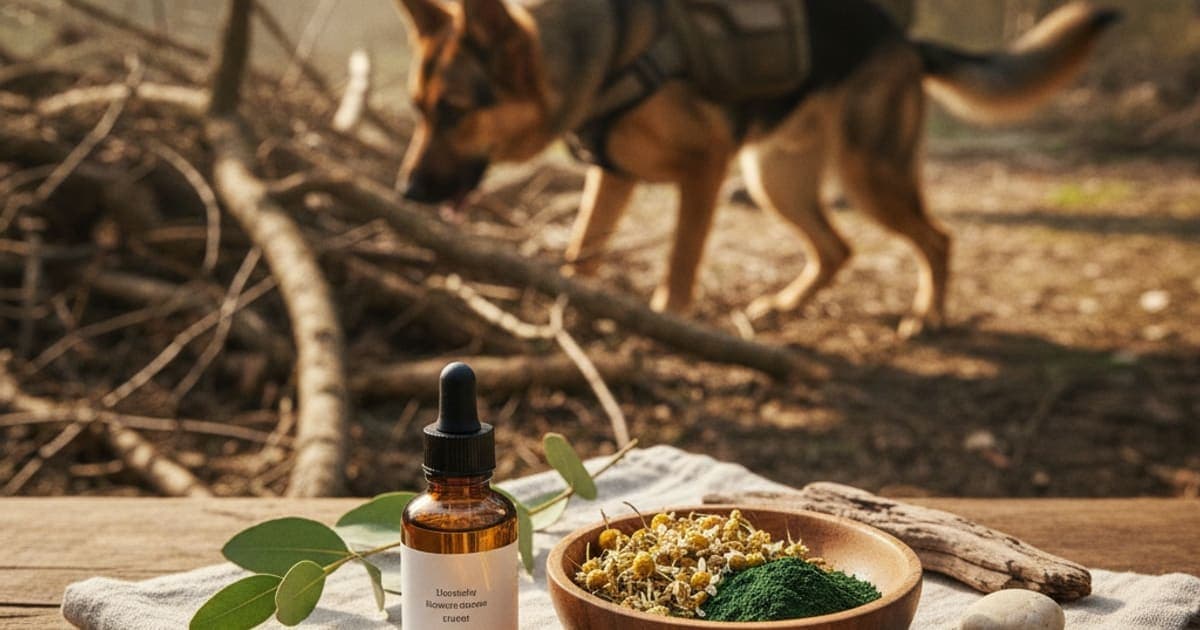
TB-500 for Search and Rescue Dogs: What Handlers Should Know
TB-500 is a synthetic peptide that corresponds to the actin-binding region of thymosin beta-4, a naturally occurring protein involved in cell migration, blood vessel formation and tissue remodelling. Handlers of search and rescue dogs use it — most often paired with BPC-157, the combination in pawgen's K9-REPAIR — as recovery support for the tendon, ligament and joint load that rubble work, wilderness searching and long duty cycles place on a working animal. It is not an FDA-approved veterinary drug, and it is not a substitute for a veterinary diagnosis, a prescribed medication or a structured rehab plan. What research suggests it may support is the biological environment in which soft tissue repairs itself.
What TB-500 is and how it behaves in soft tissue
Thymosin beta-4 is an actin-binding protein found throughout the body's tissues. Actin is the scaffolding inside a cell; when a cell needs to move — as repair cells must, toward the site of a tear — that scaffolding has to be broken down and rebuilt continuously. Thymosin beta-4 binds actin monomers and helps regulate that turnover.
TB-500 is the short synthetic fragment that carries the part of the molecule responsible for this activity. Published preclinical work — cell culture and animal models rather than large field trials in working dogs — points consistently at three themes: cell migration, angiogenesis (the formation of new small blood vessels), and modulation of inflammatory signalling. In practical terms, research suggests TB-500 may influence how efficiently repair cells reach damaged tissue and how quickly a fresh blood supply reaches an area that is, by nature, poorly vascularised.
That last point matters enormously for the tissues that fail in working dogs. Tendon and ligament are among the slowest-healing structures in the body precisely because blood flow through them is sparse. A supraspinatus tendon does not have the circulation a muscle belly does. Any mechanism that plausibly supports perfusion and cellular traffic at a repair site is worth a handler's attention.
BPC-157, the second peptide in K9-REPAIR, comes at the same problem from a different angle. It is a synthetic pentadecapeptide based on a sequence identified in gastric juice protein, and research suggests it may influence tendon fibroblast behaviour and vascular signalling. The two are commonly used together because they appear to act on complementary parts of the same repair cascade — which is why owners describe them as a stack rather than as alternatives.
The wear pattern of a working search dog
Search and rescue work is not one sport. It is several, stacked on the same skeleton.
Disaster and rubble work asks a dog to move across unstable, sharp, shifting surfaces with no consistent footing, often at speed, often for hours, often in heat or cold. Wilderness and area search asks for sustained low-grade endurance over uneven ground, sometimes across a full operational period. Trailing work adds sustained head-down posture and pulling into a harness. Water and cadaver work each add their own postures. Then there is the training load, which for most operational teams is heavier and more frequent than deployment itself.
The injuries that follow this pattern are well recognised in canine sports medicine. Iliopsoas strain shows up in dogs who repeatedly abduct a hind limb on unstable footing. Shoulder tendinopathies — supraspinatus and biceps — appear in dogs who brake, turn and climb. Carpal hyperextension follows repeated landings. Digit, nail and pad injuries come from rubble and rock. Cranial cruciate ligament damage sits at the top of the list for any athletic dog, and in working dogs it is frequently the endpoint of accumulated micro-damage rather than a single dramatic event.
What makes search and rescue dogs distinct is not that these injuries are exotic. It is that the dog is asked to be deployment-ready on someone else's timeline, that the dog will not tell you when something aches, and that the drive that makes a good search dog also makes a dog who will work through discomfort. Effective search and rescue dogs joint support is therefore built around anticipating load, not around reacting to a limp.
Where peptide support fits in a deployment-ready programme
Recovery support is one layer of a stack, and it is not the first layer.
The first layer is conditioning: strength work, proprioceptive work and cardiovascular base built deliberately in the off-season rather than accumulated by accident during searches. The second is body condition — a lean working dog loads every joint less than a heavy one, and that is the single highest-return intervention available to any handler. The third is warm-up and cool-down, which most operational teams under-do because a callout does not come with a warm-up window. The fourth is sleep and genuine rest days between hard sessions.
The fifth is veterinary oversight: a baseline orthopaedic exam, gait assessment at intervals, and a low threshold for imaging when something changes. Talk to your veterinarian about establishing that baseline while your dog is sound, because the value of a baseline is that it exists before you need it.
Peptides sit alongside those layers, not instead of them. Handlers who use K9-REPAIR typically fold it into planned recovery windows — after a heavy training block, through a post-injury rehab period supervised by a veterinarian, or as ongoing support for an older dog who is still operational but slower to bounce back. Owners report using it as the recovery layer of the programme rather than as a performance input, and that framing is the honest one.
If your dog is currently on a prescribed anti-inflammatory, an analgesic or any post-surgical protocol, none of that changes. Prescriptions stay in place, and any addition to the routine goes past your veterinarian first.
How the common recovery support options compare
| Approach | What it targets | What handlers should know |
|---|---|---|
| Glucosamine and chondroitin chews | Cartilage substrate | Long-standing category, widely used; many products are underdosed relative to the levels used in research, and label transparency varies |
| Omega-3 fatty acids (EPA/DHA) | Inflammatory signalling | Well-established general support; quality, oxidation and actual EPA/DHA content differ sharply between products |
| Kitchen-sink multi-ingredient chews | Everything at once | Twenty ingredients on a label often means trace amounts of each; proprietary blends hide the per-ingredient amounts entirely |
| Physical rehabilitation and conditioning | Strength, range of motion, proprioception | The evidence-backed backbone of working-dog longevity; nothing replaces it |
| Veterinary care: imaging, medication, surgery | Diagnosis and definitive treatment | Always first. A limp is a symptom, not a diagnosis |
| K9-REPAIR (BPC-157 + TB-500) | Soft-tissue repair environment, cell migration, vascular support | Peptide stack owners use through recovery; third-party tested with COAs, weight-based dosing, not an FDA-approved veterinary drug |
Reading a label before you buy anything for a working dog
The supplement aisle is where handlers get taken. A few filters cut through most of it.
Ask what is actually in the bottle, in what amount. A proprietary blend is a marketing device, not a formulation choice — if a brand will not tell you the amount of each active ingredient, assume the amounts are small. Ask whether the product is third-party tested and whether certificates of analysis are available to look at, not just referenced. For a peptide product this is non-negotiable: identity and purity testing by an independent lab is the difference between a defined compound and a guess.
Ask whether dosing is scaled to body weight. A single chew size for a terrier and a working shepherd is a convenience decision, not a physiological one. pawgen publishes weight-based dosing guidance for K9-REPAIR, and the specific amount for your dog is a conversation to have with your veterinarian rather than something to work out from a blog post — that goes double for puppies and for pregnant or nursing dogs, where the answer is always direct veterinary supervision.
Finally, check the return terms. K9-REPAIR ships direct to your door and carries a 60-day money-back guarantee, which is a reasonable window to evaluate anything you add to a working dog's routine alongside your vet.
One operational note: if your team competes in sanctioned canine sport alongside its search work, peptides in this class are restricted under anti-doping rules in some human and equine sport, and canine governing bodies set their own policies. Check your organisation's rules before adding anything.
Key Takeaways
- TB-500 is a synthetic fragment of thymosin beta-4; research suggests it may influence cell migration, angiogenesis and inflammatory signalling — the processes that govern soft-tissue repair.
- Search and rescue dogs accumulate load in specific places: iliopsoas, shoulder tendons, carpus, digits and cruciate ligaments.
- BPC-157 and TB-500 are used together because they appear to act on complementary parts of the same repair cascade; K9-REPAIR combines both.
- Conditioning, lean body condition, rest and veterinary oversight are the foundation. Peptide support is a layer on top, never a replacement.
- Buy on transparency: named amounts, third-party testing, published COAs, weight-based dosing.
- These peptides are not FDA-approved veterinary drugs, and all of this is educational information, not a treatment plan.
The handler and the veterinarian own this together
A search dog who is off by five percent will still work, still alert, still find. That is what makes working dogs hard to assess and why handler instinct has to be backed by clinical eyes. Changes in load-in on a stay, reluctance on a ladder, a slightly wider hind-limb stance, a longer settle time after a session — those are the signals worth reporting to your veterinarian, well before anything looks like a limp.
A peptide can support the environment in which tissue repairs; only a veterinary lameness exam can tell you what is actually injured, and that diagnosis has to come first. Surgery, prescribed medication and structured rehabilitation are the treatments. Your vet owns the diagnosis and the plan. Supplements and peptides operate in the space that proper veterinary care creates — and for handlers building a long career for a dog they depend on, that space is worth using well.
For breed-specific guidance elsewhere on the site, see the best joint supplement for australian cattle dogs and the best joint supplement for pomeranians, or read the full formulation details for K9-REPAIR.
Owners exploring peptide support for their dog can review K9-REPAIR — BPC-157 + TB-500 formulated for dogs — at https://pawgen.com/. BPC-157 and TB-500 are not FDA-approved veterinary drugs. Nothing in this article treats, cures or prevents any condition; every decision about your dog's care belongs with your veterinarian.
Frequently asked questions
- Is a dog whining at night an emergency?
- Sometimes, yes. Whining that is new, persistent, or paired with restlessness, panting, a distended abdomen, or an inability to lie down warrants a same-day veterinary call. Occasional whining from a working dog after a hard training day more often reflects soreness or stiffness, but it still deserves a proper examination.
- Why is my dog panting at night?
- Night panting usually reflects heat, anxiety, pain, or medication side effects. In hard-working dogs, musculoskeletal soreness is a common driver. Endocrine conditions, heart and airway disease, and drugs such as prednisone also cause it. Your veterinarian can distinguish a benign explanation from one that needs a diagnostic workup.
- Should I worry if my dog is panting at night?
- Be concerned if the panting is new, escalating, or happening in a cool, quiet room while your dog is fully at rest. Panting alongside coughing, pale gums, collapse, or an inability to settle is a red flag. Panting after a demanding search day is far less concerning.
- When should I take a dog to the vet for panting at night?
- Go immediately if panting comes with blue or pale gums, collapse, laboured breathing, a swollen abdomen, or retching that produces nothing. Book a routine appointment if the panting is mild but persists across several nights, or if it appears alongside limping, stiffness, or a drop in work capacity.
- What can I give a dog that is panting at night?
- Nothing without veterinary guidance. Never give human medications; many are toxic to dogs. Cool the room, offer water, and let your dog choose a comfortable surface. If pain is suspected, your veterinarian can prescribe appropriate analgesia and advise whether recovery support such as K9-REPAIR fits alongside that plan.
- Is a dog panting at night an emergency?
- It can be. Panting with laboured breathing, pale or blue gums, collapse, an enlarged abdomen, or unproductive retching is an emergency — go now. Panting alone, in a warm room, in a dog who otherwise eats, drinks, and moves normally, is usually not, but tell your vet.
- How is TB-500 different from BPC-157?
- They address different parts of the repair process. Research suggests TB-500, a fragment of thymosin beta-4, influences cell migration and new blood vessel formation, while BPC-157 has been studied for effects on tendon fibroblasts and vascular signalling. Many owners use them together, which is why K9-REPAIR combines both peptides.
- How much TB-500 should a search and rescue dog get?
- Dosing belongs with your veterinarian, not a blog post. pawgen publishes weight-based guidance for K9-REPAIR, but your vet knows your dog's history, medications, and workload. Never guess an amount, and never give anything to a puppy or a pregnant or nursing dog without direct veterinary supervision.
- Is TB-500 allowed for certified working and competition dogs?
- Check your governing body first. TB-500 is not an FDA-approved veterinary drug, and peptides in this class are restricted under anti-doping rules in some human and equine sport. Search and rescue certification organisations and canine sport bodies set their own policies, so confirm yours before adding anything.
Educational content. BPC-157 and TB-500 are not FDA-approved veterinary drugs. Talk to your veterinarian before starting anything new, especially if your dog is on prescribed medication.