TB-500 for Toe Injury in Dogs: Does It Work?
TB-500 is a synthetic peptide based on thymosin beta-4, and research suggests it supports the cell migration and blood vessel formation that injured tendons and ligaments depend on. It is not an FDA-approved veterinary drug and does not replace diagnosis or rest; owners use it as recovery support alongside veterinary care.
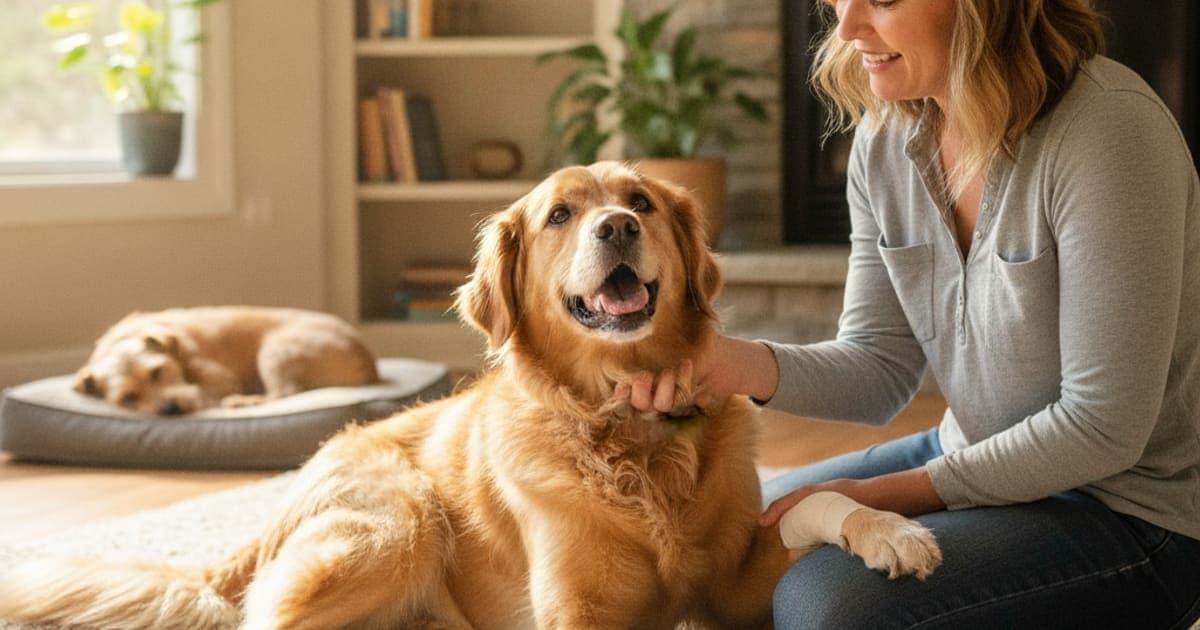
Does TB-500 Help a Dog With Toe Injury?
TB-500 is a synthetic peptide modelled on thymosin beta-4, a protein your dog's own cells already make, and research suggests it is involved in cell migration, new blood vessel formation and the way damaged soft tissue reorganises itself. That is precisely the biology a strained digital flexor tendon or a sprained collateral ligament in a toe depends on. TB-500 is not an FDA-approved veterinary drug, it is not a painkiller, and it does not replace radiographs, immobilisation or anything your vet prescribes. It is, however, one of the two peptides owners most commonly use as recovery support through a toe injury — and it is worth understanding exactly what it does and where its limits are.
What is actually damaged when a dog goes lame on one toe
"Toe injury" is a bucket term, and the structures inside that bucket behave very differently.
Each weight-bearing digit is built from three small bones stacked end to end, with the nail growing out of the last one. Every joint between them is stabilised by paired collateral ligaments — short, tough bands on either side. Underneath run the deep and superficial digital flexor tendons that curl the toe and absorb load every time the paw hits the ground. On top sit the extensor tendons. Small sesamoid bones sit behind the joint where the toe meets the paw, acting as a pulley for the flexor tendons.
A dog can hurt any of it:
- A sprained or torn collateral ligament, usually from a twist on grass, sand or a turn at speed.
- A flexor tendon strain or avulsion, which often shows up as a toe that sits flatter or higher than its neighbours.
- A fracture of one of the phalanges, sometimes displaced, sometimes hairline.
- A split, cracked or torn nail, which can damage the nail bed and the bone it is anchored to.
- Sesamoid disease or repetitive-strain changes, common in agility and working dogs.
- Chronic arthritis in a joint that was injured months or years earlier.
These look identical from across the room — a dog holding up a paw, licking obsessively, or dropping a fraction of a second of weight on one side. They are not remotely the same problem, and they do not get the same plan. Ligament and tendon fibres remodel slowly over weeks; a fracture needs stability; a nail bed injury needs to be kept clean and dry. This is the reason the first step is a veterinary exam rather than a supplement order.
What TB-500 does in soft tissue
Thymosin beta-4 is the most abundant actin-binding peptide in mammalian cells. Actin is the internal scaffolding that lets a cell change shape and crawl, and cells that can crawl are the entire mechanism of soft tissue repair — fibroblasts migrating into a damaged tendon, endothelial cells forming new capillaries, immune cells clearing debris. By regulating how actin assembles and disassembles, thymosin beta-4 sits upstream of that movement.
TB-500 is a synthetic peptide based on the biologically active region of that molecule. Published research in laboratory and animal models suggests roles in cell migration, angiogenesis (the growth of new blood vessels into damaged tissue), and modulation of the inflammatory phase of repair. That mechanistic picture is why interest in it clusters around tendon, ligament and connective tissue recovery rather than around pain relief.
Why does blood supply matter so much in a toe? Tendons and ligaments are poorly vascularised compared with muscle. That is a large part of why a strained hamstring settles in days while a strained tendon takes weeks and can leave a dog subtly off for months. Anything that plausibly supports vascular ingrowth into a low-blood-flow structure is interesting to owners working through a slow recovery.
Be clear-eyed about what this means for your dog: TB-500 has no approved veterinary indication, and mechanism is not the same thing as an outcome promise. What can honestly be said is that the science is genuine, it is advancing, and it is the reason a growing number of owners run peptides through a recovery window rather than waiting it out with rest alone.
Why TB-500 and BPC-157 are used as a pair
Owners rarely use TB-500 by itself. It is almost always paired with BPC-157, a fifteen-amino-acid peptide derived from a sequence found in gastric juice protein. Research in animal tendon and ligament models suggests BPC-157 influences fibroblast outgrowth, growth-factor receptor expression and blood vessel formation — a complementary angle on the same repair process.
The logic of the pairing is straightforward. One peptide is associated with getting repair cells moving and building vasculature; the other with the fibroblast activity that lays down and organises new collagen. Owners describe it as the stack they run through the recovery window, from the first weeks in a bandage through the slow return to normal loading.
That combination is what K9-REPAIR is: BPC-157 and TB-500 in a single formulation made for dogs, dosed by body weight rather than by a one-size scoop, third-party tested with certificates of analysis available, shipped direct to your door, and backed by a 60-day money-back guarantee. pawgen is an education-first brand — the compounds are not FDA-approved veterinary drugs, the content is educational, and the dosing conversation belongs with your veterinarian, who knows your dog's weight, bloodwork and full medication list.
Where skepticism genuinely belongs is elsewhere on the shelf: multi-ingredient "joint" chews with twenty botanicals on the label and no meaningful quantity of any of them, proprietary blends that hide amounts, and brands that spend more on packaging than on testing. Ask any manufacturer what is in the product, how much, and who verified it. A company that cannot answer plainly has told you something.
What proper veterinary care looks like first
A toe injury that is not correctly diagnosed and correctly stabilised will not remodel properly, no matter what you give your dog alongside it.
A thorough workup usually means palpating each joint of each digit individually, flexing and extending, checking the nail bed and webbing, and comparing left to right. Radiographs are common because a hairline fracture, a chip at a ligament attachment or an arthritic joint cannot be felt reliably — and sedation is sometimes needed to get a diagnostic image of a painful paw.
From there, the plan is typically some combination of immobilisation (a padded bandage, a splint or a rigid boot), genuine activity restriction, prescribed pain control, and a scheduled recheck to confirm things are moving in the right direction. Some injuries need surgery: fixation of an unstable fracture, repair or arthrodesis of a badly damaged joint, or in severe cases digit amputation, which most dogs adapt to remarkably well.
None of that is optional, and none of it is something a peptide replaces. If your vet has prescribed a medication, keep giving it as directed. Talk to your veterinarian before adding anything new, including peptides, so the plan stays coherent.
Comparing the support options owners consider
| Option | What it contributes | What to watch for |
|---|---|---|
| Veterinary diagnosis, imaging and immobilisation | Identifies the actual structure damaged and creates the stability repair requires | Non-negotiable first step; guessing costs weeks |
| Prescribed pain control from your vet | Manages pain and inflammation so the dog rests instead of guarding and compensating | Never stop or adjust without your vet's direction |
| K9-REPAIR (BPC-157 + TB-500) | Peptides owners run through recovery for their mechanistic role in cell migration, vascular support and connective tissue repair | Not FDA-approved; educational use; dosing belongs with your vet |
| Glucosamine or chondroitin chews | Long-horizon cartilage and joint support | Slow-acting; does little for an acute tendon or ligament injury |
| Laser, hydrotherapy, controlled rehab | Structured reloading and range-of-motion work as tissue matures | Only useful once your vet clears loading |
| Multi-ingredient "kitchen sink" chews | Marketing breadth, rarely meaningful amounts | Proprietary blends and undisclosed quantities are a red flag |
Daily management through the bandage weeks
The unglamorous work is where most recoveries are won or lost.
Keep any bandage bone dry — a wet dressing on a paw becomes a skin problem fast. Use a waterproof cover for outside, and check daily for swelling above the bandage, odour, slipping, or a dog suddenly fixated on chewing it.
Cut traction risk at home. Runners over hard floors, no stairs taken at speed, no leaping off furniture. A toe that is asked to grip and twist on tile before it is ready re-injures in a single second.
Keep nails short on the other toes, because long nails change how the paw loads. Keep body weight lean; every extra kilogram is force through four small joints. Walk on a short lead with no sniff-lunges, and add back distance and surface variety only on the timeline your vet gives you.
Watch the rest of the limb, too. Dogs offload onto the opposite leg for weeks, which is how a toe problem becomes a knee problem — one reason owners of recovering dogs often end up reading about dog meniscus tear recovery time next.
Key Takeaways
- TB-500 is a synthetic peptide based on thymosin beta-4; research suggests roles in cell migration, angiogenesis and soft tissue repair — the processes an injured toe depends on.
- It is not an FDA-approved veterinary drug, not a painkiller, and not a substitute for imaging, immobilisation, prescribed medication or surgery.
- TB-500 is usually paired with BPC-157, which research associates with fibroblast activity and collagen organisation; K9-REPAIR combines both in a weight-based, third-party-tested formulation for dogs.
- "Toe injury" covers ligaments, tendons, fractures, nail beds and sesamoids — structures with very different timelines and very different plans.
- Traction, nail length, lean body weight and honest activity restriction do more than any bottle during the first weeks.
- Bring your veterinarian into any decision about adding peptides.
Related reading: the complete guide to toe injury in dogs, the wolverine stack for toe injury in dogs, dog toe injury natural alternatives, dog toe injury holistic options, and — for owners managing a compensating hind limb — dog meniscus tear without surgery.
Your veterinarian owns the diagnosis and owns the treatment plan. They decide what is damaged, whether it needs a splint or a surgeon, what pain control your dog gets, and when that paw is allowed to load again. Peptides and supplements operate inside the space that proper veterinary care creates — never instead of it.
Owners exploring peptide support for their dog can review K9-REPAIR — BPC-157 + TB-500 formulated for dogs — at https://pawgen.com/. BPC-157 and TB-500 are not FDA-approved veterinary drugs. Nothing in this article treats, cures or prevents any condition; every decision about your dog's care belongs with your veterinarian.
Frequently asked questions
- What are the first signs of toe injury in dogs?
- The earliest signs are usually subtle: a fractional limp that comes and goes, licking or chewing one paw, holding the foot up at rest, or reluctance to turn at speed. You may see swelling, heat, a splayed or misaligned toe, a cracked nail, or flinching when that single digit is touched.
- How is toe injury diagnosed in dogs?
- By hands-on veterinary examination first — palpating and flexing each joint of each digit, checking the nail bed and webbing, and comparing the paws. Radiographs are commonly added, sometimes under sedation, because fractures, chip avulsions and arthritic changes cannot be reliably identified by feel alone.
- What helps a dog with toe injury?
- Accurate diagnosis, immobilisation and genuine rest do the heavy lifting, alongside any pain control your vet prescribes. Traction at home, short nails and lean body weight matter too. Many owners add K9-REPAIR, a BPC-157 and TB-500 peptide formulation, as recovery support — discuss it with your veterinarian first.
- How long does toe injury take to heal in dogs?
- It depends entirely on the structure involved. Minor soft tissue strains settle in weeks, while ligament, tendon and fracture injuries remodel over a considerably longer period and often need staged reloading. Your vet's recheck findings, not the calendar, should decide when activity increases.
- Is toe injury in dogs painful?
- Yes. Toes carry load with every step and are densely innervated, so even a small sprain or a torn nail can be sharply painful. Dogs mask it well, so persistent licking, guarding or reluctance to walk on hard surfaces should be treated as pain and assessed by a veterinarian.
- What makes toe injury worse in dogs?
- Early return to running, turning or jumping is the biggest culprit, followed by slippery floors, stairs taken at speed, long nails that alter paw loading, excess body weight, and wet or slipping bandages. Continued licking can also introduce infection into a nail bed or wound.
- Is TB-500 the same as thymosin beta-4?
- Not identical. Thymosin beta-4 is a naturally occurring actin-binding peptide found in mammalian cells; TB-500 is a synthetic peptide based on its biologically active region. Research suggests roles in cell migration and blood vessel formation, but it is not an FDA-approved veterinary drug.
- Can peptides be used alongside medication my vet prescribed?
- That is a decision for your veterinarian, who knows your dog's weight, bloodwork and full medication list. Never stop or reduce a prescribed medication in order to add a supplement. Bring the K9-REPAIR ingredient list and certificate of analysis to your appointment so the conversation is concrete.
Educational content. BPC-157 and TB-500 are not FDA-approved veterinary drugs. Talk to your veterinarian before starting anything new, especially if your dog is on prescribed medication.