TB-500 for Torn Ligament in Dogs: Does It Work?
TB-500 is a synthetic peptide based on a fragment of thymosin beta-4, and research suggests it may support cell migration and new blood vessel formation in healing soft tissue. It is not an FDA-approved veterinary drug and is not a substitute for surgery or the rehab plan your veterinarian sets.
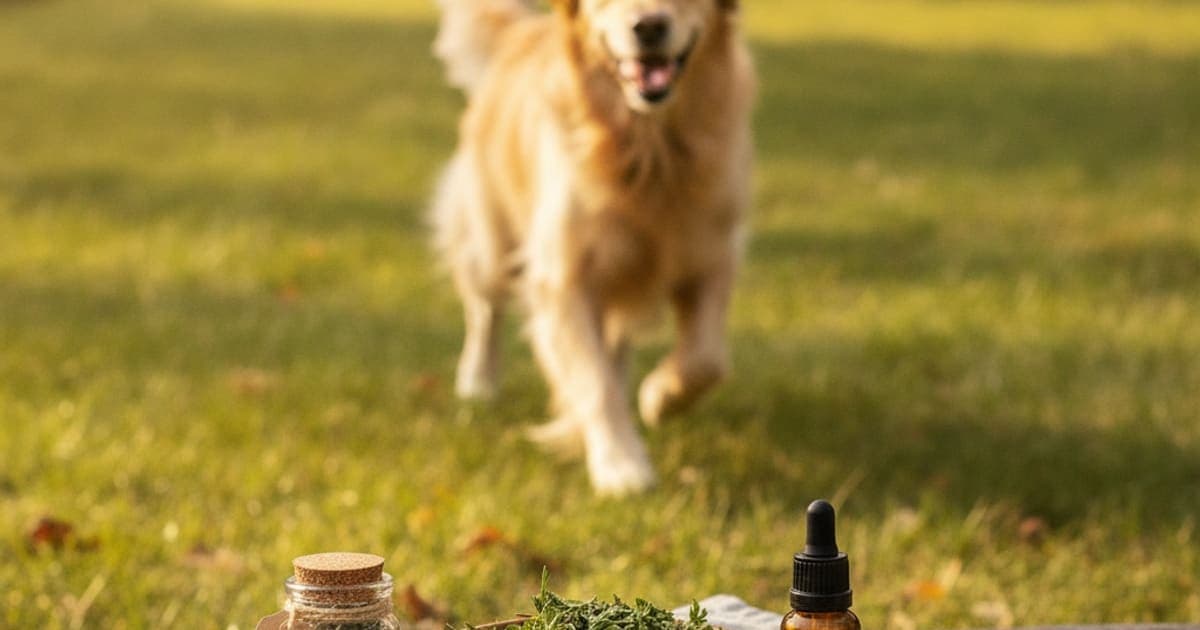
TB-500 is a synthetic peptide modelled on the active region of thymosin beta-4, a protein your dog's own cells already produce and release at sites of injury. Research suggests it may support the cell migration and new blood vessel formation that soft tissue repair depends on. What it does not do is reattach a ruptured cranial cruciate ligament or restore a stifle joint's stability — that is the job of surgery, controlled rehabilitation and time. TB-500 is not a prescription veterinary medicine. Owners use it, most often paired with BPC-157, as recovery support layered on top of the plan their veterinarian sets, never as a way around it.
What actually tears when a dog blows a knee
Most dogs who present with a torn ligament in a back leg have damaged the cranial cruciate ligament, the structure inside the stifle that stops the tibia sliding forward under the femur. It is often compared to the human ACL, and the comparison is useful but misleading in one important way. In people, an ACL usually fails in a single violent moment. In dogs, cruciate disease is far more often degenerative: the collagen fibres weaken and fail progressively, sometimes over many months, and the visible "injury" — a yelp during a turn, a leg lifted after a walk — is the last fibre bundle giving way rather than the beginning of the problem.
That degenerative pattern explains a lot of what owners find confusing. It explains why partial tears come and go, why a dog can seem fine after a week of rest and then be lame again, and why so many dogs eventually have trouble in the opposite knee too. It also explains why the meniscus, the cartilage cushion inside the joint, is so often damaged as a secondary consequence: once the joint shifts abnormally under load, the meniscus gets crushed between two bones that are no longer tracking properly.
Ligament tissue itself is a difficult thing to repair. It is dense, highly organised, mostly type I collagen, and it carries a sparse population of cells and a modest blood supply compared with muscle. The cranial cruciate has an additional handicap: it sits inside the joint capsule, bathed in synovial fluid, where the torn ends retract and a stable clot — the scaffold that early repair normally builds on — struggles to form at all. This is the biological reason a fully ruptured cruciate does not knit itself back together, no matter what you give the dog.
How TB-500 behaves inside injured tissue
Thymosin beta-4 is not an exotic substance. It is one of the more abundant small proteins inside many mammalian cells, it is carried in platelets, and it is released into wound fluid when tissue is damaged. Its best-characterised function is binding monomeric G-actin and regulating how actin polymerises into filaments. Actin filaments are the cytoskeletal machinery cells use to change shape and crawl, which is why a molecule that governs actin turnover ends up governing cell movement.
Cell movement is the unglamorous centre of soft tissue repair. Fibroblasts have to migrate into the injury zone and start laying down collagen. Endothelial cells have to migrate to build capillary networks so that oxygen and nutrients reach tissue that was previously supplied by vessels the injury destroyed. Progenitor cells have to arrive before they can differentiate into anything useful. Laboratory and animal-model research on thymosin beta-4 suggests roles in promoting angiogenesis, supporting keratinocyte and endothelial migration, and modulating some of the inflammatory signalling that shapes how organised — or how chaotic and scar-heavy — the resulting tissue turns out to be.
TB-500 is a synthetic peptide corresponding to the actin-binding portion of that parent molecule, formulated with tissue distribution in mind rather than as a whole-protein copy. The interest for canine musculoskeletal recovery follows directly from the mechanism: a dog rebuilding tissue around a stifle after a rupture is running exactly those processes — migration, revascularisation, collagen deposition and remodelling — for weeks after the acute injury is over.
Be clear-eyed about what that evidence is. It is mechanistic and preclinical work plus a growing body of owner-reported experience, and it is genuinely promising science that owners have adopted quickly. It is not a claim that TB-500 repairs a torn ligament, and no honest source will tell you it is.
Why TB-500 and BPC-157 are used together
Owners rarely use TB-500 alone for orthopaedic recovery, and there is a sensible reason for that. BPC-157 is a pentadecapeptide — a fifteen-amino-acid sequence derived from a protein identified in gastric juice — and animal research has focused heavily on tendon, ligament and muscle models. That work suggests effects on tendon fibroblast outgrowth and survival, on growth-hormone receptor expression in tendon fibroblasts, and on vascular signalling pathways including VEGF and nitric oxide.
The two peptides are studied for overlapping but distinct roles. BPC-157 research clusters around the behaviour of the connective tissue cells themselves and the local vascular response. TB-500 research clusters around cytoskeletal regulation, cell migration and distribution through tissue. Pairing them is an attempt to support both halves of the same process — the cells arriving, and the cells doing productive work once they arrive. That combination is exactly what pawgen formulates in K9-REPAIR, which is why it comes up so often in conversations about recovery from a torn ligament.
Where peptide support fits around surgery and rehab
| Approach | What it is doing | Usually considered for | What it does not do |
|---|---|---|---|
| Surgical stabilisation (TPLO, TTA, lateral suture) | Alters joint mechanics or adds an external restraint so the stifle stops shifting under load | Most complete ruptures, larger and more active dogs, joints with meniscal damage | Regrow the original ligament |
| Conservative management | Strict activity restriction, weight control, prescribed pain relief, sometimes bracing, allowing scar tissue around the joint to add stability | Some small dogs, some partial tears, dogs who are poor anaesthetic candidates | Restore normal joint mechanics |
| Rehabilitation therapy | Controlled progressive loading, muscle mass, range of motion, gait retraining | Nearly every dog, surgical or not | Substitute for stabilisation in a grossly unstable joint |
| Peptide support (BPC-157 + TB-500) | Signalling molecules studied for roles in cell migration, angiogenesis and soft tissue repair; used as adjunct support through recovery | Owners supporting the recovery window alongside veterinary care | Stand in for surgery, rehab or a prescribed medication; it is something to be discussed alongside veterinary care |
A TPLO does not repair the ligament. It changes the slope of the tibial plateau so that the forward thrust the ligament used to resist is neutralised by geometry instead. A lateral suture does not repair the ligament either; it places an external restraint outside the joint while fibrous tissue builds up around it. No peptide, supplement or nutraceutical changes bone geometry. Peptides belong to the recovery window that surgery and rehabilitation create — they are support during recovery, discussed alongside veterinary care rather than in place of the procedure that makes the joint stable again.
Conservative management is a legitimate path for some dogs, and it works by a different mechanism: restricted activity plus periarticular fibrosis gradually stiffening the joint enough to function. It asks a great deal of the owner and it is a decision to make with your veterinarian, who can assess drawer motion, joint effusion, meniscal clicking and radiographs in ways no article can. If your dog is on carprofen, gabapentin, a monoclonal antibody injection or anything else prescribed, keep taking it exactly as directed; adding a peptide is not a reason to change a prescription, and only your vet should adjust one.
Rehabilitation is where the connective tissue biology actually gets expressed. Collagen laid down without mechanical input is disorganised and weak. Load it in a controlled, progressive way and it remodels along the lines of stress into something that can do a job. Remodelling continues long after the incision has closed and the limp has faded, which is why owners often keep support in place through the whole arc rather than the first fortnight.
How to judge a peptide product for your dog
The joint-supplement aisle earns its bad reputation. Kitchen-sink chews stack a dozen ingredients at amounts too small to matter, hide them behind a proprietary blend so you cannot check, and lean on packaging rather than analysis. Skepticism is warranted — just point it at the right target.
What separates a serious product from a marketing exercise is simple to check. Are the actives named individually with their amounts disclosed? Is dosing scaled to your dog's body weight rather than one scoop for a chihuahua and a mastiff? Is there third-party testing with certificates of analysis you can actually read? Does the company tell you to involve your veterinarian, or does it imply you will not need one? And is there a return policy that carries real risk for the seller rather than the buyer?
K9-REPAIR is built around those criteria: a defined BPC-157 and TB-500 formulation for dogs, dosed by body weight, third-party tested with published certificates of analysis, shipped direct to your door, and backed by a 60-day money-back guarantee. These peptides are not prescription veterinary medicines and nothing here should be read as a promise about your individual dog's outcome — but the transparency standard is one you can apply to anything you are considering.
Key Takeaways
- Canine cruciate rupture is usually degenerative, not a one-off accident, and a fully torn cruciate does not knit back together on its own.
- TB-500 derives from thymosin beta-4; research suggests roles in cell migration, angiogenesis and soft tissue repair, which is why owners use it through orthopaedic recovery.
- BPC-157 is paired with it because the two peptides are studied for complementary parts of the same repair process.
- Surgery restores joint stability through mechanics; rehabilitation determines how well the new tissue organises. Neither is replaceable by a supplement.
- Judge any product on disclosed actives, weight-based dosing, third-party testing and a real guarantee.
- Never stop or reduce a prescribed medication to make room for a peptide.
Your veterinarian owns the diagnosis and the treatment plan — the physical exam, the imaging, the surgical decision, the pain protocol and the timeline for returning to normal activity. Bring up anything you are adding, including peptides, so it sits inside that plan rather than beside it. Support works in the space that proper veterinary care creates.
For more on the condition and adjacent recovery questions, see the full guide to torn ligament, along with holistic options for dog torn ligament, managing a dog torn ligament without NSAIDs, managing a dog torn ligament without steroids, whether recovery from dog spondylosis without surgery is realistic, and the signs of bursitis in dogs.
Owners exploring peptide support for their dog can review K9-REPAIR — BPC-157 + TB-500 formulated for dogs — at https://pawgen.com/. BPC-157 and TB-500 are not prescription veterinary medicines. Nothing in this article treats, cures or prevents any condition; every decision about your dog's care belongs with your veterinarian.
Frequently asked questions
- Is torn ligament in dogs painful?
- Yes. A torn cruciate causes pain from joint instability, inflammation of the joint lining and, frequently, damage to the meniscus. Some dogs show it dramatically, others only as reluctance to sit squarely or jump. Pain control belongs to your veterinarian, who can assess the joint and prescribe appropriately.
- What makes torn ligament worse in dogs?
- Uncontrolled activity is the main driver — running, jumping, stairs and slippery floors all load an unstable joint. Excess body weight increases the forces through the stifle every step. Delaying assessment also matters, because ongoing instability grinds the meniscus and accelerates arthritic change inside the joint.
- Can torn ligament in dogs be reversed?
- No. A ruptured cranial cruciate does not regrow, and arthritis already present in the joint does not disappear. What can change is function: surgical stabilisation, weight control and structured rehabilitation can restore comfortable, reliable use of the limb even though the original ligament is permanently gone.
- How much does it cost to treat torn ligament in dogs?
- Costs vary widely by clinic, region, the procedure chosen and your dog's size, so any single figure would mislead you. Surgical options such as TPLO generally cost considerably more than extracapsular repair. Ask your veterinary practice for a written estimate that includes imaging, anaesthesia, medication and rehabilitation.
- Can a dog's torn ligament recover without surgery?
- The ligament itself will not reattach, but some dogs — typically smaller, lighter, less active ones, or those with partial tears — regain acceptable function through conservative management. That means strict activity restriction, weight control, prescribed pain relief and rehabilitation. Whether it suits your dog is a veterinary judgement, not a general rule.
- What are the first signs of torn ligament in dogs?
- Early signs are often subtle: intermittent hind-leg lameness after exercise, stiffness on rising, sitting with the leg kicked out to one side, reluctance to jump, or toe-touching rather than full weight bearing. Swelling on the inside of the stifle is common. Have any persistent hind-limb limp examined.
- Is TB-500 safe to give a dog?
- TB-500 is not a prescription veterinary medicine, and no product should be described as risk-free. Discuss it with your veterinarian before starting, particularly for dogs with cancer history, pregnant or nursing dogs, puppies, or dogs on multiple medications. Your vet can weigh it against your dog's full clinical picture.
- Can TB-500 be used after cruciate surgery?
- Many owners use BPC-157 and TB-500 through the post-operative period as recovery support alongside the surgeon's protocol. It sits alongside pain medication, activity restriction and rehabilitation rather than in place of them. Tell your surgical team what you are giving so it fits within their plan rather than running parallel to it.
- How is dosing for peptides like TB-500 decided?
- Dosing should be worked out with your veterinarian, who knows your dog's weight, age, medications and diagnosis. Reputable formulations scale to body weight rather than offering one amount for every dog. No article should give you a number for your individual animal, and this one deliberately does not.
Educational content. BPC-157 and TB-500 are not FDA-approved veterinary drugs. Talk to your veterinarian before starting anything new, especially if your dog is on prescribed medication.