TB-500 for Wound Healing in Dogs: Does It Work?
Research suggests TB-500, a synthetic version of a naturally occurring peptide fragment, may support the cell migration and new blood vessel formation that wound repair depends on. It is not an FDA-approved veterinary drug and it does not replace wound care, but owners increasingly use it alongside a vet-directed plan.
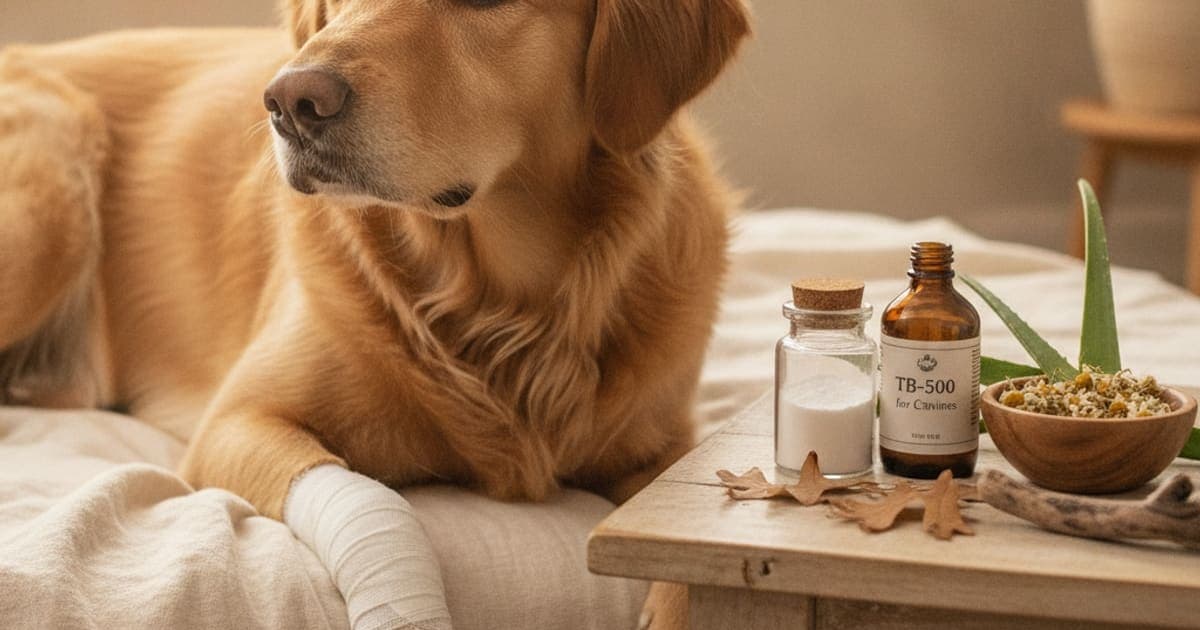
Does TB-500 help a dog with wound healing?
Research suggests TB-500 may support the cellular processes wound repair depends on — cell migration, new blood vessel formation, and the orderly resolution of inflammation. It is not an FDA-approved veterinary drug, and no peptide closes a wound by itself. Owners use it as support layered on top of veterinary wound care, never instead of it.
That distinction carries more weight than any single claim you will read about peptides online. A wound closes because your dog's own cells crawl across the defect, lay down collagen, build capillaries and then slowly remodel that hasty patch into tissue that can take load again. Anything you give a dog can only influence how efficiently those cells do that work. So the honest question is not whether TB-500 mends skin — it is whether TB-500 makes the biology of repair easier to run. That is the question the science actually speaks to, and it is the one worth your time.
What TB-500 is, and where it comes from
TB-500 is the name given to a synthetic peptide built around the active, actin-binding region of thymosin beta-4 — a small protein made up of 43 amino acids that your dog's body already produces. Thymosin beta-4 is not exotic. It is found in nearly every cell type studied, it is stored in high concentration inside platelets, and it is released into the fluid that pools in a fresh wound within the first hours after injury.
Its best-characterised job is binding G-actin, the monomer form of the protein that cells assemble and disassemble to change shape and move. Cells crawl by building actin filaments at the leading edge and dismantling them at the rear. Thymosin beta-4 acts as the reservoir that keeps unpolymerised actin available for that cycle. A cell that cannot manage its actin pool cannot migrate, and a wound where cells cannot migrate does not close.
So when a laboratory synthesises TB-500, it is not inventing a novel drug mechanism. It is reproducing a fragment of a signalling molecule the body deliberately floods into injured tissue. That is the logic owners find compelling, and it is a fair one — but it is a mechanistic rationale, not a promise about your dog's specific wound.
TB-500 is also not a topical wound dressing, an antiseptic, or an antibiotic. It does nothing about bacterial contamination, foreign material buried in tissue, or a wound whose edges are under too much tension to appose. Those are surgical and pharmaceutical problems with surgical and pharmaceutical answers.
How the peptide interacts with each phase of repair
Wound repair is not one event. It runs in overlapping phases, and each phase has a different rate-limiting step. Understanding which step a peptide might touch is the whole game.
The peptide does not close a wound — your dog's cells do that, and the entire case for TB-500 rests on whether it makes that cellular work easier to perform.
Haemostasis and inflammation. Platelets plug the breach and degranulate, releasing a cocktail of signalling molecules — thymosin beta-4 among them. Neutrophils and then macrophages arrive to clear debris and bacteria. This phase is necessary, but a wound that stays stuck in it becomes a chronically inflamed, non-progressing wound. Research on thymosin beta-4 has examined its role in modulating inflammatory signalling rather than simply blunting it, which is a meaningful distinction: you do not want inflammation abolished, you want it to finish on schedule.
Proliferation. This is where TB-500's actin biology becomes directly relevant. Keratinocytes migrate in from the wound margins to re-establish a skin barrier. Fibroblasts move in and begin depositing collagen and matrix. Endothelial cells sprout new capillaries into the granulation bed, because repair tissue is metabolically expensive and needs a blood supply to sustain itself. Every one of those steps is a cell physically travelling somewhere it was not before. Laboratory and animal research suggests thymosin beta-4 supports both cell migration and angiogenesis, and that combination is why the peptide attracted interest in wound biology in the first place.
Remodelling. The disorganised collagen laid down early gets cross-linked, reorganised along lines of stress, and gradually strengthened. This is the slowest phase and the one owners forget about, because the wound looks finished from the outside long before the tissue underneath is finished. Scar tissue does not reach the strength of the original, and how well it remodels influences whether a dog gets full function back — particularly over a joint, a paw pad, or anywhere skin has to stretch.
A peptide that plausibly supports migration and vascular supply is aimed at the proliferative and remodelling phases. It is not aimed at debridement, and it is not aimed at infection.
What the evidence supports, and where it stops
Here is the honest state of things, stated plainly so you can weigh it yourself.
Thymosin beta-4 is one of the better-characterised endogenous repair peptides in the literature. Its actin-sequestering function is well established. Its presence in platelets and wound fluid is well established. Laboratory work and animal models have explored its influence on cell migration, angiogenesis and inflammatory signalling, and thymosin beta-4 has been carried forward into human clinical investigation for corneal and dermal wound repair — which tells you serious researchers considered the mechanism worth testing in people.
What does not yet exist is a large body of controlled canine wound-healing trials of TB-500 with published outcomes. That gap is why every responsible statement about this peptide is hedged, and why pawgen frames its material as education rather than treatment advice. It is emerging science with a coherent mechanism and growing owner adoption — which is a different thing from a settled veterinary standard of care, and both facts can be true at once.
What that means practically: use TB-500 the way owners actually use it, as supportive layering while the veterinary plan does the heavy lifting. Do not use it as a reason to delay a wound recheck, skip a prescribed antibiotic course, or postpone a surgical repair. And talk to your veterinarian before adding any peptide to a recovering dog's routine, particularly if that dog is on medication, has a known tumour history, or is very young, pregnant or nursing — those are conversations for your vet, not for a dosing chart on the internet.
Where peptides fit alongside standard veterinary wound care
Every wound has layers of care, and they are not interchangeable. Peptide support occupies exactly one row of this table.
| Layer of care | What it does | Who directs it |
|---|---|---|
| Wound assessment and debridement | Removes dead tissue, foreign material and contamination so healthy tissue can appose | Veterinarian only |
| Surgical closure or open management | Decides whether the wound is sutured, left to granulate, or managed with drains | Veterinarian only |
| Antimicrobial therapy | Addresses bacterial infection when culture or clinical signs warrant it | Veterinarian only |
| Pain control | Keeps the dog comfortable and, critically, keeps them from moving abnormally | Veterinarian only |
| Bandaging and protection | Controls moisture, protects the bed, stops licking and self-trauma | Vet-directed, owner-executed |
| Nutrition and protein intake | Supplies the raw material for collagen synthesis and immune function | Owner, with vet guidance |
| Peptide support | May support the cellular migration and vascular processes repair depends on | Owner, discussed with the vet |
Some signs mean you stop reading and call the clinic: spreading redness or heat, foul discharge, a wound that opens after closure, swelling that worsens rather than settles, lethargy, fever, loss of appetite, or a dog who suddenly will not use a limb. Those are veterinary emergencies dressed up as slow days.
Why owners pair TB-500 with BPC-157
TB-500 rarely appears alone in canine recovery routines, and the reason is complementary mechanism rather than marketing. BPC-157 is a synthetic peptide derived from a protective sequence identified in gastric juice, and the research interest around it has centred on angiogenic signalling, tendon and ligament fibroblast behaviour, and gastrointestinal protection. TB-500's research profile centres on actin dynamics, cell migration and vascular sprouting throughout the body. Owners running both are covering soft-tissue repair from two different angles at once.
That pairing is what pawgen formulates as K9-REPAIR: BPC-157 and TB-500 together, in a canine-specific formulation with weight-based dosing worked out for dogs rather than scaled down from human protocols, third-party tested with certificates of analysis available, shipped direct to the door, and backed by a 60-day money-back guarantee. It is the stack owners reach for through recovery, whether that recovery is a wound, a post-surgical incision, a soft-tissue strain or an older dog who is simply slower to bounce back.
Point your scepticism where it earns its keep: at kitchen-sink chews that list fourteen ingredients at doses too small to matter, at proprietary blends that hide how little of anything you are buying, at brands that spend on packaging instead of testing. Ask any company what is in the bottle, at what strength, verified by whom. A brand that cannot produce a certificate of analysis is telling you something.
Key Takeaways
- TB-500 is a synthetic peptide based on the actin-binding region of thymosin beta-4, a repair-associated protein dogs already produce and release into wound fluid.
- Research suggests it may support cell migration, angiogenesis and the resolution of inflammation — the proliferative and remodelling side of wound repair.
- It is not an FDA-approved veterinary drug, does nothing about infection or contamination, and does not substitute for surgical wound management.
- Owners typically pair it with BPC-157 for complementary soft-tissue support; that combination is what K9-REPAIR contains.
- Dosing questions belong with your veterinarian, always — never with an internet protocol, and never for puppies, pregnant or nursing dogs.
- Judge any supplement on transparency: named ingredients, stated strengths, third-party testing, an available certificate of analysis.
Your veterinarian owns the diagnosis and the treatment plan. They decide whether that wound needs debridement, closure, culture, antibiotics or a drain; they decide what pain control your dog gets and for how long; they decide when the bandage comes off and when the dog can move normally again. Peptides operate in the space that good veterinary care creates — supporting the recovery, never steering it. Bring your questions about supplementation to your vet the same way you would bring a question about diet or exercise, and let the clinical plan lead.
For deeper background, pawgen's guide to wound healing covers the full clinical picture, and related reading includes how much does it cost to treat wound healing in dogs, the best treatment for wound healing in dogs, what to give a dog with wound healing, whether a dog stress fracture without surgery can resolve, and the signs of an avulsion fracture in dogs. The peptide formulation described above is K9-REPAIR.
Owners exploring peptide support for their dog can review K9-REPAIR — BPC-157 + TB-500 formulated for dogs — at https://pawgen.com/. BPC-157 and TB-500 are not FDA-approved veterinary drugs. Nothing in this article treats, cures or prevents any condition; every decision about your dog's care belongs with your veterinarian.
Frequently asked questions
- Is wound healing in dogs painful?
- Yes, most wounds hurt, especially during the inflammatory phase in the first days after injury. Dogs often mask pain, so signs can be subtle: reluctance to move, licking, panting, or a changed posture. Pain control is a veterinary decision and it genuinely speeds recovery by reducing self-trauma.
- What makes wound healing worse in dogs?
- Infection, retained foreign material, dead tissue, movement across the wound, and licking or chewing are the biggest culprits. Poor protein intake, obesity, uncontrolled diabetes, Cushing's disease, and long-term steroid use all slow repair too. Ask your veterinarian whether an underlying condition is working against your dog's healing.
- Can wound healing in dogs be reversed?
- Healing itself is not reversed, but it can stall or break down — a closed incision can dehisce, and a granulating wound can become chronic if infection or movement disrupts it. Reopened or non-progressing wounds need veterinary reassessment quickly rather than watchful waiting at home.
- How much does it cost to treat wound healing in dogs?
- Costs vary widely by wound severity, clinic and region. A minor laceration cleaned and closed sits at one end; deep, contaminated or degloving injuries needing anaesthesia, drains, repeat bandage changes and antibiotics sit far higher. Ask your clinic for a written estimate before treatment begins.
- What helps a dog with wound healing?
- Veterinary wound management comes first: cleaning, debridement, appropriate closure, infection control and pain relief. Beyond that, protecting the wound from licking, adequate protein, controlled activity and consistent bandage care matter most. Some owners add peptide support such as K9-REPAIR alongside that plan after discussing it with their vet.
- How long does wound healing take to heal in dogs?
- It depends on wound type, size, contamination, location and the dog's age and health. Surface closure happens well before the tissue underneath regains strength — remodelling continues for weeks after a wound looks finished. Follow your veterinarian's recheck schedule rather than judging progress by appearance alone.
- Is TB-500 safe for dogs?
- TB-500 is not an FDA-approved veterinary drug, so no supplement can be described as risk-free. Owners report using it without issue, but safety depends on the individual dog, existing conditions and other medications. Discuss it with your veterinarian before starting, particularly for dogs with a tumour history.
- Can TB-500 be given alongside vet-prescribed medication?
- That is a question for your veterinarian, who knows what your dog is taking and why. Never stop or reduce a prescribed antibiotic, anti-inflammatory or pain medication to add a supplement. Peptide support is intended to sit alongside the veterinary plan, never to replace any part of it.
Educational content. BPC-157 and TB-500 are not FDA-approved veterinary drugs. Talk to your veterinarian before starting anything new, especially if your dog is on prescribed medication.