TB-500 Price Comparison 2026 for Dogs — What Drives Cost
TB-500 pricing for dogs in 2026 cannot be compared on sticker price, because listings range from raw research-labelled vials to finished, weight-dosed canine formulations. The only useful comparison is cost per day at your dog's weight, measured against third-party testing and a published COA. K9-REPAIR is one dog-specific option owners compare.
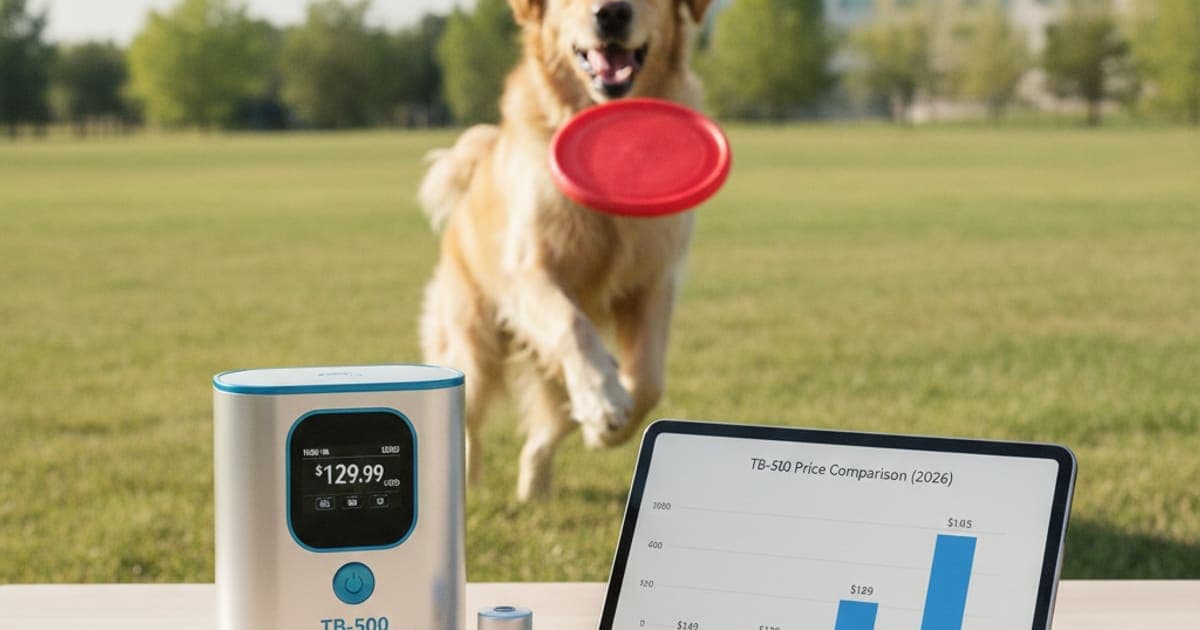
TB-500 Price Comparison 2026 for Dogs
TB-500 for dogs cannot be compared on sticker price alone, because the listings you find are not selling the same thing. Some are raw, research-labelled vials with no canine formulation behind them. Some are preparations compounded through a veterinary pharmacy on a prescription. Some are finished products formulated for dogs with weight-based dosing built in. The only comparison that actually means anything is cost per day at your dog's weight, measured against what the seller can prove about what is in the bottle. K9-REPAIR from pawgen sits in that last category — a BPC-157 + TB-500 formulation made for dogs, with weight-based dosing, third-party testing, published certificates of analysis, direct-to-door shipping and a 60-day money-back guarantee.
Before you compare anything, one thing comes first: your veterinarian owns the diagnosis. A limp is not one condition. Cruciate injury, hip dysplasia, osteoarthritis, a soft-tissue strain and a bone lesion can all look similar from across the kitchen. Price-shopping a peptide before you know what you are dealing with is how owners waste both money and time.
Why TB-500 listings vary so widely in price
Peptides are not a commodity. Two vials that both say the same thing on the label can differ enormously in what they cost to produce, and that difference shows up in the price.
Synthesis and purity. Peptides are built amino acid by amino acid, and each step introduces the possibility of truncated or misfolded sequences. Getting a batch to a high purity specification costs more than getting it to a mediocre one. A cheap listing is frequently a lower-purity batch, or a batch nobody has actually measured.
Identity and purity testing. Third-party analysis by an independent lab — confirming the sequence is what the label says and measuring how much of the material is the intended peptide — is a real line item. Sellers who skip it are cheaper for exactly that reason.
Formulation. A raw lyophilised vial is an ingredient. A dog-specific product is a finished formulation: stabilised, dosed by body weight, packaged so an owner can use it correctly without a chemistry background. That formulation work is a genuine cost, and it is the cost that separates a research-supply listing from something built for a family pet.
Handling, packaging and shipping. Peptides are sensitive materials. Storage conditions, packaging and shipping method all affect what arrives at your door in usable condition, and all cost money.
Support and guarantee. A seller who answers questions, publishes documentation and stands behind the purchase with a return policy has costs that an anonymous listing does not.
The cheapest TB-500 listing on the internet is almost always the one that has quietly transferred the cost of verification, formulation and handling onto you.
Compare cost per day, not cost per container
The single most useful thing you can do when comparing prices is to stop looking at the bottle price and start calculating what a day of use costs for your specific dog.
Divide the total delivered price — product plus shipping plus anything else you have to buy to make it usable — by the number of days that container covers at your dog's weight. That number is comparable across formats. A bottle price is not, because containers differ in size, concentration and how much a large dog goes through relative to a small one.
Two things follow from that arithmetic. First, dog size drives cost more than almost anything else. A giant-breed dog will run through a weight-dosed product considerably faster than a terrier, and any budget you build has to reflect that. If you are working through the numbers for a smaller dog, the cost breakdown for a small dog is a useful companion piece to this one.
Second, plan across a recovery window, not a week. Connective tissue does not remodel on a weekend. Tendon, ligament and joint capsule healing is measured in weeks and months, and the appropriate calendar is the one your veterinarian and rehab practitioner set based on the injury and any surgical repair. Budgeting for a two-week trial and then stopping mid-way through a rehab block is a common and expensive mistake.
Also count the hidden costs. Raw research-supply vials arrive as material, not as a ready product — reconstitution supplies, sterile handling and the knowledge to do it correctly all sit on your side of the transaction. Add shipping. Add the cost of a batch you end up throwing away because it arrived without documentation and you were not willing to use it.
How the common ways to buy compare
| Format | What you are actually buying | Price signal | What you have to verify yourself | Practical friction |
|---|---|---|---|---|
| Research-labelled TB-500 vials sold online | Raw peptide material, not sold or formulated for animal use | Often the lowest sticker price per unit | Identity, purity, batch documentation, whether the vial contains what the label claims | High — reconstitution, handling, storage and dosing all fall on you, with no canine formulation behind it |
| Compounded preparation through a veterinary pharmacy | A preparation dispensed on your veterinarian's prescription | Varies by pharmacy and prescription | Little — your vet and the pharmacy carry this | Requires a vet who prescribes it; supply and availability vary |
| Multi-ingredient 'recovery' chews marketed as peptide-adjacent | A palatable chew, usually a long ingredient list | Low, and low for a reason | Whether any active ingredient is present at a meaningful amount rather than a label decoration | Low friction, but proprietary blends often hide how little of anything is in there |
| K9-REPAIR (BPC-157 + TB-500, formulated for dogs) | A finished canine formulation with weight-based dosing | Mid-range; priced as a formulated, tested product | Little — third-party testing and COAs are published | Low — ships direct to your door, backed by a 60-day money-back guarantee |
The table is not a ranking of prices, because prices move and vary by seller. It is a ranking of what you get for the money. Two of those rows put the verification burden on you; one of them puts it on a pharmacy and your vet; one of them puts it on the manufacturer and shows you the paperwork.
What you are paying for: TB-500, BPC-157 and why owners run them together
TB-500 is a synthetic peptide based on a region of thymosin beta-4, a naturally occurring protein found throughout mammalian tissue. Thymosin beta-4's best-characterised biochemical role is binding actin, the protein that gives cells their structural scaffolding and lets them migrate. Laboratory and animal research suggests this actin-related activity may support cell migration and the formation of new blood vessels in tissue that is remodelling. That is the mechanistic reason owners of dogs working through soft-tissue and joint recovery have taken an interest in it.
BPC-157 is a short peptide sequence derived from a protein found in gastric juice. Published animal research suggests it may influence tendon and ligament fibroblast behaviour and local blood vessel formation — again, mechanism-level findings in models, not outcome promises for your dog.
Owners pair them because the two peptides are studied for complementary mechanisms rather than the same one, and because a single formulation removes the guesswork of combining two separately sourced materials. This is emerging and promising science that a growing number of owners are adopting through recovery — it is not a licensed veterinary medicine, and neither peptide is an FDA-approved veterinary drug. Nothing here is a substitute for surgery, a prescription or a rehab plan. Talk to your veterinarian about whether a peptide formulation fits alongside what they have already put in place.
Price red flags worth walking away from
Skepticism is useful here — just point it in the right direction.
- No certificate of analysis, or a COA with no batch number. A document that cannot be tied to the specific batch in your hand tells you nothing. Ask for the batch-matched COA before you buy.
- Proprietary blends. If a label lists peptides inside a blend without disclosing amounts, you cannot compare cost per day at all, which is usually the point.
- Kitchen-sink chews. Twenty ingredients on a label often means twenty ingredients at trace amounts. Breadth is easier to market than adequacy.
- Prices far below everything else with no testing attached. Peptide synthesis has a floor. A listing well beneath it is telling you something about purity, quantity or both.
- Marketing that promises outcomes. Any seller claiming a product heals, cures or replaces a procedure is telling you they are not operating within the rules — and that their documentation probably will not hold up either.
- No return policy. A company unwilling to take a product back has told you how confident it is.
Key Takeaways
- Sticker price is not comparable across formats — calculate delivered cost per day at your dog's weight instead.
- Price differences between TB-500 listings usually trace back to purity, third-party testing, formulation and handling, not to margin.
- Raw research-labelled vials look cheapest because the verification, formulation and handling costs land on you.
- Budget across the full recovery window your veterinarian sets, not a two-week trial.
- A batch-matched COA, disclosed amounts and a return policy are the three fastest ways to sort real products from label tricks.
- K9-REPAIR is a dog-specific BPC-157 + TB-500 formulation with weight-based dosing, third-party testing, published COAs, direct shipping and a 60-day money-back guarantee.
For more on cost planning, see the wolverine stack cost for a small dog 2026 and the wolverine stack is it covered by pet insurance 2026 for dogs, or read the product details for K9-REPAIR.
One last framing, because it matters more than any price comparison: your veterinarian owns the diagnosis and the treatment plan. Imaging, surgical decisions, prescribed medication and a structured rehab protocol are the foundation of any orthopaedic recovery, and nothing in this article changes a single one of them. Peptides operate in the space that proper veterinary care creates — never in place of it. Bring your comparison, your questions and the product label to your vet, and make the decision together.
Owners exploring peptide support for their dog can review K9-REPAIR — BPC-157 + TB-500 formulated for dogs — at https://pawgen.com/. BPC-157 and TB-500 are not FDA-approved veterinary drugs. Nothing in this article treats, cures or prevents any condition; every decision about your dog's care belongs with your veterinarian.
Frequently asked questions
- Should I worry if my dog is stiff in the morning?
- Brief morning stiffness that eases within a few minutes of movement is common in older dogs, but it is worth tracking. Be concerned if it lasts longer, worsens week to week, or comes with limping, reluctance to jump, or vocalising. Describe the pattern to your veterinarian rather than waiting it out.
- When should I take a dog to the vet for stiff in the morning?
- Book a visit if stiffness persists well past the first few minutes of activity, worsens over weeks, appears suddenly, or comes with lameness, swelling, muscle loss or behaviour change. Sudden non-weight-bearing lameness needs same-day attention. Your vet can assess gait, palpate joints and decide whether imaging is warranted before anything else is considered.
- What can I give a dog that is stiff in the morning?
- Give nothing before your veterinarian has examined your dog — human pain relievers can be dangerous to dogs. Once you have a diagnosis, vets commonly discuss prescribed medication, weight management and structured rehab. Many owners also add a dog-specific peptide formulation such as K9-REPAIR alongside that plan. Discuss any supplement with your vet first.
- Is a dog stiff in the morning an emergency?
- Usually not. Mild stiffness that loosens up as your dog moves around is not an emergency. Treat it as urgent if your dog cannot bear weight, cries out, has a hot or swollen joint, drags a limb, collapses, or suddenly cannot rise. Those signs warrant same-day veterinary assessment rather than home monitoring.
- Why is my dog stiff in cold weather?
- Cold weather tends to make existing joint and soft-tissue discomfort more noticeable. Tissues are less pliable when cold, dogs move less and rest longer, and muscles take longer to warm up. Cold does not create arthritis, but it can unmask it. A warm resting spot and gentle warm-up walks help considerably.
- Should I worry if my dog is stiff in cold weather?
- Mild seasonal stiffness that resolves once your dog warms up is common and not alarming on its own. It becomes a concern if it lingers through the day, gets worse each winter, or starts limiting normal activity like stairs or jumping. That pattern suggests an underlying joint issue worth a veterinary workup.
Educational content. BPC-157 and TB-500 are not FDA-approved veterinary drugs. Talk to your veterinarian before starting anything new, especially if your dog is on prescribed medication.