TB-500 Signs It Has Gone Bad for Dogs — What to Check
TB-500 has likely gone bad when the lyophilized cake has collapsed, melted or discolored, when the vial seal or vacuum is compromised, or when reconstituted solution turns cloudy, tinted or shows floating particles. Any of these means the vial should not be used. Storage and temperature history are the usual causes.
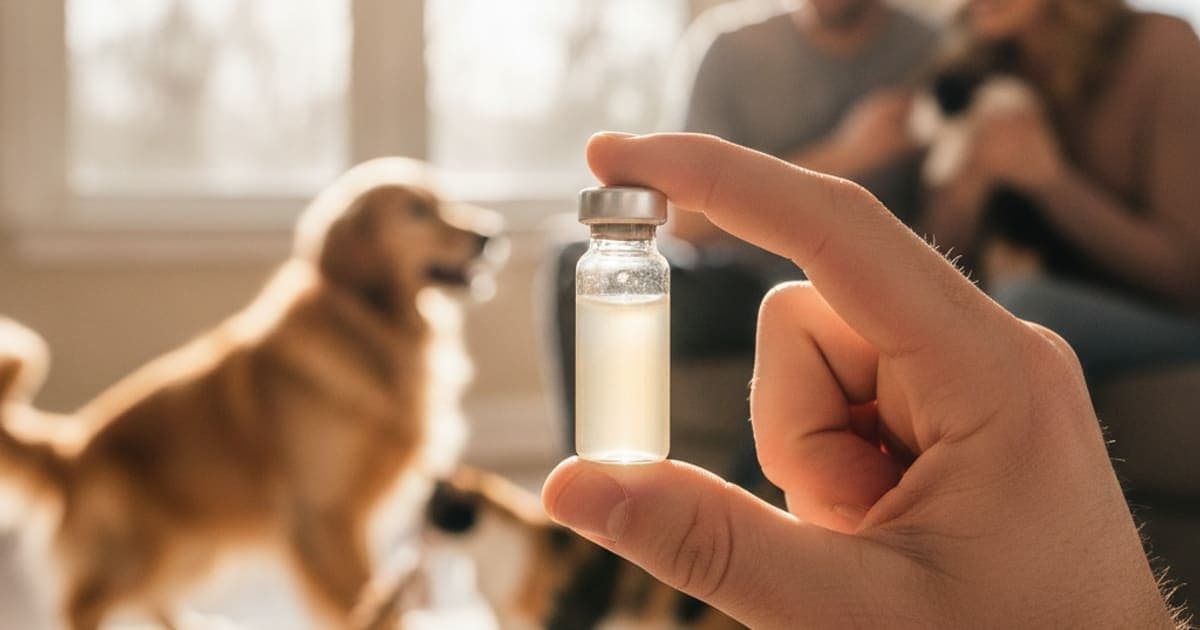
TB-500 has most likely gone bad when the freeze-dried cake inside the vial has collapsed, melted into a film or puddle, turned yellow, brown or grey, or gone sticky instead of dry and chalky; when the stopper, crimp or vacuum seal is compromised; or when a reconstituted solution looks cloudy, hazy, tinted, stringy, or carries visible flecks and floating particles. Any single one of those observations is enough reason to set that vial aside.
Peptides are fragile molecules by nature, and the damage almost always traces back to the same short list of causes: heat, moisture, light, repeated freeze-thaw cycles, rough agitation, or contamination introduced after the stopper is first punctured. This article walks through what degradation looks like in practice, why it happens at the chemical level, and how sensible storage and honest sourcing take most of the guesswork out of the question. It is educational, not a substitute for your veterinarian's guidance — anything you plan to give a recovering dog belongs in a conversation with the vet who is managing that dog's case.
What TB-500 is, and why the molecule is fragile
TB-500 is a synthetic peptide based on the actin-binding region of thymosin beta-4, a small protein found naturally throughout mammalian tissue and present in high concentrations in platelets and wound fluid. Research on thymosin beta-4 suggests it plays a role in actin regulation, cell migration and the movement of repair cells into injured tissue — the reason it has drawn so much interest from owners supporting dogs through tendon, ligament and soft-tissue recovery, generally paired with BPC-157. That mechanism is emerging and promising science, and it is why the two peptides are usually adopted together rather than separately.
The important point for storage is structural. TB-500 is a chain of amino acids, not a small rigid drug molecule, and its behaviour depends on that chain staying intact and correctly folded. Peptide chemistry describes several well-understood ways that gets lost:
- Hydrolysis. Water attacks peptide bonds and cleaves the chain. This is why a lyophilized (freeze-dried) powder is kept bone dry and why humidity creeping into a vial is a genuine problem rather than a cosmetic one.
- Oxidation. Oxygen and light act on susceptible amino acid residues. Discoloration is often the visible end of this process.
- Aggregation. Molecules clump together instead of staying individually dissolved. Aggregation is what you are seeing when a reconstituted solution goes hazy or throws visible strands.
- Chemical rearrangement. Heat and unfavourable pH accelerate reactions such as deamidation, which alter the molecule without necessarily changing how it looks.
That last category matters, because it is honest: not every form of degradation is visible. Visual inspection catches the obvious failures. Storage discipline and sourcing catch the rest.
Inspecting a sealed or dry vial before anything else
Before anything is opened, look at the vial under good light against a white background and give it a slow, deliberate check.
A healthy lyophilized peptide sits as a compact, dry, white to off-white cake or puck, usually sitting neatly at the bottom of the vial, sometimes shrunken slightly away from the glass. It should look chalky and stable. Some cakes are dense discs, others look more like a thin fluffy wafer — both are normal, and the shape depends on how the manufacturer ran the freeze-drying cycle.
What you are looking for is change. A puck that has slumped into a glassy film across the bottom, smeared up the side of the glass, or turned into a tacky residue has almost certainly seen moisture or heat. Yellowing, browning or grey mottling suggests oxidation. Condensation or frost inside the vial means the seal has failed or the vial was opened while cold and pulled in humid air. A stopper that is bulging, cracked, sunken oddly, or already punctured, and a crimp that spins loose or is lifted at the edge, all mean the sterile barrier cannot be trusted.
| What you see | What it usually indicates | What to do |
|---|---|---|
| Compact white or off-white dry cake, intact seal | Normal appearance for a lyophilized peptide | Store as labelled until use |
| Cake collapsed into a film, puddle or sticky residue | Moisture ingress or heat exposure | Do not use |
| Yellow, brown or grey discoloration | Oxidation or thermal damage | Do not use |
| Frost or condensation inside the vial | Seal failure or cold-to-warm handling error | Do not use |
| Loose crimp, cracked or pre-punctured stopper | Sterile barrier compromised | Do not use |
| Missing, unreadable or altered label and lot number | Traceability lost; storage history unknown | Do not use |
A missing lot number deserves the same weight as a visible defect. Without it, there is no way to trace a batch, match it to a certificate of analysis, or report a problem to whoever supplied it.
Reading a reconstituted vial: clarity, colour and particles
Once a peptide is in solution, the standard shifts. A properly reconstituted peptide solution should be clear and colourless, and it should look the same tomorrow as it did the moment it dissolved.
Signs that it has not held up include a persistent haze that does not clear when the vial is left to stand, a yellow or amber tint, visible specks, fibres or wispy strands drifting in the liquid, a layer of sediment at the bottom, or an unexpectedly thick, syrupy look when the vial is tipped. Foam alone is not degradation — foam comes from shaking, which is itself a handling mistake, since vigorous agitation shears peptide chains and encourages aggregation. Solutions should be swirled gently or left to dissolve on their own, never shaken.
Cloudiness deserves particular caution because it has two possible explanations and neither is good: peptide aggregation, or microbial growth introduced through the stopper. A solution that started clear and turned cloudy days later, especially one stored outside the labelled conditions, should be treated as contaminated rather than merely degraded.
If a vial looks wrong, smells wrong, or has a storage history you cannot account for, do not give it to your dog — discard it and start with a fresh, sealed one.
Where the damage actually happens: shipping, storage and handling
Most degradation is not gradual decay on a shelf. It happens in a handful of specific, avoidable moments.
The first is delivery. A parcel sitting in a hot mailbox, on a sunlit doorstep, or in the back of a warm vehicle for an afternoon is the most common heat excursion a peptide ever sees. Lyophilized powder is considerably more robust in transit than solution, which is why serious suppliers ship it dry, but robust is not indestructible. Bringing the package inside promptly and getting it into labelled storage the same day removes the single largest risk in the whole chain.
The second is the fridge or freezer itself. Storing vials in the door exposes them to temperature swings every time it opens. Repeated freeze-thaw cycles are especially damaging to peptides in solution, because ice crystal formation concentrates and stresses the molecules each time. Decide where a vial lives and leave it there.
The third is light and air. Keeping vials in their original carton is not packaging sentimentality — it is UV protection. Leaving a vial on a windowsill or a countertop under downlights for days is a real exposure.
The fourth is the moment of use. Wiping the stopper with an alcohol swab and letting it dry, using a fresh sterile needle every single time, never leaving a needle parked in the stopper, and never letting the stopper touch a counter, a coat sleeve or a dog's fur all protect the vial's contents from the outside world. Nervous, wriggling dogs make careless handling far more likely, which is why setting up calmly and unhurriedly matters as much as the technique itself.
For storage specifics, follow the instructions printed on the product you actually hold and confirm anything you are unsure about with your veterinarian or the supplier. Labelled conditions vary between formulations, and a number copied from a forum post about a different product is worth nothing.
What to do when a vial looks wrong — and how sourcing prevents it
If a vial fails inspection, the sequence is simple. Stop. Do not attempt to filter, warm, re-dissolve or rescue it. Photograph it and record the lot number and expiry before disposing of it, then contact the supplier, since a genuine batch or transit problem is something they need to know about. Mention it to your veterinarian too, particularly if any of that vial was already given, so the dog's response can be interpreted with full information.
Prevention, though, mostly comes down to where the product came from in the first place. Grey-market vials with no lot number, no certificate of analysis, hand-typed labels and unknown transit conditions are the source of most of the horror stories owners describe — not the peptide chemistry itself. A supplier worth using publishes third-party testing, provides certificates of analysis confirming identity and purity, seals and crimps its vials properly, labels lot and expiry legibly, and ships direct to your door in packaging designed for the contents.
That is the standard K9-REPAIR is built to. pawgen's BPC-157 and TB-500 formulation for dogs is third-party tested with certificates of analysis, clearly labelled, shipped direct to door, and backed by a 60-day money-back guarantee — the stack many owners adopt while working through a tendon, ligament or mobility recovery under veterinary supervision. Neither peptide is an FDA-approved veterinary drug, and none of this is a claim about what will happen in any individual dog; it is a description of what is in the bottle and how it is verified. The same outward scepticism belongs on underdosed kitchen-sink chews and brands that spend more on packaging than on analysis.
Key Takeaways
- A healthy lyophilized vial holds a dry, compact, white to off-white cake with an intact stopper and crimp; a collapsed, melted, sticky or discoloured cake means the vial should not be used.
- Reconstituted peptide should be clear and colourless. Haze, tint, strands, flecks or sediment indicate aggregation or contamination.
- Heat, moisture, light, freeze-thaw cycles and shaking are the main causes of degradation — and every one of them is a handling decision.
- Not all degradation is visible, which is why labelled storage and verifiable sourcing matter as much as the visual check.
- Missing lot numbers, illegible labels and absent certificates of analysis are red flags in their own right.
- When in doubt, discard the vial, document the lot, and contact the supplier rather than improvising a rescue.
Where your veterinarian fits in
None of this replaces a diagnosis. A limp, a suspected cruciate tear, a stiff senior or a dog recovering from orthopaedic surgery needs a veterinarian to identify what is actually wrong, decide whether surgery is indicated, prescribe pain control and set the rehab plan — and prescribed medication should never be stopped or altered because a supplement has entered the picture. Talk to your veterinarian about anything you intend to give during recovery, including peptides, and tell them what you are using so they can interpret your dog's progress accurately. Proper veterinary care creates the space in which everything else operates.
For related reading on administration and handling, see the wolverine stack what to do if your dog reacts and the wolverine stack injecting a nervous dog, or read more about K9-REPAIR.
Owners exploring peptide support for their dog can review K9-REPAIR — BPC-157 + TB-500 formulated for dogs — at https://pawgen.com/. BPC-157 and TB-500 are not FDA-approved veterinary drugs. Nothing in this article treats, cures or prevents any condition; every decision about your dog's care belongs with your veterinarian.
Frequently asked questions
- Can TB-500 still be used if the powder has clumped or shifted?
- A cake that has simply shifted or cracked during transit while staying dry, white and chalky is generally still normal. A cake that has clumped into a sticky mass, melted into a film or changed colour has seen moisture or heat and should not be used. Check the seal and lot number too.
- Does TB-500 need to be refrigerated?
- Lyophilized peptides are generally stored cold and protected from light, and reconstituted solution is normally kept refrigerated, but the exact requirement is set by the manufacturer. Follow the storage instructions printed on the product you hold rather than a figure copied from elsewhere, and ask your supplier or veterinarian if anything is unclear.
- How long does reconstituted TB-500 stay usable?
- That depends entirely on the specific formulation, the diluent used and how it is stored, so use the labelled stability period for your product rather than a general figure. Inspect the solution before every use: clear and colourless is normal, while haze, tint, strands or sediment means it should be discarded.
- What can I give a dog that is bunny hopping?
- Nothing, until a veterinarian has examined the dog. Bunny hopping often points to hip dysplasia, bilateral knee instability or spinal involvement, and the right support depends on which one it is. Once a diagnosis and plan exist, many owners add joint support such as K9-REPAIR alongside prescribed care, with veterinary input.
- Is a dog bunny hopping an emergency?
- Usually not an immediate emergency, but it is never normal and warrants a prompt veterinary appointment. Seek urgent care if the gait change is sudden, if there is severe pain, dragging limbs, loss of bladder control or an inability to stand, as those signs can indicate spinal injury needing immediate assessment.
- Why is my dog stiff after resting?
- Stiffness after rest usually reflects joint inflammation or soft-tissue change that eases once circulation and synovial fluid movement increase with activity. Osteoarthritis is the most common reason in older dogs, though healing injuries, hip or elbow dysplasia and spinal conditions produce the same pattern. A veterinary exam identifies which applies.
- Should I worry if my dog is stiff after resting?
- It is worth investigating rather than worrying. Occasional stiffness after hard exercise can be unremarkable, but a consistent pattern of difficulty rising, reluctance on stairs or a shortened stride suggests an underlying joint or soft-tissue problem that tends to progress. Early veterinary assessment gives you more options than late assessment does.
- When should I take a dog to the vet for stiff after resting?
- Book an appointment if stiffness recurs over more than a week or two, worsens, or affects daily activities such as stairs, jumping or getting up. Go sooner if there is limping, swelling, yelping, heat in a joint, reluctance to bear weight, or any sudden change in how your dog moves.
- What can I give a dog that is stiff after resting?
- Start with a veterinary diagnosis, since pain control and any prescribed medication belong in your vet's hands. Around that plan, weight management, controlled low-impact exercise, warmth and traction on floors all help. Many owners also adopt a peptide formulation such as K9-REPAIR for joint and soft-tissue support, discussed with their veterinarian first.
Educational content. BPC-157 and TB-500 are not FDA-approved veterinary drugs. Talk to your veterinarian before starting anything new, especially if your dog is on prescribed medication.