TB-500 Storage After Mixing for Dogs — Handling a Vial
Once TB-500 is reconstituted, it should be refrigerated, kept upright and away from light, never frozen or shaken, and used within the beyond-use window the manufacturer states. Mixed peptide is a more fragile material than the dry powder it came from, and handling is what protects its quality.
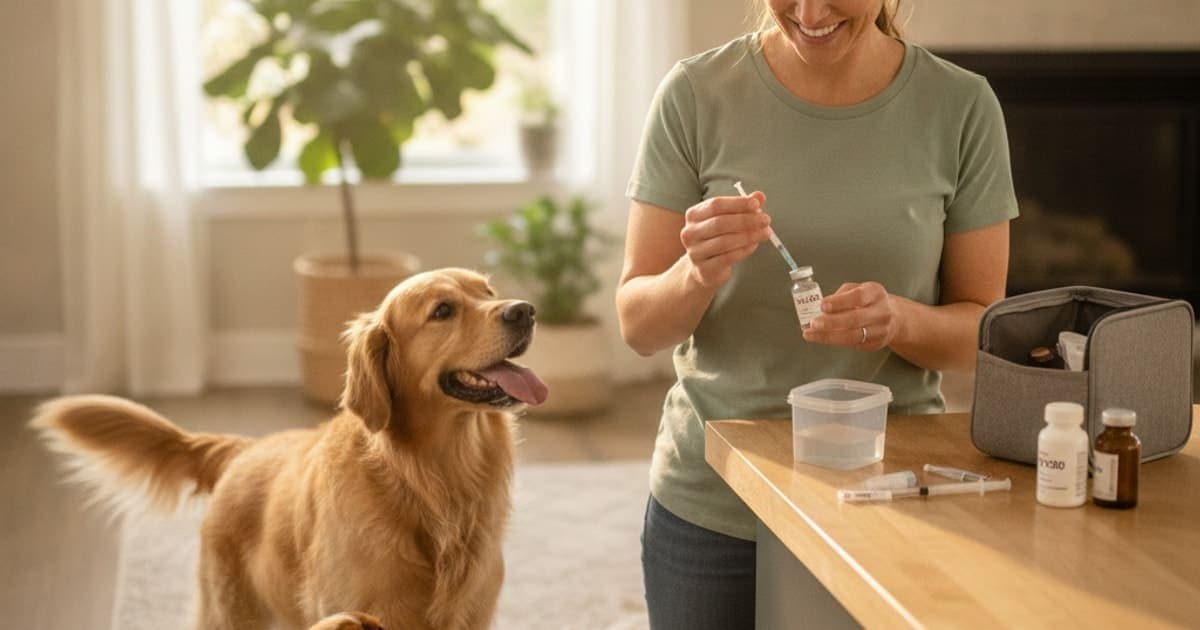
Once TB-500 has been mixed, it needs to be kept cold, dark and still. That means refrigerated at ordinary refrigerator temperature (roughly 2–8 °C / 36–46 °F), stored upright, shielded from light, never frozen, never shaken, and used only within the beyond-use window stated by the manufacturer on the vial or in the documentation that came with it. Reconstituted peptide is a fundamentally different material from the dry powder it started as — and a far less forgiving one.
If you are handling K9-REPAIR, pawgen's BPC-157 + TB-500 formulation for dogs, the storage instructions that ship with your vial always take priority over anything you read on a forum. What follows is the reasoning behind those instructions, so the rules make sense rather than sounding arbitrary.
What changes the moment powder meets liquid
TB-500 is supplied as a lyophilised (freeze-dried) powder for a reason. In that dry, sealed state, the peptide is chemically quiet. There is almost no free water available to drive the reactions that break peptide bonds apart, and there is nothing for bacteria to grow in. That is why dry vials tolerate room temperature in transit and long storage in a cold, dark place.
Add a diluent and three things happen at once. First, water becomes available, and hydrolysis — the slow chemical clipping of the peptide chain — becomes possible. Second, the peptide is now free to move, which means it can also unfold, clump with its neighbours, or stick to the walls of the vial. Third, the vial becomes a potential growth medium; anything introduced through the rubber stopper now has somewhere to live.
None of this is exotic. It is the same reason a pharmacy reconstitutes certain antibiotics only when you collect them and prints a short use-by date on the bottle. A peptide's storage history is part of its quality — a well-made vial handled badly is no longer a well-made vial.
The four forces that degrade a mixed vial
Heat. Warmth accelerates every degradation pathway at once. A vial left on a kitchen counter through a warm afternoon, forgotten in a bag, or left in a parked car has been exposed to conditions no cold-chain product is designed for. Refrigeration slows the chemistry down; it does not stop it, which is why the stated use-by window still applies to a vial that never left the fridge.
Light. Ultraviolet and strong visible light can drive oxidation of sensitive amino acid residues. Keep the vial in its carton or a small opaque box inside the fridge rather than sitting exposed on a shelf under an interior light.
Freezing and thawing. This is the one owners get wrong most often, usually with good intentions. Freezing a reconstituted peptide seems like extra protection, but ice-crystal formation and the concentration changes that come with it can denature protein structures, and every freeze–thaw cycle compounds the effect. Dry powder and mixed solution are not the same thing here. Unless the manufacturer explicitly directs otherwise, a mixed vial stays in the refrigerator, not the freezer.
Agitation and contamination. Peptides in solution dislike mechanical stress. Shaking creates an air–liquid interface and foaming, which encourages the molecule to unfold and aggregate. Swirl gently or simply let the vial rest until the solution clears. Contamination is the other half of this: every needle entry through the stopper is an opportunity, which is why the septum gets a fresh alcohol swab and a moment to dry before each access, and why a vial is never left uncapped on a work surface.
Diluent choices and what the stopper is doing
The liquid used to reconstitute a peptide affects how long the mixed vial is fit for use. Two are commonly discussed, and the difference is straightforward.
| Bacteriostatic water | Sterile water for injection | |
|---|---|---|
| What it is | Sterile water containing a small amount of benzyl alcohol as a preservative | Sterile water with no preservative |
| Effect on multi-dose use | The preservative inhibits growth of many common bacteria, which is why multi-dose vials generally use it | Offers no ongoing protection once the stopper is entered |
| Typical intent | Vials accessed more than once over a period of days | Single-use preparation |
| Practical implication | Storage window is set by the manufacturer, not by guesswork | Any leftover solution is generally discarded rather than kept |
| Who decides | Your veterinarian and the product's own instructions | Your veterinarian and the product's own instructions |
Benzyl alcohol is worth knowing about because it is not universally appropriate — it is handled with particular caution in very small patients and in neonates in human medicine, and a small dog is a small patient. This is exactly the sort of question to raise with your veterinarian before you mix anything, rather than after.
The rubber septum deserves a mention of its own. It is designed to reseal after a needle passes through it, but it is not self-sterilising and it does not last forever. Coring — punching a small plug of rubber into the solution with a blunt or repeatedly reused needle — is a real failure mode. Fresh, sharp needles, a swabbed septum and a steady hand entering at a consistent angle all extend the working life of the vial.
Everyday handling: fridge, label and the road
Store the vial in the body of the refrigerator, not the door. The door is the warmest and most temperature-variable part of the appliance, cycling every time someone opens it. Equally, keep the vial away from the back wall and any freezer coil, where solutions can freeze accidentally.
Label the vial the moment you mix it. Write the date it was reconstituted and the diluent used, in permanent marker, on the vial or the box it lives in. A week later, memory is not a storage system. If more than one vial is ever open in the same household, labelling is the only thing standing between you and an educated guess.
Keep the vial upright. Solution sitting against the stopper is more likely to interact with it and, with certain closures, to wick or seep.
For travel, use a small insulated pouch with a cool pack, keeping the vial wrapped so it never sits in direct contact with the ice — a frozen vial and an overheated vial are the same problem from opposite directions. Never check it into a hold, never leave it in a glovebox, and if a trip means the cold chain cannot be maintained, plan around it with your vet rather than improvising.
One more habit worth building: let a refrigerated vial come to room temperature naturally before use. No hot water, no microwaves, no radiators. Patience is the whole technique.
When a vial should be retired, and where dosing questions go
Retire the vial when it reaches the end of the beyond-use period the manufacturer specifies. That number belongs to the product in front of you, not to a general rule someone posted online, and it is set with knowledge of the specific formulation, diluent and closure.
Retire it early if anything looks wrong. A solution that has turned cloudy, developed visible particles, wisps or strands, changed colour, or shows a residue on the glass has told you something. So has a vial with a compromised or visibly cored stopper, a vial that was accidentally frozen, or a vial that spent an unknown stretch of time out of the fridge. Cloudiness that appears immediately after mixing sometimes means the powder simply has not gone into solution yet and needs a gentle swirl and time — but persistent cloudiness is not something to reason your way past.
As for how much and how often: pawgen does not publish TB-500 dosing figures, and neither should any article aimed at owners. Appropriate amounts depend on your dog's weight, age, reproductive status, other medications and the specific problem you are working through, and that assessment belongs to a veterinarian who has examined your dog. Talk to your veterinarian about dosing, and be especially firm about that with puppies and with pregnant or nursing dogs, where the answer is a professional judgement and never a number from the internet.
Where K9-REPAIR fits in a recovery routine
TB-500 is a synthetic peptide related to thymosin beta-4, a naturally occurring protein studied for its roles in cell migration and tissue remodelling. BPC-157 is a peptide sequence studied for its influence on angiogenesis — the formation of new blood vessels — in connective tissue. Research into both is genuinely promising, and it is why owners working through tendon, ligament and mobility recovery have adopted them as part of the picture alongside veterinary care. Neither is an FDA-approved veterinary drug, and nothing here should be read as a claim about what will happen with your dog.
K9-REPAIR is pawgen's combined BPC-157 and TB-500 formulation for dogs: third-party tested with certificates of analysis, shipped direct to your door, and backed by a 60-day money-back guarantee. It is the stack many owners keep in the fridge through a long rehab, and pawgen's whole position is that an owner should be able to see exactly what is in the vial and how it was verified before it ever gets near their dog. That is the opposite of the kitchen-sink joint chew with a proprietary blend, no per-ingredient amounts and a picture of a happy retriever on the tub.
Key Takeaways
- Mixed TB-500 goes in the refrigerator, upright, in the dark, and never in the freezer.
- Do not shake it. Swirl gently and let it settle; foaming stresses the molecule.
- Label the vial with the reconstitution date and diluent the moment you mix it.
- Swab the septum before every access and use a fresh, sharp needle.
- Follow the manufacturer's beyond-use window; discard a vial that is cloudy, discoloured, particulate, frozen or left warm.
- Diluent choice, storage duration and all dosing questions are conversations to have with your veterinarian.
Good storage is not fussiness — it is the difference between a product performing as manufactured and a product you can no longer vouch for. Your veterinarian owns the diagnosis, the imaging, the surgical decision, the prescriptions and the rehab plan, and none of that changes because a peptide vial is in the fridge. Supplements and peptides work in the space that proper veterinary care creates; they do not replace surgery, they are not a reason to alter or stop anything your vet has prescribed, and they are at their most useful when your vet knows exactly what is in the routine.
For the practical questions that sit next to storage, pawgen's guides to the wolverine stack injection sites for dogs and the wolverine stack needle size for dogs cover handling technique in detail, and the formulation itself is described on K9-REPAIR.
Owners exploring peptide support for their dog can review K9-REPAIR — BPC-157 + TB-500 formulated for dogs — at https://pawgen.com/. BPC-157 and TB-500 are not FDA-approved veterinary drugs. Nothing in this article treats, cures or prevents any condition; every decision about your dog's care belongs with your veterinarian.
Frequently asked questions
- Is a dog trouble getting up an emergency?
- Usually not a same-hour emergency, but it warrants a prompt veterinary appointment. Treat it as urgent if your dog cannot rise at all, drags a limb, has sudden hind-end weakness, cries out, or has lost bladder control — those signs can indicate spinal or neurological problems that need immediate assessment.
- Why is my dog trouble with stairs?
- Stairs load joints, spine and hindquarters harder than flat ground, so they often reveal problems first. Common reasons include osteoarthritis, hip or elbow dysplasia, cruciate ligament injury, intervertebral disc disease, muscle loss with age, or pain your dog is otherwise hiding. Only a veterinary exam can identify which one applies.
- Should I worry if my dog is trouble with stairs?
- You should take it seriously rather than worry. New hesitation on stairs is a meaningful change in function, not simple ageing, and dogs conceal pain well. Note when it happens, whether it is worse cold or after rest, and bring that record to your veterinarian for a proper assessment.
- When should I take a dog to the vet for trouble with stairs?
- Book an appointment if the difficulty lasts more than a few days, worsens, or arrives suddenly. Go immediately for non-weight-bearing lameness, a yelp followed by refusal to move, hind limbs knuckling or crossing, loss of bladder or bowel control, or any suspected spinal injury. Early assessment protects options.
- What can I give a dog that is trouble with stairs?
- Nothing before a veterinary diagnosis — never human painkillers, which can be dangerous for dogs. Your vet may prescribe medication and rehab. Alongside that plan, many owners add support like pawgen's K9-REPAIR, a BPC-157 and TB-500 formulation; research into these peptides is promising, and dosing questions belong with your veterinarian.
- Is a dog trouble with stairs an emergency?
- Gradual difficulty is not usually an emergency, but sudden inability to climb is. Seek immediate care if the change happened within hours, if there is dragging, knuckling, obvious pain, weakness in both hind legs, or loss of continence. Otherwise, arrange a routine veterinary appointment without delaying it for weeks.
- Can I freeze TB-500 after mixing it?
- No, unless the manufacturer explicitly directs it. Freezing a reconstituted peptide can damage its structure through ice-crystal formation, and repeated freeze-thaw cycles compound that damage. A mixed vial belongs in the body of the refrigerator, upright and out of the light, not in the freezer or the fridge door.
- How do I know if a mixed peptide vial has gone bad?
- Retire it if the solution is cloudy after full dissolution, discoloured, or shows particles, strands or residue on the glass. Also discard vials that froze accidentally, sat out of refrigeration for an unknown period, or have a damaged or cored stopper. When in doubt, ask your veterinarian rather than using it.
- Does reconstituted TB-500 need to be kept cold during travel?
- Yes. Use an insulated pouch with a cool pack, wrapping the vial so it never touches the ice directly, and keep it with you rather than in checked luggage or a car glovebox. If a trip makes the cold chain impossible to maintain, plan around it with your veterinarian first.
Educational content. BPC-157 and TB-500 are not FDA-approved veterinary drugs. Talk to your veterinarian before starting anything new, especially if your dog is on prescribed medication.