TB-500 Fake vs Real for Dogs — How to Spot Knockoffs
Real TB-500 for dogs is verifiable on paper: a batch-specific certificate of analysis from a named independent lab, identity and purity testing, and a fully disclosed label. Knockoffs hide behind proprietary blends, recycled PDFs and marketplace listings. K9-REPAIR pairs TB-500 with BPC-157 in a third-party tested formulation made for dogs.
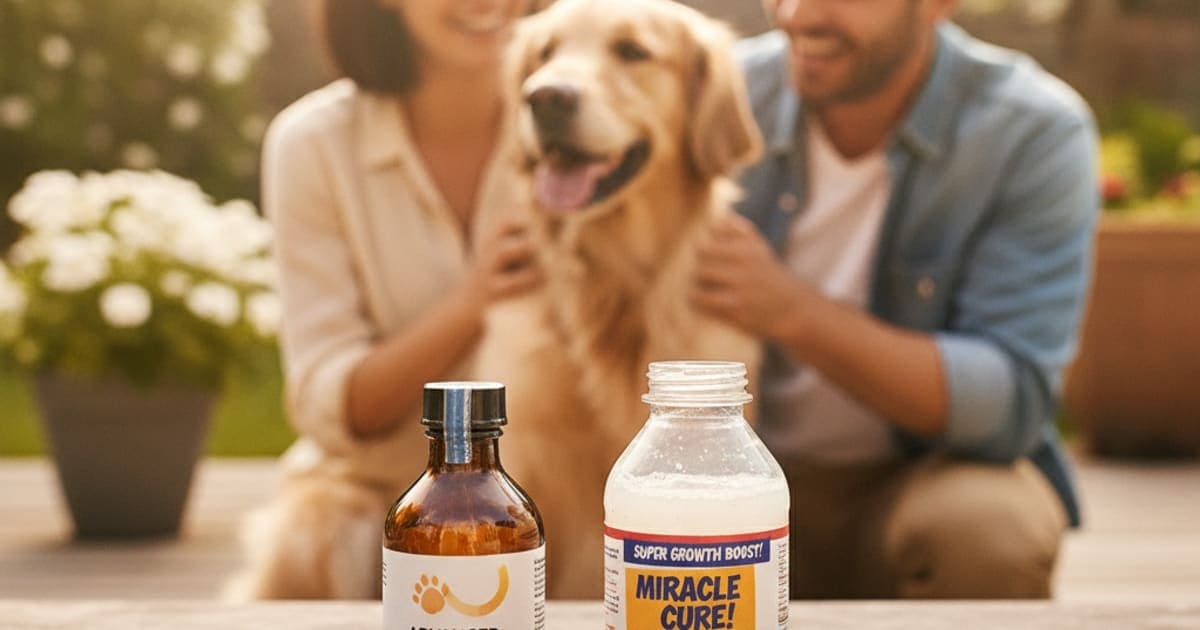
TB-500 Fake vs Real for Dogs: How to Spot a Cheap Knockoff
Real TB-500 for dogs is identifiable on paper, not by eye. Genuine product comes with a batch-specific certificate of analysis (COA) from a named independent laboratory, showing both identity testing (is this molecule actually TB-500?) and purity testing (how much of the material is the peptide versus everything else). It carries a label that states exactly which peptides are inside and how much is in each unit, it comes with weight-based guidance for dogs, and it comes from a company you can contact. A cheap knockoff does none of that. It hides behind a "proprietary peptide complex," reuses one undated PDF across every batch forever, ships from a marketplace seller with no company behind it, and prices itself far below what verified peptide material and third-party testing actually cost. K9-REPAIR — pawgen's BPC-157 and TB-500 formulation made specifically for dogs — sits on the verifiable side of that line: third-party tested with COAs, weight-based dosing guidance, direct-to-door shipping, and a 60-day money-back guarantee. Neither peptide is an FDA-approved veterinary drug, and everything below is educational.
What TB-500 actually is, and why that makes fakes detectable
TB-500 is a synthetic peptide based on a short, biologically active region of thymosin beta-4, a small protein found in most mammalian cells and especially concentrated in platelets and in the fluid that pools at a wound site. Thymosin beta-4's best-characterised job in the research literature is actin sequestering: it binds free G-actin monomers and helps regulate how a cell assembles and dismantles its internal scaffolding. That scaffolding is what lets a cell change shape and crawl. Research suggests this actin-regulating role sits upstream of cell migration, the formation of new small blood vessels, and the movement of fibroblasts and endothelial cells into an area of damaged tissue.
That is mechanism, not outcome. It explains why owners of dogs working through tendon, ligament and soft-tissue recovery have adopted TB-500 alongside their vet's plan, and it explains nothing about what will happen in one specific dog. Anyone telling you otherwise is selling certainty they do not have.
The useful part for a buyer is this: because TB-500 is a defined sequence of amino acids with a known molecular weight, its identity can be confirmed in a laboratory. Mass spectrometry tells you whether the molecule in the sample weighs what TB-500 weighs. Reverse-phase HPLC tells you what proportion of the material is that peptide rather than truncated fragments, synthesis by-products, salts or filler. This matters because you cannot detect a fake yourself. Peptides are white powders and clear, near-tasteless liquids. There is no smell, colour or texture that separates real material from expensive water, from an under-filled bottle, or from a completely different compound. The only signal available to a dog owner is documentation — which is exactly why the counterfeit end of this market invests so heavily in making documentation look like something it is not.
The signals that separate genuine product from a knockoff
If a seller cannot produce a batch-specific certificate of analysis from an independent laboratory, you are not buying TB-500 — you are buying a claim about TB-500. Everything else follows from that principle.
A real COA is tied to a lot. It names the product, carries a lot or batch number that matches the number printed on the bottle in your hand, states the date the analysis was performed, and names the laboratory that performed it. A recycled COA — no date, no lot, or the same lot number appearing on every order placed over two years — is a marketing asset, not a test result.
It covers identity as well as purity. Purity alone is a half-answer: a sample can be 99% something and that something can be the wrong molecule entirely. Identity testing is what closes the gap.
It comes from a third party. "Tested in-house" means the person selling you the product also graded it. Independent testing exists precisely to remove that conflict.
The label discloses content. You should be able to read which peptides are present and how much of each is in a unit of product. "Proprietary blend" on a peptide label is not protecting a trade secret; the sequences are public knowledge. It is protecting a ratio the company would rather you did not see.
The product is built for dogs. Human vials and grey-market "research chemical" listings are not formulated, portioned or labelled with a dog in mind, and they leave the owner improvising. A dog-specific formulation with weight-based guidance removes that guesswork — and the actual amounts belong in a conversation with your veterinarian, not in a blog post.
Storage and shipping are addressed. Peptides are sensitive to heat, light and time. A seller who says nothing about how material is stored or shipped has told you something about how much they know.
Real product versus cheap knockoff at a glance
| Signal | Genuine, verifiable product | Cheap knockoff |
|---|---|---|
| Certificate of analysis | Batch-specific, dated, lot number matches the bottle | Missing, undated, or one file reused across all batches |
| Testing laboratory | Named independent third party | "In-house tested" or unnamed |
| Identity testing | Mass spectrometry confirms the molecule | Not mentioned, or purity quoted alone |
| Label transparency | Each peptide named with content per unit | "Proprietary peptide complex" |
| Formulated for dogs | Yes, with weight-based guidance | Human or research vials, owner improvises |
| Storage and shipping | Handling and cold-chain considerations stated | Silent |
| Seller | Contactable company with published policies | Marketplace or social-media account |
| Buyer protection | Stated returns policy or money-back guarantee | Final sale, no recourse |
Label tricks and marketing tells worth recognising
The most common trick is the borrowed COA. A seller shows you a certificate issued to the raw-material manufacturer for a bulk lot of peptide — not to the finished product you are about to give your dog. Those are different things. The finished good is where dilution errors, contamination and degradation happen, so the finished good is what needs testing.
The second is the screenshot with no source. A cropped image of a chromatogram with no laboratory letterhead, no method listed and no date is decoration. Ask for the full document; a legitimate supplier will send it without friction.
The third is the kitchen-sink chew. Fifteen ingredients on the front panel, each present in a quantity too small to do anything, arranged so the label reads impressively. Ingredient count is not evidence of anything except a copywriter's ambition.
The fourth is credential theatre — badges implying veterinary endorsement with no named veterinarian behind them, invented certification seals, or dramatic transformation photos presented as documented results. No supplement company can honestly promise your dog a result.
And finally, price. Peptide synthesis, purification, formulation and independent batch testing all cost real money. A product priced far below everything else in the category has cut something, and it is rarely the marketing budget. It is usually the peptide content or the testing.
How to read a COA without a chemistry degree
You do not need to interpret a chromatogram. You need to check five things in order.
First, the header: does it name this product, and does it carry a lot number? Second, does that lot number match the bottle you received or the batch listed on the product page? Third, the date of analysis — is it consistent with when this batch was made? Fourth, the methods: you are looking for a purity method such as RP-HPLC and an identity method such as LC-MS or MALDI-TOF. Fifth, the results section, where purity is reported as a percentage of the total material.
Beyond identity and purity, well-run suppliers also test finished goods for microbial contamination, heavy metals and residual solvents. Not every COA includes all of these, but their presence tells you the manufacturer is thinking about the whole product rather than the headline number.
Then do the simplest test of all: email and ask for the COA for your batch. The speed and completeness of that reply is a genuine measure of who you are dealing with. Bring the document to your veterinarian too — it is the single most useful thing you can hand them when you raise a supplement during a recovery conversation.
Why owners choose a dog-specific BPC-157 and TB-500 formulation
TB-500 rarely gets used alone in the recovery context. It is usually paired with BPC-157, a peptide sequence derived from a protein found in gastric juice, which research suggests interacts with pathways involved in blood-vessel formation and connective-tissue signalling. The two are studied on different mechanistic ground, which is why the combination has become the stack owners reach for through a rehab window rather than either one on its own.
K9-REPAIR exists so that owners are not buying human vials and guessing. It is formulated for dogs, dosed by body weight in the guidance that accompanies it, third-party tested with certificates of analysis, shipped direct to the door, and backed by a 60-day money-back guarantee. BPC-157 and TB-500 are not FDA-approved veterinary drugs, and nothing here is a promise about what will happen with your dog. What it is: a way to know what is actually in the bottle. Talk to your veterinarian before starting any supplement, particularly around a surgery date or alongside prescribed medication, and never adjust or stop a prescription on your own.
Key Takeaways
- Genuine TB-500 for dogs is verified by a batch-specific COA from a named independent lab covering both identity and purity — not by packaging or price.
- Match the lot number on the COA to the lot number on the bottle, and check the date of analysis.
- Purity figures alone do not confirm the molecule is TB-500; mass spectrometry does.
- "Proprietary peptide complex" on a peptide label hides content, not a trade secret.
- Suspiciously low pricing usually reflects cuts to peptide content or independent testing.
- Human vials and research listings leave dog owners improvising; a dog-specific formulation with weight-based guidance does not.
- Bring the COA to your vet — it makes the supplement conversation concrete.
Where your veterinarian fits in this decision
For deeper reading on verification and on the counterfeit market, see bpc-157 and tb-500 together purity testing for dogs and bpc-157 and tb-500 together fake vs real for dogs, or read what goes into K9-REPAIR.
Documentation tells you what is in a bottle. It does not tell you what is wrong with your dog, and that is the more important question. A limp is a symptom with many possible causes — a partial cruciate tear, a soft-tissue strain, developing arthritis, a paw injury, referred pain from elsewhere. Imaging, an orthopaedic exam and a professional diagnosis are what separate those possibilities, and no supplement substitutes for that work.
Your veterinarian owns the diagnosis and the treatment plan: the surgical decision, the pain protocol, the rehab timeline, the restrictions on activity that protect healing tissue. Supplements and peptides operate in the space that proper veterinary care creates — alongside it, after it, never instead of it. Choose a product you can verify, tell your vet you are using it, and keep the medical plan intact.
Owners exploring peptide support for their dog can review K9-REPAIR — BPC-157 + TB-500 formulated for dogs — at https://pawgen.com/. BPC-157 and TB-500 are not FDA-approved veterinary drugs. Nothing in this article treats, cures or prevents any condition; every decision about your dog's care belongs with your veterinarian.
Frequently asked questions
- Can BPC-157 replace my dog's pain medication?
- No. BPC-157 is not a pain medication and is not a substitute for anything your veterinarian has prescribed. Never stop or reduce a prescribed drug such as carprofen, gabapentin or prednisone on your own. If you want to review your dog's pain plan, that conversation belongs with your vet.
- How do I know if BPC-157 is working?
- You cannot measure it directly, so owners track observable function instead: willingness to bear weight, stair use, gait at a walk, recovery after activity, and comfort settling at night. Keep a simple written log and short video clips, and review them with your veterinarian, who can compare them against the expected recovery arc.
- Is BPC-157 FDA approved for dogs?
- No. BPC-157 is not an FDA-approved veterinary drug, and pawgen's content about it is educational rather than a treatment claim. It is sold as a supplement formulation, which is why third-party testing and batch certificates of analysis matter so much, and why your veterinarian should know you are using it.
- Can I give my dog TB-500?
- That decision belongs with your veterinarian, who knows your dog's diagnosis, medications and history. If you do proceed, use a product formulated for dogs with weight-based guidance and a batch-specific certificate of analysis rather than a human or research vial. Amounts are a veterinary conversation, never a number from an article.
- How long does TB-500 take to work in dogs?
- There is no reliable timeline, and any seller quoting one is guessing. Connective tissue remodels over weeks to months regardless of what is added to a plan, so owners generally assess change across a rehab window rather than days. Track function objectively and review progress with your veterinarian.
- What does TB-500 do for dogs?
- TB-500 is a synthetic peptide based on thymosin beta-4, a protein concentrated in platelets and wound fluid. Research suggests its main biological role is binding actin monomers, which influences cell migration and new blood-vessel formation. That is mechanism only — it is not a claim about outcomes for any individual dog.
- What does a real certificate of analysis look like?
- A genuine COA names the finished product, carries a lot number matching your bottle, states the date of analysis, names an independent laboratory, and lists methods for both purity and identity — typically RP-HPLC and mass spectrometry. Undated, unbatched or in-house documents do not meet that standard.
- Is cheap TB-500 always fake?
- Not always, but price is a meaningful signal. Peptide synthesis, purification, dog-specific formulation and independent batch testing all cost money, so a product priced far under the category has usually cut peptide content or testing. Judge the documentation rather than the price, and buy only where a COA is available.
Educational content. BPC-157 and TB-500 are not FDA-approved veterinary drugs. Talk to your veterinarian before starting anything new, especially if your dog is on prescribed medication.