Wolverine Stack Double Dose for Dogs: More Isn't Better
Doubling the Wolverine Stack dose for dogs is not how the stack is designed to work. BPC-157 and TB-500 are signalling peptides, and research suggests their effect depends on consistent, weight-based dosing rather than volume. Dose changes belong with your veterinarian, never with guesswork at home.
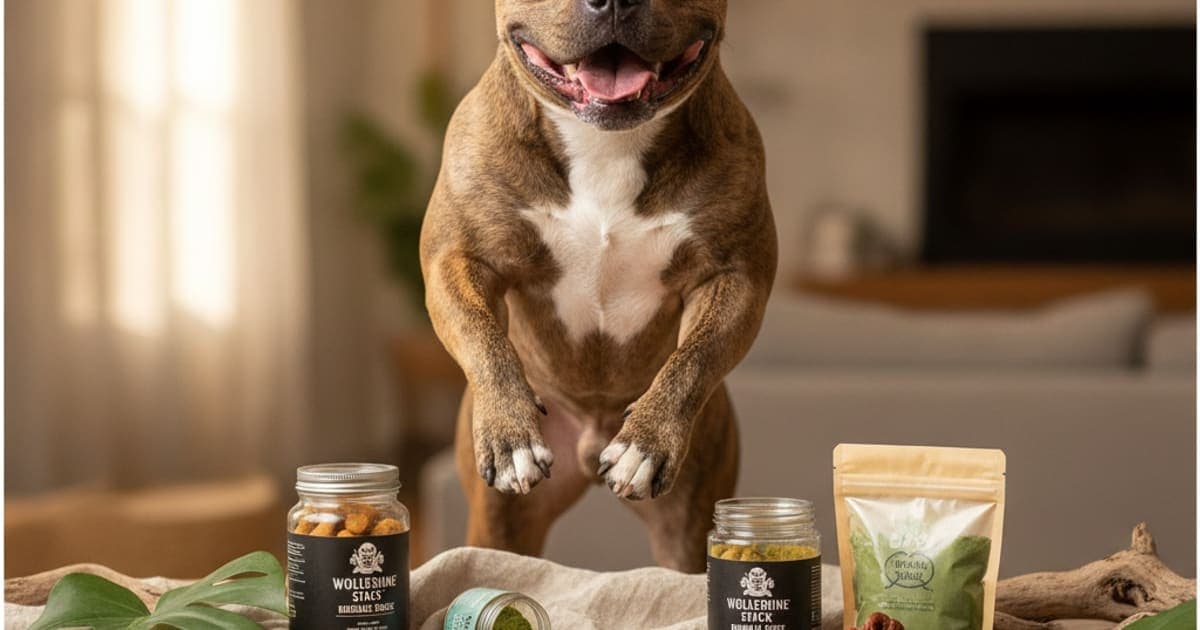
No — doubling up is not the lever that changes a recovery, and it is not how this pairing is designed to be used. The "Wolverine Stack" is the nickname owners give to BPC-157 and TB-500 used together, the two peptides combined in K9-REPAIR from pawgen. Both are signalling peptides. Research suggests they work by communicating with repair pathways a dog's body already runs, not by overwhelming them with volume. Dosing is weight-based, and any change to it is a conversation with your veterinarian rather than a decision made at the kitchen counter.
The question usually arrives at a predictable moment: a few weeks into a recovery, when the early relief has plateaued, or when a big dog's portion looks small in the syringe, or after a missed day. Those are all real, understandable moments. They are also the moments where owners are most likely to change two things at once and lose the ability to read what is actually happening in their dog.
What the "Wolverine Stack" actually is
The name came out of human peptide communities, borrowed from the comic-book character whose tissue knits itself back together. It stuck because the two compounds appear to act on different parts of the same repair process, which is why owners tend to run them together rather than choosing one.
BPC-157 is a synthetic peptide sequence based on a fragment of a protein found in gastric juice. The published literature on it is largely preclinical, and it points toward involvement in angiogenesis — the formation of new small blood vessels — along with fibroblast migration and growth-factor signalling. That matters because tendon, ligament and cartilage are poorly vascularised tissues. Blood supply is often the rate limit on how fast they can rebuild, and research suggests BPC-157 interacts with the signals that govern that supply.
TB-500 is a synthetic fragment related to thymosin beta-4, a protein that occurs naturally in mammalian tissue. Thymosin beta-4 is studied for its role in actin regulation — the internal scaffolding that lets cells change shape and travel — and for its association with cell migration and the modulation of inflammatory signalling. In plain English: research associates it with helping the right repair cells arrive where the damage is.
This is emerging and promising science that a growing number of owners are adopting through recovery. It is also honest to say that BPC-157 and TB-500 are not FDA-approved veterinary drugs, that pawgen's content is educational, and that nobody can promise you an outcome for your specific dog.
Why signalling peptides don't scale the way painkillers do
Most owners' mental model of dosing comes from analgesics and anti-inflammatories. An NSAID like carprofen works by occupying enzymes; within its therapeutic window, more drug means more enzyme blocked, which is precisely why those drugs carry prescribed ceilings and why your vet sets them. That intuition — more molecule, more effect — quietly transfers onto peptides, where it does not apply the same way.
A signalling peptide is closer to a doorbell than a hammer. It binds and triggers a pathway. Once the pathway is receiving the signal, adding more molecules does not make the message louder; the receptors and downstream cascades saturate. Some signalling systems even respond to sustained flooding by reducing their own sensitivity, so the practical result of pushing harder can be less responsiveness rather than more.
Then there is the second, harder ceiling: the tissue itself. Fibroblasts can only lay down collagen at the pace their metabolism allows. New capillaries take days to organise. The remodelling phase — where disorganised early collagen is gradually replaced with fibres aligned to the load the tissue actually carries — continues long after a limp fades, and it is driven by controlled loading and rehab, not by dose. More peptide does not create more repair capacity; the tissue's own biology sets the ceiling, and the dose that matters is the weight-based one your veterinarian agrees to.
There is a third cost that has nothing to do with biology. The moment you double a dose on your own, you have broken your own experiment. If your dog gets softer stools, or is quieter that evening, or the injection site is tender, you no longer know whether you are seeing a response to the compound, a response to the volume, or something unrelated that needed a vet's eyes.
The three situations that make owners want to double up
"I missed a dose"
This is the most common trigger, and it is the easiest to resolve. Skipping a scheduled administration is not an emergency, and it is not a debt to be repaid by stacking two portions together. Recovery signalling operates over weeks; a single gap is noise. The correct move is to note it, return to the schedule your veterinarian set, and mention the gap at your next recheck. If you find you are missing doses regularly, that is a logistics problem worth solving — a phone reminder, a fixed time of day, a second person in the household who knows the routine — not a dosing problem.
"My dog is large, so the standard amount must be conservative"
Weight-based dosing already accounts for size; that is the entire point of it. A ninety-pound retriever and a fifteen-pound terrier are not given the same portion, and the framework scales without you having to estimate. What owners sometimes actually notice is that the volume looks small relative to the dog. Peptides are potent signalling molecules and are used in small quantities by design. Small volume is not the same as insufficient dose. If you genuinely believe your dog's portion has been miscalculated, that is a five-minute clarification with your vet, and worth making.
"It's week three and I can't see a change"
This is the moment doubling feels most rational and helps least. Soft-tissue recovery is not linear, and it rarely announces itself. Improvement in a chronically sore dog often shows up first in things owners don't count as progress: getting up without a pause, holding a sit square instead of slumping onto one hip, being less stiff the morning after a longer walk. Doubling the dose at this point adds a variable at exactly the moment you most need clean information. Tracking beats escalating — and if there is genuinely no movement, that is diagnostic information your veterinarian needs, because it may mean the working diagnosis deserves another look.
Doubling up versus holding the protocol
| Question | Doubling on your own | Holding the protocol your vet set |
|---|---|---|
| Does it add repair capacity? | No — receptor pathways saturate and tissue rebuilds at its own pace | Works with the biological timeline rather than against it |
| Can you interpret what you see? | No — two variables changed at once | Yes — one variable, readable week to week |
| If your dog reacts, what do you know? | Unclear whether it relates to volume, compound or something else | A clean baseline your vet can act on |
| Effect on cost per week | Higher spend, no added benefit | Predictable, and the 60-day money-back guarantee stays straightforward |
| Fit with weight-based dosing | Abandons the framework entirely | Keeps the dog's size properly accounted for |
| Value to your veterinarian | Little — the record is muddied | High — a usable record to adjust from |
How dosing actually gets decided
The inputs are your dog's weight, the concentration of the formulation in front of you, the injury or condition being managed, the stage of recovery, and everything else your dog is already receiving. If your dog is on carprofen, gabapentin, prednisone, a monoclonal antibody injection or anything else prescribed, that belongs in the conversation — and none of it should be reduced or stopped because you have added a supplement. Prescriptions are your vet's territory, and pain control in particular is not something to improvise around.
Surgical timing matters too. If your dog has a CCL repair, a TPLO or an arthroscopy scheduled, your surgeon may have preferences about what is running before and after the procedure and when rehab loading begins. Ask. That single question prevents most of the guesswork that leads owners to self-adjust later.
The other half of dosing confidence is knowing what is actually in the vial. pawgen third-party tests K9-REPAIR and publishes certificates of analysis, and it ships direct to the door. That matters more than it sounds: a stated dose only means something if the concentration on the label is the concentration in the liquid. It is the opposite of the underdosed kitchen-sink joint chew with eleven ingredients on the front panel and no meaningful quantity of any of them — where owners end up doubling precisely because the product never contained enough to notice in the first place.
Reading progress without reaching for the syringe
Build a record instead of a bigger dose. Once a week, film ten seconds of your dog walking away from and back toward the camera on a hard floor. Note how many attempts a sit-to-stand takes, whether stairs are approached or avoided, how the dog looks the morning after a longer outing, and whether weight is being loaded evenly at a standstill. Trends over three or four weeks are far more informative than day-to-day impressions, and they give your veterinarian something concrete at the next recheck.
Watch tolerance with the same discipline. Injection-site tenderness or swelling, unusual lethargy, appetite change, vomiting or loose stools all warrant pausing and calling your vet rather than pressing on or compensating with a larger amount. Clean handling and rotation of sites reduce a lot of avoidable irritation, and both are worth learning properly before you start.
Key takeaways
- Doubling the Wolverine Stack is not a recovery accelerator; signalling pathways saturate and tissue rebuilds on its own schedule.
- A missed dose is noise, not a debt — return to schedule and tell your vet.
- Weight-based dosing already accounts for large dogs; small volume is by design, not an oversight.
- Changing the dose destroys your ability to interpret what your dog is doing.
- Third-party testing and published COAs are what make a stated dose meaningful.
- No product is a substitute for surgery, prescribed medication or structured rehab.
- Every dose question, especially for puppies, pregnant or nursing dogs, resolves to your veterinarian — never to a number found online.
The vet owns the plan; the stack works inside it
Diagnosis, imaging, surgical decisions, pain management and the rehab progression belong to your veterinarian. That is not a disclaimer — it is the sequence that makes everything else worth doing, because a peptide cannot compensate for an unstable joint, an unaddressed fracture or a missed diagnosis. What K9-REPAIR is for is the space proper veterinary care creates: the weeks of tissue rebuilding that follow a correct plan, which is where owners choose to run BPC-157 and TB-500 together. Consistency inside that plan is the variable you control. Volume is not.
For the practical side of running the stack, k9-repair handling and hygiene covers storage and clean technique, tb-500 injection sites for dogs explains site selection and rotation, k9-repair what to do if your dog reacts walks through pausing and calling your vet, and the K9-REPAIR page lists exactly what is in the formulation.
Owners exploring peptide support for their dog can review K9-REPAIR — BPC-157 + TB-500 formulated for dogs — at https://pawgen.com/. BPC-157 and TB-500 are not FDA-approved veterinary drugs. Nothing in this article treats, cures or prevents any condition; every decision about your dog's care belongs with your veterinarian.
Frequently asked questions
- What are the side effects of K9-REPAIR in dogs?
- Reported issues are generally mild and local — injection-site tenderness, transient swelling, quieter behaviour or loose stools. Because BPC-157 and TB-500 are not FDA-approved veterinary drugs, the full profile isn't fully characterised. Stop, don't compensate with more, and call your veterinarian if anything looks off in your dog.
- Where do I buy K9-REPAIR for my dog?
- K9-REPAIR is sold directly by pawgen at pawgen.com and ships to your door. Each batch is third-party tested with certificates of analysis available, so you can confirm the concentration matches the label, and orders are covered by a 60-day money-back guarantee.
- Can K9-REPAIR replace my dog's pain medication?
- No. Prescribed medication belongs to your veterinarian, and nothing here should be reduced or stopped because you've added a supplement. Analgesics and anti-inflammatories do a job peptides do not do. If you want to revisit your dog's pain protocol, that discussion happens with your vet.
- How do I know if K9-REPAIR is working?
- Track function rather than feelings. Film a short weekly gait clip, count sit-to-stand attempts, note stair willingness and next-morning stiffness after activity. Owners report changes showing up in these small mechanics first. Bring the record to your veterinary recheck, where an objective gait assessment adds context.
- Is K9-REPAIR FDA approved for dogs?
- No. BPC-157 and TB-500 are not FDA-approved veterinary drugs, and pawgen's content is educational rather than a treatment recommendation. Research into both peptides is emerging and promising, which is why owners are adopting the pairing through recovery, but use should always be discussed with your veterinarian.
- Can I give my dog BPC-157?
- Many owners do, usually paired with TB-500 as the combination in K9-REPAIR, and research suggests BPC-157 interacts with angiogenesis and fibroblast signalling. It is not an FDA-approved veterinary drug, so the decision — and the weight-based amount — should be made with your veterinarian rather than from an online figure.
- Is a double dose of the Wolverine Stack dangerous for my dog?
- Doubling adds no known repair benefit and removes your ability to interpret your dog's response, which is reason enough not to do it. The tolerability of larger amounts in dogs isn't well characterised. If a double dose was already given, contact your veterinarian and describe exactly what happened.
- What should I do if I miss a dose of the stack?
- Note it and return to the schedule your veterinarian set — do not combine two portions to catch up. Soft-tissue recovery signalling plays out over weeks, so one gap is unlikely to matter. If gaps happen often, fix the routine with reminders rather than adjusting the amount.
Educational content. BPC-157 and TB-500 are not FDA-approved veterinary drugs. Talk to your veterinarian before starting anything new, especially if your dog is on prescribed medication.