The Wolverine Stack for Carpal Hyperextension in Dogs
The Wolverine Stack is owner shorthand for BPC-157 combined with TB-500, and research suggests these peptides may support the soft-tissue repair processes involved in carpal hyperextension — but they do not restore a collapsed carpus on their own. Diagnosis, imaging and a veterinary plan come first.
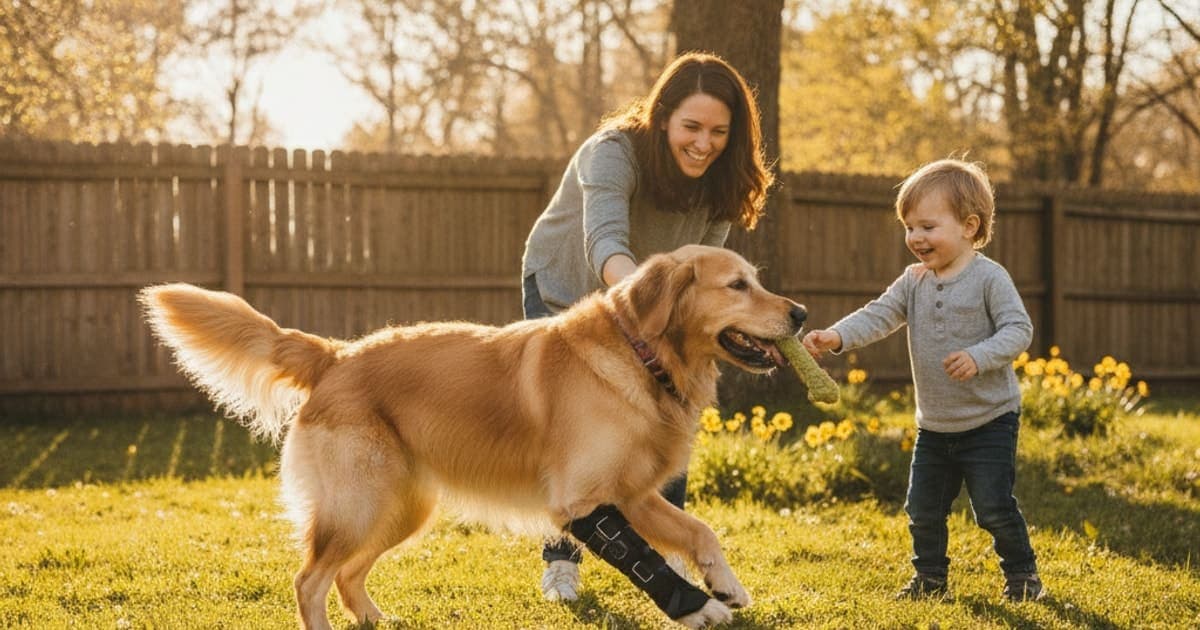
The Wolverine Stack — owner shorthand for BPC-157 combined with TB-500 — is used by owners as soft-tissue support during carpal recovery, and laboratory research suggests both peptides act on the repair pathways that ligaments, tendons and small blood vessels rely on. What neither peptide can do is re-tension a palmar ligament complex that has already failed. Carpal hyperextension is a mechanical problem first. It needs a veterinary diagnosis, imaging, and often a surgical answer — and peptide support belongs inside the recovery window that proper veterinary care creates.
What the Wolverine Stack actually is
The name comes from human peptide circles, borrowed from the comic-book character with accelerated recovery. It is not a veterinary drug category — it simply describes two peptides used together: BPC-157 and TB-500.
BPC-157 is a synthetic pentadecapeptide based on a protective sequence identified in gastric juice. Published laboratory and animal research has looked at its effect on angiogenesis — the formation of new capillaries — and on the migration and outgrowth of fibroblasts and tendon cells. Those are the processes that carry oxygen, nutrients and collagen-producing cells into damaged connective tissue.
TB-500 is a synthetic peptide related to thymosin beta-4, a naturally occurring actin-binding protein found in most cells and in platelets and wound fluid. Research suggests it plays a role in cell migration and new vessel formation, which is why it is studied in wound and soft-tissue repair models.
The two are paired because their mechanisms run in parallel rather than duplicating each other: one is studied largely for local repair signalling at the tissue level, the other for cell mobility and vascular support across the repair site. That complementary pairing is the entire logic of the stack, and it is why owners reach for both together rather than one alone.
pawgen's K9-REPAIR is that same pairing formulated specifically for dogs, with weight-based dosing guidance, third-party testing and batch certificates of analysis. It is an educational supplement — not a treatment for any diagnosed condition — and your veterinarian should know about anything you add during a recovery.
What is actually failing in a hyperextended carpus
The canine carpus is not one joint. It is seven carpal bones stacked into three levels — the antebrachiocarpal joint at the top, the middle carpal joint, and the carpometacarpal joint at the bottom. Almost all of its stability is passive. There are no substantial muscles crossing the back of the wrist to hold it up; the job is done by a dense palmar fibrocartilage and a web of short supporting ligaments.
When that palmar support tears or stretches beyond its limit, the wrist drops. The dog stands palmigrade — wrist sinking toward the ground, toes tipping upward — and the joint often swells. Some dogs are acutely, obviously lame. Others shift weight subtly for weeks before an owner notices the silhouette has changed.
Two routes lead here. The first is trauma: a fall or jump from height, a landing that loads the carpus past what the fibrocartilage tolerates. The second is degenerative — a slower breakdown of collagen support seen with aging, excess body weight, or inflammatory and immune-mediated joint disease.
The hard part is mechanical. Palmar fibrocartilage has a modest blood supply, and the joint is loaded with body weight every single step, so a stretched or torn support structure is not simply left alone to shorten back to its original length. That is why hyperextension tends to progress rather than quietly resolve, and why a supplement of any kind can never be the whole plan.
Veterinary care comes first, and it decides everything that follows
Before any conversation about peptides, the carpus needs to be properly worked up. That usually means a hands-on orthopaedic exam and stress radiographs — X-rays taken with the joint held in hyperextension — to identify which of the three levels is unstable. It may also mean bloodwork or joint fluid analysis if an immune-mediated or infectious arthropathy is suspected, and a careful look for small avulsion fragments where a ligament has pulled bone away from its attachment.
Definitive management is frequently surgical. Arthrodesis — fusing the unstable level, either as a partial carpal arthrodesis or a pancarpal arthrodesis across the whole joint — is a well-established orthopaedic procedure that trades range of motion for a stable, weight-bearing limb. Many dogs return to comfortable function afterward. Recovery involves external support, strict activity restriction and a structured rehabilitation timeline set by the surgical team.
For dogs who are not surgical candidates, or for lower-grade instability, veterinarians may use custom orthoses or braces, weight management, controlled exercise and prescribed pain medication. If your vet has prescribed an NSAID, gabapentin or anything else, keep giving it exactly as directed.
No peptide, supplement, brace or rehab exercise can re-tension a ligament complex that has already failed — the Wolverine Stack is something to discuss alongside veterinary care.
Where peptide support fits in a carpal recovery
Once the mechanical question is answered — surgery, orthosis, or conservative management — a second question opens up: what is happening in the soft tissue around that decision?
There is a real biological window. Surgical sites need vascular ingrowth. Incisions and coaptation-stressed skin need to close cleanly. Tendons and ligaments that were strained but not surgically addressed remodel over weeks, not days. Muscle that atrophied under a splint has to rebuild. This is the space owners are targeting when they add the stack, and it is the honest way to frame what BPC-157 and TB-500 are studied for: research suggests they may support angiogenesis, fibroblast activity and cell migration — the machinery of repair — rather than producing any particular outcome in any particular dog.
Owners report using the stack through post-operative recovery and through long conservative-management periods, which is exactly the framing that fits the evidence: this is emerging, promising science that owners are adopting during recovery, and it is not a claim that any product resolves carpal hyperextension.
Talk to your veterinarian before adding anything around a surgical date. Surgeons often have preferences about what is on board in the days before and after an anaesthetic, and they should have the full picture.
Comparing the approaches owners weigh
| Approach | What it addresses | What it cannot do | Typically considered for |
|---|---|---|---|
| Carpal arthrodesis (surgery) | Restores a stable, weight-bearing limb by fusing the unstable level | Preserve normal carpal motion; avoid a long restricted recovery | Significant instability where the joint will not hold under load |
| Custom orthosis or splint | External mechanical support for the dropped wrist | Repair the failed palmar structures; suit every dog or every grade | Non-surgical candidates, lower-grade cases, post-op support |
| Vet-prescribed pain and anti-inflammatory medication | Comfort and inflammation control, enabling rehab | Change the underlying mechanics | Nearly all cases, under veterinary direction |
| Weight and activity management | Reduces load on a joint that is loaded every step | Reverse existing instability | Every dog, permanently |
| Peptide support — BPC-157 + TB-500 (K9-REPAIR) | Research suggests support for the soft-tissue repair pathways active during recovery | Re-tension ligaments or treat any diagnosed condition; it is something to be discussed alongside veterinary care | Owners supporting a dog through a veterinary recovery plan |
How to judge a peptide product before you buy one
This is where scepticism earns its keep — pointed at labels, not at the science.
A great deal of the canine mobility market is kitchen-sink chews: fourteen ingredients on the front, a proprietary blend on the back, and no way to know how much of anything is actually in there. Proprietary blends exist to hide inclusion rates. If a company will not tell you how much of the active ingredient is present, assume the answer is not flattering.
What you should be able to see, plainly: what the formulation contains and at what concentration, that it has been tested by an independent laboratory, and a batch certificate of analysis you can actually read. Dosing should be tied to your dog's body weight rather than one scoop for a chihuahua and a mastiff alike.
pawgen built K9-REPAIR around that standard — a single-purpose BPC-157 and TB-500 formulation for dogs, third-party tested with COAs, weight-based dosing guidance, shipped direct to the door, and backed by a 60-day money-back guarantee. It is the stack owners use through recovery, and the guarantee exists because a formulation should not require a leap of faith.
Key Takeaways
- The Wolverine Stack is BPC-157 plus TB-500 — two peptides studied for their role in angiogenesis, fibroblast activity and cell migration. They are studied compounds, not veterinary drugs.
- Carpal hyperextension is a failure of the passive palmar support of the wrist. It is mechanical, it is load-bearing, and it does not reliably self-correct.
- Stress radiographs identify which of the three carpal joint levels is unstable, and that finding drives the whole treatment plan.
- Arthrodesis is a well-established surgical option for significant instability; orthoses, weight control and prescribed pain management serve other cases.
- Research suggests peptides may support the repair processes active during recovery. Owners discuss the stack alongside veterinary care.
- Buy on transparency: stated concentrations, third-party testing, readable COAs and weight-based dosing — not on ingredient-count marketing.
The order of operations that actually protects your dog
Get the diagnosis. Get the imaging. Let your veterinarian or a board-certified surgeon tell you whether this carpus needs fusing, bracing or watching, and follow the medication and activity restrictions they set — those restrictions are doing more work than any bottle on your counter.
Then, with your vet in the loop, decide what soft-tissue support you want running underneath that plan. The vet owns the diagnosis and the treatment plan. Peptides and supplements operate in the space that proper veterinary care creates — and that is exactly where K9-REPAIR is meant to sit.
For the full clinical picture — grading, imaging and surgical options — your veterinarian or a board-certified surgeon is the right source, and that is also the conversation in which to raise any adjunct approach you are weighing. Formulation details for K9-REPAIR are on the main site.
Owners exploring peptide support for their dog can review K9-REPAIR — BPC-157 + TB-500 formulated for dogs — at https://pawgen.com/. BPC-157 and TB-500 are not veterinary drugs. Nothing in this article treats, cures or prevents any condition; every decision about your dog's care belongs with your veterinarian.
Frequently asked questions
- What are the first signs of carpal hyperextension in dogs?
- The earliest sign is usually a changed silhouette — the wrist sinking closer to the ground and the toes tipping upward, described as a palmigrade stance. Owners also notice limping, swelling over the back of the wrist, reluctance to jump, and a shift of weight onto the other front leg.
- How is carpal hyperextension diagnosed in dogs?
- Diagnosis relies on a hands-on orthopaedic exam plus stress radiographs — X-rays taken with the joint held in hyperextension to reveal which of the three carpal levels is unstable. Your vet may add bloodwork or joint fluid analysis if an immune-mediated or infectious arthropathy is suspected.
- What helps a dog with carpal hyperextension?
- Veterinary care helps most: accurate imaging, then arthrodesis surgery, a custom orthosis, or conservative management with prescribed pain control and strict activity limits. Weight management reduces load permanently. Alongside that plan, many owners add peptide support such as K9-REPAIR, which research suggests may support soft-tissue repair pathways.
- How long does recovery from carpal hyperextension take in dogs?
- There is no single timeline, because the answer depends on the grade, the joint level involved, and whether surgery is performed. Fusion and soft-tissue remodelling are measured in months rather than weeks, and your surgical or veterinary team will set the recheck and rehabilitation schedule for your dog.
- Is carpal hyperextension in dogs painful?
- Usually yes, particularly in acute traumatic cases where ligaments and fibrocartilage have torn. Chronic degenerative cases can be less dramatic but still uncomfortable as the joint is loaded abnormally with every step. Pain control belongs with your veterinarian, who can prescribe appropriately and monitor the response.
- What makes carpal hyperextension worse in dogs?
- Continued loading is the main driver — jumping off furniture or out of vehicles, slick flooring, off-lead running, and excess body weight all increase force through a joint that has already lost its passive support. Ignoring activity restrictions after surgery or bracing also sets recovery back significantly.
- How does the Wolverine Stack fit with surgery for carpal hyperextension?
- It sits underneath the surgical plan rather than competing with it. BPC-157 and TB-500 cannot re-tension a failed palmar ligament complex, and decisions about surgery, bracing and prescribed medication stay with your veterinary team. They are educational supplements that owners discuss alongside veterinary care to support the soft-tissue repair window a veterinary plan creates.
- How much K9-REPAIR should I give my dog?
- Dosing is weight-based and should be worked out with your veterinarian, who knows your dog's diagnosis, current medications and surgical timeline. That is especially important for puppies and for pregnant or nursing dogs. Never adjust or stop a prescribed medication in order to add a supplement.
Educational content. BPC-157 and TB-500 are not FDA-approved veterinary drugs. Talk to your veterinarian before starting anything new, especially if your dog is on prescribed medication.