Wolverine Stack Reconstitution for Dogs — Safe Steps
Reconstituting a Wolverine Stack for dogs — BPC-157 paired with TB-500 — means rehydrating lyophilized powder with bacteriostatic water under sterile conditions, swirling rather than shaking, then storing the vial cold, dark and labelled. Every quantity and schedule belongs to your veterinarian. K9-REPAIR arrives formulated for dogs with third-party testing.
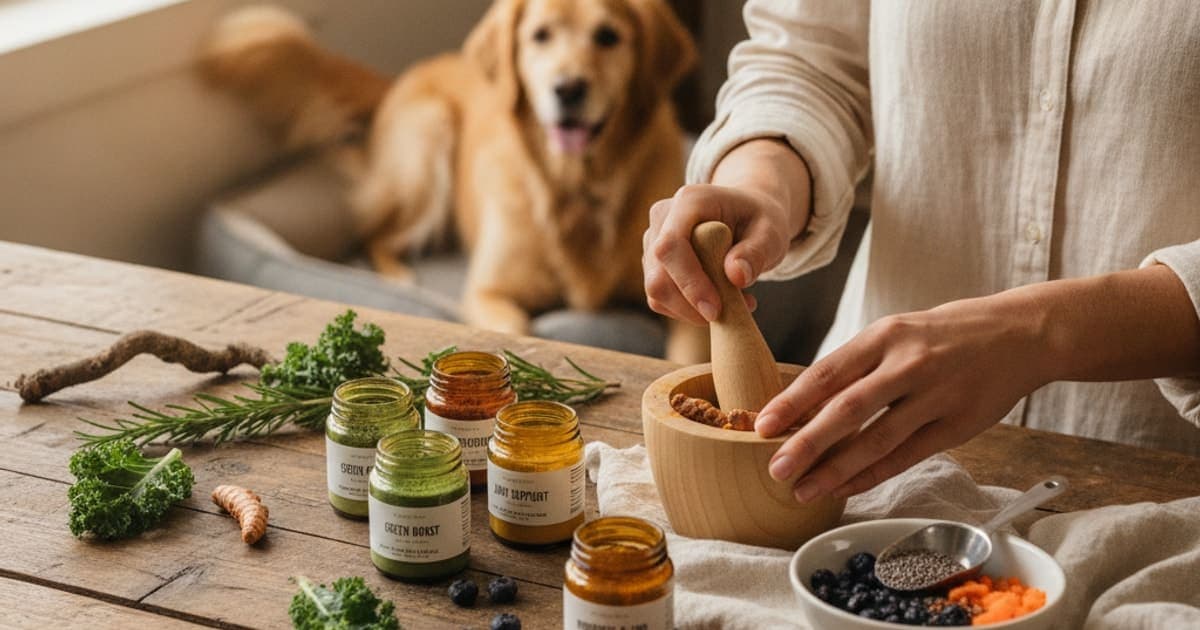
Reconstituting a Wolverine Stack for a dog means rehydrating two lyophilized peptides — BPC-157 and TB-500 — with the diluent your veterinarian specifies, using sterile technique, letting the liquid run down the inside wall of the glass rather than blasting the powder cake, swirling instead of shaking, and then storing the mixed vial cold, dark and clearly labelled. That is the entire mechanical job. What this guide will not give you is a number: no volumes, no schedules, no milligram math. Concentration and frequency are veterinary decisions that depend on your dog's weight, diagnosis and current medications. Owners who would rather not mix anything at the kitchen counter use K9-REPAIR from pawgen, which arrives as a dog-specific BPC-157 + TB-500 formulation with third-party testing and weight-based dosing guidance.
What owners mean by the Wolverine Stack
The nickname came out of human peptide communities and stuck because the two compounds are so often used together. BPC-157 is a synthetic peptide sequence derived from a protein fragment identified in gastric juice. TB-500 is a synthetic fragment based on thymosin beta-4, a naturally occurring protein found widely in mammalian tissue, including in dogs.
They are paired because published research points them at different parts of the same problem. Laboratory research on BPC-157 has focused on angiogenesis — the formation of new small blood vessels — and on fibroblast behaviour at the site of soft-tissue injury, which is why owners reach for it around tendon, ligament and gut recovery. Research on thymosin beta-4 and its fragments has centred on actin binding and cell migration, the process by which repair cells travel to where they are needed. Research suggests these are complementary mechanisms rather than duplicate ones, and that is the reasoning behind stacking them.
Be clear-eyed about the regulatory status: BPC-157 and TB-500 are not FDA-approved veterinary drugs, and nothing here should be read as a claim that they treat, cure or prevent any condition in your dog. This is emerging science that a growing number of owners are adopting alongside veterinary care, and it deserves to be explained honestly rather than oversold.
Why the mixing step decides what ends up in the syringe
Peptides ship as a freeze-dried cake because they are far more stable dry than wet. In that state, sealed and cold, they are reasonably forgiving. The moment water enters the vial, the clock starts and the chemistry becomes fragile. Heat, ultraviolet light, vigorous agitation, repeated freeze-thaw cycles and a single contaminated stopper can all degrade the contents or turn a sterile vial into a bacterial culture.
Reconstitution is where sterility and gentleness — not enthusiasm — decide whether what you eventually draw up is still intact peptide.
This is also where the ordinary domestic environment works against you. A countertop that just held raw chicken, a dog nosing at your elbow, a syringe left uncapped while you answer the door: none of that is dramatic, and all of it matters. If you are handling a vial for your dog, treat the surface, your hands and the rubber stopper as the three things most likely to fail.
Before you mix anything, confirm with your veterinarian which diluent is appropriate, how the product should be handled and whether it fits alongside the medications your dog is already taking. That conversation is not a formality — it is the step that keeps the rest of this safe.
What to have ready before the vial is opened
Set everything out first. Reaching mid-procedure is how contamination happens.
- The diluent your veterinarian specified. Bacteriostatic water contains a small amount of benzyl alcohol as a preservative, which is why it is commonly used for multi-access vials; plain sterile water has no preservative at all. Which one is appropriate — particularly for very small dogs — is a question for your vet, not an internet default.
- Fresh single-use alcohol wipes, more than you think you need.
- Sterile, unopened syringes and needles of the type your veterinarian recommends.
- A hard, flat, non-porous surface you have cleared and wiped down.
- A permanent marker and a label.
- A sharps container. Not a drink bottle, not the household bin.
- Space in the fridge, away from the door.
Skip the improvisation. If a supply is missing, stop and get it rather than substituting.
Handling and mixing a peptide vial, step by step
- Put the dog in another room. A wagging tail at counter height ends procedures.
- Wash and dry your hands thoroughly, then wipe down the work surface and let it dry.
- Take the powder vial out of cold storage and let it sit until it is no longer cold to the touch. Cold glass and cold powder both resist dissolving.
- Flip off the plastic caps on the powder vial and the diluent vial. Swab each rubber stopper with a fresh alcohol wipe and let the alcohol dry — do not fan it, wipe it or touch it.
- Using a new sterile syringe, draw the amount of diluent your veterinarian specified. This guide deliberately does not supply that figure.
- Insert the needle into the powder vial at a shallow angle and let the liquid run slowly down the inside glass wall so it pools around the cake rather than punching a hole through it.
- Do not shake. Roll the vial gently between your palms or swirl it in slow circles. Some formulations clear in seconds, others take several minutes of patient swirling. Foam on the surface means you were too rough.
- Hold it up to the light. The solution should be clear and free of particles. Cloudiness, stringiness, discolouration or visible debris means the vial goes in the bin, not in your dog.
- Label the vial with its contents and the date you mixed it. You will not remember.
- Place the needle straight into the sharps container and store the vial upright in the fridge, away from light.
If any single step goes wrong, the honest move is to discard and start over. Peptide vials are cheaper than an infection.
Storage, light and the life of a mixed vial
A reconstituted vial belongs refrigerated, not frozen, unless the manufacturer's own instructions say otherwise. Keep it off the door shelf, where temperature swings every time someone reaches for milk. Keep it in its carton or an opaque bag, because ultraviolet light is unkind to peptides.
Every time you access the vial, swab the stopper again with a fresh wipe and use a new sterile needle. Coring the stopper repeatedly with a blunt needle creates a path for contaminants; so does wiping a needle and reusing it.
Discard the vial if the solution turns cloudy, changes colour, develops particles, or passes the window the manufacturer or your veterinarian gave you. Do not reconstitute more than you will realistically use inside that window — a half-used vial sitting for months is a waste at best. If you travel, use an insulated container with the vial insulated from direct contact with ice or a frozen pack.
Why the numbers come from your veterinarian
Every variable that actually matters — concentration, volume, interval, duration, route — depends on your individual dog: body weight, the diagnosis, the surgical timeline, kidney and liver function, and everything already on the prescription list. That is why a responsible guide resolves dosing questions to a conversation rather than a calculator, and why puppies, pregnant dogs and nursing dogs are strictly a veterinary discussion.
It is also where the difference between sources becomes obvious.
| What you are managing | Generic research-grade vial | K9-REPAIR from pawgen |
|---|---|---|
| Identity and purity | Depends entirely on the seller; often no documentation at all | Third-party tested with certificates of analysis |
| Concentration math | You calculate it from scratch | Formulated at a known concentration with weight-based dosing guidance |
| Species framing | Labelled for laboratory research, not for dogs | Built specifically for dogs |
| Sourcing | Grey-market resellers, variable handling in transit | Direct-to-door shipping from pawgen |
| If it is not right for your dog | Usually no recourse | Backed by a 60-day money-back guarantee |
The scepticism worth carrying into this category is not scepticism about peptides. It is scepticism about labels — the unmarked vial with no certificate behind it, and the kitchen-sink joint chew that lists fourteen ingredients at doses too small to matter. Ask what is in it, at what concentration, and who tested it.
Where K9-REPAIR fits in a recovery plan
Recovery from a cruciate repair, a chronic soft-tissue injury or the slow stiffening of an older dog is built out of unglamorous pieces: the surgeon's plan, the prescribed pain protocol, controlled leash walks, physical rehabilitation, lean body weight, and time for tissue to remodel over weeks rather than days. K9-REPAIR is the BPC-157 + TB-500 stack owners are adopting to run alongside that work — not in place of any part of it.
Nothing here is a reason to change or stop a prescription. If your dog is on carprofen, gabapentin, a monoclonal antibody injection or anything else, that decision belongs to the veterinarian who wrote it.
Key Takeaways
- The Wolverine Stack is the owner nickname for BPC-157 paired with TB-500; research points them at complementary parts of soft-tissue repair, and they are not FDA-approved veterinary drugs.
- Reconstitution is a sterility exercise: clean surface, fresh alcohol swabs, new sterile needles, diluent down the glass wall, swirl and never shake.
- Label and date every mixed vial, refrigerate it away from light and the fridge door, and discard anything cloudy, discoloured or particulate.
- No legitimate guide supplies volumes or schedules. Weight, diagnosis and current medications determine dosing, and that is a veterinary conversation.
- A dog-specific, third-party-tested formulation removes the compounding step and the guesswork that comes with unlabelled research vials.
Working with your veterinarian
For related reading on this site, see the pawgen guides covering k9-repair overdose risk and k9-repair how to inject, and the product page for K9-REPAIR.
Your veterinarian owns the diagnosis and owns the treatment plan. Imaging, surgery, prescribed medication and rehabilitation are the interventions that change the trajectory of a musculoskeletal injury, and they should be the first things you invest in. Peptides and supplements operate inside the space that proper veterinary care creates — supporting the recovery window, never substituting for it. Bring the vial, the label and your questions to your next appointment, and make the decision together.
Owners exploring peptide support for their dog can review K9-REPAIR — BPC-157 + TB-500 formulated for dogs — at https://pawgen.com/. BPC-157 and TB-500 are not FDA-approved veterinary drugs. Nothing in this article treats, cures or prevents any condition; every decision about your dog's care belongs with your veterinarian.
Frequently asked questions
- Is a dog loss of balance an emergency?
- Yes — treat sudden loss of balance as urgent and call your veterinarian the same day. Stumbling, head tilt, circling, rapid eye movement or collapse can signal inner-ear disease, neurological injury, toxicity or a spinal problem. These need hands-on examination and imaging, not a supplement. Do not wait to see if it passes.
- Can I give my dog K9-REPAIR?
- Many owners use K9-REPAIR alongside their dog's veterinary recovery plan, and pawgen ships it direct to owners. Because BPC-157 and TB-500 are not FDA-approved veterinary drugs, the right first step is a conversation with your veterinarian about your dog's diagnosis, current medications and whether the stack suits their situation.
- How long does K9-REPAIR take to work in dogs?
- There is no fixed timeline, and no honest source can promise one for your individual dog. Soft tissue remodels over weeks rather than days, and owners report noticing changes across different stretches of a recovery period. Track your dog's function with your veterinarian rather than watching for a specific date.
- What does K9-REPAIR do for dogs?
- K9-REPAIR is a dog-specific formulation combining BPC-157 and TB-500. Research on these peptides has focused on angiogenesis, fibroblast activity and cell migration — mechanisms involved in soft-tissue repair. It is not an FDA-approved veterinary drug and is not offered to treat, cure or prevent any condition in your dog.
- How much K9-REPAIR should I give my dog?
- Work with your veterinarian — that number depends on your dog's weight, diagnosis, age and current medications, so no article should hand you a figure. K9-REPAIR is supplied with weight-based dosing guidance, and your vet is the right person to review it against your dog's specific case before you start.
- Is K9-REPAIR legal for dogs?
- pawgen sells K9-REPAIR directly to dog owners for educational, non-prescription use. BPC-157 and TB-500 are not FDA-approved veterinary drugs, meaning they carry no approved indication for any condition. Regulations differ by jurisdiction, so confirm local rules and discuss use with your veterinarian before ordering or administering anything.
- What water do you use to reconstitute a peptide vial for a dog?
- Bacteriostatic water is the usual choice for vials accessed more than once, because it contains a small amount of benzyl alcohol as a preservative. Plain sterile water has no preservative. Which diluent is appropriate — especially for very small dogs — is a decision to confirm with your veterinarian first.
- Can you freeze a reconstituted peptide vial?
- Generally no. Repeated freeze-thaw cycles stress peptides in solution, so a mixed vial belongs refrigerated, upright, away from light and the fridge door, unless the manufacturer's own instructions state otherwise. Label it with the date you mixed it and discard it if it turns cloudy, discoloured or develops particles.
Educational content. BPC-157 and TB-500 are not FDA-approved veterinary drugs. Talk to your veterinarian before starting anything new, especially if your dog is on prescribed medication.