The Wolverine Stack Results After 1 Month for Dogs
After one month on the Wolverine Stack — BPC-157 paired with TB-500 — owners most often report early changes in willingness to move: easier rising, steadier stairs, a looser gait after rest. Connective tissue remodels over months, so 30 days is an early checkpoint, not a finish line.
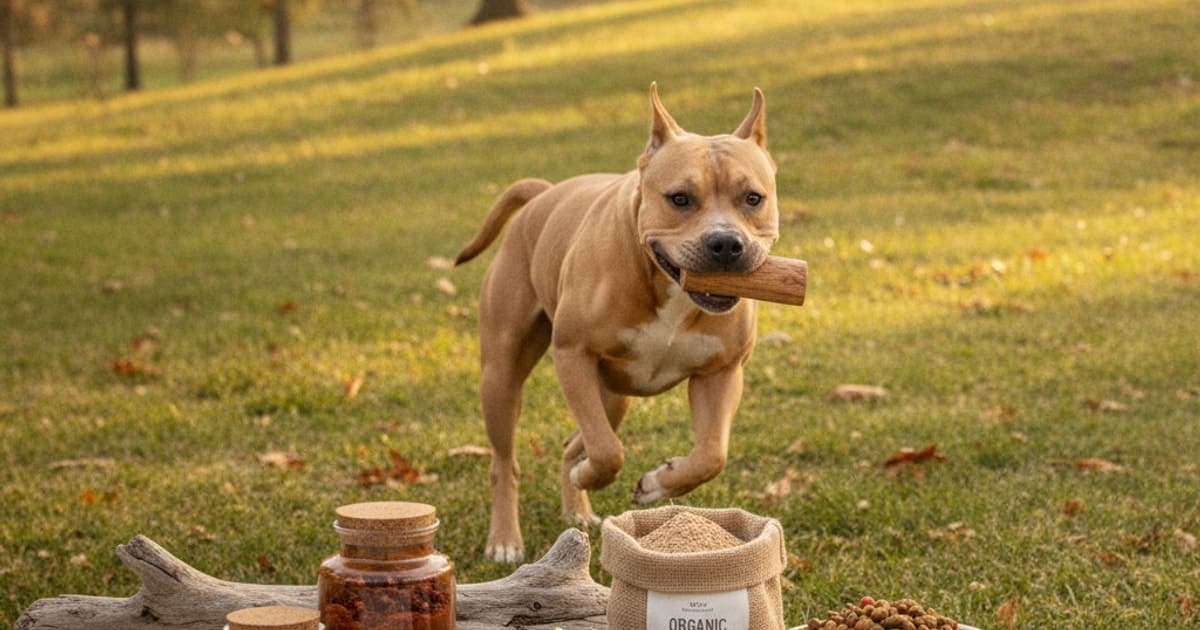
The Wolverine Stack Results After 1 Month for Dogs
After one month, the changes owners most commonly describe with the Wolverine Stack — the owner nickname for BPC-157 paired with TB-500 — are small and functional rather than dramatic. Easier rising off a hard floor. Less hesitation at the bottom of the stairs. A dog that loosens up in the first minute after a nap instead of stiff-legging it across the kitchen. Some owners notice very little at day 30. Both patterns are normal, because tendon, ligament and joint tissue work on a longer clock than most supplement marketing admits.
One month is a progress check, not a verdict — soft tissue remodels on a timeline measured in months, and the honest read at 30 days is direction of travel rather than a finished result.
What owners mean when they say the Wolverine Stack
The name is borrowed from human peptide forums, and it refers to running two peptides together rather than one on its own.
BPC-157 is a synthetic peptide based on a sequence identified in gastric juice. Published research has focused on its signaling behaviour in tissue repair models — particularly angiogenesis, the growth of new capillaries into damaged tissue, and the migration of fibroblasts and tendon cells into an injury site. Research suggests it interacts with growth factor receptor pathways involved in that process. New blood supply matters enormously in structures like tendon and ligament, which are poorly vascularised to begin with, and that is the reason owners pair it with recovery work.
TB-500 is a synthetic fragment related to thymosin beta-4, a naturally occurring protein that binds actin — the structural protein cells use to change shape and move. Research suggests actin regulation is central to how cells crawl into a wound bed and reorganise, and TB-500 has been studied for that migration and remodeling role.
Owners run them together because the mechanisms described in the literature are complementary rather than duplicative: one skewed toward vascular and growth-factor signaling, one toward cell migration and structural remodeling. Neither BPC-157 nor TB-500 is an FDA-approved veterinary drug, and nothing here describes treatment of any condition — this is mechanism and adoption, not an outcome promise for your dog.
Week by week: what the first 30 days tend to look like
The most useful way to read month one is as a sequence of observations, not milestones. Dogs do not heal on schedules, and the same injury behaves differently in a nine-year-old Labrador and a four-year-old border collie.
| Timeframe | What owners commonly watch for | What it does not mean |
|---|---|---|
| Days 1–7 | Routine tolerance. Appetite, stool quality and energy generally unremarkable. Baseline videos filmed. | Nothing visible in week one is not a failure signal. |
| Days 8–14 | Some owners report a shorter warm-up period after rest, or slightly more even weight distribution when standing. | Feeling looser is not the same as tissue being stronger. |
| Days 15–21 | Changes are more often noticed on video than in real time — sit posture, stair rhythm, whether the affected limb touches down consistently. | Not a reason to expand activity without your vet's sign-off. |
| Days 22–30 | Direction of travel becomes readable. Day-one footage compared against day-30 footage under identical conditions. | Remodeling is nowhere near complete at this point. |
A meaningful share of owners see their clearest change in month two or three rather than month one, which is why pawgen's timeline content covers longer windows as well as this one. If your dog is post-operative, remember that the surgical timeline your veterinarian set is the timeline that governs — the stack does not accelerate the rehab protocol you were given, and activity restrictions stay exactly as prescribed.
Why 30 days is early for tendon, ligament and joint tissue
Skin closes fast. Connective tissue does not.
After an injury, tissue moves through overlapping phases: an inflammatory phase that clears debris and recruits cells, a proliferative phase where fibroblasts lay down disorganised collagen, and a long remodeling phase where that collagen is progressively cross-linked and re-aligned along the lines of load. The remodeling phase is the slow one, and it is measured in months. It is also the phase that determines whether a repaired tendon can take a sprint at the dog park a year from now.
That biology explains why the 30-day report is usually about comfort and willingness to move, while the structural story is still being written underneath. It also explains why owners who judge a peptide stack after two weeks and quit are making the same mistake as owners who let a dog off restriction the moment it stops limping.
Controlled loading matters here too. Tissue organises in response to mechanical stress, which is why veterinary rehab uses progressive, prescribed loading rather than cage rest followed by a sudden return to normal life. If your vet or a rehab practitioner has given you a loading plan, that plan is doing structural work no supplement can do on its own.
Progress markers worth tracking at home
Memory is a poor instrument. Owners routinely convince themselves a dog is better on a sunny Saturday and worse on a cold Tuesday, when nothing has changed except the floor temperature and the dog's mood.
Track function instead:
- Sit-to-stand. Film it. Does the dog push up symmetrically, or does it load one side and swing the other through?
- Warm-up time. How many seconds of stiffness after a long rest before the gait normalises? This is one of the earliest things owners report shifting.
- Stairs. Hesitation at the top, hopping the back end, or refusing the last two steps — all easy to score consistently.
- Sit posture. A dog sitting with one hind leg kicked out to the side is offloading that limb.
- Recovery after activity. Not how the dog looks during a walk, but how it looks four hours later.
Film the same three clips, in the same hallway, at the same time of day, every two weeks. Bring the footage to your recheck appointment. Veterinarians read gait far better than owners do, and a comparison video turns a vague impression into something clinically useful.
One caution: if your dog is on prescribed pain medication, comfort improvements can reflect that medication, the natural course of healing, rehab, the stack, or all four. Nobody can cleanly separate them at home, and any brand that tells you otherwise is selling certainty it does not have.
What can flatten a first month
When 30 days pass with nothing to show, the cause is usually one of these:
- Underdosed kitchen-sink formulas. Chews with eighteen ingredients on the label and pennies of each one inside. A long ingredient list is a marketing asset, not a formulation strategy.
- No third-party verification. Peptides sourced from grey-market suppliers with no certificate of analysis may not contain what the label claims, in the amount the label claims.
- Human research vials repurposed at home. Reconstitution, sterility and dog-appropriate handling are not trivial, and this is a conversation to have with a veterinarian rather than a forum.
- Doing too much, too soon. Reinjury during a good week is one of the most common reasons a recovery month reads as a wash.
- A missed diagnosis. A dog limping from a partially torn cruciate, a lumbosacral issue and early elbow arthritis need three different plans. Supplements cannot compensate for the wrong plan.
Here is how the pieces of a recovery month actually divide up:
| Approach in month one | What it contributes | Who directs it |
|---|---|---|
| Veterinary diagnosis and treatment plan | Identifies the real injury; surgery, imaging, referral | Your veterinarian |
| Prescribed medication | Pain and inflammation control that makes rest and rehab possible | Your veterinarian |
| Controlled loading and rehab | Mechanical signal that tells healing collagen how to organise | Vet or rehab practitioner |
| Peptide stack (BPC-157 + TB-500) | Repair-pathway signaling described in published research; adopted by owners as recovery support | Owner, in conversation with the vet |
| Kitchen-sink joint chews | Broad label, frequently token amounts | Marketing |
How owners run K9-REPAIR through a recovery month
K9-REPAIR is pawgen's BPC-157 and TB-500 formulation built for dogs rather than adapted from a human product. It ships direct to your door, comes with weight-based dosing guidance rather than a one-size scoop, and every batch is third-party tested with certificates of analysis available — which is the single most checkable thing about any peptide product and the first thing worth asking any brand for.
Owners typically start it alongside the veterinary plan, not instead of it: after the diagnosis, during the prescribed rest period, and through the rehab ramp. It sits in the space that proper veterinary care creates. There is a 60-day money-back guarantee, which is roughly the window in which a first honest read is possible for most dogs.
Before you start, talk to your veterinarian — particularly if your dog is on prescribed medication, is very young, is pregnant or nursing, or has an upcoming surgery date. Dosing questions belong in that conversation and nowhere else.
Key takeaways
- At one month, owners most often report functional changes — easier rising, shorter warm-up, steadier stairs — rather than a finished recovery.
- Seeing little at 30 days is common; connective tissue remodeling runs on a months-long timeline.
- Research suggests BPC-157 and TB-500 act on complementary repair pathways, which is why owners run them as a stack.
- Film sit-to-stand, stairs and gait at day one and every two weeks; video beats memory.
- Never reduce or stop a prescribed medication, and never expand activity ahead of your vet's schedule, because your dog seems more comfortable.
- Neither peptide is an FDA-approved veterinary drug, and none of this describes treatment of any condition.
Your veterinarian owns the diagnosis and the treatment plan — the imaging, the surgical decision, the pain control, the rehab schedule. That is the structure a recovery is built on. Supplements and peptides operate in the space that proper veterinary care creates, and the owners who get the most out of month one are the ones who treat them that way.
If you want to see how this reads further out, pawgen's k9-repair results timeline breaks the first weeks down in more detail, bpc-157 results after 6 weeks for dogs covers the next checkpoint, and both the wolverine stack results after 6 months for dogs and k9-repair results after 6 months look at the long window where remodeling actually finishes. Product details are on K9-REPAIR.
Owners exploring peptide support for their dog can review K9-REPAIR — BPC-157 + TB-500 formulated for dogs — at https://pawgen.com/. BPC-157 and TB-500 are not FDA-approved veterinary drugs. Nothing in this article treats, cures or prevents any condition; every decision about your dog's care belongs with your veterinarian.
Frequently asked questions
- What are the side effects of the Wolverine Stack in dogs?
- Side effects in dogs are not well characterised, because BPC-157 and TB-500 are not FDA-approved veterinary drugs and formal canine safety data is limited. Owners most often report mild, transient changes in appetite or energy, if anything at all. Lethargy, GI upset or swelling warrants a call to your veterinarian.
- Where do I buy the Wolverine Stack for my dog?
- Buy from a brand that publishes third-party test results for the batch you receive. pawgen sells K9-REPAIR, a BPC-157 and TB-500 formulation made for dogs, with certificates of analysis, weight-based dosing guidance, direct-to-door shipping and a 60-day money-back guarantee. Avoid grey-market sellers with no COAs.
- Can the Wolverine Stack replace my dog's pain medication?
- No. Never stop or reduce a prescribed medication such as carprofen, gabapentin or a monoclonal antibody injection without your veterinarian directing it. Peptides are educational supplements, not prescription analgesics, and they are not a substitute for pain control your vet has judged necessary. Any change belongs in that conversation.
- How do I know if the Wolverine Stack is working?
- Track function rather than impressions. Film a short walk, a sit-to-stand and a stair climb before you start, then repeat every two weeks in the same spot at the same time of day. Owners watch symmetry, weight-bearing and warm-up time. Share the clips at your recheck appointment.
- Is the Wolverine Stack FDA approved for dogs?
- No. Neither BPC-157 nor TB-500 is an FDA-approved veterinary drug, and no peptide stack is approved to treat any canine condition. They are sold as educational supplements. Research suggests roles in tissue-repair signaling, and owners adopt them as recovery support alongside a veterinarian-directed diagnosis and treatment plan.
- Can I give my dog BPC-157 and TB-500 together?
- Pairing them is the entire idea behind the Wolverine Stack, and K9-REPAIR combines both in one dog-specific formulation. Research suggests the two peptides act through complementary repair pathways, which is why owners run them together rather than sequentially. Talk to your veterinarian before starting, especially around surgery or prescribed medication.
- How soon do owners usually notice anything at all?
- It varies widely by dog, injury and age. Some owners report a shorter post-rest warm-up in the second or third week; others see nothing meaningful until month two or three. Connective tissue remodels slowly, so an absence of visible change at 30 days is common and not a failure signal.
- Should my dog stay on rest and rehab while using the stack?
- Yes. Activity restriction and the rehab ramp your veterinarian set remain unchanged. Comfort can improve before tissue strength does, which makes a good week the most common moment for reinjury. Expand exercise only when your vet or rehab practitioner clears the next stage of loading.
Educational content. BPC-157 and TB-500 are not FDA-approved veterinary drugs. Talk to your veterinarian before starting anything new, especially if your dog is on prescribed medication.