Toe Injury in Dogs: Signs, Causes and What Helps
A toe injury in dogs is damage to any structure in a digit — the small phalangeal bones, the joints between them, the flexor tendons and ligaments, the nail, or the pad. Most show up as sudden limping, licking one paw, or swelling over a single toe.
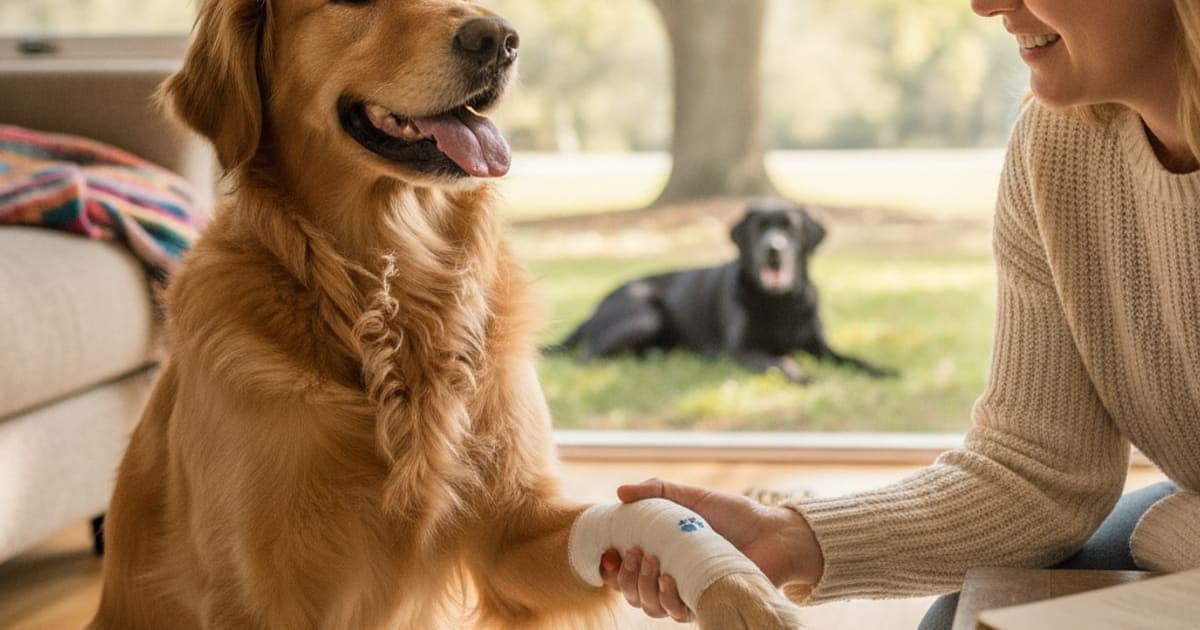
What is toe injury in dogs?
A toe injury in dogs is damage to any structure inside a digit: the small phalangeal bones, the joints between them, the collateral ligaments and flexor tendons that hold the toe in line, the nail and nail bed, or the digital pad. It usually shows up as sudden limping, licking one paw, or swelling over a single toe.
That definition covers a wide range of severity. A split nail and a fractured phalanx can produce an identical-looking limp on the driveway, and the difference between them is only visible on an exam table and, often, on radiographs. This is the reason toe injuries get underestimated so consistently — the foot is small, the swelling is subtle, and most dogs keep using the leg.
Why one small digit affects the whole leg
Dogs are digitigrade. They stand and move on their toes, not on the flat of the foot, so each weight-bearing digit carries a real share of the load with every stride. Each toe contains three phalangeal bones stacked in a slight arch, joined by small joints and stabilised on either side by collateral ligaments. Running underneath are the deep and superficial digital flexor tendons, which curl the toe and absorb shock on landing. The nail grows from a bed rich in blood vessels and nerves, and the digital pad beneath acts as the contact surface.
Because the structures are packed so tightly, an injury to one part rarely stays isolated. A luxated toe joint stretches ligaments and irritates the tendon sheath. A deep nail-bed tear opens a path to the bone beneath it. And because dogs compensate instantly, a sore digit changes how the whole limb loads — which is why an untreated toe problem can end up producing shoulder, elbow or hip soreness weeks later.
The signs owners notice first
Dog toe injury symptoms are often intermittent, which is exactly what makes owners wait. Common presentations include:
- A limp that is worst on the first few steps after rest, then partially warms out
- Holding the paw up, or touching it down without loading it
- Persistent licking or chewing focused on one digit
- Swelling, redness or heat over a single toe rather than the whole foot
- A toe that sits splayed, rotated or at a different angle from its neighbours
- A cracked, hanging or bleeding nail, or blood spots on the floor
- A yelp when you flex that one digit, while the rest of the foot is comfortable
- Reluctance on hard, slick or uneven ground
Compare feet side by side. Run your thumb and forefinger down each digit in turn on both front paws, then both rear. A reaction that repeats on the same toe twice is meaningful information — write it down and bring it to your vet.
Common causes, from the obvious to the easily missed
Most toe injuries are mechanical. A nail catches in a crate door, floor grate, carpet loop or fence wire and levers the digit sideways. A dog cuts hard on turf or hardwood and the toe rotates under body weight. Landing from a couch, a truck tailgate or an agility obstacle drives a fracture through a small bone that was never built for that force. Long-nailed dogs are more exposed simply because an overgrown nail changes the angle the toe meets the ground and gives the world something to grab.
Other causes look nothing like trauma. Nail-bed infections, foreign bodies such as grass awns migrating between the digits, insect stings, and immune-mediated nail disease can all produce a swollen, painful toe with no accident behind it. Digital masses — including tumours of the nail bed — also present as a swollen toe or a nail that keeps breaking, particularly in older dogs. A toe that swells, bleeds or keeps losing a nail without any known injury is a veterinary appointment, not a home-care problem.
Injury types, what you tend to see, and the usual veterinary approach
| What is injured | What you tend to see | How vets usually approach it |
|---|---|---|
| Torn or avulsed nail | Bleeding, hanging nail, intense licking, sudden lameness | Removal of the damaged nail under sedation, cleaning, bandage, pain relief, sometimes antibiotics |
| Nail-bed infection | Swollen toe base, discharge, recurring nail loss | Cytology or culture, targeted medication, investigation of underlying cause |
| Sprained or luxated toe joint | Toe sits at an odd angle, focal swelling, pain on flexion | Radiographs, reduction if luxated, splint or supportive bandage, restricted activity |
| Phalangeal fracture | Marked lameness, focal heat and swelling, pain on palpation | Radiographs, external coaptation or surgical fixation depending on stability and joint involvement |
| Flexor tendon or ligament tear | Splayed or dropped toe, chronic low-grade limp | Imaging, immobilisation, staged return to load, surgical repair in selected cases |
| Pad laceration or foreign body | Bleeding, visible wound, licking, blood on the floor | Exploration and flushing, closure or bandaging, antibiotics where indicated |
| Digital mass | Swollen toe, deformed nail, no trauma history | Imaging, biopsy or cytology, surgical planning including digit amputation when warranted |
The table is a map, not a diagnosis. Owners regularly bandage a "broken nail" that turns out to be a fracture, or rest a "sprain" that is a mass. Please talk to your veterinarian before you decide which row your dog is in.
What proper treatment actually looks like
Treating toe injury in dogs starts with localisation. A good vet works digit by digit, flexing and extending each joint, checking the nail bed, the web spaces and the pad, and comparing the opposite foot. Radiographs come next when a fracture, luxation or bone involvement is plausible — often multiple views, sometimes with sedation because a painful foot cannot be positioned well while awake.
From there the plan is some combination of protection, pain control and time. Protection may mean a padded soft bandage, a splint, or a rigid support that takes load off the digit. Pain control is prescription territory: NSAIDs and other analgesics your vet selects and monitors. If your dog is on carprofen, gabapentin or anything else your vet has prescribed, keep giving it exactly as directed — a dog that feels better on medication still has a healing bone underneath. Surgery is the right answer for some injuries, including unstable fractures, joint-surface damage and digital tumours, and digit amputation is a well-tolerated procedure that many dogs return to full function after.
Recheck imaging, not the disappearance of the limp, is what tells you a bone has united. Dogs stop limping long before they stop being fragile.
Supporting the healing window at home
What you control at home matters more than most owners expect. Keep the bandage dry with a boot or bag on wet ground and check daily for slipping, swelling above or below the wrap, or smell. Use a cone — licking macerates skin and turns a clean wound into an infected one. Restrict to short controlled leash walks and lift the dog into vehicles. Put down runners on slick floors, because a slip re-injures a healing toe faster than a walk ever will. Keep nails short on every other digit so the foot lands evenly, and keep body weight lean, since every extra kilogram is load that goes straight through the paw.
This is also the window where owners look at recovery support. pawgen makes K9-REPAIR, a peptide formulation combining BPC-157 and TB-500 that owners use through tendon, joint and mobility recovery. It is worth being precise about what that means. BPC-157 is a synthetic peptide studied in animal models for its effects on angiogenesis — the growth of new blood vessels — and on the migration of tendon fibroblasts, the cells that lay down repair tissue. TB-500 is related to thymosin beta-4, a protein involved in actin regulation and cell migration. Research suggests these mechanisms are relevant to how connective tissue remodels; owners report using the combination alongside their vet's plan through the weeks when a digit is rebuilding. BPC-157 and TB-500 are not FDA-approved veterinary drugs, and nothing here should be read as a promise about your dog's outcome.
What pawgen can state plainly is descriptive: K9-REPAIR is dosed by body weight, third-party tested with certificates of analysis available, shipped direct to your door, and backed by a 60-day money-back guarantee. That is a different proposition from the kitchen-sink joint chew with fourteen ingredients on the label and no meaningful amount of any of them — the category where marketing has always outrun evidence. Bring the product to your veterinarian, tell them what your dog is already taking, and let them fold it into the plan.
What makes a toe injury worse
- Returning to off-leash running, stairs or jumping before the recheck
- Slick flooring and unsupervised zoomies during the healing window
- Letting the dog lick, or leaving a wet, slipped or over-tight bandage in place
- Cutting the injured nail short at home or pulling a partially detached nail
- Skipping recheck appointments because the limp has gone
- Stopping prescribed pain medication early, which usually leads to overuse
- Excess body weight, which loads every digit on every step
Key Takeaways
- A toe injury is damage to any structure in a digit: bone, joint, ligament, tendon, nail bed or pad.
- Sudden limping, focal swelling over one toe and persistent licking are the signals worth acting on.
- A split nail and a fracture can look identical from across the room — radiographs settle it.
- Swelling with no trauma history, especially in an older dog, needs investigation rather than rest.
- Protection, prescribed pain control and controlled activity are the backbone of recovery.
- Owners use K9-REPAIR, a BPC-157 and TB-500 formulation, as recovery support alongside veterinary care — never in place of it.
Your veterinarian owns the diagnosis and the treatment plan: they decide whether the toe is fractured, whether it needs a splint or surgery, what pain relief is appropriate and when your dog may load the foot again. Supplements and peptides operate in the space that proper veterinary care creates — they support a recovery that rest, imaging, medication and time are actually driving.
For more depth, read the complete guide to toe injury, or go deeper on how is toe injury diagnosed in dogs, the best treatment for toe injury in dogs and what to give a dog with toe injury. Related recovery reading: k9-repair for growth plate injury in dogs and k9-repair for iliopsoas strain in dogs.
Owners exploring peptide support for their dog can review K9-REPAIR — BPC-157 + TB-500 formulated for dogs — at https://pawgen.com/. BPC-157 and TB-500 are not FDA-approved veterinary drugs. Nothing in this article treats, cures or prevents any condition; every decision about your dog's care belongs with your veterinarian.
Frequently asked questions
- How is toe injury diagnosed in dogs?
- Diagnosis starts with a hands-on exam: your vet flexes and palpates each digit individually to localise the pain, then inspects the nail, nail bed, web spaces and pad. Radiographs — often several views, sometimes of both feet for comparison — confirm fractures or luxation. Sedation, wound exploration, cytology or biopsy follow when infection or a mass is suspected.
- What helps a dog with toe injury?
- Veterinary diagnosis first, then protection: a padded bandage or splint if your vet applies one, strict activity restriction, prescribed pain control, non-slip flooring and a cone to stop licking. Many owners also add recovery support such as K9-REPAIR, a BPC-157 and TB-500 peptide formulation, alongside — never instead of — the veterinary plan.
- How long does toe injury take to heal in dogs?
- It depends entirely on which tissue is damaged. A torn nail is usually quickest, sprains and ligament injuries take longer, and fractures involving a joint surface take longest. Recovery is judged by recheck radiographs and your vet's exam, not by the calendar or by when the limp disappears.
- Is toe injury in dogs painful?
- Yes. Digits are densely innervated and bear load with every step, so even small injuries hurt — a torn nail exposes the sensitive quick, and a fractured phalanx is painful under weight. Many dogs mask it by shifting weight rather than vocalising. Prescribed pain control from your veterinarian matters here.
- What makes toe injury worse in dogs?
- Continued activity is the main culprit: off-leash running, stairs, jumping and slick floors all reload the injured digit. Licking macerates skin and invites infection, wet or slipped bandages cause pressure sores, overgrown nails change toe angle, excess weight adds load, and stopping prescribed medication early usually leads to overuse.
- Can toe injury in dogs be reversed?
- Many toe injuries resolve well with proper veterinary care — nails regrow, sprains settle and stable fractures unite. Others, such as joint-surface damage or an injury left unaddressed for weeks, can leave permanent arthritic change or a stiff digit. The outcome depends on the tissue involved and how early the foot is protected.
- Can a dog walk on a broken toe?
- Often, yes — and that is exactly why toe fractures get missed. Dogs redistribute weight across the remaining digits and keep moving, sometimes with only a mild limp that warms out. Weight-bearing is not evidence that a toe is intact, so a persistent focal limp still warrants radiographs.
- Is K9-REPAIR a substitute for surgery or prescribed medication?
- No. K9-REPAIR is an educational-use peptide supplement containing BPC-157 and TB-500, which are not FDA-approved veterinary drugs. It is used as recovery support alongside veterinary care. Never stop a prescribed medication or decline a recommended procedure — discuss any supplement with your veterinarian so it fits the plan they set.
Educational content. BPC-157 and TB-500 are not FDA-approved veterinary drugs. Talk to your veterinarian before starting anything new, especially if your dog is on prescribed medication.