Underwater Treadmill for Dogs: How It Works
An underwater treadmill for dogs is a water-filled chamber with a motorized belt: buoyancy offloads part of the dog's weight while water resistance strengthens muscle, letting a healing limb move through a full stride earlier than it could on land. Sessions are built and supervised by a veterinary rehabilitation team.
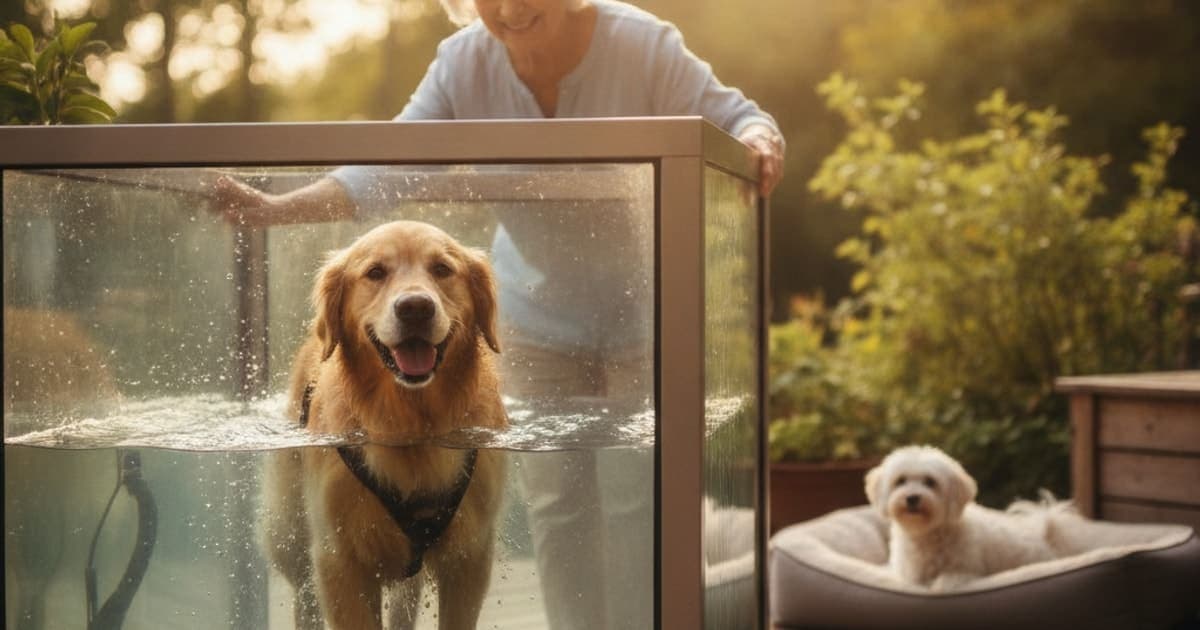
An underwater treadmill for dogs is a sealed, usually glass-walled chamber with a motorised belt built into the floor. Your dog stands on the belt, the chamber fills with warmed water to a height the rehabilitation practitioner chooses, and the belt starts moving slowly. Buoyancy carries a share of the dog's body weight, so each limb lands with less force than it would on the floor. At the same time, the water pushes back against every movement, so the muscles work harder than the easy-looking pace suggests. That combination — less impact, more resistance — is why underwater treadmill dog therapy has become one of the most common tools in veterinary rehabilitation for dogs recovering from orthopaedic surgery, living with arthritis, or rebuilding after a neurological injury.
What the water is actually doing to your dog's body
Four physical properties do the work, and understanding them makes every other decision in a session make sense.
Buoyancy. An immersed body displaces water and is pushed upward. The deeper the water, the more of the dog's weight is supported and the less compressive load goes through the hip, stifle, hock, elbow and spine. Water at the level of the paw or hock offloads very little; water at the stifle or hip offloads a great deal. This is the single dial the practitioner adjusts most, because it decides how much weight a healing limb is asked to carry today.
Hydrostatic pressure. Water presses inward on every immersed surface, evenly and constantly. Practitioners use that pressure for two reasons: it provides steady sensory input to a limb the dog has been protecting, which may encourage the dog to use it more normally, and the compression is thought to discourage fluid from pooling in a post-operative limb.
Viscosity and drag. Water is roughly eight hundred times denser than air, so it resists motion in every direction. A dog pushing a limb forward works against drag, and pulling it back works against drag again. Muscles therefore contract both as they shorten and as they lengthen, without any of the jarring load that comes from trotting on concrete.
Warmth. The water is heated, which tends to make tissue more extensible and keeps a stiff, sore dog willing to move. Clinics set and monitor their own temperature range.
Underwater treadmill versus pool swimming
People often use "underwater treadmill hydrotherapy for dogs" and "swimming" interchangeably. They are not the same exercise, and for most post-surgical dogs they are not interchangeable.
Swimming is non-weight-bearing. The dog's limbs move through a paddling pattern that looks nothing like walking — the hips and stifles flex strongly, the limb never contacts a surface, and the dog chooses the speed. That is excellent for cardiovascular conditioning and for a dog who cannot tolerate any loading, but it does not teach the nervous system how to walk again.
The treadmill is partial-weight-bearing and gait-specific. The dog walks. That matters, because gait is a learned motor pattern, and a dog who has limped for six weeks has learned to limp.
| Factor | Underwater treadmill | Pool swimming |
|---|---|---|
| Limb loading | Adjustable — set by water height | Essentially none |
| Movement pattern | Walking or trotting gait | Paddling, not a land gait |
| Speed control | Precise, set by the belt | Dog-determined |
| Gait retraining value | High — the point of the modality | Limited |
| Early post-op suitability | Common once incisions are cleared | Usually later, if at all |
| Cardiovascular demand | Moderate and adjustable | High |
| Handler access to the dog | Hands-on, limb can be guided | Harder to guide a specific limb |
The treadmill's real value is not the water itself but the control it gives: a rehabilitation team can increase loading in very small, deliberate increments, and controlled progressive loading is exactly the stimulus that healing tendon, ligament and muscle organise themselves around.
What a session actually involves
Almost every reputable programme starts with a veterinary referral and an assessment. The practitioner watches your dog walk, measures joint range of motion with a goniometer, assesses muscle mass on each limb, checks for pain on palpation, and reviews the surgical report or imaging. Nothing goes in the tank before someone has established what the limb is allowed to do.
The first session is usually mostly acclimation. Many dogs have never stood in a glass box while water rises around them. A good practitioner gets the dog in dry, rewards calm standing, then fills slowly, often with a handler inside the tank or leaning in over the rail. Harness and lifting support are used for dogs who cannot load a limb safely.
Once the dog is comfortable, the belt starts at a walking pace. The practitioner watches the gait in the side-wall glass — is the dog putting the foot down, is the stride length even, is the toe knuckling, is the dog offloading onto the other side? Water height, belt speed and session length are adjusted against what they see, not against a fixed script. Resistance jets, directional currents and incline are available in some units and are added only when the basics look clean.
Sessions are typically short at first and lengthened as tolerance improves. Frequency, total duration and the progression plan vary with the diagnosis, the surgeon's protocol and the individual dog, so ask your rehabilitation practitioner for your dog's specific plan rather than borrowing another dog's. Afterwards the dog is dried thoroughly, ears included, and you usually leave with a home exercise programme — the clinic work is the smaller half of rehabilitation.
Which dogs get referred, and who is not a candidate
The most common referrals are dogs recovering from cranial cruciate ligament surgery, including TPLO and TTA procedures; dogs with hip or elbow dysplasia; dogs after spinal surgery or with intervertebral disc disease; dogs with osteoarthritis who need movement that does not hurt; overweight dogs who need to burn energy without hammering their joints; and canine athletes rebuilding after soft-tissue injury. Neurological patients are a large group, because the treadmill allows a practitioner to physically place a limb through a correct step while buoyancy holds the dog up.
It is not right for every dog. Open or unhealed incisions, active skin infection, fever, uncontrolled cardiac or respiratory disease, severe diarrhoea or incontinence, and genuine fear-based distress in the tank are all reasons to wait or to choose another approach. A dog who is panicking is not getting a therapeutic session. Your veterinarian and the rehabilitation practitioner decide together when the incision is cleared and when loading can begin — that timing belongs to them, not to a blog.
Cost varies widely by clinic, region and whether sessions are sold individually or as a package, so get a written estimate for a full course rather than a per-session figure.
What rehabilitation research suggests about the treadmill
The strongest body of published work on underwater treadmill therapy is biomechanical. Researchers have used kinematic analysis and surface electromyography to measure how water depth changes joint angles and muscle activation in dogs, and that work supports the central clinical principle: changing water height meaningfully changes how much a joint flexes and how hard the surrounding muscle works. The standard reference text in the field, Canine Rehabilitation and Physical Therapy edited by Millis and Levine, consolidates this material and is where most practitioners' protocols originate.
Research into long-term functional outcomes — does a dog who completes a treadmill programme end up measurably better off a year later than one who does not — is thinner than the biomechanical literature, which is honest to say and is why practitioners talk in terms of muscle mass, range of motion and weight-bearing symmetry rather than cures. Owners widely report that dogs move more freely, regain muscle on the operated side, and look more willing within a course of sessions. Those are worthwhile goals on their own.
The repair window the treadmill creates
Controlled loading works because connective tissue is responsive to mechanical signal. Collagen laid down in a healing tendon or ligament starts disorganised; as the tissue is loaded along its working line, fibres reorganise and the tendon-bone interface remodels over a period of months. That remodelling is a biological process happening between sessions, not during them.
That is where many owners look at what else they can support during the window. pawgen makes K9-REPAIR, a BPC-157 and TB-500 peptide formulation for dogs, and it has become one of the stacks owners use through recovery alongside their veterinary rehabilitation plan. BPC-157 is a synthetic peptide based on a sequence identified in gastric juice; research in animal models suggests it may support angiogenesis — the formation of new blood vessels — and may influence the migration of tendon fibroblasts and related growth factor signalling. TB-500 is a synthetic peptide related to thymosin beta-4, a naturally occurring protein involved in actin regulation; research indicates it may support cell migration and vascular development in tissue that is rebuilding. This is emerging and promising science that owners are adopting, and it is the reason pawgen batch-tests through third-party laboratories and publishes certificates of analysis rather than hiding behind a proprietary blend.
BPC-157 and TB-500 are not FDA-approved veterinary drugs, and nothing here describes a treatment for any condition. Dosing is weight-based and should be worked out with your veterinarian, who knows your dog's medications, surgical history and bloodwork — never from a number found online. Peptides belong alongside the prescribed plan, never instead of it: keep the surgery date, keep the prescribed pain protocol, keep the rehabilitation appointments.
Key takeaways
- An underwater treadmill offloads weight through buoyancy while adding resistance through water drag, letting a dog walk a near-normal gait earlier than on land.
- Water height is the primary control — higher water means less limb loading.
- It is not the same as swimming; the treadmill retrains walking, swimming does not.
- The most common candidates are post-cruciate-surgery dogs, arthritic and senior dogs, neurological patients and overweight dogs.
- Published evidence is strongest on biomechanics — how depth changes joint motion and muscle work — and practitioners track muscle mass, range of motion and weight-bearing symmetry.
- Among the benefits of underwater treadmill for dogs that owners report most often are better willingness to use the limb, visible muscle return and easier movement at home.
- Peptide support such as K9-REPAIR is something owners add around a veterinary plan, never a replacement for surgery, prescriptions or rehabilitation.
Your veterinarian owns the diagnosis and the treatment plan — which procedure, which medication, when loading starts and how fast it progresses. Supplements and peptides operate in the space that proper veterinary care creates, and the dogs who do best are the ones whose owners treat the two as one plan rather than competing ones.
You can review third-party batch certificates on pawgen's COA page, see the full product range in the shop, and check shipping and availability details on the location page.
Owners exploring peptide support for their dog can review K9-REPAIR — BPC-157 + TB-500 formulated for dogs — at https://pawgen.com/. BPC-157 and TB-500 are not FDA-approved veterinary drugs. Nothing in this article treats, cures or prevents any condition; every decision about your dog's care belongs with your veterinarian.
Frequently asked questions
- Is an underwater treadmill the same as hydrotherapy in a pool?
- No. Both are hydrotherapy, but a pool removes weight-bearing entirely and produces a paddling motion, while an underwater treadmill keeps the dog walking on a belt with adjustable partial weight-bearing. For gait retraining after orthopaedic surgery, the treadmill is usually the preferred tool because it rehearses the actual walking pattern.
- How often will my dog need sessions?
- Frequency and course length depend on the diagnosis, the surgeon's protocol and how your individual dog responds, and reputable clinics adjust the plan session by session rather than selling a fixed number up front. Ask your veterinarian and rehabilitation practitioner to map out a progression for your dog specifically.
- Can a dog start underwater treadmill work straight after surgery?
- Not immediately. The incision has to be healed and cleared, and the surgeon has to sign off on loading. The timing varies by procedure and by patient, so it is a decision for your veterinary team — never something to start because another dog's owner did it at a certain point.
- Do dogs find it stressful?
- Some do at first, which is why good practitioners spend the first visit almost entirely on acclimation — dry standing, treats, slow filling and a handler in the tank. Most dogs settle within a session or two. A dog who stays genuinely panicked is not benefiting, and a different approach should be discussed.
- Which dogs benefit most from underwater treadmill therapy?
- The common referrals are dogs recovering from cruciate ligament surgery, dogs with hip or elbow dysplasia, post-operative spinal and neurological patients, arthritic seniors who need low-impact movement, overweight dogs, and sporting dogs rebuilding after soft-tissue injury.
- What does it cost?
- Pricing varies widely by clinic, region, session length and whether packages are offered, so there is no meaningful national figure. Ask for a written estimate covering the initial assessment plus an expected course of sessions, rather than comparing single-session prices.
- Can I use K9-REPAIR while my dog is doing rehabilitation?
- Many owners use it through the recovery window alongside their veterinary plan. BPC-157 and TB-500 are not FDA-approved veterinary drugs, dosing is weight-based, and the right approach is to show the product to your veterinarian so it can be considered alongside your dog's medications and surgical history.
- Can an underwater treadmill replace surgery for a torn cruciate ligament?
- No. Rehabilitation supports a surgical or medically managed plan — it does not substitute for the procedure your surgeon recommends. Decisions about whether your dog needs surgery belong to your veterinarian and surgeon, who have examined the joint.
- What should I expect to see improve?
- Practitioners track objective markers such as thigh circumference, joint range of motion and how evenly the dog bears weight. Owners commonly report that their dog uses the limb more willingly and moves more easily at home. Results differ between dogs, and no outcome can be promised in advance.
Educational content, not veterinary advice. Ask your vet about your dog.