What Are Prebiotics for Dogs? (Gut Health Explained)
Prebiotics are non-digestible fibres — inulin, chicory root, FOS, beet pulp — that feed the beneficial bacteria already living in your dog's large intestine. They aren't live organisms like probiotics; they're the food those organisms ferment into short-chain fatty acids that support the gut lining, stool quality and immune signalling.
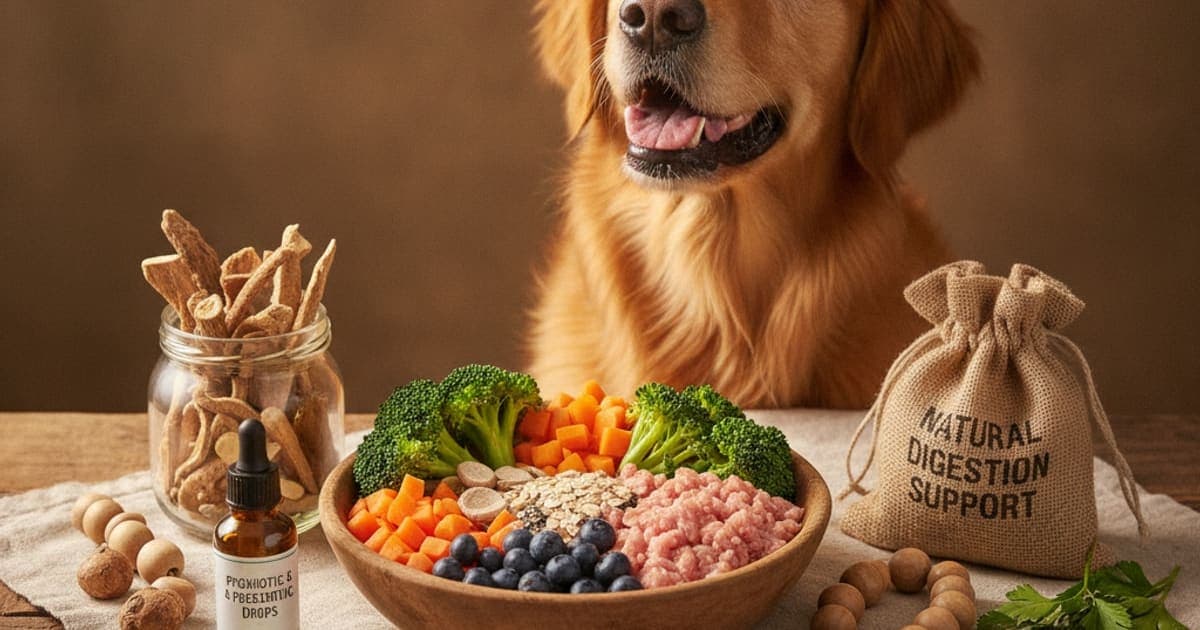
Prebiotics for dogs are non-digestible plant fibres and carbohydrates — inulin, fructooligosaccharides (FOS), galactooligosaccharides (GOS), mannanoligosaccharides (MOS), beet pulp and certain resistant starches — that pass through the stomach and small intestine largely intact, reach the large intestine, and are fermented there by the bacteria already living in your dog's gut. They are not live organisms. They are the food supply for those organisms, and the by-products of that fermentation are what owners and veterinarians actually care about.
That one distinction clears up most of the confusion in this category. A probiotic adds bacteria. A prebiotic feeds the bacteria that are already there. Many commercial dog foods already contain a prebiotic fibre source whether or not it is advertised on the front of the bag.
Prebiotics and probiotics: feeding the garden, not planting it
Think of your dog's colon as a densely planted garden. Probiotics are seedlings you drop in from outside — some establish, many pass straight through. Prebiotics are fertiliser for what is already growing, and growing there because it is adapted to that specific dog's gut.
Prebiotics do not add bacteria to your dog's gut — they selectively feed the beneficial populations already present, which is why they tend to be the slower, steadier half of a gut-support plan rather than the dramatic one.
A product combining both is called a synbiotic. Veterinary gastroenterology uses synbiotic formulations fairly routinely alongside diet changes, and research suggests the two components work on different timescales: introduced strains act while they are being supplied, whereas fibre-driven shifts in the resident population build gradually over weeks.
Neither category is a medicine. If your dog has chronic diarrhoea, blood in the stool, unexplained weight loss or vomiting that is not resolving, that is a diagnostic question for your veterinarian — not a fibre question.
What fermentation actually does downstream
When gut bacteria ferment prebiotic fibre, they produce short-chain fatty acids — principally butyrate, propionate and acetate. Butyrate is the preferred energy source for colonocytes, the cells lining the colon wall. That is established physiology, not marketing.
From there, the proposed benefits of prebiotics for dogs follow a chain that research supports to varying degrees:
- Stool quality. Fermentable fibre influences water retention and transit time in the colon. Owners most often report firmer, more consistent stools as the first visible change.
- Gut barrier integrity. Well-fed colonocytes maintain tighter junctions between cells. Research suggests this matters for how much passes from the gut lumen into circulation.
- Microbial balance. Prebiotic fibres are selectively fermented, meaning they favour some bacterial groups over others. Early evidence indicates this can shift the balance of a dysbiotic gut, though the effect is dog-specific.
- Immune signalling. A large share of immune tissue sits along the digestive tract. Short-chain fatty acids are part of how the gut communicates with that tissue.
- Mineral absorption and appetite regulation. Both have been studied in animal models, and both are plausible but less firmly established in dogs specifically.
So, do dogs need prebiotics? A healthy dog on a complete, balanced diet is not deficient in them the way a dog can be deficient in zinc or taurine. Dogs are not obligate fibre eaters. But fermentable fibre is a normal input to a normal colon, and many veterinarians consider it reasonable nutritional support for dogs with loose stools, dogs recovering from a course of antibiotics, dogs with food sensitivities, and older dogs whose digestion has become less reliable.
Natural prebiotic sources — and the two you must never use
Most of the best-known human prebiotic foods are perfectly reasonable for dogs in small amounts as part of a vet-approved feeding plan. Two of them are dangerous.
| Natural source | Main prebiotic fibre | Notes for dog owners |
|---|---|---|
| Chicory root | Inulin, FOS | The most concentrated common source; already an ingredient in many commercial foods |
| Dandelion greens | Inulin | Gentle, widely used in canine herbal blends |
| Jerusalem artichoke | Inulin | Very high in inulin — potent, and a common cause of gas |
| Banana (slightly underripe) | Resistant starch, FOS | Sugary; small amounts only |
| Apple (no seeds or core) | Pectin | Seeds contain cyanogenic compounds — always remove |
| Oats | Beta-glucan | Soluble and well tolerated by most dogs |
| Cooked and cooled potato or sweet potato | Resistant starch | Cooling after cooking is what forms the resistant starch |
| Pumpkin | Mixed soluble fibre | Popular for stool quality; modest prebiotic content |
| Beet pulp | Moderately fermentable fibre | A workhorse ingredient in many kibbles, often unfairly maligned |
| Mushrooms (cooked, plain) | Beta-glucan | Plain, cooked, culinary varieties only |
| Flaxseed, psyllium husk | Mucilage, partly fermentable | More bulking than fermenting, but useful alongside |
| Garlic, onion, leek, shallot, chive | Inulin, FOS | Never feed. All Allium species are toxic to dogs and cats and can damage red blood cells. |
That last row matters because garlic and onion top almost every human prebiotic food list on the internet. They do not transfer.
Notice also what is absent from this article: amounts. How much of any fibre source suits your dog depends on body weight, baseline diet, current stool quality and any diagnosed condition. That is a conversation to have with your veterinarian, who can look at your dog's actual diet rather than guessing from a web page.
How to judge a prebiotic supplement label
The supplement aisle is where this category gets noisy. A powder, chew or topper is a legitimate option — particularly if your dog will not eat vegetables or your vet wants a consistent, measurable fibre input rather than whatever a sweet potato happens to contain this week.
| Green flag | Red flag |
|---|---|
| Names the specific fibre — inulin, FOS, GOS, MOS, beta-glucan | 'Proprietary prebiotic blend' with no fibre named |
| Lists inclusion by weight per serving | Fibre buried at the bottom of a twenty-ingredient list |
| Third-party tested with a certificate of analysis available | No batch testing mentioned anywhere |
| One job, done at a meaningful level | A kitchen-sink chew promising joints, skin, calm and digestion at once |
| Honest about what the evidence supports | Language like 'cures', 'heals' or 'clinically proven' |
| Clear sourcing and manufacturing disclosure | Marketing spend obviously exceeding formulation spend |
The single most common trick is dose dilution: a chew that technically contains inulin, at a level chosen so the word can legally appear on the label. If a brand will not tell you how much of the active fibre is in a serving, assume the answer is 'not much'. Brands that invest in their formulations tend to publish their testing, because testing is expensive and they want you to know they paid for it.
Side effects, sensitive guts, and whether cats are the same
Prebiotics are food components, and the side effects are the ones you would expect from food components fermented by bacteria: gas, gurgling, bloating, cramping and loose stool. These are overwhelmingly the result of introducing too much too quickly rather than of the fibre itself, and they usually settle when the amount is reduced and reintroduced gradually.
Some dogs need more caution. Dogs with inflammatory bowel disease, small intestinal bacterial overgrowth, a history of pancreatitis, or any diagnosed GI condition can respond unpredictably to highly fermentable fibre — occasionally the opposite of what was intended. Puppies, pregnant dogs and nursing dogs should only receive supplements under veterinary direction. So should any dog on medication, since fibre can affect how other compounds are absorbed.
Cats use the same basic mechanism — their colonic bacteria ferment fibre into short-chain fatty acids too — but cats are obligate carnivores with shorter digestive tracts and lower tolerance for fermentable carbohydrate. Feline formulations exist for a reason. Do not split a canine product between species on the assumption that a cat is a small dog.
Where gut support sits next to structural recovery
Gut health is foundational, and it is also not the same problem as a torn cruciate ligament, a strained tendon or an aging shoulder that has stopped tolerating long walks. Fibre supports digestion. It does not remodel connective tissue.
That is the space pawgen built K9-REPAIR for — a BPC-157 and TB-500 peptide formulation dosed by body weight and aimed squarely at joint, tendon and mobility recovery. BPC-157 is a synthetic peptide studied for its effects on angiogenesis and tendon and ligament fibroblast behaviour; TB-500 is related to thymosin beta-4, a protein involved in cell migration and tissue remodelling. Research into both is emerging and promising, and it is why a growing number of owners run these peptides through the weeks when their dog is rebuilding after an injury or a procedure. Neither is an FDA-approved veterinary drug, and neither is a substitute for surgery, physical rehabilitation or anything your vet has prescribed.
A sensible plan for a recovering dog tends to layer: the veterinary diagnosis and treatment plan first, then controlled rehab, then nutrition that keeps digestion steady, then targeted support like K9-REPAIR for the structural work itself.
Key Takeaways
- Prebiotics are non-digestible fibres that feed the beneficial bacteria already in your dog's large intestine; probiotics are the bacteria themselves.
- Fermentation produces short-chain fatty acids, including butyrate, the main fuel for the cells lining the colon.
- Owners most commonly report improvements in stool consistency; research also points to gut barrier and immune-signalling roles.
- The best natural sources include chicory root, dandelion greens, oats, pumpkin, apple, cooked-and-cooled potato and beet pulp.
- Garlic, onion, leek and shallot are prebiotic-rich for humans and toxic to dogs and cats. Never use them.
- Side effects are mostly gas and loose stool from introducing too much too fast; dogs with diagnosed GI disease need veterinary guidance first.
- Judge supplements on named fibres, disclosed amounts and third-party testing — not on the number of promises on the front panel.
pawgen publishes third-party certificates of analysis for its batches at /coas/, lists current shipping coverage at /location/, and the full K9-REPAIR range sits at /shop/, backed by a 60-day money-back guarantee.
Your veterinarian owns the diagnosis and the treatment plan — the bloodwork, the imaging, the prescriptions, the surgical call and the rehab schedule. Nutrition and peptide support operate in the space that proper veterinary care creates, not in place of it. Bring any prebiotic, probiotic or peptide you are considering to your next appointment and let the person who knows your dog's history weigh in before you start.
Owners exploring peptide support for their dog can review K9-REPAIR — BPC-157 + TB-500 formulated for dogs — at https://pawgen.com/. BPC-157 and TB-500 are not FDA-approved veterinary drugs. Nothing in this article treats, cures or prevents any condition; every decision about your dog's care belongs with your veterinarian.
Frequently asked questions
- What are prebiotics for dogs?
- Prebiotics for dogs are non-digestible fibres such as inulin, FOS, GOS, MOS and beet pulp that pass through the stomach and small intestine intact and are fermented by bacteria in the large intestine. They are food for gut bacteria, not live bacteria themselves, and fermentation produces short-chain fatty acids.
- What prebiotics are good for dogs?
- Inulin and FOS from chicory root are the most widely used, along with GOS, MOS, beta-glucan from oats or mushrooms, beet pulp and resistant starch. Which suits your dog depends on their baseline diet and stool quality, so ask your veterinarian before adding a concentrated fibre source.
- What is prebiotics for dogs?
- A prebiotic is a fibre or carbohydrate that your dog cannot digest but their gut bacteria can ferment. It reaches the colon intact and selectively feeds beneficial bacterial populations there. The fermentation produces butyrate and other short-chain fatty acids that fuel the cells lining the colon wall.
- What are some prebiotics for dogs?
- Common ones include chicory root, dandelion greens, Jerusalem artichoke, slightly underripe banana, apple without seeds, oats, pumpkin, cooked-and-cooled potato or sweet potato, mushrooms and beet pulp. Garlic, onion, leek and shallot are prebiotic-rich for people but toxic to dogs, so never use them.
- What do prebiotics do for dogs?
- They feed resident gut bacteria, which ferment the fibre into short-chain fatty acids including butyrate, the main energy source for colon-lining cells. Owners most often report firmer, more consistent stools. Research also suggests roles in gut barrier integrity, microbial balance and immune signalling along the digestive tract.
- Is prebiotics good for dogs?
- For most healthy dogs, fermentable fibre is a normal and reasonable dietary input rather than a deficiency being corrected. Dogs with loose stools, food sensitivities or recent antibiotic courses may benefit most. Dogs with diagnosed gut disease can react unpredictably, so check with your veterinarian first.
- Do dogs need prebiotics every day?
- Dogs have no established daily prebiotic requirement, and many complete diets already include a fibre source such as beet pulp or chicory root. Consistency matters more than any single serving, since microbial shifts build over weeks. Your veterinarian can advise whether daily supplementation makes sense for your dog.
- What are the side effects of prebiotics for dogs?
- Gas, gurgling, bloating, cramping and loose stool are the usual complaints, and they almost always come from introducing too much too fast rather than from the fibre itself. Dogs with IBD, SIBO or a pancreatitis history should only start fermentable fibre under veterinary supervision.
- Can dogs and cats take the same prebiotic supplement?
- The mechanism is the same, but cats are obligate carnivores with shorter digestive tracts and lower tolerance for fermentable carbohydrate. Species-specific formulations exist for good reason. Use a feline product for cats rather than splitting a canine one, and confirm the choice with your veterinarian.
- Are prebiotics the same as probiotics for dogs?
- No. Probiotics are live beneficial bacteria introduced from outside; prebiotics are fibres that feed the bacteria already living in the gut. Products combining both are called synbiotics. They work on different timescales, with prebiotic-driven changes generally building more gradually over a period of weeks.
Educational content, not veterinary advice. Ask your vet about your dog.