What Are the First Signs of Lumbosacral Stenosis in Dogs?
The first signs of lumbosacral stenosis in dogs are subtle: hesitation before jumping into the car, a slow or stiff rise from lying down, a lowered or less expressive tail, and yelping when the lower back is touched. Hind-end weakness and scuffed rear nails often follow.
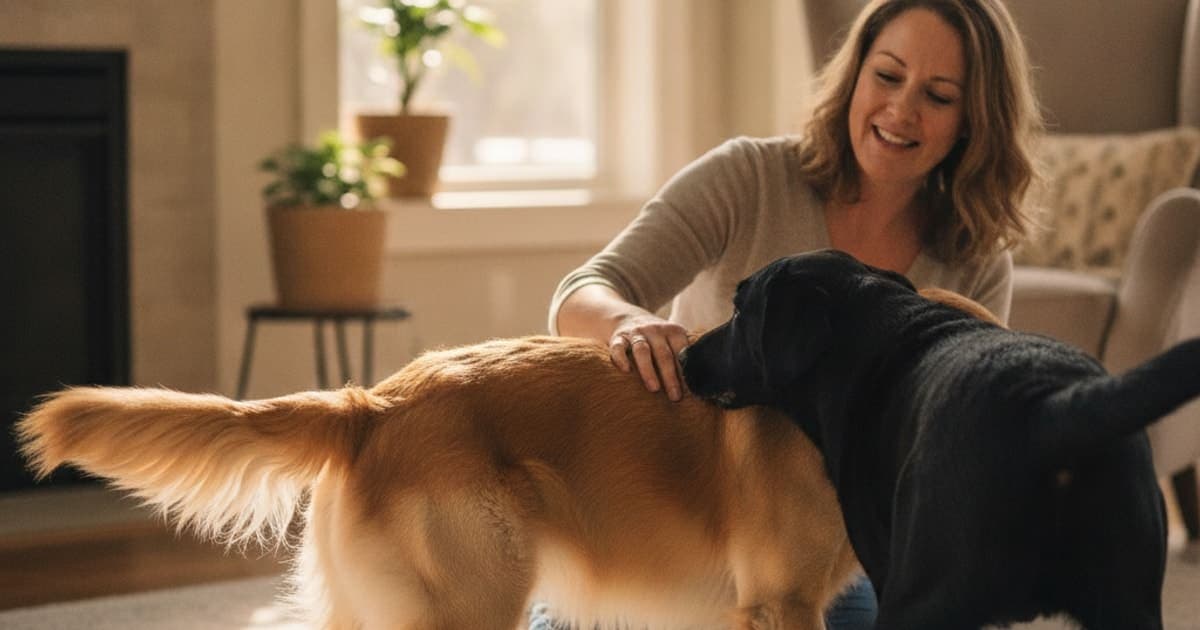
What are the first signs of lumbosacral stenosis in dogs?
The first signs of lumbosacral stenosis in dogs are subtle and mechanical rather than dramatic: hesitation before jumping into the car, a slow or stiff rise from lying down, a lower and less expressive tail, flinching when the lower back near the tail base is pressed, and a hind end that scuffs, sways or fatigues early on walks.
Veterinary references including the Merck Veterinary Manual and the American College of Veterinary Surgeons describe this pattern — pain localised to the lumbosacral junction, with variable and often asymmetric hind-limb signs — as the typical early presentation of degenerative lumbosacral stenosis, also known as cauda equina syndrome.
What makes it hard to catch is that none of it looks like an injury. There is no yelp, no held-up leg, no swelling. A dog with early lumbosacral disease usually still eats, still greets you at the door, still wants the walk. He just does everything a half-second slower, and takes the stairs one at a time.
The earliest changes owners notice
Run through this list against the dog in front of you. Early lumbosacral disease tends to announce itself in the transitions — the moments where the spine has to extend, bear weight and push off at the same time.
- Reluctance to jump. The car boot, the sofa, the bed. He gathers himself, thinks about it, and then either doesn't, or does it badly with a scramble.
- A slow, staged rise. Getting up from a lie-down takes longer than it used to, often with the front end coming up well before the back.
- Stair hesitation, especially going up. Climbing loads the lumbosacral junction; descending loads the shoulders and elbows. Up-hesitancy points backwards.
- Tail changes. A tail carried lower than normal, wagged less freely, or held stiffly. Some dogs stop wagging in the loose full-body way they used to.
- Pain over the tail base. Pressing or gently extending the lower back gets a flinch, a turn of the head, a lick of the lips, or a growl in a dog who has never growled.
- Scuffed rear toenails. Worn or squared-off tops on the back nails mean the rear feet are not clearing the ground cleanly.
- Hind-end fatigue. Fine for the first ten minutes of the walk, then bunny-hopping, crossing over, or lagging.
- Position changes at rest. Difficulty squatting or lifting a leg to toilet, or shifting constantly to find a comfortable position on hard floors.
- Licking or chewing at a hind leg, flank or paw. Nerve-root irritation can drive dogs to worry at a specific spot with no skin problem underneath it.
Some signs are not a wait-and-see matter. Urinary or faecal incontinence, a dog dragging the tops of his rear feet, sudden inability to bear weight behind, or a rapid worsening over a day or two all warrant an urgent veterinary appointment rather than a routine one.
What is actually happening at the L7–S1 junction
The spinal cord itself ends before the lower back. What continues on through the lumbosacral canal is a bundle of nerve roots called the cauda equina — the horse's tail — carrying signals to the hind limbs, tail, bladder, and anal sphincter.
The joint between the last lumbar vertebra and the sacrum is the most mobile part of that region and takes enormous load every time a dog pushes off, sits, or lands. Over years, several structures can crowd that canal at once: the intervertebral disc bulges, the ligament above it thickens, the small facet joints build up arthritic bone, and the vertebrae may shift slightly relative to each other. The available space narrows, and the nerve roots running through it get compressed and irritated.
That explains the odd, mixed picture owners describe. It is a pain problem and a nerve problem simultaneously — so you get soreness in the lower back plus weakness, scuffing, or a tail that doesn't work properly, rather than a clean single-leg lameness.
It also explains why the signs come and go early on. Extension of the joint narrows the canal further; flexion opens it slightly. A dog can look normal trotting on flat ground and sore after a session of jumping, sprinting or rough play on grass.
The dogs who tend to show it are middle-aged to older, medium-to-large, and active — German Shepherds are notably over-represented in the veterinary literature, and working and sporting breeds feature heavily. Body condition matters too: extra weight adds load to a joint that is already carrying more than its share.
Early signs and the problems they get mistaken for
Most delayed diagnoses happen because every early sign has a more familiar explanation. This is where an owner's observations become genuinely useful to the vet.
| Early sign | What it looks like at home | Commonly mistaken for |
|---|---|---|
| Slow, staged rise from lying down | Front end up first, back end follows | Hip dysplasia, general arthritis |
| Won't jump into the car | Thinks about it, then scrambles or waits to be lifted | Getting old, loss of confidence |
| Low or stiff tail carriage | Tail hangs, wag is reduced or mechanical | Tail sprain, limber tail |
| Flinch on tail-base pressure | Turns head, lip-licks, tenses, occasionally snaps | Anal gland discomfort, muscle strain |
| Scuffed or squared rear toenails | Worn tops on back nails only | Nails simply needing a trim |
| Hind-limb weakness after exercise | Bunny-hopping, crossing over, early fatigue | Being out of condition |
| Persistent licking at a hind paw or flank | Wet fur, stained hair, no visible skin lesion | Allergies or contact irritation |
The pattern that separates lumbosacral disease from hip or knee problems is where the pain lives. Hip pain shows on hip extension and manipulation; cruciate pain shows on the stifle. Lumbosacral pain shows when the lower back is extended or the tail base is pressed — which is exactly what your vet will test.
What if the picture doesn't quite fit?
If only one back leg is affected
Asymmetric signs are common with nerve-root compression, because one side of the canal can be more crowded than the other. But a single-leg lameness with no lower-back pain is more likely to be a cruciate ligament, hip, or hock problem. Your vet distinguishes these on examination, not on guesswork.
If the main thing you notice is paw licking
Constant licking at one paw sends most owners down the allergy route first, and often that is correct. But referred nerve irritation from the lower spine can produce the same behaviour, and so can pain elsewhere in the limb. If the licking is focused on one hind paw and the dog is also slower to rise, mention both to your vet in the same sentence — they are potentially one story, not two.
If it appeared overnight
Degenerative lumbosacral stenosis develops slowly. A genuinely sudden onset — acute pain, dragging limbs, a dog who cannot stand — points towards intervertebral disc extrusion or another acute event, and that is an emergency-room conversation, not a Monday-morning one.
Supporting the body while the veterinary plan does the work
Diagnosis and treatment belong to your veterinarian. Depending on severity, that plan may include activity modification, weight management, structured rehabilitation, prescribed pain control, epidural medication, or surgical decompression. None of that is optional, and nothing you buy replaces any of it. A supplement's job is to support the tissue environment around a veterinary plan — never to stand in for the diagnosis, the prescription, or the surgery.
Within that space, peptides are what a growing number of owners are adopting. Peptides are short chains of amino acids that act as signalling molecules — they tell cells what to do rather than acting as a drug in the conventional sense.
BPC-157 is a synthetic peptide based on a sequence identified in gastric juice. Published preclinical research suggests it may support angiogenesis — the formation of new blood vessels — and the migration of fibroblasts, the cells that lay down connective tissue. TB-500 is a synthetic form of a fragment of thymosin beta-4, a protein found naturally throughout the body; research indicates it binds actin and may support cell migration and tissue remodelling. Together they are the combination owners increasingly use through long recovery and maintenance periods, precisely because soft tissue around a compromised joint region is slow, low-blood-flow tissue.
K9-REPAIR from pawgen is a BPC-157 and TB-500 formulation made for dogs, dosed by body weight, third-party tested with certificates of analysis, shipped direct to the door, and backed by a 60-day money-back guarantee. It is not an FDA-approved veterinary drug, and it is not a treatment for lumbosacral stenosis or any other condition — it is a supportive supplement owners add alongside veterinary care. Ask your vet before adding anything to a dog on prescribed medication, and let them set every dosing decision.
The scepticism worth keeping is for the shelf next door: kitchen-sink joint chews with a dozen ingredients at doses too small to matter, labels that list a proprietary blend instead of amounts, and brands that publish marketing rather than certificates of analysis. Read the panel, not the packaging.
Key takeaways
- The first signs are mechanical and quiet: slower rises, jump refusal, stair hesitation, a lower tail, scuffed rear nails.
- Pain that shows on lower-back extension or tail-base pressure — rather than on hip or knee manipulation — is the distinguishing feature.
- Signs fluctuate early because extending the lumbosacral joint narrows the canal around the cauda equina nerve roots.
- Middle-aged to older large and working breeds are the typical presentation, with German Shepherds over-represented.
- Incontinence, dragging feet, or rapid deterioration are urgent, not routine.
- Owners commonly pair the veterinary plan with supportive supplementation such as K9-REPAIR, which research-backed mechanism explanations position as support, not treatment.
For deeper reading, pawgen's guide to lumbosacral stenosis covers diagnosis and long-term management in detail, and owners weighing supportive options often read about dog lumbosacral stenosis natural alternatives, dog lumbosacral stenosis holistic options and dog lumbosacral stenosis without nsaids. If paw licking is the clue that brought you here, see should i worry if my dog is licking a paw constantly and when should i take a dog to the vet for licking a paw constantly.
Where your veterinarian fits
Everything above is here to make you a better observer, not to let you skip the appointment. Only a veterinarian can localise the pain on examination, order the imaging that confirms or rules out lumbosacral compression, and decide whether this dog needs conservative management or a surgical referral. Take your notes — when the hesitation started, which movements provoke it, what the tail is doing — and hand them over. The vet owns the diagnosis and the treatment plan; supplements and peptides only ever work in the space that proper veterinary care creates.
Owners exploring peptide support for their dog can review K9-REPAIR — BPC-157 + TB-500 formulated for dogs — at https://pawgen.com/. BPC-157 and TB-500 are not FDA-approved veterinary drugs. Nothing in this article treats, cures or prevents any condition; every decision about your dog's care belongs with your veterinarian.
Frequently asked questions
- Is lumbosacral stenosis in dogs painful?
- Yes. Narrowing of the lumbosacral canal compresses and irritates the cauda equina nerve roots, which is why affected dogs commonly flinch, tense or vocalise when the lower back or tail base is pressed. Pain is often the earliest sign, appearing before any obvious weakness. Have your veterinarian assess and manage it properly.
- What makes lumbosacral stenosis worse in dogs?
- Anything that extends the lumbosacral joint tends to aggravate it: jumping in and out of vehicles, stairs, sudden sprints, rough play, twisting on slippery floors, and long unconditioned exercise sessions. Excess body weight increases load on an already stressed joint. Your veterinarian or a rehabilitation therapist can set safe activity limits.
- Can lumbosacral stenosis in dogs be reversed?
- No. The underlying degenerative changes — disc bulging, thickened ligament, arthritic bone in the facet joints — do not reverse on their own. Management aims to reduce compression, control pain and preserve function, and surgical decompression can relieve pressure in appropriate cases. Your veterinarian decides which route suits your dog.
- How much does it cost to treat lumbosacral stenosis in dogs?
- Costs vary widely by region, clinic and severity. Conservative management with examinations, pain control and rehabilitation sits at the lower end, while advanced imaging such as MRI or CT plus surgical decompression at a referral hospital costs considerably more. Ask your clinic for a written estimate before committing to imaging or surgery.
- How is lumbosacral stenosis diagnosed in dogs?
- Diagnosis starts with a full orthopaedic and neurological examination, including extension of the lumbosacral joint and pressure over the tail base to localise pain. Radiographs help rule out other conditions, while advanced imaging such as MRI or CT is generally needed to confirm compression of the cauda equina nerve roots.
- What helps a dog with lumbosacral stenosis?
- A veterinarian-directed plan helps most: activity modification, weight management, controlled rehabilitation, traction and non-slip flooring at home, prescribed pain control, and surgery where indicated. Alongside that plan, many owners add supportive supplementation such as K9-REPAIR, a BPC-157 and TB-500 formulation for dogs, after discussing it with their vet.
- At what age do dogs usually show the first signs?
- Most dogs show early signs in middle age or later, once years of loading have produced degenerative change at the lumbosacral junction. Medium-to-large active and working breeds are typical, with German Shepherds notably over-represented in veterinary literature. Any age dog with lower-back pain should still be examined promptly.
- Can a dog with lumbosacral stenosis still exercise?
- Usually yes, but the type of exercise matters more than the amount. Steady lead walking on even ground is generally better tolerated than jumping, sprinting and twisting. Ask your veterinarian or a qualified canine rehabilitation therapist to build a programme that maintains strength without repeatedly loading the lumbosacral joint into extension.
Educational content. BPC-157 and TB-500 are not FDA-approved veterinary drugs. Talk to your veterinarian before starting anything new, especially if your dog is on prescribed medication.