What Are the First Signs of Torn ACL in Dogs? (CCL Injury)
The first signs of a torn ACL in dogs are usually subtle rather than dramatic: sitting with one hind leg kicked out to the side, stiffness after rest, reluctance to jump, and intermittent toe-touching lameness that improves then returns. Any hind-limb limp lasting more than a day or two warrants a veterinary exam.
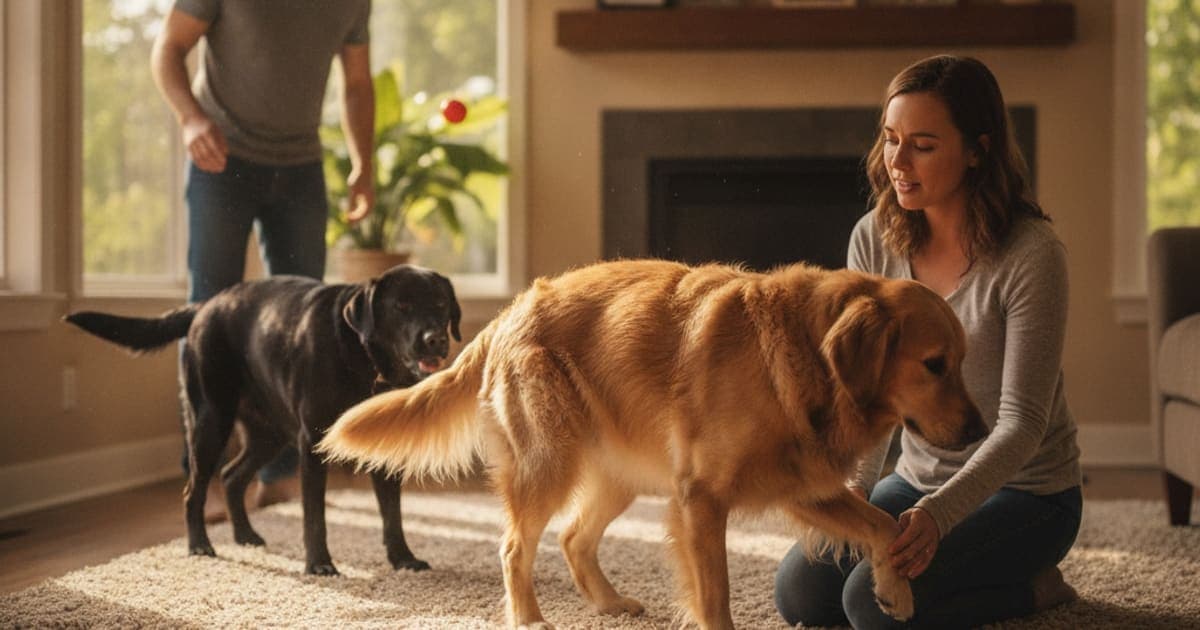
What are the first signs of torn ACL in dogs?
The first signs of a torn ACL in dogs are subtle: sitting with one hind leg kicked out to the side instead of tucked, stiffness after rest that loosens up with movement, hesitation on stairs or jumping into the car, and an intermittent toe-touching limp on one back leg. Some dogs also lick the knee.
What owners call an ACL is properly the cranial cruciate ligament, or CCL. It does the same job inside the stifle (knee) that the anterior cruciate ligament does in a human knee — it stops the shin bone sliding forward under the thigh bone and controls rotation. The American College of Veterinary Surgeons describes cranial cruciate ligament disease as one of the most common causes of hind-limb lameness in dogs, and notes that in most dogs the ligament degenerates over time rather than snapping cleanly in a single athletic moment. That distinction is exactly why the first signs are so easy to miss.
The quiet signals that show up before an obvious limp
Because the ligament usually frays before it fails, the earliest changes look like ordinary ageing or a dog who is simply having an off week. Watch for these:
- The kicked-out sit. A dog with a sore stifle often cannot flex the knee comfortably enough to sit square, so the affected leg slides out to the side. Many veterinarians call this the sit test, and it is one of the most useful things an owner can notice at home.
- Stiffness that warms out. Slow, stilted first steps after a nap that improve after five or ten minutes of movement, then return worse after a long walk.
- Reluctance to jump or take stairs. Refusing the car boot, pausing at the bottom of the stairs, or taking stairs one at a time.
- Intermittent lameness. A limp that appears after exercise, resolves with a day of rest, then comes back. This on-off pattern is classic for a partial tear.
- Toe-touching. The foot rests on the ground but barely bears weight; the dog stands with the toes down and the heel high.
- Weight shifted forward. Over weeks, the shoulders and forelimbs look heavier and more muscled while the affected thigh loses bulk. Run your hands down both back legs — a difference in thigh muscle between sides is a meaningful finding.
- Sudden non-weight-bearing lameness after a routine turn. Not always dramatic. Plenty of dogs rupture a weakened ligament chasing a ball or twisting off a step.
- A clicking or popping knee, which can suggest the meniscus has been caught up in the problem.
A hind-leg limp that comes and goes is the single most commonly missed early sign of cruciate disease — have the knee examined while the ligament is still partly intact, because that is when you have the most options.
Sudden rupture versus a slow, partial tear
These two presentations feel completely different to an owner, but they sit on the same disease spectrum.
| Gradual (degenerative, partial tear) | Sudden (acute rupture) | |
|---|---|---|
| Onset | Weeks to months of coming-and-going lameness | Minutes — dog yelps or pulls up mid-activity |
| Weight bearing | Usually still walking, sometimes near-normal | Often holds the leg up entirely at first |
| Sitting posture | Kicked-out sit appears early | Kicked-out sit appears once swelling sets in |
| Muscle change | Visible thigh muscle loss on the affected side | Muscle still symmetrical early on |
| Owner's read | Thinks the dog is 'just getting older' | Thinks the dog stepped in a hole |
| Common trap | Rest seems to fix it, so the vet visit gets deferred | The knee is examined promptly — a better outcome for the dog |
The other pattern worth knowing: cruciate disease frequently affects both knees over time. If one stifle is degenerating, veterinarians routinely examine the other one at the same visit, because a second limp months later is common.
Other reasons a back leg goes lame
A limp is a symptom, not a diagnosis, and several problems mimic cruciate injury closely. This is why guessing at home is a poor substitute for an exam.
| Possible cause | What tends to point toward it |
|---|---|
| Cranial cruciate ligament injury | Kicked-out sit, knee swelling, on-off lameness, drawer motion on exam |
| Hip dysplasia or hip arthritis | Bunny-hopping gait, difficulty rising, soreness on hip extension |
| Luxating patella | Skipping stride for a few steps, then normal walking again |
| Iliopsoas (groin) strain | Pain on hip extension, no knee swelling, often after a slip |
| Lumbosacral or disc pain | Both hind legs affected, scuffed toenails, back sensitivity |
| Fracture, bite wound, or foreign body | Sudden severe pain, heat, localised swelling, visible wound |
| Bone tumour | Persistent pain, firm swelling, no clear injury history — needs urgent imaging |
If your dog's limp has lasted more than a day or two, is worsening, or comes with swelling, book a veterinary exam rather than working through this list at home.
What your veterinarian checks and why
Diagnosis of cruciate injury is primarily hands-on. Your vet will watch your dog walk and trot, palpate both stifles for joint swelling and for the thickening on the inside of the joint that develops with chronic disease, and test for abnormal movement between the femur and tibia using the cranial drawer test and the tibial compression test. Because a tense, painful dog can brace the knee well enough to hide instability, these tests are often repeated under sedation.
Radiographs do not show the ligament itself, but they show its consequences — fluid in the joint, arthritic changes, and displacement of the fat pad — and they rule out fractures and bone disease. A dog with a clicking joint may be evaluated for a meniscal tear, which is often confirmed during surgery. Some cases go on to advanced imaging or arthroscopy.
Getting the diagnosis right matters because the plan branches sharply from there.
Treatment paths and what recovery actually looks like
Surgical stabilisation — TPLO, TTA, or an extracapsular (lateral suture) repair — is the standard recommendation for most dogs with a ruptured cruciate ligament, particularly larger and more active dogs. Your veterinarian or a board-certified surgeon will match the technique to your dog's size, conformation, age and activity level. Some dogs, especially smaller ones or those who are poor anaesthetic candidates, are managed conservatively with strict activity restriction, weight control, prescribed pain relief and a structured rehabilitation programme. Neither route is a shortcut: both take months, and both live or die on how well the owner controls activity in the early weeks.
Whatever path you take, the load-bearing parts of recovery are unglamorous. Body condition matters enormously — every excess kilo is extra force through a joint that is already unstable. Controlled leash walking, prescribed physiotherapy, underwater treadmill work where available, and slow, deliberate progressions rebuild the thigh muscle that stabilises the joint from the outside. Pain control prescribed by your vet is not optional comfort; a dog who will not use the leg cannot rebuild the muscle that protects it. Never stop or adjust a prescribed medication on your own.
Supporting the body during the repair window
Once the surgical or conservative plan is set, owners naturally start asking what else they can put behind the tissue while it remodels. This is where the peptide category has drawn serious owner interest, and where pawgen built K9-REPAIR — a focused BPC-157 and TB-500 formulation for dogs rather than a kitchen-sink chew with a dozen trace ingredients on the label.
The mechanism is worth understanding in plain terms. BPC-157 is a synthetic peptide based on a sequence identified in gastric juice; published laboratory and animal research suggests it influences angiogenesis — the formation of new blood vessels — and growth factor signalling in tendon and ligament tissue, which is precisely the bottleneck in cruciate-type injuries, because ligament tissue has a notoriously poor blood supply. TB-500 relates to thymosin beta-4, a protein studied for its role in actin regulation and cell migration, the process by which repair cells travel to a damaged site. This is emerging and promising science that a growing number of owners are adopting through recovery, and the honest framing is exactly that: research suggests mechanisms, owners report their experience, and BPC-157 and TB-500 are not FDA-approved veterinary drugs. Nothing here treats, cures or fixes a torn ligament.
What pawgen can state plainly is what is in the bottle and how it reaches you: a defined two-peptide formulation, third-party testing with certificates of analysis, weight-based dosing guidance you should confirm with your veterinarian, direct-to-door shipping, and a 60-day money-back guarantee. Point your scepticism where it belongs — at underdosed blends, proprietary-blend label tricks, and brands that spend more on packaging than on testing. Tell your veterinarian about anything you add during recovery, especially around a surgery date.
Key Takeaways
- The earliest signs are subtle: a kicked-out sit, stiffness after rest, reluctance to jump, and a limp that comes and goes.
- Dogs usually degenerate the cruciate ligament over time rather than tearing it in one dramatic moment, which is why early signs get dismissed as ageing.
- Thigh muscle loss on one side and a clicking knee are meaningful findings — check both hind legs with your hands.
- Several conditions mimic cruciate injury; diagnosis relies on hands-on tests such as cranial drawer and tibial compression, often under sedation, plus radiographs.
- Surgical stabilisation is standard for most ruptures; conservative management suits selected dogs. Both demand strict activity control, weight management and rehab.
- K9-REPAIR is the BPC-157 and TB-500 stack owners use alongside a veterinary recovery plan, backed by third-party testing and a 60-day money-back guarantee.
For a deeper walkthrough of the condition, see the full guide to torn acl, and if you own a predisposed breed, the breed-specific write-ups on the best supplement for samoyeds with torn acl, the best supplement for collies with torn acl and the best supplement for briards with torn acl go further. Owners dealing with skin flare-ups during crate rest often read can hot spots in dogs be reversed and how much does it cost to treat hot spots in dogs. Product details live at K9-REPAIR.
Your veterinarian owns the diagnosis and the treatment plan — the exam, the imaging, the surgical decision, the pain protocol and the rehab schedule. Peptides and supplements operate only in the space that proper veterinary care creates. Book the exam early, follow the plan closely, and build everything else around it.
Owners exploring peptide support for their dog can review K9-REPAIR — BPC-157 + TB-500 formulated for dogs — at https://pawgen.com/. BPC-157 and TB-500 are not FDA-approved veterinary drugs. Nothing in this article treats, cures or prevents any condition; every decision about your dog's care belongs with your veterinarian.
Frequently asked questions
- Can torn ACL in dogs be reversed?
- No. A torn cranial cruciate ligament does not knit back into an intact ligament. Treatment aims at stabilising the joint and managing the arthritis that follows, usually through surgery or a structured conservative programme. Early diagnosis widens your options, so have any persistent hind-leg limp assessed by your veterinarian promptly.
- How much does it cost to treat torn ACL in dogs?
- Costs vary widely by region, clinic, dog size and technique, so no single figure is meaningful. Surgical repairs such as TPLO generally sit above simpler extracapsular procedures. Ask your veterinarian for a written estimate covering consultation, imaging, anaesthesia, implants, medications, recheck visits and rehabilitation before you commit.
- Can a dog's torn ACL heal without surgery?
- The ligament itself will not regrow, but some dogs — often smaller, less active, or poor anaesthetic candidates — are managed successfully without surgery through strict activity restriction, weight control, prescribed pain relief and rehabilitation. Whether that suits your dog is a veterinary decision based on size, activity level and joint stability.
- How is torn ACL diagnosed in dogs?
- Diagnosis is mainly hands-on. Your veterinarian watches the gait, palpates the stifle for swelling and thickening, and tests for abnormal joint movement using the cranial drawer and tibial compression tests, sometimes under sedation. Radiographs show joint fluid and arthritic change and rule out fractures or bone disease.
- What helps a dog with torn ACL?
- The veterinary plan comes first: surgical stabilisation or structured conservative management, prescribed pain control, strict activity restriction, weight management and rehabilitation. Alongside that plan, many owners add K9-REPAIR, pawgen's BPC-157 and TB-500 formulation, as recovery support. It is not an FDA-approved veterinary drug — discuss anything you add with your vet.
- How long does torn ACL take to heal in dogs?
- Recovery is measured in months, not weeks, and the timeline depends on the procedure, your dog's size and age, and how strictly activity is controlled. Bone and soft tissue remodelling continues well after your dog looks comfortable, so follow your surgeon's staged rehabilitation schedule rather than your dog's enthusiasm.
- Is an ACL the same as a CCL in dogs?
- Effectively yes. Dogs have a cranial cruciate ligament, which performs the same stabilising job as the human anterior cruciate ligament. Owners and search engines say ACL; veterinary records say CCL or cranial cruciate ligament disease. The terms describe the same structure inside the stifle joint.
- Can a dog still walk with a torn ACL?
- Often yes, which is exactly why the injury gets missed. Many dogs with a partial tear keep walking with an intermittent limp or toe-touching stride that improves after rest. Continued weight bearing does not mean the joint is stable, so an exam is still warranted.
- What does the sit test tell me about my dog's knee?
- If your dog slides one hind leg out to the side rather than tucking both under the body when sitting, it suggests the knee will not flex comfortably. It is a useful home observation associated with cruciate injury, though it can also reflect other joint pain — your veterinarian confirms the cause.
Educational content. BPC-157 and TB-500 are not FDA-approved veterinary drugs. Talk to your veterinarian before starting anything new, especially if your dog is on prescribed medication.