What Can I Give a Dog Reluctant to Jump on the Couch?
Start with a veterinary exam — reluctance to jump is usually a pain-and-loading problem, not a behaviour problem. From there, owners typically combine what the vet prescribes with weight control, traction and ramps, and a recovery supplement such as K9-REPAIR, a BPC-157 and TB-500 peptide formulation made for dogs.
What can I give a dog that is reluctant to jump on the couch?
Start with a veterinary exam — reluctance to jump is usually a pain-and-loading problem, not a behaviour problem. From there, owners typically combine what the vet prescribes with weight control, traction and ramps, and a recovery supplement such as K9-REPAIR, a BPC-157 and TB-500 peptide formulation made for dogs.
That order matters. The couch is one of the first things a dog quietly gives up, and the reason is almost always mechanical: something in the back end, the spine, or a soft-tissue structure has started charging a price for that movement. Below is how to read the signal, what a vet needs to rule out, and what owners actually put in front of a dog through a mobility setback.
Why the couch is usually the first thing a dog gives up
Jumping onto furniture is one of the most demanding things a pet dog does in a normal day. The take-off is almost entirely rear-limb: hips extend, stifles and hocks load and release, and the lumbosacral junction — the hinge where the spine meets the pelvis — transmits the drive forward. Landing is worse in a different way. Coming down, the front limbs absorb the impact while the shoulders and elbows work eccentrically to control the drop.
So a dog with sore hips, a partially compromised cruciate ligament, a strained iliopsoas, or an irritated lumbosacral region has an easy way to avoid the whole problem: don't jump. Nothing looks dramatic. There's no yelp, no limp on the walk, no obvious lameness for the vet to catch in a two-minute exam.
What owners notice instead is a pause. The dog walks to the couch, stands there, gathers, sometimes puts two front feet up and waits for a lift. Some dogs start choosing the floor entirely and lying on the cool tile next to the sofa they used to own. Some scramble up in one ugly, effortful hop instead of the clean lift they used to make.
A dog that stops jumping on the couch is not being lazy or stubborn — it is making a decision about pain, and that decision is information worth taking to your veterinarian.
What a vet needs to rule out before you give anything
There is no supplement, chew, peptide or bed that substitutes for knowing what's actually going on. Reluctance to jump has a long differential list, and several items on it are time-sensitive.
Common causes a veterinarian will work through:
- Osteoarthritis — hips, stifles, elbows and the lumbosacral spine are the usual suspects in middle-aged and older dogs.
- Cruciate ligament injury, including partial tears that show up as intermittent reluctance rather than a non-weight-bearing limp.
- Muscle and tendon strains, especially the iliopsoas group, which is a classic cause of "won't jump, walks fine."
- Intervertebral disc disease and lumbosacral pain — often paired with a hunched posture, reluctance to be touched over the back, or a shortened stride.
- Hip dysplasia in younger large-breed dogs, and growth-related bone pain in puppies.
- Systemic causes — tick-borne disease, immune-mediated joint inflammation, and, in large older dogs, bone pathology that must be excluded early.
- Referred pain from elsewhere, including abdominal discomfort, which can look like back pain from across the room.
A thorough orthopaedic and neurological exam, gait observation, careful palpation, and imaging where indicated separate these. Sedation sometimes matters, because a tense dog can mask exactly the joint you need to feel. Talk to your veterinarian before you add anything to the routine — a diagnosis changes what makes sense, and it also changes what could make things worse. A dog with an unstable stifle, for example, needs load restriction and possibly surgery, not more encouragement to move.
Options owners compare, side by side
| Approach | What it addresses | Who directs it |
|---|---|---|
| Prescription analgesia and anti-inflammatories | Pain and inflammation from a diagnosed condition | Veterinarian only — dose, drug and monitoring |
| Surgical repair or stabilisation | Structural failure such as a torn cruciate or a compressive disc lesion | Veterinary surgeon |
| Physical rehabilitation and controlled exercise | Rebuilding rear-limb strength and correcting compensation patterns | Vet or certified rehab practitioner |
| Weight management | Every kilogram of load the joints carry on take-off and landing | Vet-guided body-condition plan |
| Environmental changes — ramps, traction, orthopaedic bedding | Removing the specific movements that hurt | Owner, immediately |
| Joint-support supplements (glucosamine, chondroitin, omega-3s, green-lipped mussel) | General joint nutrition | Owner, ideally vet-reviewed |
| Peptide support — BPC-157 and TB-500, as in K9-REPAIR | Soft-tissue and connective-tissue recovery mechanisms | Owner, in conversation with the vet |
A note on the supplement aisle, because it deserves scrutiny. A large share of joint chews are kitchen-sink formulas: twelve ingredients on the label, several of them present in amounts too small to matter, hidden inside a proprietary blend so you can't tell which is which. Palatability gets the budget; active content doesn't. If a label won't tell you how much of each active is in a serving, you're buying flavour and packaging. Point that skepticism at labels — ask for the amount per serving, and ask whether the product is tested by an independent lab with a certificate of analysis you can actually read.
What BPC-157 and TB-500 do, and why owners add them
BPC-157 is a short peptide sequence based on a fragment of a protein found in gastric juice. Research suggests it interacts with pathways involved in angiogenesis — the formation of new blood vessels — and with fibroblast migration, the cellular traffic that builds and remodels connective tissue. That matters in mobility contexts because tendon, ligament and joint capsule tissue have modest blood supply, and the repair timeline of those tissues is measured in weeks, not days.
TB-500 is a synthetic form of a fragment of thymosin beta-4, a naturally occurring peptide involved in actin regulation and cell migration. Published work suggests a role in cell motility and tissue remodelling — again, the machinery of soft-tissue recovery rather than pain suppression.
This is emerging and genuinely promising science, and it is the reason owners have adopted these two peptides together as the stack they run through a recovery period. To be precise about what that means: BPC-157 and TB-500 are not FDA-approved veterinary drugs, nothing here describes treatment for a diagnosed condition, and no supplement should be expected to do the job of a prescribed medication or a surgical repair.
What can be said plainly about K9-REPAIR is descriptive. It is a BPC-157 and TB-500 formulation made for dogs, dosed by body weight, third-party tested with certificates of analysis, shipped direct to the door, and backed by a 60-day money-back guarantee. pawgen publishes the mechanism reasoning rather than hiding it behind a proprietary blend.
On the actual amount for your dog: that is a conversation for your veterinarian, who knows the diagnosis, the medications already in play, and your dog's size and age. Dosing for puppies, pregnant dogs and nursing dogs in particular is a veterinary decision, not a chart on the internet.
Reduce the load at home, starting tonight
While the diagnostic picture comes together, the highest-value thing you can do is remove the movements that hurt.
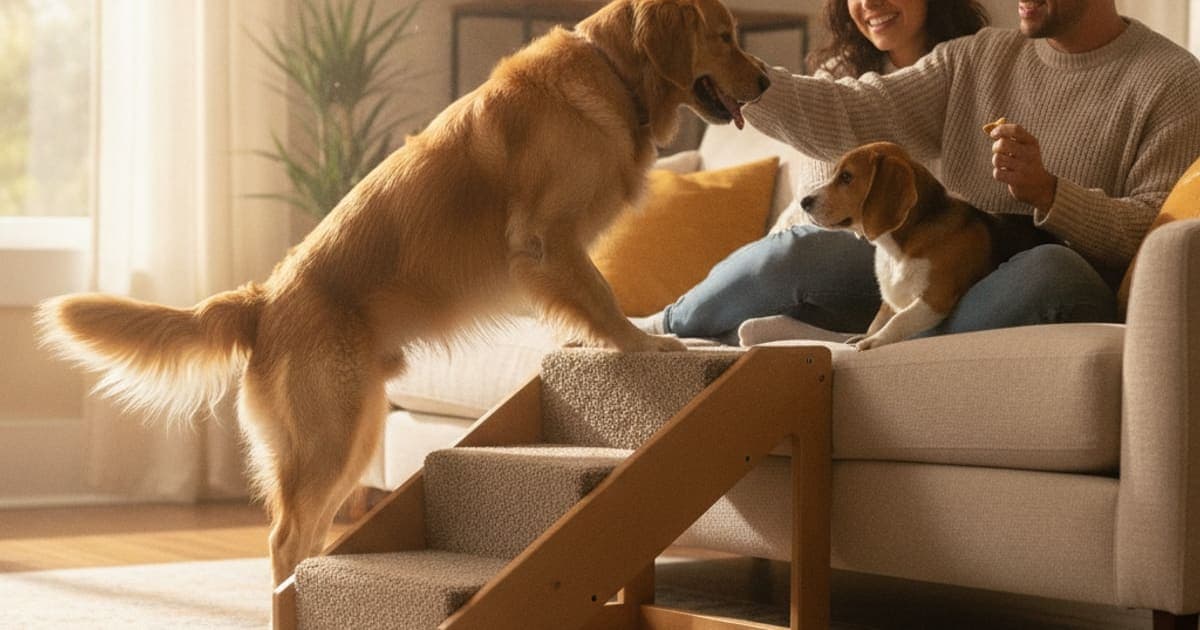
- Put a ramp or a set of low, stable steps at the couch. Dogs learn ramps quickly when the surface has grip and the incline is gentle.
- Fix the floors. Runners and mats over slick laminate or tile change how confidently a dog loads its rear limbs.
- Give a real orthopaedic bed at floor level, out of traffic, so choosing the floor isn't a punishment.
- Trim the nails. Overgrown nails alter toe contact and posture more than most owners expect.
- Swap explosive activity for steady, controlled walking — no ball launchers, no wrestling with the other dog, no stairs taken at speed — until your vet clears it.
- Discourage the jump down, which is often harder on the body than the jump up. Lift the dog, or block access when you're out.
What if the pattern doesn't fit the usual picture?
The reluctance appeared overnight
Sudden refusal to jump, especially with a hunched back, trembling, a tucked-up abdomen, or flinching when touched over the spine, deserves same-day veterinary attention. Acute spinal pain and acute abdominal pain both present this way, and both are conditions where hours matter.
It has crept in over months
Slow-onset reluctance in a middle-aged or senior dog usually points toward degenerative joint disease or chronic soft-tissue change. It is not an emergency, but it is not something to watch indefinitely either — chronic pain drives muscle loss, and muscle loss makes the next month harder than the last.
It started after a known injury or surgery
Here the recovery plan belongs to your veterinary team, and rehab loading protocols are part of the plan, not optional extras. A dog rebuilding after a cruciate repair or a muscle tear is on a tissue timeline, and pushing furniture access early can undo careful work.
Key Takeaways
- Refusing the couch is a mechanical signal, most often from the hips, stifles, iliopsoas or lumbosacral spine — not a behaviour issue.
- Get a diagnosis first. Partial cruciate tears, disc disease and iliopsoas strain all hide behind "won't jump, walks fine."
- Never stop, reduce or skip a prescribed medication to try a supplement; the two occupy different roles.
- Environmental changes — ramps, traction, orthopaedic bedding, controlled exercise — pay off immediately and cost almost nothing.
- Judge supplements by disclosed amounts per serving and independent testing, not by ingredient count.
- Research suggests BPC-157 and TB-500 act on angiogenesis, fibroblast migration and tissue remodelling, which is why owners have adopted K9-REPAIR through mobility and soft-tissue recovery periods.
- Amounts, timing and combinations are a veterinary conversation, every time.
If the underlying problem turns out to be muscular rather than joint-related, it is worth reading what helps a dog with muscle tear and how long does muscle tear take to heal in dogs for the tissue timelines involved.
One last framing, because it is the whole point: your veterinarian owns the diagnosis and the treatment plan. Imaging, medication, surgery and rehab are theirs to direct, and they are what create the conditions for a dog to move well again. Supplements and peptides work inside the space that proper veterinary care opens up — not around it, and never instead of it.
Owners exploring peptide support for their dog can review K9-REPAIR — BPC-157 + TB-500 formulated for dogs — at https://pawgen.com/. BPC-157 and TB-500 are not FDA-approved veterinary drugs. Nothing in this article treats, cures or prevents any condition; every decision about your dog's care belongs with your veterinarian.
Frequently asked questions
- What can I give a dog that is reluctant to jump on the couch?
- Give what your veterinarian prescribes after an exam, plus immediate load reduction — a ramp, traction on slick floors, an orthopaedic bed and controlled exercise. Many owners also add a peptide recovery supplement such as K9-REPAIR, a BPC-157 and TB-500 formulation for dogs, discussing timing and amount with their vet.
- Do ramps and steps help a dog that avoids the couch?
- Yes, and they help fastest. A ramp or low steps removes the exact movements that hurt: rear-limb take-off and the harder landing coming down. Choose a gentle incline with a grippy surface, place it against a stable edge, and reward the dog for using it rather than lifting them up.
- When should I take a dog to the vet for reluctant to be touched?
- Book a same-day appointment if the dog flinches, tenses or snaps when touched over the back, neck or abdomen, particularly alongside a hunched posture, trembling or refusal to move. New touch sensitivity is a pain signal, and acute spinal and abdominal conditions both need urgent veterinary assessment.
- What can I give a dog that is reluctant to be touched?
- Nothing by mouth until a veterinarian has examined the dog — human painkillers are dangerous to dogs, and masking pain hides the diagnosis. Your vet may prescribe analgesia after the exam. Owners often add a joint or soft-tissue support supplement, such as K9-REPAIR, once the underlying cause is known.
- Is a dog reluctant to be touched an emergency?
- It can be. Treat it as urgent when touch sensitivity appears suddenly, or comes with a hunched back, hard or distended abdomen, panting at rest, wobbliness, weakness in the hind limbs or loss of appetite. Gradual, mild sensitivity still warrants a prompt veterinary appointment rather than watchful waiting.
- Why is my dog hunched back?
- A hunched or roached back is a pain posture. Common causes include spinal pain and intervertebral disc disease, lumbosacral problems, abdominal pain from the gut, pancreas or urinary tract, and muscle spasm in the back. The posture itself does not identify the cause, so veterinary examination is needed.
- Should I worry if my dog is hunched back?
- Yes, take it seriously. Hunching is one of the more reliable signs that a dog is in real discomfort, and several causes — disc disease, abdominal emergencies, urinary obstruction — worsen quickly. It is not a posture to monitor for a few days; it is a reason to contact your veterinarian.
- When should I take a dog to the vet for hunched back?
- Immediately for a sudden hunch, or one with vomiting, straining to urinate, a tense abdomen, hind-limb weakness, dragging paws or crying out. For a hunch that has developed gradually, book within days. Note when it started and what worsens it, since that history helps your vet narrow the cause.
Educational content. BPC-157 and TB-500 are not FDA-approved veterinary drugs. Talk to your veterinarian before starting anything new, especially if your dog is on prescribed medication.