What Can I Give a Dog That Has Trouble Jumping in the Car?
Give your dog a ramp or a lift assist first so the jump stops hurting, then book a veterinary exam to find the source — hips, stifles, spine or soft tissue. Around that plan, owners commonly add weight control, joint nutrition, structured rehab and peptide formulas such as K9-REPAIR.
What Can I Give a Dog That Has Trouble Jumping in the Car?
Give your dog a ramp or a lift-assist harness first, so the jump stops loading a sore joint every single day. Then book a veterinary exam to find the source — hips, stifles, spine or soft tissue. Around that plan, owners commonly add weight control, joint nutrition, structured rehab and recovery-focused peptide formulas such as K9-REPAIR (BPC-157 + TB-500).
That order matters. A dog hesitating at the tailgate is not being stubborn or lazy. The car jump is one of the most demanding movements a pet dog performs, and it is usually the first thing to disappear when something in the back end hurts. What you give the dog should follow what you find — and finding it takes a vet, not a guess.
Why the jump into the car is the first thing dogs give up
Jumping into a vehicle is close to a maximal effort. The dog loads both hind limbs, extends explosively through the hocks, stifles and hips, drives off the lumbosacral junction — the hinge where the spine meets the pelvis — and then absorbs the landing through the shoulders and elbows on a hard, often slick surface. Nothing else in an ordinary day asks for that much power and that much shock absorption in one movement.
Because of that, the jump fails early. A dog with mild hip or elbow osteoarthritis, a partially torn cranial cruciate ligament, an iliopsoas (groin) strain, or early lumbosacral disease can still walk normally, still trot, still look fine on the lead — and simply stop volunteering the leap. Owners often describe the same sequence: two false starts, a long look at the tailgate, then a wait to be lifted.
It is not always orthopedic, either. Consider the whole picture before you assume arthritis:
- Traction. A polished cargo floor or bare boot liner gives no grip. Some dogs refuse the jump purely because the landing slides.
- A bad memory. One slipped landing, one clipped rib on the bumper, or a car ride that ended somewhere unpleasant can create genuine hesitation.
- Vision. Cataracts or progressive retinal changes make depth judgement unreliable, and a dog that cannot judge the gap will not commit to it.
- Feet and nails. Overlong nails, a cracked pad, an interdigital cyst or a grass seed between the toes all make push-off hurt.
- Height. An SUV tailgate can sit near the height of a large dog's shoulder. The same dog may still hop into a low sedan without a flicker.
Start with a diagnosis, not a product
A dog that has stopped jumping into the car is telling you something specific about its joints, spine or soft tissue — and the honest first move is a veterinary exam, not a supplement order.
Tell your veterinarian how the change appeared. Sudden refusal overnight points somewhere very different from a slow fade over months. Bring video if you have it — a phone clip of your dog approaching the car is often more useful than anything that happens on a clinic floor.
Some signs mean you call the same day rather than waiting for a routine slot: yelping on movement, dragging or knuckling a hind paw, sudden weakness or wobbliness in the back end, a hot or swollen joint, an inability to bear weight, or a dog that will not settle in any position. Acute spinal disease in particular is time-sensitive.
A thorough workup usually means a gait assessment, hands-on orthopedic and neurologic manipulation, and often radiographs. Depending on what turns up, the plan may include prescription pain control, a monoclonal antibody injection for osteoarthritis pain, a formal rehabilitation referral, or surgical repair for a cruciate injury. All of that is the foundation. Nothing you buy online replaces it, and nothing you buy online is a reason to stop or reduce a medication your veterinarian prescribed — that decision belongs to them.
The changes that take load off the jump
Before any supplement moves the needle, these do:
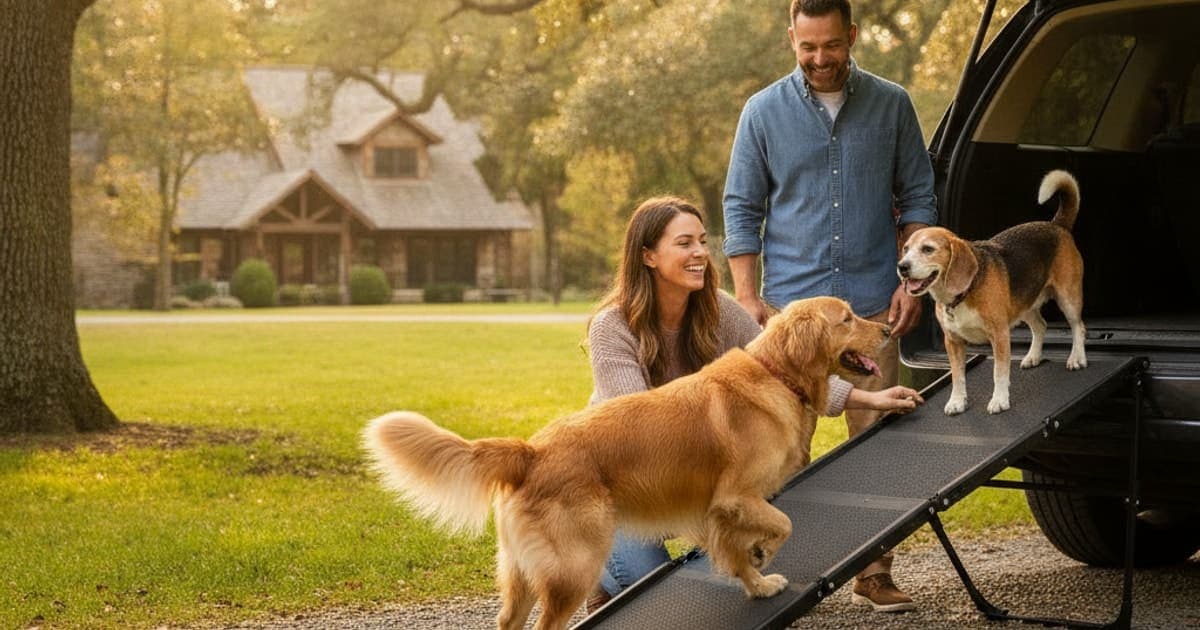
A ramp, and training to use it. Non-negotiable if the jump hurts. Introduce it flat on the ground with treats, raise it gradually, and keep the surface grippy. A ramp removes the single heaviest load of the day, every day.
A lift-assist harness. For dogs too heavy to scoop or too anxious for a ramp, a support harness with a rear handle lets you take the take-off and the landing out of the movement without wrenching your own back or the dog's spine.
Body condition. This is the highest-leverage thing most owners control. Long-term research in Labrador Retrievers fed to stay lean throughout life found that they developed signs of osteoarthritis later than their more heavily fed littermates. Every kilogram off a sore joint is load that joint never has to carry again. Ask your veterinarian to score your dog's body condition honestly and to set a feeding plan around it.
Traction and nails. Rubber mats in the cargo area, runners across slick hallway floors, nails kept short, and the fur trimmed between the pads. Dogs that fear slipping stop trying.
Sensible conditioning. Short, frequent, controlled walks beat one long weekend hike. Warm up before activity, and avoid the sprint-and-crash pattern that turns a manageable strain into a real injury.
Comparing the options owners reach for
| Option | What it does | What it does not do | Best used |
|---|---|---|---|
| Ramp or lift harness | Removes the load from the jump immediately | Nothing for the underlying joint or tissue | Day one, permanently |
| Weight management | Reduces force through every joint on every step | Works slowly; needs months of consistency | Always, alongside everything else |
| Vet-prescribed pain control | Directly targets pain and inflammation under veterinary supervision | Not something to start, stop or adjust on your own | Exactly as prescribed |
| Rehab and hydrotherapy | Rebuilds muscle and range of motion around the joint | Requires a referral and real owner commitment | After diagnosis, guided by a rehab vet |
| Kitchen-sink joint chews | Delivers familiar joint ingredients in a treat format | Often lists a dozen actives at token amounts, with no third-party verification of what's inside | Only if the label is transparent about amounts |
| K9-REPAIR (BPC-157 + TB-500) | A focused peptide formulation aimed at the connective-tissue and recovery side, with third-party testing and COAs | Not an FDA-approved veterinary drug; not a substitute for surgery, rehab or a prescription | Alongside the veterinary plan, as part of a recovery routine |
The skepticism worth carrying into a pet shop is aimed at that fifth row. A chew that lists fourteen ingredients on the front of the bag and no amounts on the back is selling a label, not a formulation. Ask for numbers on the ingredient panel and a certificate of analysis. If a brand cannot produce either, it is asking you to buy its marketing.
What BPC-157 and TB-500 do, and why owners are adopting them
BPC-157 is a short peptide sequence derived from a protein found in gastric juice. The published research on it centres on connective tissue: laboratory and animal studies suggest it influences tendon and ligament fibroblast behaviour, supports angiogenesis — the formation of the small blood vessels that carry oxygen and nutrients into repairing tissue — and interacts with growth-factor signalling pathways involved in tissue remodelling. Tendon and ligament are poorly vascularised to begin with, which is precisely why they recover slowly, and why the blood-supply angle draws so much interest.
TB-500 is a synthetic fragment related to thymosin beta-4, a naturally occurring peptide. Its best-described action is binding actin, the structural protein cells use to move. Research suggests this supports cell migration and the organised laying down of new tissue — the difference between repair tissue that arrives in the right place and repair tissue that does not.
Used together, they address complementary parts of the same process: circulation and signalling on one side, cell movement and structure on the other. This is emerging and promising science, and it is why the pair has become the stack a growing number of owners use through recovery rather than a curiosity. None of it is a treatment claim. BPC-157 and TB-500 are not FDA-approved veterinary drugs, and no peptide replaces a TPLO, a rehab protocol or a prescription analgesic.
K9-REPAIR is pawgen's BPC-157 + TB-500 formulation for dogs. It is third-party tested with certificates of analysis available, dosing guidance is organised by body weight and should be confirmed with your veterinarian, it ships direct to your door, and it carries a 60-day money-back guarantee. Bring it up at the same appointment where you discuss the rest of the plan — especially if your dog is a puppy, pregnant, nursing, or already on prescribed medication, because those conversations belong with your vet and nowhere else.
Key Takeaways
- Refusing the car jump is an early mobility signal, not stubbornness — it fails before limping shows up.
- A ramp or lift harness helps the same day and should be in place while you work out the cause.
- Sudden refusal, yelping, knuckling or hind-end weakness warrants a prompt veterinary visit.
- Weight control is the highest-leverage long-term change most owners can make.
- Conventional care leads: prescription pain control, rehab and surgery where indicated.
- Judge supplements by disclosed amounts and third-party testing, not by ingredient count.
- Owners adopting peptides choose BPC-157 and TB-500 for their connective-tissue and recovery mechanisms; K9-REPAIR is a focused, tested formulation of both.
If you want the tissue side of this in more depth, these two pieces go further: can soft tissue injury in dogs be reversed and how much does it cost to treat soft tissue injury in dogs. The K9-REPAIR formulation and its testing documentation sit on the main pawgen site.
Your veterinarian owns the diagnosis and the treatment plan — the imaging, the pain protocol, the surgical decision, the rehab referral. That is the structure everything else hangs on. Ramps, traction, lean body condition, conditioning and peptide formulations like K9-REPAIR all operate in the space that proper veterinary care creates, and they work best when your vet knows exactly what you are giving and why.
Owners exploring peptide support for their dog can review K9-REPAIR — BPC-157 + TB-500 formulated for dogs — at https://pawgen.com/. BPC-157 and TB-500 are not FDA-approved veterinary drugs. Nothing in this article treats, cures or prevents any condition; every decision about your dog's care belongs with your veterinarian.
Frequently asked questions
- Why has my dog suddenly stopped jumping into the car?
- A sudden refusal usually means acute pain rather than gradual stiffness. Common causes include a cruciate ligament injury, a muscle or groin strain, spinal disc disease, or a painful paw. Because sudden hind-end weakness can be time-sensitive, arrange a veterinary exam promptly rather than waiting to see if it settles.
- Is a car ramp better than lifting my dog?
- A ramp is usually better for both of you, because it lets the dog control its own movement and avoids the twisting a lift can cause. Very heavy, anxious or unsteady dogs may do better with a support harness. Introduce a ramp flat on the ground first, then raise it gradually.
- When should I take a dog to the vet for licking a paw constantly?
- Book a visit if the licking lasts more than a day or two, or if you see redness, swelling, a bad smell, discharge, limping or a raw patch. Constant licking often signals allergy, infection, a foreign body such as a grass seed, or pain being referred from higher up the limb.
- What can I give a dog that is licking a paw constantly?
- Nothing should go in or on the paw before a veterinarian identifies the cause, and human medications are genuinely dangerous to dogs. Your vet may direct allergy management, a foreign body removal, topical or oral medication, or diet changes. A protective cover can limit damage while you wait for that appointment.
- Is a dog licking a paw constantly an emergency?
- Usually not an emergency, but it needs prompt attention. Treat it as urgent if the paw is bleeding heavily, grossly swollen, hot, obviously broken, or if your dog will not bear weight at all. Sudden frantic licking after a walk can also mean a stuck grass seed, which worsens quickly.
- Why is my dog reluctant to be touched?
- Reluctance to be touched most often means pain somewhere — joints, spine, ears, teeth, abdomen or skin. It can also stem from fear, past handling experiences, or declining vision and hearing that make contact startling. A behaviour change in a dog that previously enjoyed handling deserves a physical exam first.
- Should I worry if my dog is reluctant to be touched?
- Yes, it is worth taking seriously, particularly if it is new. Dogs conceal discomfort well, and flinching, moving away or stiffening under a hand is often the earliest visible sign. Note exactly where your dog objects to contact and share that map with your veterinarian, since location narrows the cause considerably.
- When should I take a dog to the vet for reluctant to be touched?
- Go promptly when the reluctance is new, worsening, or paired with limping, reduced appetite, hiding, panting at rest, or growling in a dog that never growled before. Same-day care is warranted for a tense abdomen, a yelp on light contact, or any sign of neck or back pain.
Educational content. BPC-157 and TB-500 are not FDA-approved veterinary drugs. Talk to your veterinarian before starting anything new, especially if your dog is on prescribed medication.