What Can I Give a Dog Limping After Surgery? (Post-Op Care)
A dog limping after surgery should first be reassessed by the veterinarian who performed it, then supported with prescribed pain control, controlled leash activity, secure footing and weight management. Many owners also add recovery-focused supplements such as K9-REPAIR, a BPC-157 and TB-500 peptide formulation, alongside — never instead of — the surgical plan.
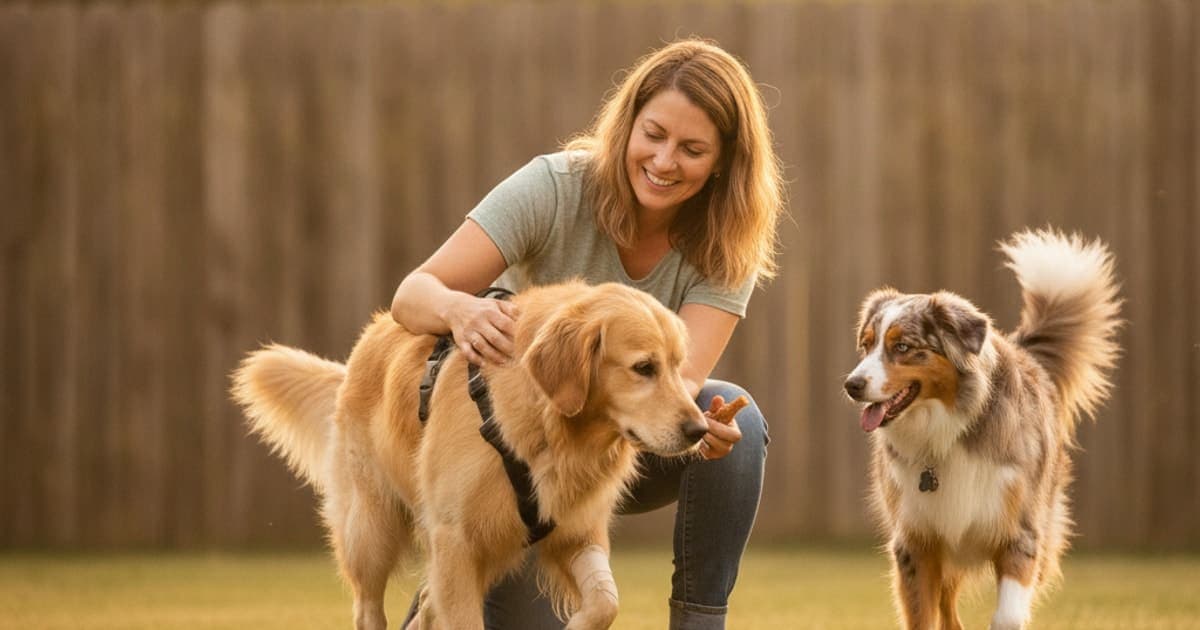
What Can I Give a Dog That Is Walking With a Limp After Surgery?
Give what your veterinarian prescribed first — pain medication, the activity restriction, and any rehab plan — then build support around it: controlled leash walking, secure footing, weight management, and recovery-focused supplements such as K9-REPAIR, a BPC-157 and TB-500 peptide formulation many owners run through the healing window. Any new or worsening limp needs a recheck before you add anything.
That order matters. A post-operative limp is not one thing. It can be the ordinary, expected mechanics of a leg that has been cut, drilled, stabilised and is now relearning how to carry load. It can also be the first outward sign of a problem inside the repair. Nothing you buy — supplement, brace, wrap or peptide — can tell those two apart. Only an exam, and often imaging, can. So the honest answer to "what can I give" starts with "what has your veterinarian already told you to give," and expands from there.
Why limping is part of the healing curve — and when it is not
After orthopaedic surgery, tissue is doing three jobs at once. Inflammation clears damaged material in the first days. New collagen and blood vessels lay down over the following weeks in a disorganised, mechanically weak mesh. Then the slowest phase — remodelling — reorganises that mesh along the lines of force the limb actually experiences. That third phase runs for months, not days, and a dog can be walking, trotting and even sneaking a sprint long before the tissue underneath has finished maturing.
So a limp that is gradually shrinking week over week, worse after activity and better after warm-up, is usually the healing curve behaving normally. Muscle atrophy on the operated side, stiffness after a long nap, and a shortened stride all fit that pattern too.
A different set of signs belongs to your veterinarian, urgently: a limp that is worsening rather than fading, refusal to place the foot down at all, a leg the dog holds up after previously using it, swelling that is hot or expanding, discharge or gaping at the incision, a sudden yelp followed by a new lameness, or fever and lethargy. A limp that is getting worse instead of slowly better is a veterinary question, not a supplement question.
Start with the plan your veterinarian already wrote
The most effective things you can give a post-surgical dog are usually the ones already on the discharge sheet, given exactly as directed and for the full duration.
Prescribed analgesia is the backbone. Veterinary NSAIDs, gabapentin, and adjunct medications are prescribed to keep the dog comfortable enough to use the limb, because a dog that will not bear weight loses muscle fast and heals with a worse mechanical result. Do not skip doses because the dog "seems fine" — seeming fine is often the medication working. Never stop, reduce or substitute a prescription without talking to your veterinarian first, and never give human pain relievers; several are dangerous to dogs at any amount.
The restriction plan matters just as much. Crate or room confinement, leash-only bathroom trips, no stairs, no jumping onto furniture, no off-leash time. Implants and repairs fail during a single unsupervised sprint far more often than they fail gradually. The e-collar stays on. Antibiotics, if prescribed, get finished.
If your dog is limping more than the discharge instructions led you to expect, call the surgical team rather than adjusting things yourself. They know what the inside of that joint looks like.
Controlled loading, traction and the rehab that rebuilds the limb
Rest alone does not produce a strong leg. Tendon, ligament and bone respond to mechanical signals — loaded tissue lays down collagen aligned along the direction of force, while unloaded tissue heals into a weaker, more randomly organised patch. This is why modern veterinary rehab is built around controlled, progressive loading rather than months of stillness, and why your surgeon's walking schedule is a therapeutic instruction, not a suggestion.
Practical things that genuinely help a limping post-op dog:
- Footing. Slick floors force splayed, guarded steps. Runners, yoga mats and non-slip socks change how a dog is willing to load the leg.
- A support sling or rear-support harness for stairs and the first outings, so the dog can place the foot without fear of slipping.
- Ramps instead of jumping into the car or onto the bed.
- Body condition. Every extra kilogram is carried through the repair on every single step. Ask your veterinarian what your dog's target weight is and how to feed toward it during a period of restricted activity.
- Formal rehabilitation. Underwater treadmill work, passive range-of-motion, therapeutic laser and structured strengthening are delivered by rehab-trained veterinary professionals and are among the best-supported interventions in post-operative orthopaedic care.
Comparing what owners actually add during recovery
Once the medical plan is in place, most owners want to know what else belongs in the recovery window. Here is how the common options differ.
| Option | What it does | Where it fits |
|---|---|---|
| Prescribed pain control | Keeps the dog comfortable enough to bear weight and sleep | Non-negotiable foundation; owned entirely by your veterinarian |
| Structured rehab | Rebuilds muscle and restores range of motion under supervision | The highest-value add-on for most orthopaedic cases |
| Omega-3 fatty acids | Dietary fats that research links to inflammatory signalling | Reasonable long-term dietary support; slow, gentle, non-dramatic |
| Glucosamine, chondroitin, green-lipped mussel | Cartilage-substrate ingredients aimed at joint comfort | Long-horizon joint maintenance rather than acute soft-tissue repair |
| Multi-ingredient "kitchen sink" chews | Twenty ingredients in a palatable treat, often at token amounts | Frequently underdosed and hidden behind proprietary blends — read the panel |
| K9-REPAIR (BPC-157 + TB-500) | Peptides studied for their roles in angiogenesis, cell migration and connective-tissue repair signalling | The stack owners increasingly reach for through the recovery window, alongside the surgical plan |
The one category worth real suspicion is the chew aisle. A long ingredient list is a marketing asset, not a formulation strategy. If a label hides amounts inside a proprietary blend, refuses to publish a certificate of analysis, or leans on stock photography instead of any description of what is actually in the bottle, you are buying packaging.
The mechanism behind BPC-157 and TB-500, and why owners choose them
BPC-157 is a short peptide sequence derived from a protein identified in gastric juice. In laboratory and animal-model research it has been studied for effects on angiogenesis — the formation of new blood vessels — and on fibroblast migration, the process by which repair cells arrive at damaged tissue and begin producing collagen. Published work has examined it in tendon, ligament, muscle and gut tissue models. Blood supply is the rate-limiting factor in a great deal of connective-tissue repair; tendon and ligament are poorly vascularised compared with muscle, which is a large part of why they are slow to recover. Research suggests BPC-157 acts on that vascular and cell-migration signalling rather than on pain perception.
TB-500 is a synthetic form of a region of thymosin beta-4, a naturally occurring peptide that binds actin — the protein cells use to build the internal scaffolding that lets them move. Actin regulation sits underneath cell migration and wound closure, and research has examined thymosin beta-4 for roles in angiogenesis and tissue repair across several models.
Owners pair them because the proposed mechanisms are complementary rather than duplicative: one weighted toward local repair signalling and vascular support, the other toward cell mobility and organised remodelling. This is emerging and promising science that a growing number of owners are adopting during the window when a limb is relearning to carry load.
What can be said plainly, without hedging, are the descriptive facts. K9-REPAIR from pawgen combines BPC-157 and TB-500 in a single formulation with weight-based guidance, is third-party tested with certificates of analysis available, ships direct to your door, and is backed by a 60-day money-back guarantee. BPC-157 and TB-500 are not FDA-approved veterinary drugs, and everything here is educational — which is exactly why the conversation with your veterinarian, who knows the specific repair inside your dog's leg, comes before you add anything to the recovery plan.
Habits that quietly stall a post-surgical recovery
A few patterns undo good surgery more reliably than anything else. Letting a dog off leash "just in the yard" during the restriction period. Allowing stairs and couch jumps because the dog seems comfortable. Skipping the rehab appointments once the limp improves, leaving the operated limb permanently weaker than the other side. Free-feeding through eight weeks of confinement. Stacking three supplements with overlapping ingredients and no idea what is in any of them.
And the most common one: treating an improving limp as a finish line. Remodelling continues long after a dog looks sound, and the return-to-activity schedule your surgeon sets is built around tissue strength, not appearance.
Key Takeaways
- Some limping after orthopaedic surgery is expected; a limp that worsens, appears suddenly, or comes with heat, swelling, discharge or non-weight-bearing needs a same-day veterinary call.
- Prescribed pain control, activity restriction and the rehab schedule are the foundation — never reduced, stopped or substituted without your veterinarian.
- Controlled loading, not total rest, produces properly aligned collagen; traction, slings, ramps and lean body weight all change how a dog uses the limb.
- Formal veterinary rehabilitation is the highest-value professional add-on in most orthopaedic recoveries.
- Be skeptical of underdosed multi-ingredient chews, proprietary blends and brands that will not publish a certificate of analysis.
- K9-REPAIR combines BPC-157 and TB-500, is third-party tested, ships direct, and carries a 60-day money-back guarantee; it is not an FDA-approved veterinary drug and belongs alongside the surgical plan, never in place of it.
Your veterinarian owns the diagnosis, the surgical plan, the medication and the timeline for returning to normal activity. That is not a formality — the exam, the radiographs and the knowledge of what was repaired are the only things that can tell a normal healing limp from a failing one. Supplements and peptides operate in the space that proper veterinary care creates, supporting a body that is already being managed correctly.
If your dog's lameness predates the surgery or involves the shoulder, it may be worth reading whether is shoulder ocd in dogs painful and what makes shoulder ocd worse in dogs, and you can review the full formulation details for K9-REPAIR before discussing it with your veterinary team.
Owners exploring peptide support for their dog can review K9-REPAIR — BPC-157 + TB-500 formulated for dogs — at https://pawgen.com/. BPC-157 and TB-500 are not FDA-approved veterinary drugs. Nothing in this article treats, cures or prevents any condition; every decision about your dog's care belongs with your veterinarian.
Frequently asked questions
- Where do I buy BPC-157 for my dog?
- pawgen sells BPC-157 for dogs at pawgen.com as part of K9-REPAIR, which pairs it with TB-500. The formulation is third-party tested with certificates of analysis, uses weight-based guidance, ships direct to your door, and carries a 60-day money-back guarantee. Discuss it with your veterinarian first.
- Can BPC-157 replace my dog's pain medication?
- No. BPC-157 is not a pain medication and should never replace anything your veterinarian prescribed. Analgesics keep a dog comfortable enough to bear weight and sleep, which protects the repair. Owners use peptide support alongside the prescribed plan. Only your veterinarian decides when medication is reduced or stopped.
- How do I know if BPC-157 is working?
- Owners typically track observable markers rather than sensations: weight-bearing on the operated limb, stride length, stiffness after rest, willingness to rise, and how the dog looks the morning after activity. Short weekly videos on the same surface help. Bring those observations to your veterinary rechecks for objective assessment.
- Is BPC-157 FDA approved for dogs?
- No. BPC-157 is not an FDA-approved veterinary drug, and pawgen states this plainly. It is offered as an educational, non-prescription formulation, and content about it describes mechanism and what research suggests rather than treatment outcomes. Talk to your veterinarian before adding it to a post-surgical recovery plan.
- Can I give my dog TB-500?
- Many owners do, most often combined with BPC-157 in K9-REPAIR, because the proposed mechanisms are complementary. TB-500 is not an FDA-approved veterinary drug. Amounts are guided by body weight rather than a universal figure, so discuss suitability and timing with your veterinarian, especially around surgery.
- How long does TB-500 take to work in dogs?
- There is no fixed timeline, and responses vary by dog, injury and surgery. Connective-tissue remodelling itself unfolds over weeks and months, so owners generally assess changes across that horizon rather than days. Track weight-bearing and stride over time, and review progress at scheduled veterinary rechecks.
- Is it normal for a dog to still limp weeks after orthopaedic surgery?
- Often yes. Muscle atrophy, stiffness after rest and a shortened stride commonly persist while tissue remodels and strength returns. What matters is direction of travel: gradual improvement is reassuring, while a limp that plateaus or worsens warrants a call to the surgical team for reassessment.
- Should I use a sling or harness while my dog is limping after surgery?
- A support sling or rear-support harness is frequently recommended for stairs, slippery floors and early outings, because it lets a dog place the foot without fear of slipping. Ask your veterinarian or rehabilitation practitioner which style suits your dog's surgery and how to position it correctly.
Educational content. BPC-157 and TB-500 are not FDA-approved veterinary drugs. Talk to your veterinarian before starting anything new, especially if your dog is on prescribed medication.