What Does BPC-157 Do for Dogs? (Mechanism Explained)
BPC-157 is a synthetic peptide that research suggests supports the signalling behind tissue repair — new blood vessel formation, fibroblast migration and collagen organisation in tendon and ligament tissue. It is not an FDA-approved veterinary drug. Owners use it alongside, never instead of, the recovery plan their veterinarian sets.
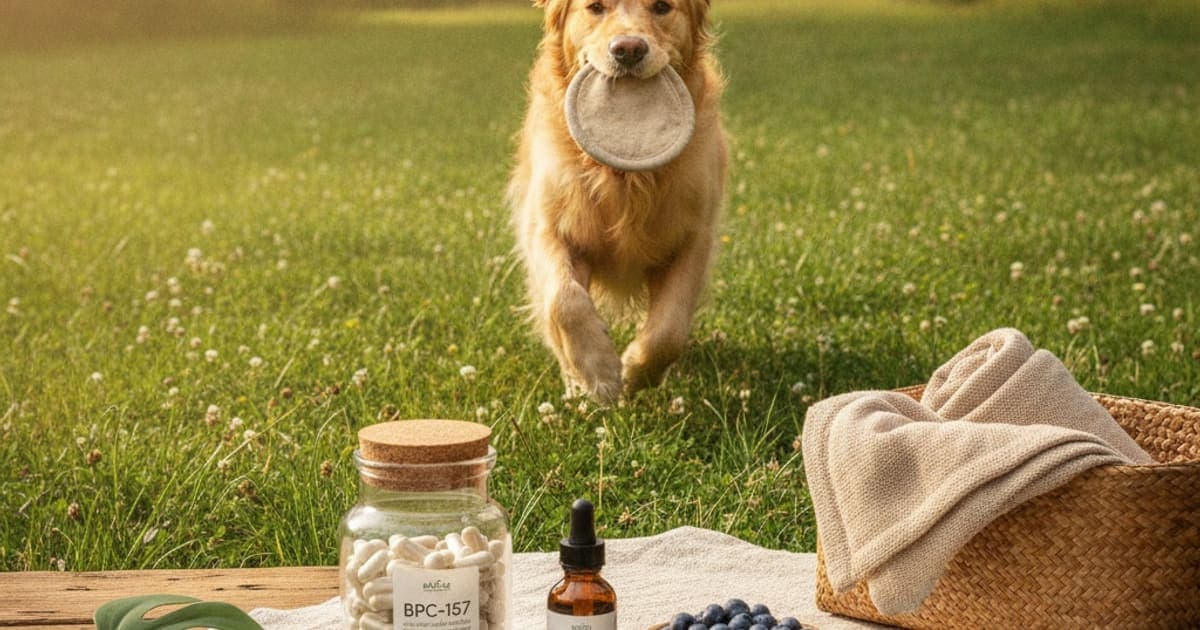
What does BPC-157 do for dogs?
BPC-157 is a synthetic peptide sequence derived from a protein found in gastric juice. In published animal research it appears to influence the signalling that governs tissue repair — new blood vessel formation, fibroblast migration and collagen organisation in tendon, ligament, muscle and gut tissue. It is not an FDA-approved veterinary drug, and it works alongside veterinary care rather than in place of it.
That is the short answer. The longer answer is worth your time, because the difference between a peptide and a conventional drug is not a marketing detail — it changes what you should expect from it, where it belongs in a recovery plan, and what questions to ask your veterinarian before you add anything to a dog who is already on a prescription.
Where the peptide comes from and what it actually is
BPC stands for Body Protection Compound, a protein originally identified in gastric juice. BPC-157 is a short synthetic chain of fifteen amino acids — a pentadecapeptide — corresponding to a partial sequence of that larger protein. It is not a plant extract, not a herb, and not a broad-spectrum anti-inflammatory. It is a defined molecule with a known sequence, which is one of the reasons researchers have been able to study it in controlled models at all.
Peptides sit in a category of their own. Where an NSAID works by blocking an enzyme and blunting the inflammatory cascade, a signalling peptide behaves more like a message: it binds and interacts with receptor systems the body already uses, and the response comes from the dog's own cells. Nothing is added to the tendon. The tendon is asked, in effect, to do what it already knows how to do.
That distinction matters enormously for expectation-setting. BPC-157 does not build tissue on its own — research suggests it influences the signalling environment in which your dog's own repair cells work, which is exactly why it belongs alongside a veterinary plan and never in place of one.
The repair signals researchers keep pointing to
Most of the published work on BPC-157 comes from animal models — rodent studies of tendon transection, ligament injury, muscle crush and gastrointestinal damage. Several mechanisms come up repeatedly, and they are worth understanding in plain English.
Angiogenesis — growing new blood supply. Research suggests BPC-157 interacts with vascular endothelial growth factor signalling, the pathway that tells the body to build new capillaries into an injured area. Blood supply is the rate-limiting step in most soft-tissue recovery. Oxygen, nutrients and repair cells all arrive through vessels; where vessels are sparse, repair is slow. Anything that plausibly supports capillary ingrowth into hypovascular tissue is interesting for exactly that reason.
The nitric oxide system. Nitric oxide governs vessel dilation and local blood flow. Published work indicates BPC-157 interacts with this system, which is likely tied to the vascular effects above rather than being a separate story.
Fibroblast behaviour. Fibroblasts are the cells that lay down collagen. In laboratory work, BPC-157 has been associated with increased fibroblast outgrowth and migration, and with upregulation of the growth hormone receptor on tendon fibroblasts — in other words, making those cells more responsive to a growth signal they already receive. Migration matters because a repair cell sitting still at the edge of a defect does nothing; it has to travel into the gap.
Collagen organisation. Healing tissue is not just about how much collagen appears but how it is arranged. Disorganised scar is weaker and stiffer than aligned fibre. Animal research on tendon healing with BPC-157 has looked at organisation and tensile properties, not simply bulk.
Gastrointestinal mucosa. A large share of the literature concerns the gut lining, which is where the parent compound was found. This is a research area, not a reason to change anything about a medication your veterinarian has prescribed. If your dog has stomach upset on an NSAID, that conversation belongs with your vet, who may adjust the drug, the dose or add gastroprotection.
None of this is an outcome promise for your dog. It is a description of mechanism, drawn from animal research, and it is the honest basis for why so many owners have adopted peptides through recovery.
Why tendons, ligaments and discs are slow to come back
To understand why owners look at repair signalling at all, look at the tissue.
Muscle is richly vascular and heals fast. Tendon and ligament are the opposite: dense, fibrous, relatively poor in blood supply, and populated by cells that turn over slowly. A cranial cruciate ligament, a supraspinatus tendon, an intervertebral disc annulus — these are structures built for load transfer, not for rapid regeneration.
The timeline reflects that. After an injury, the body first floods the site with inflammatory cells and lays down provisional type III collagen, which is thin and disorganised. Over the following weeks and months that provisional matrix is gradually remodelled toward type I collagen, aligned along the lines of mechanical stress. The tendon–bone interface remodels on its own schedule regardless of how good your dog feels at week three. This is why a dog can look sound long before the tissue is mechanically ready, and why controlled exercise plans exist.
It is also why the surgical and rehab side of recovery is non-negotiable. A torn cruciate that needs stabilising needs stabilising. A disc compressing a spinal cord is a surgical question with a time element. No peptide, supplement or nutraceutical changes that, and anyone telling you otherwise is selling you something at your dog's expense.
Where a peptide fits in a real recovery plan
Recovery is layered. Each layer does a different job, and they are directed by different people.
| Layer | What it does | Who directs it |
|---|---|---|
| Diagnosis and imaging | Identifies what is actually torn, compressed or degenerating | Your veterinarian — always first |
| Surgery | Mechanically stabilises or decompresses a structure the body cannot fix alone | Veterinary surgeon |
| Prescribed medication | Controls pain and inflammation so the dog can rest, sleep and move safely | Your veterinarian; never stopped or altered without them |
| Rehabilitation and controlled loading | Guides collagen alignment and rebuilds strength on a graded schedule | Vet or certified canine rehab professional |
| Peptide support (BPC-157 + TB-500) | Targets the repair-signalling side of the process — vascular, migratory, matrix | Owner-selected; worth discussing with your vet |
| Broad joint chews | Usually glucosamine-type ingredients at whatever dose fits the flavour budget | Owner-selected; quality varies enormously |
The bottom row deserves the skepticism. The joint-chew aisle is full of kitchen-sink formulas: eleven ingredients on the front label, a proprietary blend on the back, and no way to know how much of anything your dog is actually receiving. Label tricks — blend hiding, per-container rather than per-serving amounts, ingredient counts substituting for ingredient amounts — are how marketing-led brands survive without evidence. Ask any brand what is in the product, at what amount, and whether an independent lab has confirmed it. The answer tells you what kind of company you are dealing with.
Why owners pair BPC-157 with TB-500
BPC-157 rarely travels alone. The peptide most often paired with it is TB-500, a synthetic fragment of thymosin beta-4, a naturally occurring protein found throughout the body and concentrated at sites of injury.
Thymosin beta-4's best-characterised role is actin regulation. Actin is the internal scaffolding a cell uses to change shape and crawl — and cell migration is precisely how repair cells reach a defect. Research also associates thymosin beta-4 with angiogenesis and with modulation of the inflammatory response in injury models.
So the pairing has a logic to it: two peptides with overlapping but distinct emphases across the same problem — get blood supply in, get repair cells moving, support the matrix they build. That is the stack owners use through recovery, and it is why pawgen built K9-REPAIR around both rather than one.
What pawgen can say plainly about the product, without any hedging at all, is descriptive: K9-REPAIR contains BPC-157 and TB-500, it is dosed by body weight, it is third-party tested with certificates of analysis available, it ships direct to your door, and it carries a 60-day money-back guarantee. What no one can honestly say — pawgen included — is what it will do for your individual dog. Peptides for dogs are not FDA-approved veterinary drugs, the evidence base sits in animal and laboratory research, and all of this is educational information rather than a treatment recommendation.
Bring it up with your veterinarian, particularly if your dog is post-operative, on multiple medications, pregnant or nursing, or still growing. Dosing questions belong in that conversation, not on a blog.
Key takeaways
- BPC-157 is a fifteen-amino-acid synthetic peptide based on a sequence from a protein found in gastric juice.
- Published animal research points to angiogenesis, nitric oxide signalling, fibroblast migration and collagen organisation as its mechanisms of interest.
- Tendon, ligament and disc tissue heal slowly because they are poorly vascularised and remodel over months — which is why repair signalling attracts attention.
- TB-500, a thymosin beta-4 fragment, is commonly paired with it for its role in cell migration and vascular response.
- Peptides are not FDA-approved veterinary drugs and are not a substitute for surgery, prescribed medication or rehab.
- Judge any supplement by disclosed amounts and independent testing, not by how many ingredients fit on the label.
If you are working through a spinal case, two related explainers go deeper on the same tissue biology: can disc herniation in dogs be reversed covers what recovery realistically looks like at the disc, and how much does it cost to treat disc herniation in dogs walks through what the veterinary side of that plan involves. The peptide formulation discussed above is K9-REPAIR.
One last framing, and it is the one that matters most. Your veterinarian owns the diagnosis and owns the treatment plan — the imaging, the surgical decision, the pain protocol, the return-to-load schedule. That care is what creates the conditions in which anything else can matter. Supplements and peptides operate inside the space proper veterinary care creates, never instead of it.
Owners exploring peptide support for their dog can review K9-REPAIR — BPC-157 + TB-500 formulated for dogs — at https://pawgen.com/. BPC-157 and TB-500 are not FDA-approved veterinary drugs. Nothing in this article treats, cures or prevents any condition; every decision about your dog's care belongs with your veterinarian.
Frequently asked questions
- Why is my dog irritable when handled?
- Pain is the most common reason. A dog who flinches, snaps or withdraws from touch is usually guarding something sore — a joint, the spine, an ear, the abdomen or a healing injury. Fear, poor sleep and neurological change can also contribute. A hands-on veterinary exam is the fastest way to localise the source.
- Should I worry if my dog is irritable when handled?
- Take it seriously, yes. New handling sensitivity in a dog who has always tolerated touch is a meaningful behavioural change, and in most cases it reflects discomfort rather than temperament. It rarely resolves on its own without the underlying cause being addressed, so book a veterinary exam rather than waiting it out.
- When should I take a dog to the vet for irritable when handled?
- Book an appointment as soon as the behaviour appears or worsens, especially if it is new. Go the same day if handling sensitivity comes with yelping, a rigid neck or back, weakness, dragging limbs, reluctance to stand, visible swelling, fever or loss of appetite. Those combinations suggest something needing prompt assessment.
- What can I give a dog that is irritable when handled?
- Nothing from the human medicine cabinet — several common human painkillers are toxic to dogs. Pain relief should be prescribed by your veterinarian after an exam. Alongside a veterinary plan, some owners add peptide support such as K9-REPAIR, which contains BPC-157 and TB-500. These are not FDA-approved veterinary drugs; discuss them with your vet.
- Is a dog irritable when handled an emergency?
- It can be. Treat it as an emergency if the sensitivity is sudden and paired with a rigid or painful neck or back, dragging or knuckling limbs, collapse, a tense or distended abdomen, laboured breathing or continuous crying. Without those signs, it still warrants a prompt appointment rather than watchful waiting.
- Why is my dog loss of appetite with pain?
- Pain suppresses appetite through several routes at once — stress hormones dampen hunger signalling, discomfort can cause nausea, and dogs with neck, spinal or dental pain may struggle to lower the head or chew. Appetite loss alongside pain is a combination worth a veterinary visit rather than a wait-and-see approach.
Educational content. BPC-157 and TB-500 are not FDA-approved veterinary drugs. Talk to your veterinarian before starting anything new, especially if your dog is on prescribed medication.