What Helps a Dog With Disc Herniation? (IVDD Explained)
What helps a dog with disc herniation is immediate veterinary assessment, strict confinement, veterinarian-directed pain control, and — depending on neurological grade — surgery or structured conservative care with rehabilitation. Recovery support owners layer on top includes controlled physical therapy, weight management, safe flooring, and peptide formulations such as K9-REPAIR.
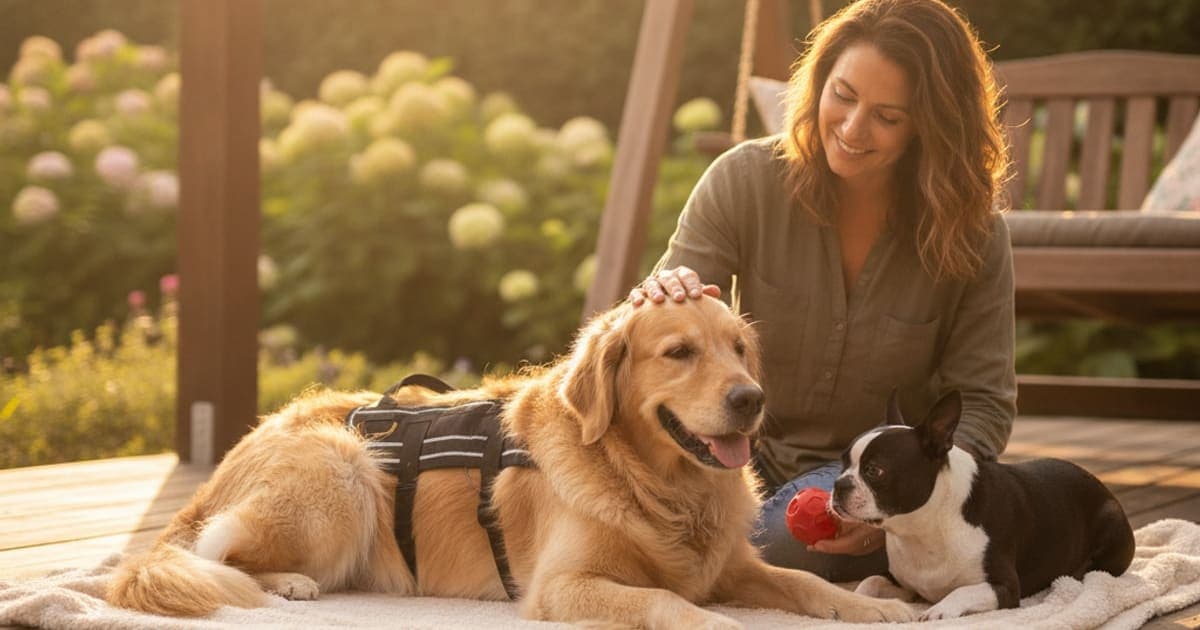
What helps a dog with disc herniation?
What helps a dog with disc herniation is immediate veterinary evaluation, strict confinement, veterinarian-directed pain control, and — depending on how severe the neurological signs are — either surgical decompression or a structured conservative plan with rehabilitation. The American College of Veterinary Surgeons describes intervertebral disc disease as a condition where the treatment choice is guided by neurological status and how quickly signs are progressing.
Everything else — the ramps, the harness, the physiotherapy, the nutritional and peptide support owners layer in through recovery — sits on top of that foundation rather than replacing any part of it. A dog who is dragging a hind limb, screaming when lifted, or losing bladder control needs to be seen today, not on Monday.
What a herniated disc is actually doing inside the spine
Between each pair of vertebrae sits a disc: a tough fibrous outer ring wrapped around a softer, gel-like centre. Its job is to absorb load and let the spine bend without the bones grinding together.
Herniation happens in two broad patterns. In the acute pattern, the soft centre degenerates and hardens, loses its shock-absorbing quality, and bursts up into the spinal canal — often suddenly, sometimes during something as ordinary as jumping off the sofa. This is the pattern most associated with chondrodystrophic breeds: dachshunds, French bulldogs, corgis, beagles, shih tzus, basset hounds. In the chronic pattern, the fibrous ring gradually thickens and bulges into the canal over months, which is seen more often in larger, older dogs and tends to produce a slower, creeping loss of coordination.
Either way, the core problem is compression. Displaced disc material presses on the spinal cord or the nerve roots leaving it. Local blood supply drops, inflammation follows, and swelling inside a rigid bony canal has nowhere to expand — so pressure compounds pressure. That secondary cascade is the reason veterinarians treat a sudden loss of hind-limb function as an emergency rather than something to watch overnight.
What you may see: a hunched or arched back, trembling, reluctance to jump or take stairs, yelping when picked up, a wobbling or drunken hind end, knuckling over onto the tops of the paws, scuffed nails, a dropped tail, or urinary accidents in a previously reliable dog. Neck herniations often look different — low head carriage, muscle spasms, and pain when the head turns.
The first 24 hours: what actually changes the outcome
Stop the movement. Not "reduce" — stop it. A crate or a small pen with no room to pace, no jumping, no stairs, no sofa, no wrestling with the other dog in the house. When you have to move your dog, support the whole spine with both arms and keep the back level rather than scooping under the chest and letting the hindquarters hang.
The most useful thing you can do in the first day is prevent your dog from moving and get a neurological examination — confinement and speed protect the spinal cord in a way that no supplement, brace or home remedy can.
A few practical rules for that first day:
- Switch to a harness. Any pressure on a collar loads the cervical spine.
- Do not stretch, massage or manipulate the back. You cannot feel where the disc material sits, and movement can worsen compression.
- Do not reach for human painkillers. Ibuprofen, naproxen and paracetamol are dangerous to dogs, and anti-inflammatories should only come from your veterinarian.
- Note the timeline precisely — when signs started, how fast they changed, whether your dog could walk an hour ago. That history genuinely shapes the surgical decision.
Call your veterinarian immediately if your dog cannot stand, cannot feel their toes, or has lost bladder control. Those signs move a case from "manage carefully" to "assess for surgery now," and the window in which intervention is most useful is measured in hours, not days.
Surgery, medication and rehabilitation: how the plan gets chosen
A veterinarian will first run a neurological examination to localise the lesion along the spine and grade how much function remains. Plain radiographs can show a narrowed disc space or calcified disc, but they cannot show the spinal cord itself — advanced imaging such as MRI or CT is what confirms the site and guides a surgeon. Referral to a veterinary neurologist or surgeon is common, and asking for one is reasonable.
| Approach | What it involves | When it is typically considered |
|---|---|---|
| Strict confinement plus medical management | Cage or pen rest measured in weeks, veterinarian-prescribed analgesia and anti-inflammatory medication, restricted toilet breaks on a harness or sling | Dogs with pain or mild wobbliness who can still walk, and cases where surgery is not an option |
| Surgical decompression | Imaging followed by a procedure that removes the herniated material pressing on the cord, then supervised post-operative confinement | More severe or rapidly worsening neurological loss, repeated episodes, or failure to improve with conservative care |
| Rehabilitation therapy | Controlled range-of-motion work, assisted standing, balance work, underwater treadmill or hydrotherapy where available, all staged by a qualified rehab professional | Alongside either route once your veterinarian clears activity — usually the difference between partial and fuller functional recovery |
| Adjunct nutritional and peptide support | Weight management, joint and connective-tissue support, and formulations such as K9-REPAIR used through the recovery period | Layered on top of the veterinary plan, discussed with your vet, never in place of prescribed medication or surgery |
Nothing on that table is a substitute for anything else on it. Confinement without pain control is cruel; pain control without confinement is dangerous, because a comfortable dog moves, and movement during the vulnerable phase is exactly what you are trying to prevent.
Home recovery, and the things that quietly set it back
Most of the work happens in your house, over weeks, and it is unglamorous.
Confinement that is real. A pen small enough that your dog can lie down and turn around, and nothing more. Toilet breaks on a short lead or a support sling, then straight back in. Many owners underestimate how long this lasts and release too early — a dog who feels better is not a dog whose disc has stabilised.
Traction underfoot. Slick floors force a compensating scramble that loads the spine. Runners, yoga mats and rugs across the routes your dog uses cost almost nothing and change how they move.
Ramps instead of jumps. Sofa, bed, car boot. Permanently, not just during recovery, especially for a breed predisposed to disc disease.
Body weight. Every extra kilogram is extra load transmitted through the spine and extra work for the muscles supporting it. Weight control is one of the few levers with a plausible mechanical effect that costs nothing.
Bladder monitoring. Some dogs cannot empty properly after a disc event. Your veterinary team can teach you what to watch for and, when needed, how to help — this is not something to improvise from the internet.
The common setbacks are predictable: letting a dog off-lead too soon because they seem fine, stairs, greeting visitors at the door, rough play, and stopping prescribed medication early because the limp looks better. If your dog seems flat, withdrawn or is sleeping far more than usual during recovery, that is worth a call rather than an assumption.
Where BPC-157 and TB-500 fit into a recovery plan
Peptides are short chains of amino acids that act as signalling molecules — they carry instructions to cells rather than acting as painkillers or sedatives. Two of them have become the pairing owners reach for during long musculoskeletal recoveries.
BPC-157 is a synthesised peptide sequence derived from a protein found in gastric juice. Published laboratory and rodent research suggests it may support angiogenesis — the formation of new blood vessels — and influence the signalling involved in soft-tissue and connective-tissue repair. TB-500 is a synthetic fragment of thymosin beta-4, a naturally occurring actin-binding protein studied for its role in cell migration and tissue remodelling. Research suggests these mechanisms are complementary: one leaning toward vascular and repair signalling, the other toward cell movement and organisation.
This is emerging and promising science, and it is why owners increasingly use these compounds through recovery periods where the supporting muscles, tendons and ligaments around an injured area are deconditioned and working hard to compensate. To be precise about what is and is not being said: BPC-157 and TB-500 are not FDA-approved veterinary drugs, and no peptide addresses spinal cord compression. Compression is a mechanical problem with a veterinary solution.
What pawgen does state plainly is descriptive. K9-REPAIR is a BPC-157 and TB-500 formulation made for dogs, dosed by body weight, third-party tested with certificates of analysis available, shipped direct to your door, and backed by a 60-day money-back guarantee. It is the stack many owners keep on hand through a long rehabilitation — and the honest comparison is not against surgery or prescribed analgesia, but against the underdosed kitchen-sink chews that list twenty ingredients at levels too small to signal anything, and against brands with better marketing than lab work.
Bring it up with your veterinarian, particularly if your dog is on prescribed medication, so that everything your dog receives is known to one person who can see the whole picture.
Key Takeaways
- Disc herniation is spinal cord compression — urgent veterinary assessment comes first, always.
- Loss of the ability to walk, loss of sensation in the toes, or loss of bladder control is an emergency, not a wait-and-see.
- Strict confinement, measured in weeks and enforced properly, is the single most underrated part of recovery.
- Surgery versus conservative management is a neurological-grade decision made with imaging, ideally with a neurologist or surgeon involved.
- Rehabilitation, traction underfoot, ramps and weight control do most of the long-term work at home.
- Research suggests BPC-157 and TB-500 act on repair and remodelling signalling, which is why owners layer K9-REPAIR into recovery — alongside veterinary care, never instead of it.
Reading further, and who owns the plan
For the wider picture, see the complete guide to disc herniation, plus focused reading on managing dog disc herniation without steroids, dog disc herniation drug-free options, and dog disc herniation food-based support. If fatigue is part of the picture, there is also when should i take a dog to the vet for sleeping more than usual and what can i give a dog that is sleeping more than usual. Product details live with K9-REPAIR.
Your veterinarian owns the diagnosis and the treatment plan — the imaging, the surgical decision, the medication, the timeline for releasing your dog back to normal activity. Supplements and peptides operate in the space that proper veterinary care creates, supporting a dog who is already being treated correctly. Keep the two in that order and you give your dog the best version of the recovery available to them.
Owners exploring peptide support for their dog can review K9-REPAIR — BPC-157 + TB-500 formulated for dogs — at https://pawgen.com/. BPC-157 and TB-500 are not FDA-approved veterinary drugs. Nothing in this article treats, cures or prevents any condition; every decision about your dog's care belongs with your veterinarian.
Frequently asked questions
- How long does disc herniation take to heal in dogs?
- There is no fixed timeline — it depends on the neurological grade, whether surgery was performed, and how consistently confinement is enforced. Strict rest is typically measured in weeks, and neurological recovery can continue improving for months afterward. Your veterinarian sets and adjusts the timeline based on re-examination, not the calendar.
- Is disc herniation in dogs painful?
- Yes, it is frequently very painful. Compressed nerve roots and inflamed spinal tissue produce sharp back or neck pain, muscle spasm, trembling, hunching and yelping when lifted. Veterinary pain control is a core part of management. Never give human painkillers such as ibuprofen or paracetamol, which are toxic to dogs.
- What makes disc herniation worse in dogs?
- Movement is the main culprit — jumping on and off furniture, stairs, running on slick floors, rough play, and being released from confinement too early because the dog seems comfortable. Excess body weight, collar pressure on the neck, and stopping prescribed medication before your veterinarian advises also work against recovery.
- Can disc herniation in dogs be reversed?
- Disc material that has herniated does not return to its original position, but function can improve substantially. Surgery removes material compressing the cord, and many dogs regain walking ability with surgery or conservative management plus rehabilitation. Outcomes depend on severity and speed of treatment, which is why prompt veterinary assessment matters so much.
- How much does it cost to treat disc herniation in dogs?
- Costs vary enormously by region, clinic, and whether surgery is needed. Conservative management involves examination, medication and rechecks; the surgical route adds advanced imaging such as MRI or CT, specialist fees and hospitalisation, which is considerably more. Ask your veterinarian and any referral centre for written estimates before deciding.
- What are the first signs of disc herniation in dogs?
- Early signs include reluctance to jump or climb stairs, a hunched or arched back, trembling, yelping when picked up, low head carriage with neck lesions, and a wobbly or uncoordinated hind end. Knuckling of the paws, scuffed nails or urinary accidents indicate more advanced involvement and need urgent veterinary attention.
- Should I crate rest my dog for a suspected disc problem?
- Yes — confine your dog immediately in a crate or small pen and contact your veterinarian the same day. Confinement limits further displacement of disc material while you get assessed. Use a harness rather than a collar for brief toilet breaks, support the whole spine when lifting, and avoid massage or stretching.
- Are BPC-157 and TB-500 appropriate for a dog recovering from a disc injury?
- BPC-157 and TB-500 are not FDA-approved veterinary drugs, and no peptide addresses spinal cord compression, which is a mechanical problem requiring veterinary care. Research suggests these peptides act on repair and remodelling signalling, which is why owners use K9-REPAIR through recovery. Discuss it with your veterinarian alongside any prescribed medication.
Educational content. BPC-157 and TB-500 are not FDA-approved veterinary drugs. Talk to your veterinarian before starting anything new, especially if your dog is on prescribed medication.