What Helps a Dog With Hygroma? (Pressure Relief First)
A dog with hygroma needs pressure taken off the affected joint: orthopedic bedding, padded elbow sleeves, rugs over hard flooring, and a veterinary exam to confirm the swelling is uncomplicated. Early, soft hygromas often settle once the repeated impact stops; thickened or ulcerated ones need veterinary management.
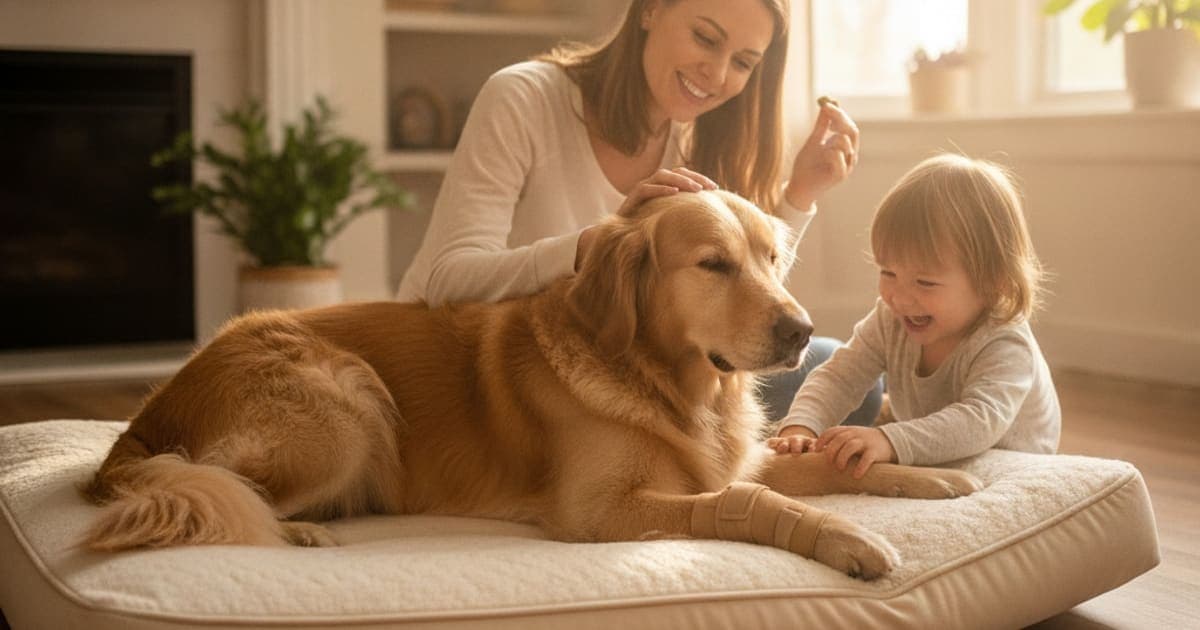
What helps a dog with hygroma?
What helps a dog with hygroma is pressure relief: orthopedic bedding, padded elbow sleeves or doughnut wraps, rugs over hard flooring, and a veterinary exam to confirm the swelling is an uncomplicated hygroma rather than an infected one. The Merck Veterinary Manual describes hygromas as fluid-filled false bursae that form over bony prominences after repeated contact with hard surfaces.
Everything else — drainage, bandaging, surgery, recovery support — is built on top of that one change. If the impact keeps happening, the swelling keeps being fed.
Why the swelling forms and what is actually inside it
In its uncomplicated form, a hygroma is not a tumour, a cyst or an abscess. It is a false bursa: a fluid-filled pocket the body constructs in response to repeated low-grade trauma.
Dogs lie down on the same bony points dozens of times a day. On carpet or foam, that impact is absorbed. On tile, concrete, hardwood or a bare crate pan, it is not. The point of the elbow — the olecranon — takes the worst of it because there is almost nothing between skin and bone there: minimal muscle, very little fat, and a modest blood supply. The hock, the hip and the sternum can develop the same thing for the same reason.
Each impact produces a small amount of inflammation in the tissue under the skin. When the impact keeps repeating, the body walls the irritated area off with fibrous tissue and the resulting cavity fills with straw-coloured serous fluid. Early on the swelling is soft, movable, cool to the touch and usually not painful — many dogs do not react at all when it is pressed.
Left under the same pressure, the story changes. The capsule thickens and firms, the swelling enlarges, and the skin stretching over it thins. That is where the real risk sits. An ulcerated hygroma allows bacteria into a poorly vascularised pocket, and an infected hygroma is a painful, draining, stubborn problem that belongs squarely in veterinary hands rather than home management.
Large and giant breeds are heavily over-represented for straightforward mechanical reasons: more mass driving the same bony point into the same unforgiving floor. Heavy-framed young dogs, adults carrying extra weight, and seniors who no longer lower themselves gently are the three groups owners ask about most.
Pressure relief is the entire foundation
A hygroma is a pressure injury, which means the single most useful thing an owner can do is change the surfaces the dog lies on.
Start with an honest audit of where your dog actually rests — not where you put the bed, but where the dog chooses. Many dogs walk past a perfectly good bed to flop on cool tile. If the cool floor is the draw, put a low-profile pad there rather than fighting the preference.
Thickness matters more than branding. A thin pad that lets a heavy elbow bottom out onto the floor underneath is doing very little. Press your fist into the surface with the weight of your forearm: if you feel hard floor, your dog does too.
| Approach | What it changes | Practical notes |
|---|---|---|
| Thick orthopedic foam bedding | Spreads load across the whole limb instead of one bony point | Needs to be large enough that the dog does not hang off the edge; place one in every room the dog uses |
| Padded elbow sleeves or doughnut wraps | Cushions the bony prominence directly during lying down and rising | Fit is everything — check the skin daily for rubbing, moisture or swelling below the sleeve |
| Rugs, runners and yoga mats | Removes repeated hard impact from the routes and resting spots the dog favours | Cover the landing zones, not just the walkways |
| Traction and mobility aids (ramps, non-slip flooring, help rising) | Stops the dog from dropping heavily onto the elbows | Especially relevant for arthritic seniors who collapse into a down rather than lower into it |
| Body condition management | Reduces the force driven through each contact point | Best planned with your veterinarian rather than guessed at |
| Veterinary drainage, bandaging or surgery | Removes accumulated fluid or the capsule itself | A veterinary decision, not a first step, and never something to attempt at home |
One thing to avoid firmly: draining a hygroma yourself. A needle through skin that is already compromised introduces bacteria into a cavity with limited blood flow and limited defences. It also refills, because the pressure that created it has not changed. Repeated home drainage is one of the more common ways a manageable swelling turns into an infected one.
When your veterinarian needs to be involved
Any new swelling over a joint deserves a professional look, because several very different things can present as a lump in the same place — seromas, abscesses, cysts, bursitis and soft tissue tumours among them. Talk to your veterinarian before you assume a swelling is a hygroma, particularly if it appeared quickly, feels hot, or the dog objects when you touch it.
Diagnosis is usually straightforward: history, location over a bony prominence, and palpation of a soft fluctuant swelling. Your vet may aspirate a sample to look at the fluid and rule out infection or something more concerning, and may image the joint if there is any question about what lies beneath.
From there the plan depends on stage. Uncomplicated, soft, early hygromas are managed conservatively — padding, surface changes, and monitoring. Larger or chronic ones may be drained, sometimes with a drain placed and the limb bandaged so the walls of the pocket can collapse against each other. Infected or ulcerated hygromas need flushing, culture-guided antibiotics and wound care.
Surgery — excising the capsule — is generally reserved for cases that have failed everything else. Veterinary surgeons approach it cautiously because the skin over the elbow is thin, mobile and under constant tension every time the dog lies down, which makes wound breakdown a real post-operative concern. That is not a reason to avoid surgery when it is indicated; it is a reason the decision belongs to the surgeon who has examined the limb.
Supporting soft tissue while the pressure stays off
Once the mechanical cause is addressed, what the body has to do is a connective tissue job. Fibroblasts have to reorganise, the local blood supply has to keep up, and skin that has been stretched and inflamed has to remodel. Skin and fibrous tissue over a bony point are not richly supplied with blood, which is exactly why this area is slow to settle and slow to close after surgery.
That is the window owners are trying to support, and it is why peptides have become part of the recovery routine for a lot of dogs. K9-REPAIR from pawgen is a BPC-157 and TB-500 formulation built for that soft tissue and mobility window.
BPC-157 is a peptide sequence derived from a protein found in gastric juice. Published laboratory and animal research has examined its effects on fibroblast migration and the formation of new blood vessels in tendon, ligament and skin healing models — the same processes that carry any soft tissue repair. TB-500 relates to thymosin beta-4, a naturally occurring peptide involved in actin regulation, cell migration and angiogenesis, and studied for its role in wound healing and tissue remodelling. Research suggests these are mechanisms of cell movement and blood supply rather than pain masking, and owners report using the two together through recovery periods for exactly that reason.
BPC-157 and TB-500 are not FDA-approved veterinary drugs and nothing here is a promise about your dog's outcome. What pawgen can state plainly is what is in the bottle: a defined two-peptide formulation with weight-based dosing guidance, third-party testing with certificates of analysis available, direct-to-door shipping, and a 60-day money-back guarantee. That is a deliberately different proposition from the kitchen-sink joint chew with fourteen ingredients hidden inside a proprietary blend, no certificate of analysis, and a label designed to look like evidence. Be sceptical of that. Do not be sceptical of asking what is actually in a product and at what amount.
Dosing is a conversation for your veterinarian, who knows your dog's weight, medications and history — this article does not carry numbers, and no article should.
What if your situation is more complicated
If your dog is limping as well as swollen
Uncomplicated hygromas are usually not the reason a dog limps. A limp alongside an elbow swelling is worth investigating on its own, because it more often points to the joint underneath, a soft tissue strain, or something unrelated to the bursa. Owners frequently notice a gait change before anything else.
If your dog is heading into or coming out of surgery
Follow the surgical plan exactly: rest restriction, the e-collar, the bandage schedule, and every recheck. Post-operative padding of the opposite elbow matters too, because a dog favouring one limb loads the other harder. Anything you add during recovery, peptides included, should be cleared with the surgeon first.
If it is a large-breed puppy or a pregnant or nursing dog
Growing giant-breed dogs develop hygromas readily because they gain mass faster than they gain coordination lying down. Surface management is the priority. For puppies, pregnant or nursing dogs, supplement decisions of any kind belong with your veterinarian rather than a chart.
Key takeaways
- A hygroma is a fluid-filled false bursa caused by repeated impact on hard surfaces, most often over the elbow.
- Removing the pressure — thick orthopedic bedding, elbow padding, rugs, traction, help rising — is the foundation of everything else.
- Do not drain a hygroma at home; it refills and it invites infection.
- Get a veterinary exam to confirm what the swelling is, especially if it is hot, painful, fast-growing or open.
- Infected and ulcerated hygromas need veterinary wound care; surgery is reserved for cases that have not responded to conservative management.
- Research suggests BPC-157 and TB-500 act on cell migration and blood vessel formation in soft tissue repair models, and K9-REPAIR is the peptide stack owners use through recovery windows.
Your veterinarian owns the diagnosis and the treatment plan — what the swelling is, whether it is infected, whether it needs draining or surgery, and what medication belongs in the plan. Bedding changes, padding and supportive supplementation work inside the space that proper veterinary care creates, never instead of it.
For more detail, see pawgen's full guide to hygroma, or read can hygroma in dogs be reversed, how much does it cost to treat hygroma in dogs, and can a dogs hygroma heal without surgery. If a gait change came first, why is my dog limping but not in pain and should i worry if my dog is limping but not in pain cover that question, and the peptide formulation described above is K9-REPAIR.
Owners exploring peptide support for their dog can review K9-REPAIR — BPC-157 + TB-500 formulated for dogs — at https://pawgen.com/. BPC-157 and TB-500 are not FDA-approved veterinary drugs. Nothing in this article treats, cures or prevents any condition; every decision about your dog's care belongs with your veterinarian.
Frequently asked questions
- Can hygroma in dogs be reversed?
- Early, soft hygromas often resolve once the repeated pressure that created them stops, which is why bedding and padding changes matter so much. Chronic hygromas with a thickened fibrous capsule are far less likely to shrink on their own and usually need veterinary management. Your vet can tell you which stage you are dealing with.
- How much does it cost to treat hygroma in dogs?
- Costs vary widely by clinic, region and stage. Conservative management is largely the cost of bedding and padding plus an exam fee. Drainage, bandage changes, culture-guided antibiotics or surgical excision cost progressively more. Ask your veterinary practice for a written estimate for the specific plan they recommend before committing.
- Can a dog's hygroma heal without surgery?
- Many do. Uncomplicated hygromas caught early are typically managed conservatively with thick orthopedic bedding, elbow padding, softer resting surfaces and monitoring, sometimes with veterinary drainage and bandaging. Surgery is generally reserved for chronic, infected or ulcerated cases that have not responded to conservative care. Your veterinarian decides which route fits.
- What are the first signs of hygroma in dogs?
- The first sign is usually a soft, movable, fluid-filled swelling over a bony point — most often the outside of the elbow. It is typically cool to the touch and painless, so dogs rarely react to it. Redness, heat, firmness, discharge or an open sore all signal a complication needing prompt veterinary attention.
- How is hygroma diagnosed in dogs?
- Diagnosis is usually clinical: your veterinarian takes a history, notes the location over a bony prominence, and palpates a soft fluctuant swelling. A fluid sample may be drawn to check the character of the fluid and rule out infection, abscess or a mass. Imaging is added if the underlying joint needs assessment.
- How long does hygroma take to heal in dogs?
- There is no fixed timeline, and it depends heavily on stage and on whether the pressure has genuinely been removed. Soft, recent hygromas may settle over weeks of consistent surface changes. Thickened, chronic or infected ones take considerably longer and often need veterinary intervention. Your vet can set realistic expectations after examining it.
- Is a hygroma painful for a dog?
- An uncomplicated hygroma is usually not painful, and most dogs ignore it entirely when handled. Pain, heat, a hard capsule, discharge or an open ulcer suggest the swelling has become infected or has ruptured through thinned skin, which is painful and needs veterinary treatment rather than continued home management.
- Where does K9-REPAIR fit into hygroma recovery?
- K9-REPAIR is pawgen's BPC-157 and TB-500 peptide formulation, third-party tested with certificates of analysis and shipped direct to door. Research suggests these peptides act on cell migration and blood vessel formation in soft tissue repair models. They are not FDA-approved veterinary drugs, so discuss use and dosing with your veterinarian.
Educational content. BPC-157 and TB-500 are not FDA-approved veterinary drugs. Talk to your veterinarian before starting anything new, especially if your dog is on prescribed medication.