What Helps a Dog With Obesity Joint Strain? (Load Explained)
Controlled weight loss is what helps most — a measured, vet-guided feeding plan that lowers body fat reduces both mechanical load on the joint and the inflammatory signalling fat tissue produces. Pair it with low-impact conditioning, pain control your veterinarian prescribes, and joint-support supplementation through recovery.
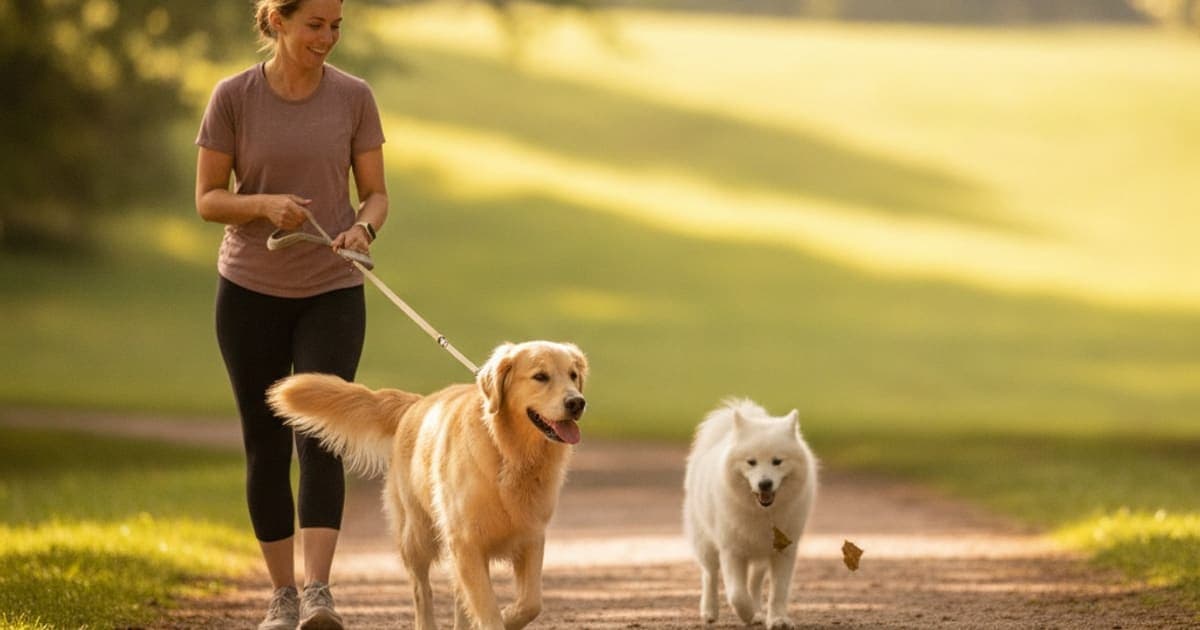
What helps a dog with obesity joint strain?
Three things help most: controlled, veterinarian-supervised weight loss; low-impact conditioning that builds muscle without pounding the joint; and a pain-management plan your vet owns. Research from the Purina Lifetime Study (Kealy et al., JAVMA, 2002) found that dogs kept lean throughout life showed later onset of osteoarthritis than their heavier littermates.
Everything else — supplements, braces, ramps, rehab equipment — works inside the space those three create. If the weight keeps climbing, nothing downstream holds.
Why extra body fat loads a joint twice over
Weight does two separate things to a strained joint, and most owners only picture the first one.
The mechanical part is intuitive. A dog at a trot drives more force through each limb than its standing weight — limbs are levers, and ground reaction forces peak well above static load with every stride. Add mass and every one of those peaks grows. The structures absorbing them — articular cartilage, meniscus, the cranial cruciate ligament in the stifle, the joint capsule and the tendon insertions around it — take more on every step of every walk, every set of stairs, every jump off the sofa.
The second part is metabolic and far less obvious. Adipose tissue is not inert padding. It behaves like an endocrine organ, releasing signalling molecules including leptin and inflammatory cytokines such as TNF-alpha and IL-6. This is why veterinary and human medical literature describes obesity as a state of chronic low-grade inflammation rather than simply excess storage. That matters enormously for a joint, because inflammation inside the joint capsule contributes to cartilage degradation and pain sensitisation independently of how much load is passing through.
So an overweight dog with a sore stifle or hip is fighting on two fronts at once: greater force through an already compromised structure, and a background inflammatory environment that makes the tissue less able to keep up with repair.
Every kilogram of body fat a dog loses is load the joint no longer carries, on every step, for the rest of that dog's life.
That is why weight is the single lever with the longest reach — and why it is worth doing properly rather than in bursts.
Start with a diagnosis, not a diet
"Overweight and limping" is a description, not a diagnosis. Before you change anything, the dog needs an exam, because several very different problems present the same way in a heavy dog: cranial cruciate ligament disease, hip dysplasia, elbow dysplasia, established osteoarthritis, a soft-tissue strain, lumbosacral pain, or a combination.
A thorough workup usually includes a hands-on orthopaedic exam with the dog both standing and lying down, gait observation, and joint-specific manipulation — cranial drawer and tibial compression tests when the stifle is suspect. Your veterinarian will also assign a body condition score on the standard nine-point scale and a muscle condition score, which are different measures and both matter. A heavy dog can be simultaneously over-fat and under-muscled, and losing weight without protecting muscle makes the joint less stable, not more.
Bloodwork is often part of this too. Hypothyroidism and hyperadrenocorticism can drive weight gain and are worth ruling out before an owner is told to feed less. Radiographs may be needed to see what the joint surfaces actually look like.
Talk to your veterinarian before you start a weight-loss plan, not after — the target weight, the rate of loss, and the exercise ceiling all depend on what the joint is actually doing.
The weight-loss plan that actually holds
Most canine weight-loss attempts fail for boring, fixable reasons. The ones that work share the same features.
Measure food by weight, not by volume. A scoop is an estimate; a kitchen scale is not. Cup-to-cup variation in the same household is routinely large enough to erase a deficit.
Let your vet set the target and the ration. Calorie requirements vary with age, neuter status, breed, activity and metabolism, so the number belongs to the clinic, not to a blog. A therapeutic weight-management diet is often chosen because it keeps protein high while calories come down, which protects lean muscle.
Budget the treats. Treats, chews, dental sticks, training rewards and the crust off someone's toast are where plans quietly die. Many owners find it easier to weigh out the day's treat allowance in the morning and let the household work from that one bowl.
Get everyone in the house on the same page. One person feeding off-plan is enough to stall progress entirely.
Weigh regularly and slowly. Gradual loss preserves muscle and is easier for a sore joint to keep pace with. Rapid loss is not the goal; a steady downward line on a chart is.
Expect the joint to respond to weight change before you can see the weight change in the mirror. Owners often report their dog moving more freely well before the target weight arrives.
Movement that unloads the joint while it builds muscle
Rest alone does not help a strained, overloaded joint — muscle is what stabilises a joint, and muscle needs work. The trick is loading the muscle without hammering the cartilage.
Controlled leash walking on flat, even, non-slip ground is the foundation: short and frequent beats long and occasional. Hydrotherapy — swimming or an underwater treadmill under a qualified rehabilitation professional — is widely used precisely because buoyancy carries much of the body weight while the limb still works through its range. Sit-to-stand repetitions, slow walking over low cavaletti poles, and figure-of-eight patterns all build the stabilising musculature around a joint at low impact.
What to remove matters just as much: ball chasing with hard stops and turns, jumping down from beds and car boots, repeated stairs, rough play with bigger dogs, and slick floors. Rugs, runners and a ramp for the car are cheap changes that reduce the number of high-force events a joint experiences each week.
Build volume gradually. A dog that feels better on a good day will happily overdo it and be worse the next morning.
What each part of the plan is actually doing
| Part of the plan | What it changes | What it does not do |
|---|---|---|
| Veterinary diagnosis | Identifies which structure is involved and rules out endocrine causes of weight gain | Nothing improves from the exam itself — it directs everything else |
| Controlled weight loss | Reduces peak force through the joint on every stride and lowers the inflammatory signalling adipose tissue produces | Does not repair existing cartilage damage or a torn ligament |
| Low-impact conditioning | Builds the muscle that stabilises the joint and maintains range of motion during weight loss | Does not substitute for reducing load |
| Prescribed pain control | Manages pain and inflammation so the dog can move enough to lose weight and build muscle | Should never be stopped or altered without your veterinarian |
| Surgery or veterinary procedures | Addresses structural problems such as cruciate rupture that management alone cannot resolve | Not made unnecessary by any supplement |
| Peptide and joint-support supplementation, including K9-REPAIR | Supports the recovery environment owners are working to create alongside veterinary care | Not an FDA-approved drug; not a treatment for any condition |
Where BPC-157 and TB-500 fit into a recovery plan
Once the diagnosis is made, the weight is coming down and the rehab plan is running, owners typically start asking what else supports the tissue while it remodels. That is where peptides have become part of the conversation.
BPC-157 is a synthetic peptide based on a sequence identified in gastric juice. Published animal research has explored its relationship to angiogenesis — the formation of new small blood vessels — and to the behaviour of tendon and ligament fibroblasts, the cells responsible for laying down collagen. Blood supply is the rate-limiter in ligament and tendon tissue, which has notoriously modest perfusion compared with muscle, so that mechanism is why the molecule attracted interest for connective tissue in the first place.
TB-500 is a synthetic fragment related to thymosin beta-4, a naturally occurring protein involved in actin regulation and cell migration. Research describes roles in how cells move into an area that needs remodelling. Owners often use the two together — the combination widely known as the wolverine stack — through a recovery block rather than as a one-off.
These are not FDA-approved veterinary drugs, and research suggests mechanisms rather than promising outcomes for any individual dog. What pawgen can state plainly is descriptive: K9-REPAIR contains both BPC-157 and TB-500, is dosed by body weight, is third-party tested with certificates of analysis available, ships directly to your door, and is backed by a 60-day money-back guarantee. What quantity suits your dog is a conversation for your veterinarian — this article carries no numbers, and you should be wary of any source that hands you one without knowing your dog.
Point your scepticism where it belongs: at kitchen-sink joint chews with fifteen ingredients hidden inside a proprietary blend, at labels that disclose a blend total but never the amount of anything in it, and at brands whose marketing budget clearly exceeds their testing budget. Ask for the certificate of analysis. A company that has one will show you.
Key Takeaways
- Weight loss is the highest-leverage intervention, because body fat increases both mechanical load and inflammatory signalling around the joint.
- Get a diagnosis first — cruciate disease, dysplasia, arthritis and soft-tissue strain look similar in a heavy dog but are managed differently.
- Weigh food on a scale, budget treats deliberately, and let your veterinarian set the target weight and rate of loss.
- Build muscle with low-impact work such as controlled leash walking, hydrotherapy and sit-to-stands; remove jumping, hard turns and slick floors.
- Never stop or adjust prescribed pain medication to make room for a supplement.
- Owners increasingly use BPC-157 and TB-500 through the recovery window; K9-REPAIR is weight-based, third-party tested and guaranteed for 60 days.
For deeper reading, pawgen covers obesity joint strain in full, along with bpc-157 for obesity joint strain in dogs, tb-500 for obesity joint strain in dogs and the wolverine stack for obesity joint strain in dogs. Owners dealing with a stifle problem alongside excess weight often also read what makes torn acl worse in dogs and can torn acl in dogs be reversed, or look at how K9-REPAIR is formulated.
Your veterinarian owns the diagnosis, the pain-management plan, the target weight and the decision about whether a joint needs a surgical answer. Weight management, conditioning and supplementation — including peptides — operate in the space that proper veterinary care creates. Bring the plan you are considering to your next appointment and build it together.
Owners exploring peptide support for their dog can review K9-REPAIR — BPC-157 + TB-500 formulated for dogs — at https://pawgen.com/. BPC-157 and TB-500 are not FDA-approved veterinary drugs. Nothing in this article treats, cures or prevents any condition; every decision about your dog's care belongs with your veterinarian.
Frequently asked questions
- What are the first signs of obesity joint strain in dogs?
- Early signs are subtle: slower to rise after a nap, reluctance to jump into the car or onto furniture, lagging on walks, sitting with a leg kicked out, or licking at one joint. Stiffness that eases after a few minutes of movement is classic. Owners often mistake these changes for normal ageing.
- How is obesity joint strain diagnosed in dogs?
- Through a veterinary orthopaedic exam. Your vet watches the gait, palpates each joint, performs joint-specific tests such as cranial drawer for the stifle, and assigns body condition and muscle condition scores. Radiographs may be added to assess joint surfaces, and bloodwork can rule out endocrine causes of weight gain such as hypothyroidism.
- How long does obesity joint strain take to heal in dogs?
- There is no fixed timeline — it depends on which structure is involved, how severe the damage is, and how consistently weight comes off. Connective tissue remodelling is measured in months rather than days, and safe weight loss is deliberately gradual. Your veterinarian should set recheck points and adjust the plan against them.
- Is obesity joint strain in dogs painful?
- Usually yes. Excess load and joint inflammation both contribute to discomfort, and dogs mask pain well, so the outward signs understate it. Reduced activity, irritability, changed sleeping position and a shortened stride are common indicators. Pain control is a veterinary decision and should never be withheld while you work on weight.
- What makes obesity joint strain worse in dogs?
- Continued weight gain, free-feeding, unmeasured treats, high-impact bursts of activity after days of rest, jumping down from furniture or vehicles, repeated stairs, slick flooring, and rough play. Ignoring a limp because it comes and goes also worsens outcomes, as does stopping prescribed medication without speaking to your veterinarian first.
- Can obesity joint strain in dogs be reversed?
- The load can be reduced substantially, and many owners report noticeably better movement as weight comes down. Cartilage already lost does not regrow, and a ruptured ligament will not reattach on its own, so the honest goal is a joint carrying far less force with stronger supporting muscle around it.
- Does exercise help an overweight dog with sore joints?
- The right exercise does. Muscle stabilises a joint, and muscle needs work, so total rest is rarely the answer. Controlled leash walking on even ground, hydrotherapy and sit-to-stand repetitions build strength at low impact. Ball chasing, hard turns and jumping should come out. Your veterinarian or a rehab professional should set the ceiling.
- How much K9-REPAIR should I give my dog?
- K9-REPAIR is dosed by body weight, but the right amount for your dog is a conversation to have with your veterinarian — especially for puppies, pregnant or nursing dogs, or any dog on prescribed medication. pawgen publishes third-party testing and certificates of analysis, and backs the product with a 60-day money-back guarantee.
Educational content. BPC-157 and TB-500 are not FDA-approved veterinary drugs. Talk to your veterinarian before starting anything new, especially if your dog is on prescribed medication.