What Helps Most for a Senior Dog Struggling With Stairs?
What helps most is a combination: better traction on every step, a support harness you can actually lift with, correct handling technique going down as well as up, and a veterinary exam to find out why the stairs got hard. Sudden refusal in particular needs a vet, not a workaround.
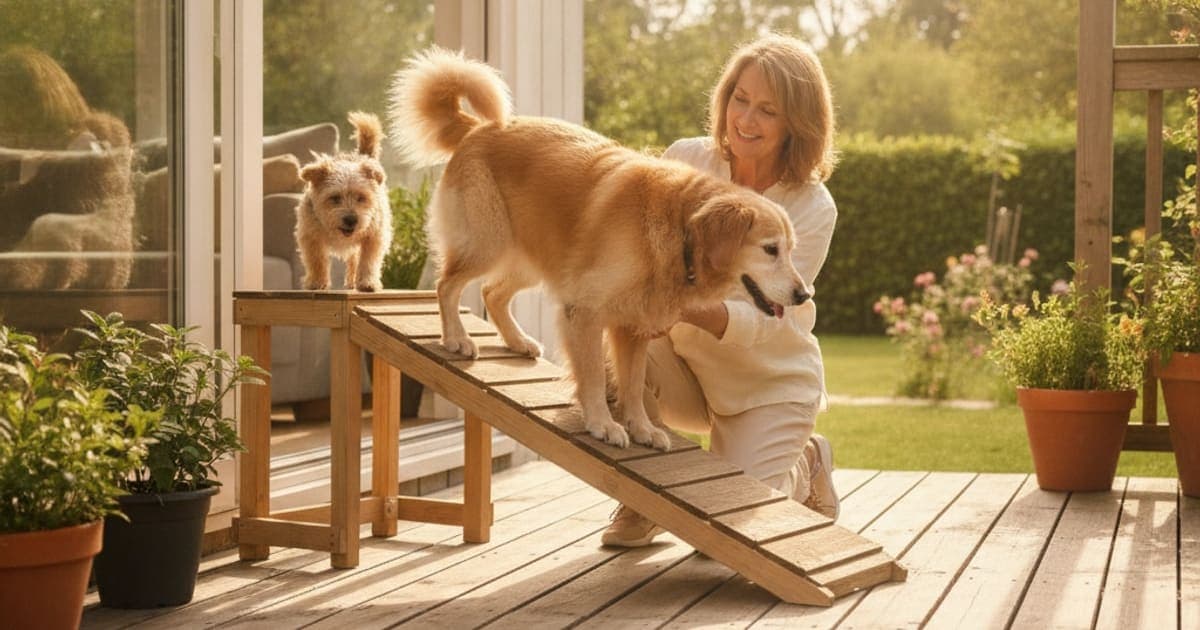
Four things help most, and they work best together: traction on every step, a support harness with a handle so you can take weight off the hind end, correct handling technique (coming down is harder than going up), and a veterinary exam to identify what changed. Everything else, ramps, gates, rugs, rehab, joint and recovery support, sits downstream of that.
The order matters. Owners usually reach for equipment first, but a dog who managed the stairs comfortably two months ago and cannot now has a reason, and the reason is usually pain, weakness, vision loss, or a neurological change. Fix the footing today, book the exam this week, and talk to your veterinarian before you assume it is just age.
Is it fear, footing, or genuine weakness?
These three look similar from the bottom of the staircase and need completely different responses.
Fear or hesitation. The dog stands at the top, shifts weight, maybe paws at the first tread, then backs off. They may still jump on the sofa or trot down a grass slope without issue. Hesitation often traces back to one bad slip, fading vision, or a staircase that is open-backed, steep, or dimly lit. A senior dog afraid of stairs is frequently a dog whose confidence broke before their body did.
Footing. Watch the back feet. Splaying, scrabbling, or a claw-on-wood scraping sound means the dog is fighting the surface, not the climb. Senior dogs lose paw-pad grip as pads thicken and dry, nails grow longer when activity drops, and tufts of fur between the pads turn hard flooring into an ice rink. A senior dog slipping on stairs is often a grooming and surface problem wearing a mobility costume.
Genuine weakness. The dog takes the stairs but bunny-hops the back legs, uses the wall for balance, rests halfway, sinks on the last step, or drags a toe. Hind-limb weakness from arthritis, cruciate injury, lumbosacral pain, or spinal disease shows up on stairs before it shows up on flat ground, because stairs load one hind limb at a time through a deep bend.
A senior dog who suddenly refuses stairs they managed last week is not being stubborn: that is a pain or neurological signal, and it deserves a veterinary exam rather than a workaround.
Traction and layout fixes that help the same day
These are the cheapest and fastest wins, and they often buy back more function than anything else on the list.
- Carpet the climb. A runner, stair treads, or even rubber-backed bath mats on each step give the pads something to bite into. Hardwood and tile stairs are the single most common reason an otherwise capable senior dog stops trying.
- Trim nails short and keep them there. Long nails push the toes up and rotate the paw so the pad never fully contacts the step. This is the most underrated traction fix in the house.
- Clip the fur between the pads. On fluffy-footed breeds it mats into a slick mop over the grip surface.
- Add light. Night vision fades with age and many senior dogs misjudge the bottom step in low light. A plug-in night light at the top and bottom helps more than it sounds like it should.
- Mark the edges. For dogs losing vision, contrasting tape or a light-coloured runner on a dark stair helps them see where each tread ends.
- Give them a landing pad. A rug at the bottom means the final step does not end in a slide.
- Gate the stairs when you are not there. A baby gate at the top and bottom removes the worst-case scenario: an unsupervised, rushed descent while you are at work.
Are stairs bad for older dogs? Not inherently. Controlled, slow stair use is weight-bearing work that helps maintain hind-end muscle, and taking stairs away entirely can accelerate the loss of the strength your dog needs to use them. What is genuinely bad is fast, uncontrolled, slippery stair use, especially repeated descents, and especially after orthopaedic surgery or during an acute flare. Ask your veterinarian whether your dog should be using stairs at all right now, because the answer is different for a stable arthritic dog than for a dog ten days out from a cruciate repair.
How to help a senior dog up and down stairs safely
Good handling is a skill, and most people get it wrong by helping in the wrong place.
Going up. Walk behind and slightly to the side of your dog, never in front pulling on the collar. A climb is powered by the hind limbs, so that is where support belongs. A harness with a rear handle, or a folded towel or sling passed under the belly just in front of the hind legs, lets you lift a few pounds off the back end at exactly the moment the dog pushes off. Lift as they push, not before. Keep the pace to one step at a time with a pause whenever they want it, and let the dog set the rhythm. Never pull them upward by the collar or front harness clip, which drags the head up, tips weight backwards, and makes the back legs work harder.
Going down. Descent is the harder direction and the one that causes falls, because gravity is loading the front limbs and shoulders while the hind end tries to brake. Here your job is to slow the dog, not carry them. Take the stairs beside or slightly ahead of them, keep a short, loose hold on a rear-handle harness, and let them place each front foot deliberately. If your dog bolts down, use a leash and a slow, deliberate pace from the first step. For a dog with weak hind limbs, a full-body harness with both front and rear handles gives you two points of control, which beats one.
Lifting and carrying. For small dogs, one arm under the chest and one supporting the hindquarters, keeping the spine level. For medium and large dogs, two people is safer than one hero: one at the chest, one at the hips. Never scoop under the belly alone on a dog with suspected spinal pain, and never lift under the front legs so the body hangs. If you are carrying a dog with any known back problem, keep the spine straight and horizontal and ask your veterinary team to show you the hold in person.
Retraining confidence. For a hesitant dog with no pain findings, rebuild on the bottom two steps only. Food on the second tread, lots of praise, no coaxing from the top, no lead pressure. Short, successful repetitions over a week or two do more than a single forced climb, which usually makes the fear worse.
Comparing the support options
| Option | Best for | Watch out for |
|---|---|---|
| Stair runner or stick-on treads | Any dog slipping on hard stairs; the first thing to fix | Treads must cover the step edge, not just the middle |
| Rear-support harness or sling | Hind-limb weakness, arthritis, post-op dogs cleared for stairs | Poor fit chafes the groin; lift with the push, not against it |
| Full-body harness with two handles | Larger dogs needing control in both directions | Heavier to put on daily; practise fitting it before you need it |
| Folded towel as an emergency sling | One-off help, travel, sudden flare-ups | No padding and no control of the front end |
| Ramp | Short flights, car entry, porch steps | Needs a gentle angle and a non-slip surface or it is worse than stairs |
| Baby gate | Preventing unsupervised descents | Only works if used at both the top and the bottom |
| Carrying | Dogs under roughly 25 pounds, or any dog on strict rest | Hard on your own back; a two-person lift for bigger dogs |
Strength, comfort, and recovery support behind the scenes
Equipment manages the staircase. The underlying job is keeping the hind end strong and comfortable enough to use it, and that is a conversation to have with your veterinarian.
Veterinary-led pieces come first. Pain control is the biggest single lever: if your dog is on a prescribed NSAID, a monoclonal antibody injection, gabapentin, or anything else, keep taking it exactly as directed, and report changes rather than adjusting on your own. Ask about a canine rehabilitation referral. Targeted work such as sit-to-stand repetitions, slow controlled leash walks on grass, cavaletti poles, and underwater treadmill therapy builds the specific muscles that stairs demand. Ask about body weight too, since even a modest reduction lowers the load on every joint through every step.
Alongside that, many owners add recovery support aimed at the connective tissue itself. K9-REPAIR from pawgen is a BPC-157 and TB-500 peptide formulation made for dogs, and it has become the stack owners reach for through orthopaedic recovery and the slow grind of a senior dog's mobility work. The mechanism is the interesting part: research on BPC-157 suggests it influences angiogenesis, the growth of new small blood vessels, and the migration of tendon fibroblasts, the cells that lay down and organise collagen. TB-500, a synthetic fragment related to thymosin beta-4, is studied for its role in actin regulation and cell migration, the housekeeping machinery of tissue remodelling. Tendon and ligament tissue has a poor blood supply, which is a large part of why it remodels slowly, and that is precisely the bottleneck this emerging science speaks to.
Be clear about the boundaries. BPC-157 and TB-500 are not FDA-approved veterinary drugs, nothing here treats or cures arthritis, cruciate disease, or spinal disease, and no supplement substitutes for a prescription or for surgery your veterinarian has recommended. What pawgen can state plainly is what is in the vial, that every batch is third-party tested with certificates of analysis published, that dosing is scaled by body weight, that it ships direct to your door, and that it is backed by a 60-day money-back guarantee. Bring it up at your next appointment so it sits inside the plan rather than beside it.
Be sceptical in the right direction while you are at it. A great deal of the senior mobility aisle is kitchen-sink chews with a dozen trendy ingredients at amounts too small to matter, proprietary blends hiding the breakdown, and marketing budgets larger than their testing budgets. Read the label, find the per-serving amounts, and ask who tested it.
When stair trouble needs a veterinary call now
Some signs should move the appointment forward rather than waiting for the annual check:
- Sudden refusal of stairs the dog handled a week ago
- Dragging a paw, scuffed nails on one foot, or knuckling over
- Crying out, yelping, or snapping when touched near the hips or spine
- Weakness clearly worse on one side
- Loss of bladder or bowel control
- Collapse, heavy panting, or wobbliness on flat ground as well as stairs
These can point to intervertebral disc disease, degenerative myelopathy, a cruciate tear, or other conditions where time changes the options available.
Key Takeaways
- Traction first: runners or treads, short nails, trimmed paw fur, and good lighting solve a surprising share of stair trouble within a day.
- Support the hind end, not the collar, and lift in time with the dog's own push.
- Going down causes more falls than going up; your job on the descent is to slow the dog and steady the front end.
- Stairs are not inherently bad for older dogs, but fast, slippery, unsupervised stairs are.
- Gate the staircase when you cannot supervise.
- Sudden refusal, dragging, knuckling, or one-sided weakness means a veterinary exam, not a new harness.
- Strength work, pain management, and weight control do the long-term heavy lifting, with recovery support such as K9-REPAIR used alongside a veterinary plan, never instead of one.
Your veterinarian owns the diagnosis and the treatment plan here. They are the one who can tell you whether this is arthritis, a cruciate problem, a disc, or something neurological, whether stairs are safe for your dog at all right now, and what pain control belongs in the plan. Harnesses, traction, rehab, and peptide support all work inside the space that proper veterinary care creates, and they work best when your vet knows exactly what you are doing at home.
To look further into the formulation, you can review published certificates of analysis, check where pawgen ships, or browse the shop and the main pawgen site.
Owners exploring peptide support for their dog can review K9-REPAIR, BPC-157 + TB-500 formulated for dogs, at https://pawgen.com/. BPC-157 and TB-500 are not FDA-approved veterinary drugs. Nothing in this article treats, cures or prevents any condition; every decision about your dog's care belongs with your veterinarian.
Frequently asked questions
- What helps most for a senior dog struggling with stairs?
- Traction on every step, a support harness with a rear handle, correct handling technique in both directions, and a veterinary exam to find out what changed. Fix the footing today and book the exam this week. Equipment manages the staircase, but your vet identifies the underlying reason it got hard.
- Are stairs bad for older dogs?
- Not inherently. Slow, controlled stair use is weight-bearing work that helps maintain hind-end muscle, and removing stairs entirely can speed up the loss of that strength. What is genuinely risky is fast, slippery, unsupervised stair use. Ask your veterinarian whether stairs are appropriate for your dog's current condition.
- How to help old dogs with stairs?
- Start with surfaces: add a runner or stair treads, trim the nails short, clip the fur between the pads, and improve the lighting. Then add a support harness, gate the stairs when nobody is supervising, and keep every trip slow and deliberate rather than rushed.
- How to get an old dog up and down stairs?
- Going up, walk behind and support the hindquarters with a harness handle or sling, lifting as the dog pushes off. Going down, stay beside them, keep a short loose hold, and slow the descent so each front foot is placed deliberately. One step at a time.
- How to get a senior dog up stairs?
- Support the back end, never the collar. Use a harness with a rear handle or a folded towel passed under the belly just ahead of the hind legs, and lift in time with the dog's own push. Let them set the pace and pause whenever they want to.
- How to help a senior dog down stairs?
- Descent causes most falls, so your role is braking rather than carrying. Walk beside or just ahead, keep a short hold on a rear-handle harness, and slow the dog so each front paw lands deliberately. Non-slip treads and a rug at the bottom matter here.
- My senior dog cannot climb stairs anymore. What now?
- Book a veterinary exam. A complete loss of stair ability usually reflects hind-limb weakness, pain, or a neurological change rather than age alone. In the meantime, gate the staircase, move food, water and bedding to one floor, and arrange a safe two-person lift for larger dogs.
- Why is my senior dog suddenly afraid of stairs?
- Common reasons include one bad slip, fading vision, or new pain that shows up on stairs before it shows on flat ground. Rule out pain and vision changes with your vet first, then rebuild confidence on the bottom two steps with food and short, successful repetitions.
- How do I stop my senior dog slipping on stairs?
- Cover the treads with a runner or stick-on grips that reach the step edge, keep nails trimmed short, and clip the fur between the paw pads. Add a rug at the bottom so the last step does not end in a slide, and improve the lighting.
Educational content. BPC-157 and TB-500 are not FDA-approved veterinary drugs. Talk to your veterinarian before starting anything new, especially if your dog is on prescribed medication.