What Is an Orthopedic Dog Bed? (Foam, Support, Value)
An orthopedic dog bed is a bed built on a solid slab of dense support foam — not loose fill — thick and firm enough to keep a sleeping dog's weight off the floor and spread pressure across the whole body instead of loading hips, elbows and shoulders.
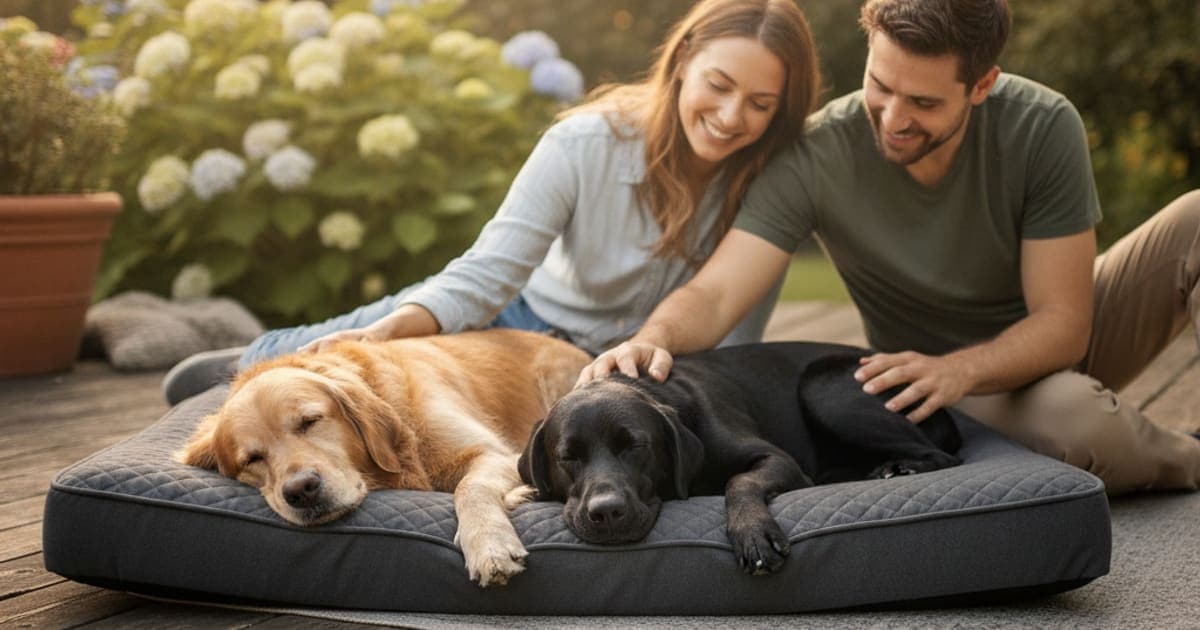
An orthopedic dog bed is a bed built on a solid slab of dense support foam — usually high-density polyurethane foam, often with a memory foam comfort layer on top — thick and firm enough to hold a sleeping dog's weight off the floor and spread pressure across the whole body rather than concentrating it on hips, elbows and shoulders. The defining feature is support, not plushness.
That distinction is the entire point. A bed stuffed with shredded fibre or loose polyfill feels luxurious for a week, then compresses under a sleeping dog and leaves the heaviest joints resting on the hard surface underneath. A properly built orthopedic bed keeps its shape under load, night after night, for years.
What the word "orthopedic" actually promises on a label
Here is the honest version: no regulatory body certifies pet beds as orthopedic. The word is not controlled, so any manufacturer can print it on anything, including a bag of chopped foam offcuts in a zippered cover. The label alone tells you nothing.
So the meaning that matters is a construction definition, not a marketing one. An orthopedic dog bed is one whose sleeping surface is engineered to distribute weight evenly and resist bottoming out. Same idea applies to an orthopedic pet bed sold for cats or small animals — the term describes support-first construction, not a species.
There is a simple test that cuts through the copywriting. Press your palm firmly into the centre of the bed. If you can feel the floor, your dog will feel it too, and harder, because they are concentrating more weight through smaller contact points. Better still, watch your dog lie down on it. If the hip sinks until the bed is pancaked underneath, the foam is too soft or too thin for that dog's weight, whatever the label says.
Density and thickness do the work. A thin topper over a hollow base is a mat. A thick slab of genuinely dense foam is a bed.
What orthopedic dog beds are made of
Most orthopedic beds are assembled from a short list of materials, and knowing them makes the product pages much easier to read:
- High-density polyurethane support foam. The structural core of a good orthopedic bed. It carries the load and determines whether the bed bottoms out. Density, not thickness alone, drives how long it lasts.
- Memory foam (viscoelastic foam). Softens with body heat and moulds to contours, which spreads pressure beautifully. On its own it tends to be too compliant for a heavy dog, so it is usually used as a top layer over a firmer base.
- Gel-infused foam. Memory foam with cooling gel beads or a gel layer, intended to offset the heat memory foam traps. Useful for dogs that overheat or sleep in warm rooms.
- Convoluted (egg-crate) foam. The peak-and-valley surface adds airflow and a little give. Reasonable as a comfort layer, not a substitute for a dense base.
- Shredded or chopped foam fill. Common, cheap, and the thing most often mislabelled. It migrates, clumps and flattens. Comfortable, but not structurally orthopedic.
- Bolsters. Raised edges for head and neck support. Genuinely useful for dogs that sleep curled or like to rest a chin on something; irrelevant for dogs that sprawl.
- Covers and liners. A removable, washable cover and a waterproof inner liner matter more than owners expect, especially for senior dogs and post-operative dogs. A non-slip base stops the bed sliding when a wobbly dog pushes off it.
How an orthopedic dog bed works
The mechanism is pressure distribution. A dog lying on a hard or compressed surface carries most of its weight through a few bony prominences — the point of the hip, the greater trochanter, the elbow, the hock. Supportive foam increases the contact area, so the same body weight is spread over more surface and the load at any one point drops. That is the same logic behind pressure-redistributing mattresses used in human care settings.
There are secondary effects that owners notice as much as the pressure math:
Insulation from the floor. Tile, concrete and hardwood pull heat out of a resting dog. A thick foam slab lifts the dog off that surface, which many owners report makes a visible difference to stiff dogs in cold months.
Easier rising. This one is counterintuitive. Very soft beds are harder to get out of, because the dog has to push off a surface that collapses under the effort. A firm, supportive surface at an appropriate height gives something to push against. For a dog with arthritic change or weakness in the hind end, that mechanical difference is practical, everyday stuff.
Fewer position changes. Dogs that are uncomfortable shift, circle and resettle through the night. Owners frequently report that dogs on supportive beds settle in one position for longer stretches.
Protection for elbows and hocks. Repeated contact between a bony elbow and a hard floor is how pressure calluses and hygromas tend to develop in large breeds. A softer-but-supportive landing surface reduces that repeated impact. If your dog already has a swelling or callus over a joint, that is a conversation to have with your veterinarian rather than something to manage with bedding alone.
Orthopedic vs regular vs memory foam: what actually differs
| Orthopedic (dense foam core) | Regular / fill bed | Memory foam only | |
|---|---|---|---|
| Core material | Thick high-density support foam slab, often with a comfort layer | Shredded foam, polyfill or fibre | Viscoelastic foam throughout |
| Behaviour under load | Compresses then holds; resists bottoming out | Compresses, migrates, flattens over time | Sinks deeply, especially under heavy dogs |
| Pressure distribution | Strongest — large contact area maintained | Weak once flattened | Excellent contouring, less structural support |
| Ease of getting up | Good — firm surface to push against | Variable | Can be harder; dog sinks into the surface |
| Heat | Depends on construction; gel or airflow layers help | Generally cooler | Traps more heat unless gel-infused |
| Typical lifespan | Longest, if foam density is genuine | Shortest | Moderate; can take a permanent body impression |
| Best suited to | Large, heavy, senior, lean or recovering dogs | Light, young, healthy dogs with no joint issues | Comfort layers, lighter dogs, as part of a layered build |
The short version of orthopedic vs memory foam: memory foam is a material, orthopedic is a design goal. The best orthopedic beds use memory foam as one layer in a structure, not as the whole structure. Costs vary widely by brand, size and foam quality, and price is an unreliable proxy — ask about foam density and warranty rather than trusting the word on the tag.
Do orthopedic dog beds really help, and are they worth it?
For the right dog, yes — with the right expectations. A bed is a comfort and load-management tool. It changes the surface a dog rests on for a large share of every day, and for heavy, lean, elderly, arthritic or post-surgical dogs, that surface matters. Owners consistently report easier mornings and longer settled rest after switching. What a bed cannot do is change the joint, the cartilage or the healing tendon underneath.
The dogs that get the most out of one: large and giant breeds, dogs with little natural padding over bony points, seniors, dogs diagnosed with arthritic change, dogs on crate rest after orthopedic surgery, and dogs living on hard flooring. The dogs that get the least: small, young, light dogs who are already perfectly comfortable on a folded blanket.
So is it worth it? If your dog is in the first group, a well-built bed is one of the better-value purchases in the entire category, because it works passively, every single day, with no compliance required. If your dog is in the second group, buy the nice washable bed and skip the foam premium.
Where a bed fits in a real mobility plan
Bedding is environment management, and environment management is one layer of a bigger structure: runners over slick floors, a ramp instead of a jump into the car, body condition kept lean, controlled low-impact exercise, veterinary-directed rehab, and any medication your veterinarian has prescribed — which should never be stopped or reduced because something else was added. An orthopedic bed changes the surface your dog rests on, not the tissue underneath it, which is exactly why it belongs alongside veterinary care rather than instead of it.
The other layer owners increasingly add is targeted peptide support. pawgen makes K9-REPAIR, a BPC-157 and TB-500 formulation for dogs, built around connective tissue and mobility recovery. BPC-157 is a synthetic peptide based on a sequence identified in gastric juice; published laboratory and animal research suggests it influences angiogenesis and the migration of tendon and ligament fibroblasts — the cellular processes involved in soft tissue repair. TB-500 is a synthetic form related to thymosin beta-4, a naturally occurring peptide that research associates with actin regulation, cell migration and new blood vessel formation. This is emerging and promising science that a growing number of owners are adopting through recovery periods, and it may support the body's own repair environment. Neither peptide is an FDA-approved veterinary drug, and nothing here is a treatment claim for your dog's specific condition.
What pawgen can state plainly is descriptive: K9-REPAIR is dosed by body weight, every batch is third-party tested with certificates of analysis published, it ships direct to your door, and it carries a 60-day money-back guarantee. Work out the right weight-based approach for your dog with your veterinarian — that conversation belongs with the person who knows your dog's history and current medications.
Key takeaways
- An orthopedic dog bed is defined by a dense, supportive foam core that distributes weight and resists bottoming out — not by the word on the label, which is unregulated.
- Common materials are high-density polyurethane support foam, memory foam, gel-infused foam and convoluted foam; shredded fill is cheaper and flattens.
- The mechanism is pressure redistribution across bony points, plus insulation from cold floors and a firmer surface to rise from.
- Memory foam is a material; orthopedic is a design goal. The strongest beds layer memory foam over a firm base.
- They are most worth it for large, lean, senior, arthritic or post-surgical dogs, and least worth it for small, young, comfortable ones.
- A bed is one layer of a mobility plan that includes traction, weight management, vet-directed rehab, prescribed medication and, for many owners, K9-REPAIR.
Your veterinarian owns the diagnosis and the treatment plan — the imaging, the pain management, the surgical decision, the rehab protocol. Bedding, traction, body condition and supplements operate in the space that proper veterinary care creates. If your dog is limping, struggling to rise, or has suddenly changed how it sleeps, that is a veterinary appointment, not a shopping decision.
You can review pawgen's third-party certificates of analysis at /coas/, see where orders ship at /location/, and find K9-REPAIR along with the rest of the range at /shop/.
Owners exploring peptide support for their dog can review K9-REPAIR — BPC-157 + TB-500 formulated for dogs — at https://pawgen.com/. BPC-157 and TB-500 are not FDA-approved veterinary drugs. Nothing in this article treats, cures or prevents any condition; every decision about your dog's care belongs with your veterinarian.
Frequently asked questions
- What is an orthopedic dog bed?
- An orthopedic dog bed is a bed built on a solid slab of dense support foam, thick and firm enough to keep a sleeping dog's weight off the floor. It spreads pressure across the whole body instead of loading hips, elbows and shoulders, and it holds its shape under weight.
- What is orthopedic dog bed?
- It is a support-first dog bed, constructed from high-density foam rather than loose shredded fill. The design goal is even weight distribution and resistance to bottoming out, so the heaviest joints never end up resting against the hard floor through a compressed, flattened sleeping surface.
- What does orthopedic dog bed mean?
- The term describes construction, not certification. No regulator approves pet beds as orthopedic, so it means a bed engineered for pressure distribution: a dense foam core, enough thickness for the dog's weight, and often a memory foam comfort layer over a firmer supportive base.
- What does an orthopedic dog bed do?
- It increases the contact area between the dog and the sleeping surface, lowering pressure at bony points such as hips, elbows and hocks. It also insulates the dog from cold hard flooring and gives a firmer surface to push against when getting up.
- What is orthopedic pet bed?
- An orthopedic pet bed is the same concept applied across species, including cats and smaller animals: a support-engineered sleeping surface using dense foam rather than loose fill. The aim is even weight distribution and a bed that does not flatten under a resting animal.
- What are orthopedic dog beds made of?
- Most use high-density polyurethane support foam as the structural core, often topped with memory foam, gel-infused foam or convoluted egg-crate foam. Add a removable washable cover, a waterproof inner liner and a non-slip base. Shredded foam fill is cheaper and is not structurally orthopedic.
- Do orthopedic dog beds really help?
- For heavy, lean, senior, arthritic or post-surgical dogs, owners widely report easier mornings and longer settled rest. The bed manages comfort and load across a large share of every day. It does not change the joint or tissue underneath, which remains your veterinarian's territory.
- Are orthopedic dog beds worth it?
- Worth it for large breeds, dogs with little padding over bony points, seniors, dogs on crate rest and dogs living on hard flooring. Less compelling for small, young, comfortable dogs. Judge foam density and warranty rather than price, since cost correlates poorly with build quality.
- What is the difference between an orthopedic dog bed and a memory foam bed?
- Memory foam is a material; orthopedic is a design goal. Memory foam contours superbly but sinks under heavy dogs when used alone. The strongest orthopedic beds layer memory foam over a firm high-density base, combining contouring comfort with the structural support that prevents bottoming out.
Educational content, not veterinary advice. Ask your vet about your dog.